


What images and sounds are made from an injustice? Where is the camera positioned to record them? How (and over all “why”) is cinema made in authoritarian times? Since the 2016 parliamentary coup, these questions have (once again) resonated significantly in Brazilian audiovisual production. In this text, they bring a near past into conversation, driven by the creative nodes of director Adélia Sampaio's first films: Denúncia Vazia (1979), Adulto não Brinca (1980) and Amor Maldito (1984). The former two titles are short films that were only recently put into circulation, and they now have been made available for free online along with many other films she directed and produced. Amor Maldito is the director’s only fiction feature to date.

Sampaio was belatedly recognized as the first Brazilian black woman to direct a fictional feature film with Amor Maldito. Later in her career, in works such as the television documentary AI-5 – O Dia que Não Existiu (Sampaio & Markun, 2001), and O Mundo de Dentro (2017), her most recent short film, the Brazilian civil-military dictatorship (1964-85) returns openly as a theme, with its collective and subjective traumas. Even so, a careful look at the beginning of Sampaio’s production makes it evident that the filmmaker’s position in the face of forms of oppression (whether institutionalized or not) had already shaped her creative modus operandi.
This is overtly displayed in the narratives of Sampaio’s films (based on real events): an elderly couple commits suicide after being evicted from their apartment, children end up at a police station after a misunderstood prank, and a woman is framed for the death of her ex-lover without evidence. It also seems crucial to remark on how, in these first films, Sampaio formally constructs images and sounds which are keen on taking an incisive stand against the underlying brutality of the social structure in the early 1980s, when the dictatorship held its last gasp.
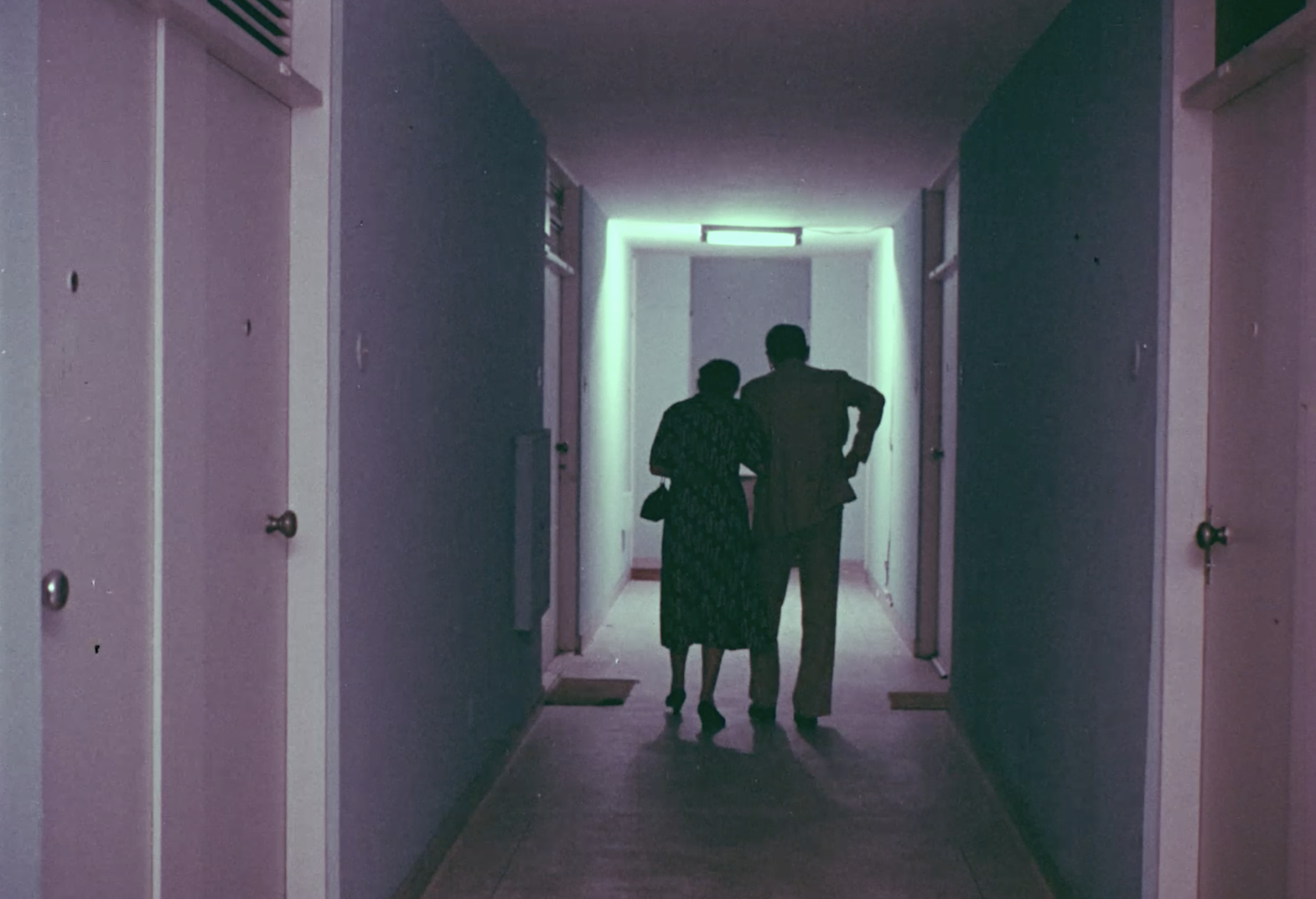
The beginning of Denúncia Vazia (Empty Denunciation) is marked by a camera that shakes and slides down a poorly lit and simple-looking corridor. These images move to the rate of a heartbeat that echoes in the soundtrack. In this manner, slowly, we enter the living room of an elderly couple’s small apartment. The television is on and the dishes need to be washed, but The Magus (Green, 1968) is about to start, and the film and crochet are better excuses for the couple to take a nap. Everything looks comforting and ordinary. Triviality is abruptly interrupted by the ringing doorbell and the arrival of a judicial eviction notice. The drama is set: the couple needs to leave the property. There is no way to appeal, explains the lawyer.

The walk back to the same corridor from the opening images is even slower in the company of the couple, but now the camera can no longer enter the apartment. If there is no way for the elderly couple to resolve their problem, there also does not seem to be anything left to show of their lives. From a distance, through the gap in the peephole, the film reveals only brief images of the couple’s final tea and their revisiting a photo album. Denúncia Vazia creates an interdiction that, through its absence, builds and preserves dignity in refusal. In the concision regarding what should be shown (and therefore, what shouldn’t), Sampaio’s direction reinforces a position of respect and complicity.
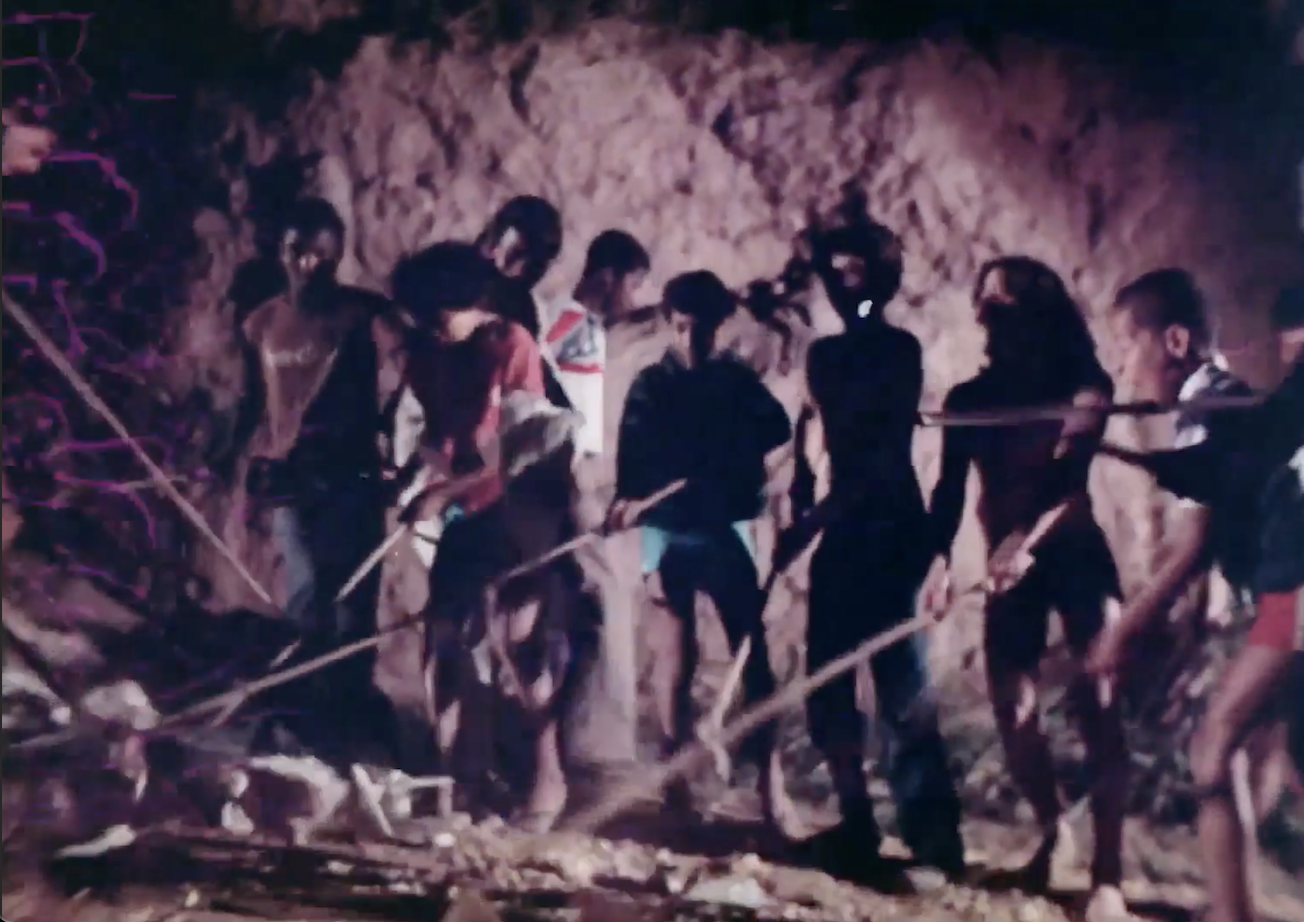
This sense of complicity expands even more in Adulto não Brinca (Adults Don't Play), Sampaio's second film. The short film is preceded by a card from the Public Entertainment Censorship Division1 (Divisão de Censura das Diversões Públicas), classifying it as inappropriate for children under 14 due to “scenes of suspense and trauma”. The censorship notice is nonsense from the get-go, being that the narrative relies on the lucid perspectives of children. Adulto não Brinca tells the story of a group of kids who make a doll of Judas to beat2 and end up at the police station when the doll is mistaken for a corpse. Complicity is also reflected in the method of framing the boys’ prank, which covers up the romp until the final act.

The “suspense” referred to by the censors is itself one of the procedures Sampaio uses to prolong the film’s main point of deception. Darkness, distorted sounds, and almost ritualistic gestures occur in the preparation of the stiff/doll:3 the film curiously explores death (or rather, the possibility of its suggestion) in a darkly enchanting way. But the policeman’s self-proclaimed “authority” clashes with the possibility of this macabre humor, allowing little room for discovery and even less space for what the film embraces as complex or contradictory: the “malhação”.4 Referring to the act of a dozen children tearing apart the Judas doll with sticks and then setting it on fire, the malhação is as wild as it is fun. The film displays a threshold for the staging of child violence less related to “trauma” (as announced in the censorship card), but more so to catharsis.
This notion of contrast continues in Sampaio’s first feature film, Amor Maldito, not only as a thematic resort (a couple's nest vs. the lack of perspective in old age, child curiosity vs. adult authoritarianism), but also as a procedure for assembling the narrative. Contrast provides a structure that introduces itself early in the opening of the film, when Sueli (Wilma Dias) glamorously appears as the winner of a beauty contest, and then enters her ex-girlfriend Fernanda’s (Monique Lafond) apartment to throw herself out of the window. As a starting point of the narrative, the scenes of Sueli dying on the floor are opposed to the moments in her life of greatest splendor. The story unfolds from there, highlighting an outrageous and homophobic accusation that holds Fernanda responsible for the death of her ex-partner.

The thematic contrast of Amor Maldito is set between an affectionate, confident lesbian woman and a conservative and hypocritical patriarchal society (featuring an abusive minister, a womanizing, family-man journalist, and a queerphobic and supposedly prude prosecutor). As already mentioned, this contrast will also be repeatedly explored as a process of linking together the plot. The same can be said for Sampaio’s use of social spaces: the film features a dreamlike space of a large garden surrounding the sensual bath of Sueli and Fernanda, and holds these images against the confinement of the suffocatingly framed cold and dark space of the court. Similarly, it compares and scrutinizes the predominantly male systems of justice and its interpersonal relationships as opposed to the affective love between women felt on the beach and at parties. And finally, the film contrasts flashbacks of violent memories of paternal abuse and tender memories of sex between Sueli and Fernanda. The string of scenes of a lonely Fernanda vomiting, filmed through the bars of a cell, and the chauvinist conversation between defense and prosecution lawyers is perhaps the most straightforward demonstration of the distance and cruelty between these two poles. This distance is reinforced by the final contrast at Sueli’s tomb: a huge stone engraving ordered by her father with the words “Eternal saudade”5 as opposed to the off-the-cuff “only I loved you” scrawled by Fernanda on the tomb after her visit.
Seen presently, almost four decades later, these first films by Adélia Sampaio allow us think about the possibilities of a cinema that delineates societal contours and explicit separations, while positioning itself before them. In the face of social and legal brutalities, the intimate, loving and sexual life is not only an act of resistance, but is rather filmed as being permeated by affection, dignity, curiosity and sharing. The transformation of these contrasts in the cinematic form sets itself as an exercise towards expanding the ethical and aesthetic limits in between an oppressive structure and the strategies of creation in each shot.
------
1. The Public Entertainment Censorship Division was an institution that was part of the body of the Ministry of Justice.
2. TN: In Brazil, the act expressed as “malhar o Judas”, which could be roughly translated as “beating the Judas”, leads back to a tradition of Catholic and Orthodox communities that was introduced in Latin America by the Spanish and Portuguese. It consists of beating a doll the size of a man, lined with sawdust, rags or newspaper, through the streets of a neighborhood and then setting it on fire, usually at noon, as an act that symbolizes the death of Judas Iscariot.
3. TN: The term used by the arresting officer in the film to refer to what he thinks is a corpse is presunto, which means “ham" in English. We have translated the word here as "stiff", in keeping with period-accurate crime fiction dialogue.
4. TN: “Malhação” of the Judas, or hitting the Judas.5. TN: “Saudade” is a Portuguese word understood to have no exact correspondence in other languages. The word refers to a deep sense of simultaneous nostalgia, longing and yearning addressed to a place, a time, something or somebody.


