

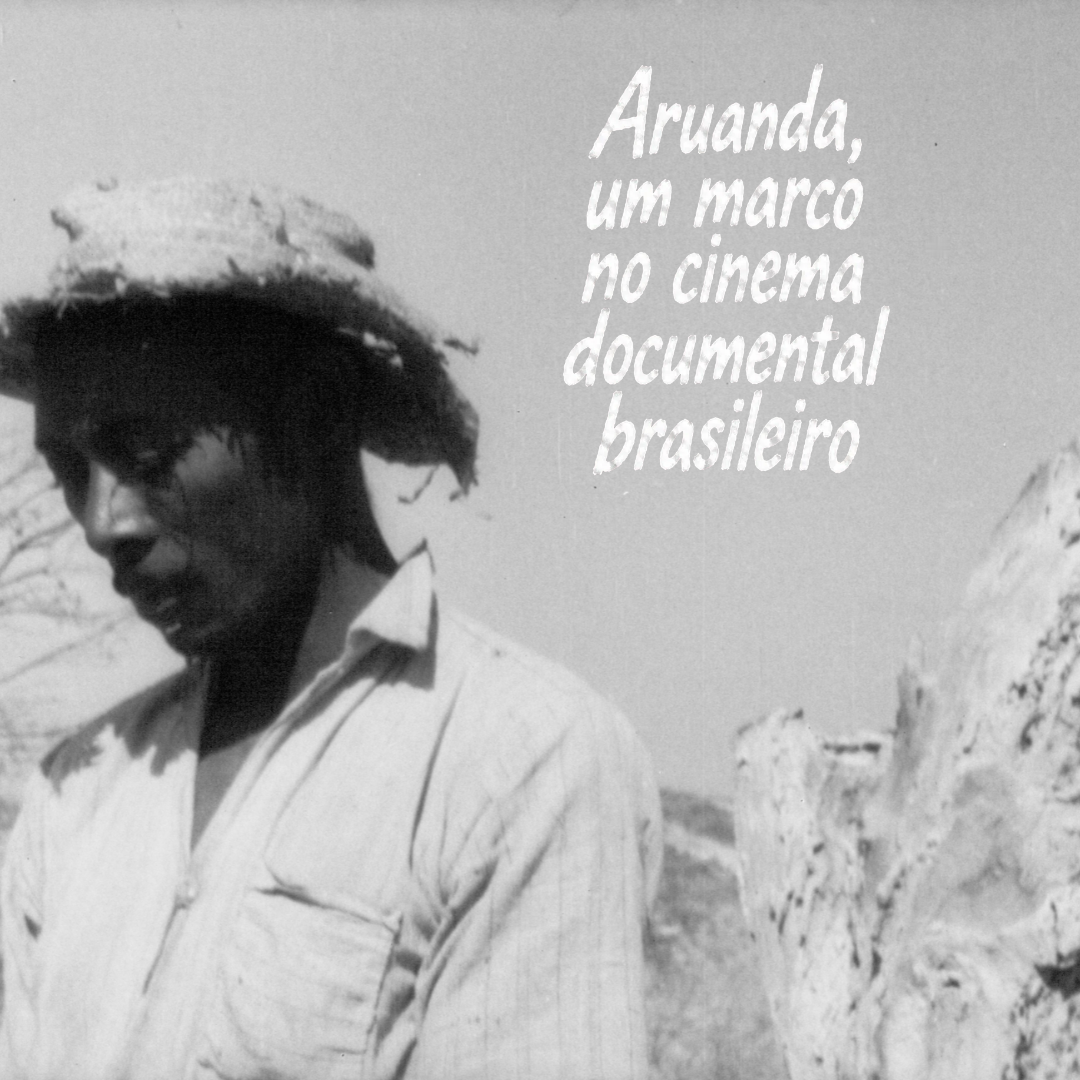
Beyond being a touchstone of the emerging cinema of Paraíba in the 1960s, Aruanda (Linduarte Noronha) is a landmark in the filmmaking movement that would later come to be known as Cinema Novo. The short film presents a depiction of reality clearly inspired by Nanook of the North (Robert Flaherty, 1922), which laid the foundations for the documentary genre by introducing a distinctive approach: a dramatic structure modeled on narrative fiction filmmaking, which by that time was already well established and readily recognizable to audiences.
Flaherty's great innovation was that he did not limit himself to documenting reality but instead staged events from the past, some of which were no longer part of Inuit life. By employing characters and situations within a narrative structure, he created a growing sense of tension and suspense characteristic of fiction cinema, as Silvio Da-Rin observed in Espelho partido: tradição e transformação do documentário (2004).
What Nanook and Aruanda (made forty years later) have in common is that both tell the stories of particular characters: in the former, Nanook and his family; in the latter, Zé Bento and his family, consisting of his wife and two children. In Nanook, the antagonist is the natural environment, with its frozen landscapes of northern Canada; in Aruanda, it is the arid terrain of Paraíba’s semi-arid region.
To this must be added the centuries-long legacy of slavery and exploitation endured by the protagonist, Zé Bento, a recently freed man seeking to establish a sustainable livelihood in a land steeped in mysticism. Both films are characterized by continuity in their editing and the use of social actors portraying roles closely connected to the worlds they inhabit, “natural actors” performing within their own environments.
As Wills Leal, a film historian and critic from Paraíba, observes in the second volume of Cinema na Paraíba e Cinema da Paraíba: “This is how Aruanda begins and ends. At the beginning, Zé Bento symbolizes a man who has freed himself from slavery, yet who exists in and is part of a world of nothingness, inhabited only by a donkey, drought, monotonous music [extradiegetic, it should be noted], and pale, suffering faces. By the end, he is still the same Bento, no longer a slave, no longer the property of a wealthy landowner, but a slave to the land, a land that offers him nothing.” Noronha staged the journey of Zé Bento and his family as they sought the means to survive in an arid landscape, where his wife becomes the family's breadwinner by making clay utensils.
As early as 1957, Linduarte Noronha had been considering documenting the quilombo community of Serra do Talhado, in Santa Luzia, which he had visited while working on a journalistic report. The screenplay was written collaboratively over two months by Vladimir Carvalho, João Ramiro Mello, and Noronha himself. They belonged to a generation of cineclub enthusiasts in the 1950s who regarded León Kulechov's Tratado de la realización cinematográfica (1956) as the bible of cinephiles of the era. Members of this group, active in Paraíba's capital, included José Rafael de Menezes, Paulo Pires, João Ramiro Mello, Wills Leal, Vladimir Carvalho, Paulo Melo, and others, all of whom had practical experience in filmmaking.
Support for the film’s production came from the Joaquim Nabuco Institute for Social Research, based in Recife, and from Odilon Ribeiro, an industrialist from Paraíba, intellectual, and patron of the arts. During post-production, the film received crucial support from the INCE (National Institute of Educational Cinema, 1936–1966), an institution established to promote Brazilian cinema, particularly films intended for public education.
The journey undertaken by the Aruanda team, from their initial encounter with the subject through the writing of the screenplay to the film’s premiere at the Cine Rex in João Pessoa, the capital of Paraíba, on September 19, took approximately three years. Aruanda is also the “manifesto film” of a generation whose leading figures included Vladimir Carvalho, João Ramiro Mello, and Linduarte Noronha. The documentary was regarded by Glauber Rocha, Paulo Emílio Salles Gomes, and Jean-Claude Bernardet as “a pioneering landmark of Cinema Novo (...) a film that, until the release of Nelson Pereira dos Santos’s Vidas Secas, represented the boldest and most uncompromising vision for Brazilian cinema,” as Vladimir Carvalho himself notes in Jornal de Cinema (2015).


