



Writing about Carnaval no Fogo today, given the material conditions of the available digital copy - mutilated, and at times impossible to see or hear - calls for an initial consideration. What is the subject here? Is it the film released on the eve of Carnaval 1949, celebrated at the time by even some of the hastiest enemies of Brazilian cinema? Is it the film that would later be considered the "model chanchada" by Sérgio Augusto? Or is it this painfully pale vision of a lost splendor, this obviously partial restitution of an imaginary object that perhaps still persists, silently, in a film archive basement?
How can one write about a work that no longer contains what may be the single most commented upon scene in the history of film criticism on carioca chanchadas? Namely, Grande Otelo and Oscarito parodying Romeo and Juliet on the balcony. It would be possible, of course, to find a version of the missing sequence on the internet and artificially reinsert it in the film. But wouldn't that then be to perform a senseless prosthesis in a vain attempt to restore an already lost integrity, further compromised each time an image jumps or there is a sudden silence on the soundtrack? Wouldn't that then transform the film into a mere source of information and annul the materiality that presents itself, here and now, to our senses?
Perhaps an alternative approach is in order: what if we were to start from this corrupted surface, from these shreds of image and sound? What if we were to find in them, perhaps, a new opportunity to reexamine the chanchada? Writing about Brazilian cinema of the past is almost always a process of describing something that cannot be seen or heard. But what if, rather than starting from a hypothetical lost film in need of restoration, we begin by considering the visual distortion and sonic turbidity, the blurred temporal flow to which the body is forced to get used to when viewing the only existing digital copy of Carnaval no Fogo?


A frame darkened at its edges barely allows us to read a poster that says: "Teatro Municipal - Concerto Sinfônico", while showing the blurred silhouette of a conductor in front of his musicians. In the next shot, Oscarito, wearing a tuxedo, conducts an invisible orchestra in a slight low-angle shot. The image is barely perceptible - scratches cross the surface of the screen, random blurs and whitish blotches suddenly appear to obscure its texture. The sound that can be distinguished is a distracting noise reminiscent of a film passing through a projector. We can barely make out the sound of instruments while we guess the melody amidst the chaos of cracks and hums. The editing alternates between a medium frontal shot - which doesn't let us see the darkened background of the theater - and the rear view of the comedian, who continues to furiously brandish his baton in front of a closed curtain, preventing us from identifying even the slightest shadow of a musician. Until, with his maddened expression and disheveled hair, Oscarito suddenly turns to the antechamber. Now staring at the audience, he delivers a sharp blow to the spectator, shattering the illusion of transparency.

The delightful joke ends by giving up the charade: the opening shot shows us a room in the Copacabana Palace hotel. The curtain of the imaginary theater is revealed as a lavish bed, a closet the place where this individual, who turns out to be a valet, returns the tuxedo he momentarily stole from a rich guest. As with the best reflexive moments of chanchadas (such as the carnaval staging proposed by Othello to Helen of Troy in the 1952 Carnaval Atlântida, the high-voltage political satire that stresses the relations between social classes, the highbrow and lowbrow culture, nobility and vulgarity), here, Carnaval no Fogo self-consciously mocks the neocolonial cinematographic framework as an object of interrogation and scorn. The slow pull-back of the camera to reveal, little by little, the true environment of the impossible maestro is what impresses us most, despite the distorted image and sound, of Watson Macedo's powerful mise-en-scène. But everything else that clouds the eye and the ear - the blurred visuals, the choppy sound - instead of softening the reflexivity of Carnaval no Fogo, further underscores it. It is as if the underdeveloped, parodic, anarchic fury of the chanchada gains relief and substance in the exacerbated superficiality of the degraded image and in the chaos of the distorted sound. Amidst the sudden scratches and explosions, submerged in this uncomfortable and inescapable noise, Oscarito is the conductor of a visual and sonic battle for the imminent destruction of mainstream cinema. He is the commander-in-chief of the violent dissolution of any colonized good taste.
At this point, perhaps it is important to say that arguing in defense of the poor image - as Hito Steyerl would call it - does not amount to an argument against restorations of Brazilian films, or anything like that. It is considering, in a materialistic way, the integrity of Carnaval no Fogo as it now presents itself to us, trying to find something in it that allows us to reevaluate the legacy and the potency of the chanchada in the form in which it has survived to this day. But it is also important to point out something that has become commonplace in many recent restorations: a near obsession with total cleanliness, an elimination of whatever is dirty in the image and sound, which perhaps makes us doubt the acuity of Glauber's aesthetics of hunger or Sganzerla's defense of the avacalho.1 Perhaps there might be an argument that restoration projects should materially preserve some of this fury, this filth, this disorganization that is so characteristic of our cinema, and that tends to lose much of its force in certain recent restorations obsessed with adjustment and perfection.
One wonders what the lifelong conservative Moniz Vianna, who called on the Censors to "put an end to the celluloid pornography that infests our screens" (apud AUGUSTO, 1989, p. 21) in the same year of 1949, would say about this digitized copy of a shabby chanchada. How would he react to the fact that celluloid is now no more than a faint memory? One wonders what the cinemanovista David Neves, who in 1966 still condemned "the old opportunistic and improvised practice of 'chanchadas'" (NEVES, 1966, p. 6) would think if he today came across this copy of a copy of a copy. In a way, it is as if the sheer precariousness of this plastic and musical matter highlights that which both the contemporary critics of the chanchada and the Cinema Novo condemned so much - improvisation, vulgarity, haste, sloppiness, anarchy - and that which Sganzerla and the Cinema Marginal filmmakers would recover with a new breath, inverting the bourgeois values of condemnation and transforming them into the ultimate vocation of Brazilian cinema.
If the chanchada revisited by the Cinema Marginal filmmakers had already been transformed into a powerful anti-colonial weapon for its frequent attacks on quality cinema, for assuming from the start underdevelopment as an inescapable paradigm, the poor quality digital version of Carnaval no Fogo turbocharges this arsenal with a demolition of technicist hygiene, with an open confrontation with the hegemony of the ultra high-resolution image. If the chanchada in its time waged a cinematographic battle in which the guerrilla tactic consisted of corrupting and disfiguring the Hollywood model to the point of exhaustion - and Carlos Manga's parodies Matar ou Correr (1954) or Nem Sansão, Nem Dalila (1955) are perfect examples of that - the impact of this gesture today is amplified by its decisive incursion in a "class struggle of images", as Maria Bogado proposes, in which the hierarchy of resolutions has become a new battleground. In an audiovisual ecosystem where Hito Steyerl tells us, "resolution has been fetishized to the point that its absence is equivalent to the castration of the author" (STEYERL, 2009, p. 188), Macedo's genius is - paradoxically - underscored by the extreme compression of the file. Strangely enough, seeing poorly and hearing worse here does not lessen Macedo's authorship, but accentuates his most prominent aesthetic gestures.

Following the opening sequence, Grande Otelo's character - also a hotel employee - arrives with a message for Serafim (Oscarito). "A telegram from Uncle Sam," he says. "But I don't have an uncle," replies Serafim. The jokes in profusion spoken in English are a conscious mockery of the imperialist language, to the point where the poorly copied imitations extends to the performances: Otelo and Oscarito, broom in hand, improvise a very Brazilian version of dance steps to an American rhythm, mimicking Hollywood musicals with a smile on their faces. But it is not only the cinematographic metropolis that is parodied to exhaustion. Serafim's explanation about his family tree that branched off to produce a brother from the United States is a delightful parody of the famous poem "Quadrilha" (1930), by Carlos Drummond de Andrade, transforming the lyrical text into a profusion of chaotic and entirely illogical arrangements, to the point where Oscarito's words become pure unintelligible noise - accentuated, of course, by the extra noise coming from the poor sound of the copy.
It would be tempting to invoke Tom Zé's "plagiarism/combination" [plagiocombinação] as the core of the construction of Carnaval no Fogo, from the script by Macedo and Alinor Azevedo to the performances by Oscarito and Grande Otelo; from the treatment of the scenery to the choreography. In an interview for Carta Maior magazine in 2006, the tropicalist musician comments on his compositional strategy: "I assume plagiarism/combination. I can say, for example, that something from pop or classical music influences me. Do you know why? Because when I lean into this influence, I can create an abyss between what influences me and the work I present". Also, in this "model chanchada", there is a conscious assumption of the model and the reflexive interposition of a distance between the model and the copy (the audience knows very well that it is an imitation, and their laughter comes precisely from the enjoyment of that distance). But what Macedo and the other creators of the chanchada - especially José Carlos Burle, Carlos Manga and José Cajado Filho - accomplish is a kind plagiarism/mockery, which, by making the defective copy, corrupts the reference to the model until it becomes unrecognizable. The copy made by chanchadas is a ridicule of the model, to the point of complete disfigurement.
The economy of exchange - the "paramount twist of the chanchada" according to Sérgio Augusto (AUGUSTO, 1989, p. 15) - permeates every layer of the film. Serafim needs to pretend to be an artist to impress his gringo brother; Ricardo needs to pretend to be a villain until he can reveal a crime to the police; the whole dramatic structure of Carnaval no Fogo is based on this endless barter. But the exchanges are also present in the frequent breaking of expectations in relation to the classical model: the seemingly defenseless girl suddenly punches the good guy in the face, and then suddenly kisses him with the same rebellious impetus. The imitation starts from a self-conscious motivation and then completely dissolves the reference point into chaos and anarchy. In an otherwise unimportant scene, the heroine's friend asks, as if it were possible to summarize the destruction of the American model carried out by the chanchada in a single line: "Marina, is it true that Americans are made of plastic matter?"
What also happens to the spectator when faced with these ruined images and sounds is that initially, we are tempted to see in spite of the visual static, to hear in spite of the sound distortion. As if there is an integrity somehow still recoverable, beyond or behind the copy of the copy. As if it is possible to separate the supplementary defect of the version in front of us from the original manufacturing defect of the film. But soon we get used to the ruin, soon we are forced to accept the defect as the first surface of the image and sound, until the pleasure comes to reside precisely in engaging in this total disarray, this hyper-enhanced anarchy and chaos, this impossibility of referring to any original. The plastic, vagrant, precarious, inorganic matter of this version of Carnaval no Fogo is, in a certain sense, the ultimate realization of its aesthetic-political vocation.


Serafim, in distress over his brother Johnny's impending visit, goes to young Marina (Eliana) to ask her to convince artistic director Ricardo (Anselmo Duarte) to include him in the Copacabana Palace show. Leaning back in the Director's vacant chair, he exclaims, "Ah, Ms. Marina, I am an artist!". In a masterful cut - Macedo had been an editor at Atlântida for years - the next shot jumps to a performance by the Aqualoucos, a troupe of acrobatic clowns, poolside at the luxury hotel, demonstrating their wacky skills to the good guy Ricardo while unraveling his well-ironed suit. The cut between the ironic vindication of Art with a capital A - in the colonial mold - and the generalized mess of the Aqualoucos is a seed of what would be, three years later, the fundamental gesture of Carnaval Atlântida: the defense of total carnavalization as a fundamental underdeveloped artistic gesture, instantly destroying the hierarchies between high and low culture, between the noble forms of opera and concert music and the popular forms of the circus and vaudeville theater. But if the cut between the shots is precise in its formulation, no less important is the startle of the image that, as in a superimposed defect or a visual glitch, shuffles the overall shot and the general shot and syncopates the rhythm, injecting even more vulgarity into the sloppiness assumed as power.
The sympathy for the devil of this chanchada concludes some time later, when the Aqualoucos throw the righteous director into the pool of the luxury hotel, messing up his outfit. But the distorted image itself - which barely allows us to distinguish in the scene who is crazy and who is not - intensifies the chaos. We no longer know if what we see is water in the pool or a defect on the image, if what we hear is the sound of water or the noise left by the multiple conversions from celluloid to digital. If a critic from A Cena Muda magazine at the time of Carnaval no Fogo's release considered "the scenes 'rushed', the situations 'illogical', the cuts 'careless', and the characters 'poorly developed'" (apud AUGUSTO, 1989, p. 117) - revealing, of course, his conception of cinema based on reactionary good taste - in our shabby copy we see today it is exactly haste, illogicality, carelessness, and underdevelopment that gain even more importance.
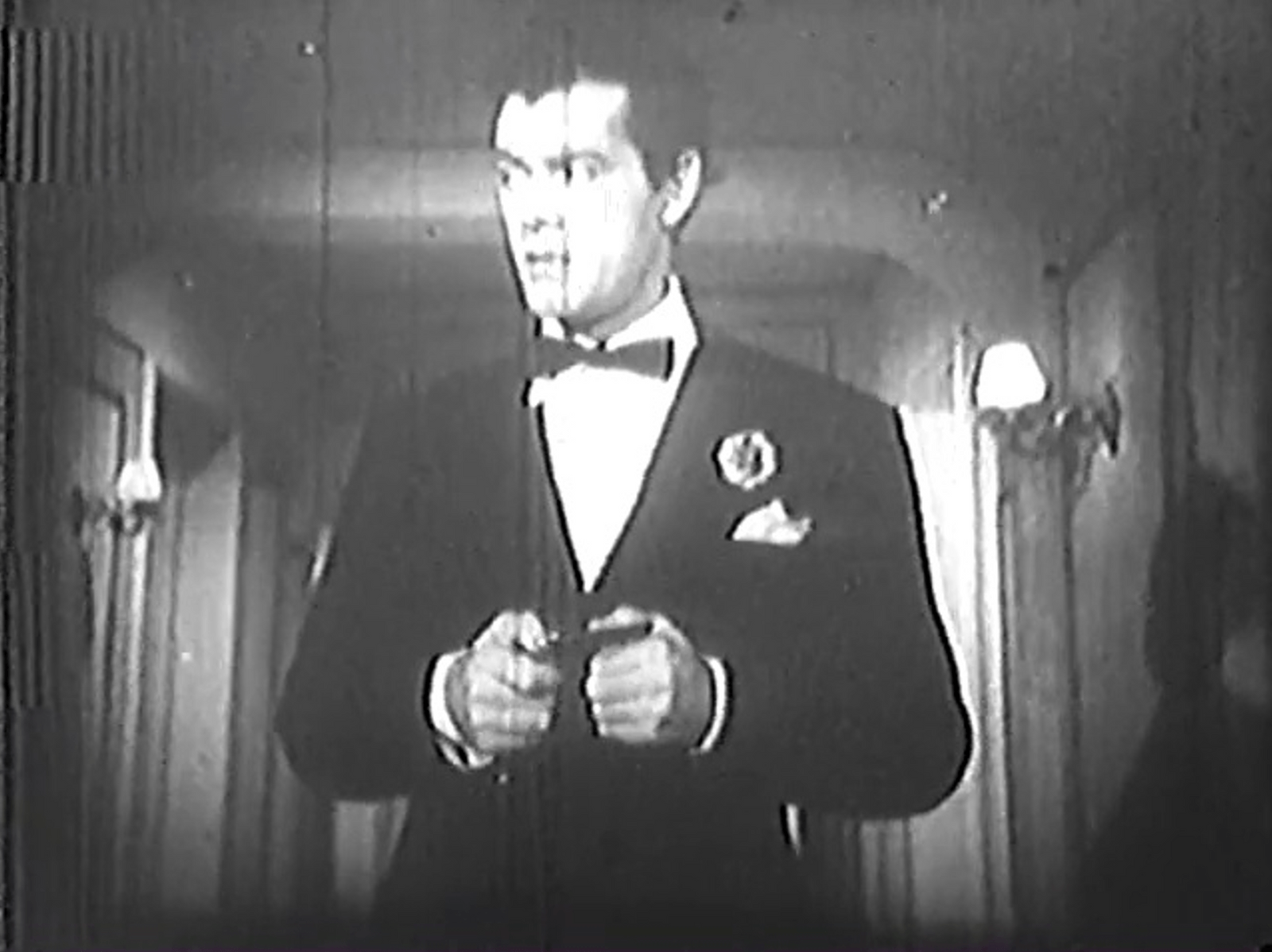
There is a visual economy of the copy that constantly underlines the aesthetic-political gesture of Macedo's chanchada. If the dance performances on the stage of the Copacabana Palace were already produced cheaply - the Eiffel Tower hastily painted in the background - the surface of the image triples the stakes: the contrast exacerbated by poor quality, the faulty textures, the accentuated white areas, the sudden explosions of light within the frame, the populated background always rendered an indistinct blur, the sudden silences of the image in which a black screen comes into view while the dialogue continues.
But there is something very significant also happening with sound. An animal impersonator visits the hotel, seeking to demonstrate his skills to director Ricardo. If, for Sérgio Augusto, Watson Macedo is the "master of the exchange" (AUGUSTO, 1989, p. 116) - a precise formulation that synthesizes the director's taste for exchanging identities, objects, and social positions - this sequence from Carnaval no Fogo makes that operation literal, transferring it from the screenplay to the film's sound. In this exchange-joke-trick-special effect, the gag here is entirely cinematic, since the joke is based on the comparison between the impersonation - performed by the hard-working hotel employee - and the pure and simple replacement, on the soundtrack, by the noise captured from chickens, horses, and machine guns. Today, the sound that has been obscured by the poor copy of the film intensifies the gesture, since everything appears to our ears as more mechanical, more over-processed, even more distant from any natural sounds.

But nothing compares to what happens in the final sequence, where the mayhem settles once and for all in the hotel corridors. The good guys team up with the comical employees to unravel their confusion and reveal the villains to the police, while the bad guys regroup to get away with their crime. As if the mad dash and hilarious punching and kicking were not enough - the young lady in the ballerina costume is the most skilled fighter - there is also a bomb about to explode. But it is precisely at this point that the deterioration of the copy becomes exponentially worse: floating scratches, uncontrollable dimming, and sudden flashes of light ruin the picture, while nothing can be heard on the soundtrack except the wild noise of the copy's faulty processing. Dialogue is smothered by a renitent hum that is now at maximum volume (and even subtitling has become impossible). The imminence of the explosion ignites the rhythm of the film, while the material texture of the copy seems about to tear itself apart entirely, consumed by an invisible fire. The images and sounds take on the final appearance of an object found in the trash. But this garbage burns, it is alive in its inner fire. And it is precisely in this self-incineration of the film that the spectator is fully immersed, surrendered to this inextinguishable fire.


Oscarito, with the suitcase-bomb in hand, sets off dashing towards the spectator, as if his task now was to set fire to the film, to the screen - and take us along. The ending explosion of Carnaval no Fogo is an implosion of cinema, a final fire that leaves no image intact, no sound intact. Converted into an abstract blur, vision is shattered into a thousand pieces. Absorbed by noise, hearing has become impossible. Magically resurging from the ashes, amidst the smoke and the scratches on the image's surface, the actors stare at us once again, their expression somewhere between astonishment and uncontrollable laughter. Their work is done.
Instead of focusing here on the extreme precariousness of this film that we can barely see and hear, a trail that is about to be erased, what we propose is to see precisely in this abyssal poverty an elevation to the ultimate power of this “screwed up underdeveloped roguish democratic nationalistic anarchistic and freeing scumvulgarity chanchada” (ROCHA, 2004, p. 316), which Glauber famously defined with precision, and so begrudgingly, after decades of merciless condemnations against the genius of Macedo, Manga, Burle, and Cajado Filho. Seen today, in this deteriorated and shabby copy, the chanchada obliges us to reevaluate, once again, the depth of its incendiary fury. At a moment in which Brazilian cinema is literally under the constant risk of total fire, perhaps Carnaval no Fogo can teach us something about the power of these other flames. Flames that are still capable of setting our eyes and ears on fire. May our memory be a memory of fire.

1. Speaking about The Red Light Bandit , Sganzerla said: ”Quando a gente não pode fazer nada a gente avacalha” ("When we can't do anything, we should mess around/mock everything.")
REFERENCES
AUGUSTO, Sérgio. Estemundo é um pandeiro: a chanchada de Getúlio a JK. São Paulo: Cinemateca Brasileira; Companhia das Letras, 1989.
BOGADO, Maria. “Na lutade classes das imagens”. Série de textos publicada na revista Cinética,2021. Disponível em: http://revistacinetica.com.br/nova/tag/nalutadeclassesdasimagens/ Acesso em 01/03/2022.
NEVES, David. Cinema Novo no Brasil. Petrópolis: Vozes, 1966
STEYERL, Hito. “Em defesada imagem ruim”. Serrote, Rio de Janeiro, IMS, nº19 mar, 2015, p.185-199.
VIEIRA, João Luiz. “Chanchadae a Estética do Lixo”. Contracampo, Niterói, n. 5, 2º. sem. 2000, p.169-182.
ZÉ, Tom. VILELA, Sávio. “Primeira parte daentrevista exclusiva com Tom Zé”. Carta Maior, 11/04/2006. Disponível em: https://www.cartamaior.com.br/?/Editoria/Midia/Primeira-parte-da-entrevista-exclusiva-com-Tom-Ze/12/9546.


