


It was a February day
A storm in the high sea
It was my mates and I
And death rounding up on us
On the beach there was a river of tears
Roses and prayer against the bad weather
Euê, euá
It was enchantment
In a chant for Yemanjá
- Sérgio Ricardo1
THE FILMMAKER

Juliana do Amor Perdido was shown hors concours at the 1970 Berlin Festival. It was shot between 1969 and 1972 on the seashores of the state of São Paulo, in Guarujá and Piracicaba2 The film was produced by both Entrefilmes and Vera Cruz, and it was distributed in Brazil by Metro Goldwyn Mayer. Juliana do Amor Perdido is a valuable work that has been far too ignored in the field of Brazilian film studies and among general audiences. This article will contextualize the production of Juliana do Amor Perdido, highlight the film’s poor initial critical reception and later redemption, underline the ways in which the military regime censors reacted to it, discuss Sérgio Ricardo’s own feelings about the film, and present some of the reasons as to why it deserves to be more recognized.
1969 was an emblematic year throughout the world. It was the year of the remarkable Woodstock festival, humans went to the moon, and the first message was sent via ARPANET - the precursor to the internet. In that same year, general Emilio Garrastazu Medici became president of Brazil in indirect elections. Brazil had been amidst a military dictatorship since 1964. Filmmaking was absolutely dangerous during this period. Depending on the censor’s interpretation, a film could be mutilated or banned entirely. This could then lead to the cast and crew becoming persecuted, exiled or even assassinated by the military regime.3
Sérgio Ricardo had originally planned to shoot A Noite do Espantalho (1974) in 1969, but production was postponed once the AI-5 was proclaimed in late 1968.The AI-5 (Institutional Act 5) meant the military coup was radicalizing.4 The AI-5 meant:
- All citizens had their political rights suspended for ten years.
- The military regime could freely intervene in states and municipalities.
- The National Congress, City Councils and State Legislative Assemblies could be forced into recess indefinitely by the President.
- The regime could remove the mandates of federal, state or municipal representatives.
- The right for citizens to vote and to be voted in union elections was suspended.
- Any activity or demonstrations of a political nature were forbidden.
- The guarantee of habeas corpus was suspended for political crimes.
- The press, theater, music and films would be increasingly censored.5
The producer of Juliana do Amor Perdido was Jorge Ileli, who had directed films such as Amei um Bicheiro (1952) and Mulheres e Milhões (1961). Sérgio Ricardo himself explains how their production strategy had to change due to the AI-5:
When the AI-5 came, he (Jorge Ileli) told me: Look, man… A Noite do Espantalho won’t be approved by the censors, and I’m not going to invest in a film that’s going to be banned. So, either you come up with a different, lighter story, or we give up on A Noite do Espantalho. (Ricardo, 2017)
It was after this conversation that Sérgio Ricardo had the idea to make Juliana do Amor Perdido. He would base the film on a story told to him by his uncle “about a train that, at the same time every evening, would whistle, and make everybody melancholic” (Ricardo, 2017). From that premise, Sérgio Ricardo teamed up with filmmaker and screenwriter Roberto Santos to develop a screenplay.
Once the screenplay was completed, Sérgio began the casting process. He ended up casting a newcomer, Maria do Rosário from Rio de Janeiro, as Juliana. He also casted Francisco di Franco as Faísca, Antonio Pitanga, Ítala Nandi and Macedo Neto. After financial resources were gathered, and the crew was ready to shoot, the production of Juliana do Amor Perdido began.
The story of Juliana do Amor Perdido centers on Juliana, who is the daughter of a man who leads an entire fishing community. This community lives on an island somewhere in Brazil. The first fifteen minutes of the film reveal the major elements and themes that will be articulated throughout it. Juliana appears as a mystical being. She has a mysterious connection to the sea, and her presence is seen as fundamental to the success of fishing and the commercialization of fish on the island. The opening scene of the film reveals a magical ritual that the community undergoes, which they believe will lead to their success when fishing. Juliana is at the center of this ritual, appearing as if she were a Yemanjá, a religious figure with totally syncretic elements between Afro-Brazilian religions, Christianity, and the experience of fishing. In this opening scene, Juliana is almost an apparition of the sea queen.
Once this ritual is over, the following scene presents a dialogue between Silva, Juliana’s father, and Mr. Moisés, who owns the island and is the middleman between the island fishermen and the fish market. In the scene, Silva complains to Moisés (who happens to have a foreign and possibly Jewish accent) that he truly believes in Juliana's holiness. Their conversation denotes that the presentation of Juliana as a Saint is a way for these businessmen to continually exploit the fishing community based on their willingness to believe whatever they are told. Aboard Mr. Moisés's boat, Silva says:
Silva: People are complaining about the money, Mr. Moisés.
Mr. Moisés: Fishermen are stubborn. My situation is very bad, and the fisherman don’t understand it. You are a very intelligent man, and that’s why I trust you. You know, Silva… the island is my property. Some Americans want to buy it. If I sell it, the fishermen will lose their jobs, they’ll have to leave. I pity the fishermen. I get sick when I see them starving. And another thing, Silva: the purchasing power of the people is very low. No one’s eating fish in the city anymore. Only rich people eat fish. The people eat flour, in very bad quality. I’d lose my word of honor. I can’t raise your pay now. Don’t you agree, Silva?
Silva: We have problems too, you know, Mr. Moisés? Fishermen like to work on their own.
Mr. Moisés: How old is your daughter, Silva?
Silva: 21, Mr. Moisés.
Mr. Moisés: You have to think of the future, Silva.
Silva: I can raise your wages, and yours alone. Be smart, don’t tell the other fishermen. Tell them about my situation. Then everything is settled.
Silva stares at his boss for a while, keeps silent, and puts his head down in agreement.
This dialogue is symbolic. The cunning way the boss leads the conversation with Silva portrays how exploitation and capitalism have the power to dictate an environment. The belief the fishermen had in the saintliness of Juliana is what maintains power structures and the status quo on the island. The above dialogue is intercut with reverse shots of Juliana blessing boats and fish with flowers. Through clever visual metaphors, the film deals with the reality of Brazil at the time. Such a strategy is widely used by artists in states of exception to deal with social issues directly or allegorically. As the story of Juliana do Amor Perdido continues on from this point, the theme of labor force exploitation is attenuated. The relationship between Juliana and her father, with the men of the island, and with a new lover, Faísca, becomes the center of the narrative.Juliana do Amor Perdido was received with little sympathy by film critics at the time of its initial release. Comparisons between Sérgio Ricardo's musical work and the film are recurrent. The film is also compared to Glauber Rocha's Barravento (1962), especially in the way that it criticizes religions as "…the opium of the masses…". The newspaper A Província do Pará, on December 16, 1970, states: "sincerely we find the film quite bad (...) what we see is a carnival-like ritual, exoticism meant for foreign eyes”. São Paulo’s Opereta da Tarde, in August 1970, also harshly criticizes the work: "…he, who is so good at singing stories, shouldn’t be so bad at telling them". Jornal da Bahia, in December 1970, is fonder of Juliana do Amor Perdido, writing, "…the film does not defend political theses, but instead it narrates with color, sounds and lyrical rhythms. It is love murdered in a society of lies, exploitation and incest…". Jornal da Bahia’s positive review of the film, saying that it does not have a strong political message, seems to misinterpret it or perhaps to try to apply a pro-military regime bias to it.It seems obvious that the critical consensus around Juliana do Amor Perdido had a considerable impact on the film’s commercial success when it was first released. However, Juliana do Amor Perdido has gained new appreciation over time, with recent texts highlighting its many praiseworthy aspects. However, one of the constant elements of the film which seem to have retained praise since it was first released is Dib Lutfi's photography and camera work.
The Saint

In Juliana do Amor Perdido, the island fishermen do not completely believe Juliana is a saint. This is reflected in the desirous way they look at her. Juliana's virginity is the supposed central element for her magical powers to operate, and she is able to defend herself from the men of the island because of this. Looking at her father, Juliana says, "I don't like the way the men look at me here”, him included. As such, incest is strongly suggested in the narrative.
Juliana's virginity/sanctity is simultaneously presented as the organizing element that maintains balance on the island, but it is also a factor of imbalance. Juliana’s deceased mother, played by Ítala Nandi, is characterized as a witch and prostitute who, through her infidelity, led Juliana's father and the fishing community to ruin. The Saint, Juliana, is the heir to all of this evil. When she falls in love with the train conductor, Faísca, the false balance of the fishing community begins to collapse once again. This patriarchal structure is present in the film's narrative. Women are oppressed by men and religion – two prisons whose only way out is death.
Juliana's deceased mother only makes an appearance in a few scenes, but when she does, her presence is highly emblematic. The mother’s character personifies a magical woman, similar to the Western concept of a witch. The mother is presented as a mixed, magical being, a saint and a whore, who leads men astray. Juliana's encounter with her mother happens under a dreamlike aura. The mother appears on a rock with a gypsy card in her hand, the card representing death. The mother reveals the card and says: "You are going to be a saint, Juliana. My daughter will be a saint". The tension of this scene revolves around Juliana's holiness, which the mother reaffirms, and Juliana denies.

This scene is a reflection of the gender stereotypes that were persistent during the era that Juliana do Amor Perdido was produced (Ferro, 2010). Notably, the old idea that women use their powers for evil and to drag men into disgrace. Portrayals of the demonization of women were all too common during this period, and they reveal the larger tensions experienced by women during the military dictatorship. While perpetuating these stereotypes may not have necessarily been intended by the director, they reveal themselves to us now because we understand that this perception was a major part of that historical moment. According to Marco Ferro:
[Cinema] destroys the image of the double that each institution and each individual has managed to build for society. The camera reveals that image the way it really is, it says more about each person than they want to show. It unveils the secrets, it shows the opposite of society, its “lapses” (Ferro 2010, p. 31).
Censorship
The film advances into Juliana's relationship with Faísca. Faísca is the conductor of a train which passes near by the island on a daily basis. For Juliana, the train not only brings the possibility of romance, but also the possibility of escape, to leave the community which is oppressing her. Faísca, in love with Juliana, tries to help her get off the island. He invites her to run away on the train, and while Juliana first refuses, she later gives in.
On the train, Juliana’s supposed sanctity falls apart when she loses her virginity. Originally there was a sex scene in the film, but the censors cut it, leaving in only a few frames. As a result, the sex scene in Juliana do Amor Perdido is one of the strangest in Brazilian cinema. Initially, this scene portrayed oral sex from a man to a woman. This was something the censors did not approve of, even though there is a simulated marriage in the scene before it occurs. For the censors, films cannot portray or promote any form of sex before marriage.
This sex scene attracted attention from one of the censors responsible for analyzing the film, Sebastião Minas Brasil Coelho. Sebastião did not pay as much attention to the previously mentioned dialogue between Silva and Moisés. However, the second censor, C. Montebello, was more rigorous, even citing the dialogue between the boss and the fisherman in his report. The sex scene with the insinuation of oral sex from a man to a woman, during the dictatorship, represented female empowerment. These censors clearly felt that sexual freedom needed to be contained, as the sexual revolution was a danger to the system. The remaining shots left in the film after the censorship cuts are close ups of Juliana and Faísca and a final shot between piles of paper.
The following quotations present the opinions of censors Sebastião Minas Brasil Coelho and C. Montebello in their censorship reports. On June 9, 1970, Sebastião Minas Brasil Coelho issued:
To conclude, I must reiterate that it is a romantic film, full of lyricism and sensitivity, about a typical Brazilian theme, which is mysticism and religious sects of the country’s coastal areas. Its development is homogeneous, with inserts of opportune and intelligently placed flashbacks. There is a sex scene with Juliana and Faísca, in a poetic and non-erotic manner. I consider it inconvenient for minors to watch certain scenes. Therefore, I recommend it to be released for 18 and older.6
That concludes his report, but, after signing the document, Sebastião makes an observation in the body of the paper:
Considering that during the sex scene in the fourth part of the film there are shots of eroticism when Juliana is taken by Faísca, I suggest that shot be cut down to six frames in the moment Juliana appears in the foreground with erotic nuances. Considering that this film will represent Brazil in the International Berlin Festival, I think it should receive a special certificate for an uncut release. To be shown nationally, however, the cuts described above must be made.7

C. Montebello, the second censor, offers different opinions in his report issued on August 10th, 1970:
1a part - there is a dialogue between the leader of the fishermen and the “Jew” who owns the island where they live, in which said owner threatens to sell it to “the American” and says, “then you won’t have the right to fish”, and also that “fish is too expensive and only rich people can afford it”, that the people have little purchasing power and can only eat flour.
4a part – We totally agree with the previous censor, who thought the scene of the carnal conjunction should have this shot removed entirely or made shorter: when the young man, after kissing his lover, goes down alongside her body (then he disappears behind the boxes which were probably placed in the shot), and leaving only the shot when the young woman twists her body, at the mercy of the pleasure given to her by her lover (not in the shot), in an erotic practice which is not thought well of by the moral norms, which we could be considered aberrant, and therefore unfit to be shown in public.8
Conclusion: just to notify the dignified boss of SCDP, we reiterate that the film does not seem fit to be shown internationally, due to the fact that it centers on an isolated group of uncultured fishermen (for that reason they are exploited by the “Jew”) and subdued by the utterly primitive spiritualist cult of Yemanjá. It would send foreigners a demoralizing view of Brazilian reality, contrary to the efforts of our public administration to erase the negative image by which our country is known in other places.9


C. Montebello noticed and remarked upon the political tones of the dialogue between Mr. Moises and Silva, but was more emphatic to highlight the sex scene, about which he totally agreed with Sebastião Minas Brasil Coelho. As a result, the dialogue remained intact and the sex scene was cut to six frames. It is important to call attention to the fact that he recommends the film shouldn’t be shown internationally. This demonstrates that censors cared about how the military regime was being perceived by other countries.
Juliana do Amor Perdido is not a film about femininity. Rather, it is about a masculine world which has become disorganized by two women, Juliana and her mother. These women are portrayed as stereotypes - magical women who are dominated by the men around them and exploited for capital gain. At the end of the film, Traíra, a young fisherman, takes Silva’s place and Moisés proposes to raise his pay under the condition that he arranges for a new saint to be brought into the community. As they talk, they look at a young girl on the beach. Thus, the exploitation of that community is perpetuated. A new saint, like Juliana, will have her body become an object of order and disorder on the island.
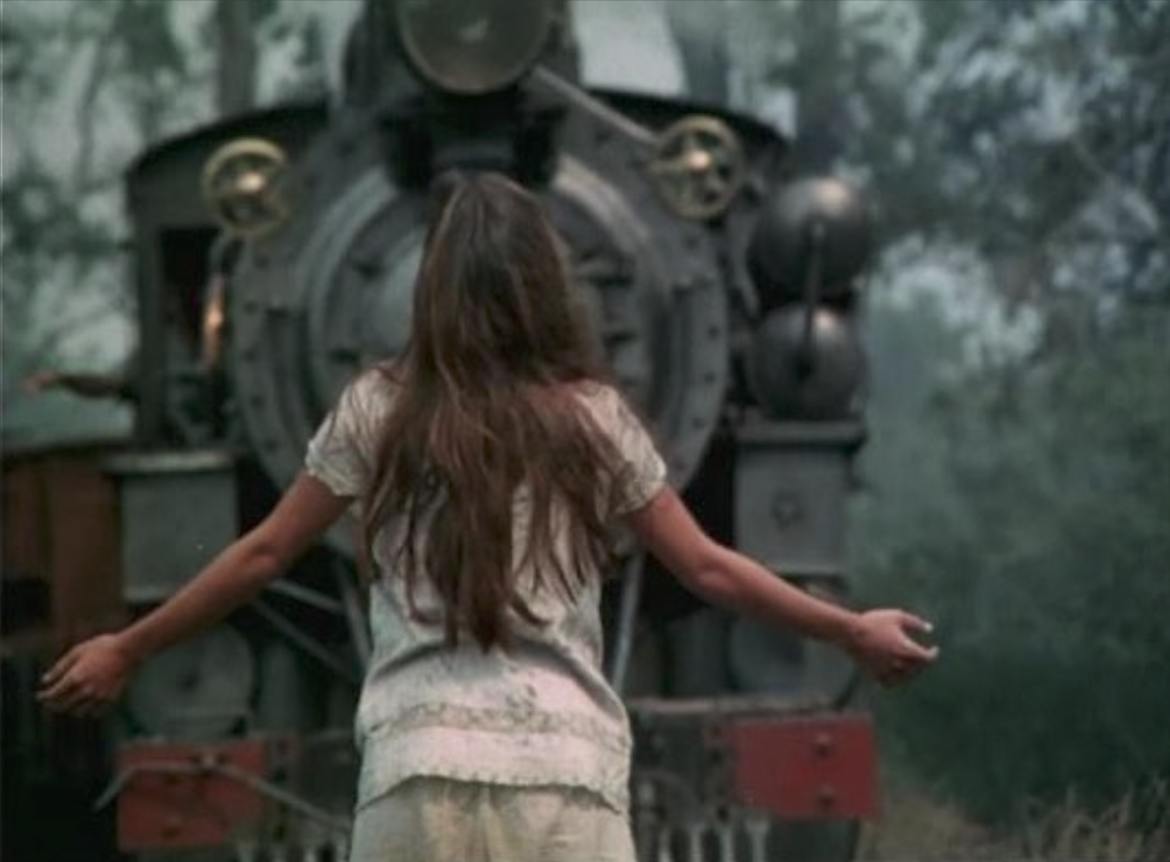
The tragic end sequence shows Juliana on the tracks again, running barefoot and being chased by part of the island community. She sees Faísca’s train coming towards her. Behind her is the oppression of her old world, and in front of her is the train, which no longer represents love or escape, but an iron monster. Juliana meets her death between the two poles that would have led to further trauma in her life.
Juliana do Amor Perdido is not Sérgio Ricardo’s best film, but it is an important work in the history of Brazilian cinema. Juliana do Amor Perdido displays a visual beauty that stands out for its time, its precious soundtrack has songs written and sung by Sérgio Ricardo himself, and the film highlights themes that were important to deal with during an era of repression. There is something inside all of us that needs to be freed, a magic that needs to be tapped into and shared. This magic needs to be used for good, rather than serving as an instrument of domination. Perhaps the message of Juliana do Amor Perdido, one year after the AI-5, was that there is no solution in the individual. There is no escape from oppressive relations, unless we come together. Exile solves nothing.
“Juliana is the queen of the sea”.
- Sérgio Ricardo

1. Part of the lyrics of the song “Juliana, Rainha do Mar”. Released on the LP Arrebentação in 1971. Lyrics, composition, and interpretation by Sérgio Ricardo.
2. Juliana do Amor Perdido received its commercial release in 1970, but the production and filming took place in 1969. This article will take 1969 as its production date.
3. If the military suspected that filmmakers were involved in any subversive activities, even if there was no reason to believe it, those filmmakers could have been persecuted.
4. When the military rose to power in 1964, their public discourse was generally mild. However, they were already persecuting, spying, censoring, arresting, exiling, and torturing their enemies from day one. The AI-5 meant the regime was tougher and more openly dictatorial.
5. Source: Presidência da República – Casa Civil.
6. Source: Memória da Censura no Cinema Brasileiro 1964-1988.
7. Ibid.
8. Source: Memória da Censura no Cinema Brasileiro 1964-1988.
9. Ibid.
REFERENCES
Ferro, M. Cinema e História. São Paulo: Paz e Terra, 2010.Hagemeyer, Rafel Rosa. SARAIVA, Daniel Lopes (orgs.) Esse Mundo é Meu: As artes de Sérgio Ricardo. Curitiba: April, 2018.
Nandi, I. Interview conducted in the project A Câmara Acústica de Sérgio Ricardo. Rio de Janeiro, July 23rd, 2017.
Ricardo, S. Interview conducted in the project A Câmara Acústica de Sérgio Ricardo. Rio de Janeiro, July 22nd, 2017.


