PT/ENG
PT/ENG
9/9/2021
By/Por:
Kênia Freitas

# Humano-Mais-que-humano-Transmutação

Em Uma noite sem lua (Castiel Vitorino Brasileiro, 2020) uma voz nos pergunta: “e se eu abandonasse todas vocês?”. Abandonar o binarismo da polarização, o limite do humano e as separações antropocêntricas são os desafios aos quais o filme se lança. Desfazendo a ideia de ponto de vista humano como ponto de vista da câmera, e mesclando posicionalidades variadas para filmar seres vivos e entidades - misturando formas de ver (e ser visto por) o céu, o mar, a terra, as plantas, os animais, os corpos humanos e celestes.  Vitorino Brasileiro cria, assim em filme, o desejo de viver a completude do híbrido, do mais que humano. A sua criação audiovisual convoca a uma percepção de cinema sensorial em que visível e invisível, dito e não dito, superexposição e segredo não são contrapontos polarizados (plano e contraplano, quadro e fora de quadro), mas sim apostas na invenção por um outro regime do sensível (híbrido, transhumano, mais-que-humano).

A voz de Vitorino Brasileiro nos guia por essa jornada incerta dos corpos em movimento, entre amor, medo, dúvidas e prazeres. Uma voz pontuada pela estranheza repetitiva de sons e ruídos que atravessam o filme. Com mais perguntas do que afirmações, essa voz modula as sensações e caminhos possíveis para “desmaterializar o gênero e a raça no corpo”, sugere a narração, usando para isso a materialidade inquestionável das imagens e sons do filme. Há um jogo, portanto, com uma materialidade hiperbolizada, que sobrepõe e mistura texturas e sentidos. Assim, na dança do final do filme juntam-se os desenhos da parede, a pintura na bunda, as estampas do biquíni e da saia vestidas por Vitorino Brasileiro. Rebolando e orbitando espaços terrestres e siderais de forma não hierarquizada, a artista se anuncia: “Eu sou a mensageira que anuncia a transmutação travesti”. Uma apresentação que estabelece os princípios do seu cinema.

Princípios que nos parecem especular com a proposta da filosofia de Denise Ferreira da Silva de imagear “cada coisa existente (humano e mais-que-humano) como expressões singulares de cada um dos outros existentes e também do tudo implicado em que/como elas existem” (A dívida Impagável, p. 43). Em muitos momentos do filme, o corpo (humano e mais-que-humano) dança: singular, errático, incontrolável e sublime. Cabeça, braços, bunda e mãos. O corpo é mandinga e transmutação, nos diz a artista. O corpo é peixe, tartaruga, plantas marinhas, pedra. Corpos deslizam no fundo do mar, flutuam na ventania e colidem no cosmos. Transmutam-se.

# (D)esquecer-Mostrar-Escutar

Uma das primeiras imagens do documentário Lembrar daquilo que esqueci (Castiel Vitorino Brasileiro, 2020) é a de uma carta denúncia de crime de Lesa a humanidade endereçada ao Governo do Espírito Santo por racismo institucional e sistêmico pelo apagamento dos Povos Bantus na constituição da história e da cultura do estado. Enquanto lemos a carta, uma voz em off nos pergunta: “então qual é a cura para o povo afrodescendente?”. A pergunta e o documento sintetizam a investigação do filme: questionar o que pode ser a cura (através de uma série de depoimentos também em off) articulando com um processo de criação de imagens que são em si um processo espiritual e terapêutico de cura. Imagens que são registros de pertencimento e encontros: uma roda de capoeira, uma celebração para Iemanjá, um coral de jovens que se apresenta na rua. Numa junção de momentos públicos, como as da exposição da artista, e de íntimos, o cabelo sendo trançado em casa e os preparativos para uma festa de aniversário.

Sem interesse em uma resposta fechada, a cura é ato e processo contínuo de contradições e sobreposições. Assim é possível compor uma sequência que vai da bandeira do Brasil (com o seu “Ordem e Progresso” positivista) ao cartaz da exposição da artista que afirma “O trauma é brasileiro”. E também compor toda uma sequência que nos questiona sobre o que pode ser uma imagem de sereia. Seria a jovem negra que posa e dança na frente da sereia branca e loira pintada no muro? Seria a divindade indiana na estampa da canga dessa mulher? Mais do que uma imagem, a sobreposição e o encontro entre elas.

O filme instaura o processo de cura no tempo e no espaço como repetição ao inserir desenhos em vermelho na tela preta que dividem os diversos blocos do filme e subvertem as possibilidades de entendimento do que pode ser a menor distância entre dois pontos (nem sempre uma reta linear). Com a Romaria dos Testículos Femininos pelo centro da cidade de Vitória até a galeria da exposição “O trauma é brasileiro”, a artista desfaz e refaz os significados do território e pertencimento. A Romaria é posta  em contraposição às imagens do convento de Nossa Senhora da Penha, ressituando os significados da arquitetura católica sobre a cidade. Andar a cidade, a avenida Beira-mar, pode ser também um processo de cura.

O corpo de Vitorino Brasileiro e os corpos que a artista encontra como pertencimento no filme (humanos e mais-que-humanos) são por fim espaço, tempo e cura. O filme não é o fim, mas o próprio processo de lembrar, escutar e, às vezes, ver.

#Ver-Desver-Ouvir

Ao som do batuque do Centro Espírita Caboclo Sete Estrelas do Mar, Vitorino Brasileiro conjura o seu feitiço : “Eu agora vou falar para todas as moças. Eu agora vou bater, para todas as moças. Para todas as travestis, para todas elas. Eu agora vou fazer macumba para todas as bixas. Para todos os testículos femininos, para todas elas”, em Para todas as moças (2019). Guiada por seu canto, as imagens se sucedem em uma montagem de ritmo e texturas múltiplas: o calor do quarto de cura - com velas, pedras, conchas e objetos diversos de macumba -, uma gravação azulada e tremida feita com celular em frente a pedra do Penedo, na baía de Vitória/ES, e uma filmagem oficial da NASA da Terra vista do espaço. Assim, entre o quente, o frio e a institucionalidade neutra é conjurado o filme-feitiço-macumba para quebrar as embarcações coloniais.

Pensar as incursões audiovisuais da artista, macumbeira e psicóloga é encarar simultaneamente esse gesto de aterrar-se na subida do morro da Fonte Grande, de afundar-se nas águas profundas da ilha de Vitória, e de desterrar-se (“afastar-se da Terra maldita, Terra que a assassina”) - gestos que são tão corporificados (pela performance), quanto imateriais (pela manutenção do mistério).

Em Para todas as moças, esses gestos são transmutações que desestabilizam também o mover errante da câmera pelo inventários de objetos (vela, osso, folhas, pedras) - mais uma vez no exercício de um olhar audiovisual não hierarquizante ou antropocêntrico. Objetos, entidades, seres, que são sempre mais do que se pode ver/mostrar. Assim como na performance de Vitorino Brasileiro a beira mar, as imagens da câmera de celular jogam com o aparecer e esconder-se da sua coreografia - entrecortada por uma máscara preta que ora mostra, ora esconde o que podemos ver.

A criação de Vitorino Brasileiro nos lembra que: ver não é o mesmo que enxergar. Visibilidade e opacidade não são opostos. E a escuta das vozes e sons são portais preciosos de percepção do invisível no visível.

# Humano-Mais-que-humano-Transmutação

Em Uma noite sem lua (Castiel Vitorino Brasileiro, 2020) uma voz nos pergunta: “e se eu abandonasse todas vocês?”. Abandonar o binarismo da polarização, o limite do humano e as separações antropocêntricas são os desafios aos quais o filme se lança. Desfazendo a ideia de ponto de vista humano como ponto de vista da câmera, e mesclando posicionalidades variadas para filmar seres vivos e entidades - misturando formas de ver (e ser visto por) o céu, o mar, a terra, as plantas, os animais, os corpos humanos e celestes.  Vitorino Brasileiro cria, assim em filme, o desejo de viver a completude do híbrido, do mais que humano. A sua criação audiovisual convoca a uma percepção de cinema sensorial em que visível e invisível, dito e não dito, superexposição e segredo não são contrapontos polarizados (plano e contraplano, quadro e fora de quadro), mas sim apostas na invenção por um outro regime do sensível (híbrido, transhumano, mais-que-humano).

A voz de Vitorino Brasileiro nos guia por essa jornada incerta dos corpos em movimento, entre amor, medo, dúvidas e prazeres. Uma voz pontuada pela estranheza repetitiva de sons e ruídos que atravessam o filme. Com mais perguntas do que afirmações, essa voz modula as sensações e caminhos possíveis para “desmaterializar o gênero e a raça no corpo”, sugere a narração, usando para isso a materialidade inquestionável das imagens e sons do filme. Há um jogo, portanto, com uma materialidade hiperbolizada, que sobrepõe e mistura texturas e sentidos. Assim, na dança do final do filme juntam-se os desenhos da parede, a pintura na bunda, as estampas do biquíni e da saia vestidas por Vitorino Brasileiro. Rebolando e orbitando espaços terrestres e siderais de forma não hierarquizada, a artista se anuncia: “Eu sou a mensageira que anuncia a transmutação travesti”. Uma apresentação que estabelece os princípios do seu cinema.

Princípios que nos parecem especular com a proposta da filosofia de Denise Ferreira da Silva de imagear “cada coisa existente (humano e mais-que-humano) como expressões singulares de cada um dos outros existentes e também do tudo implicado em que/como elas existem” (A dívida Impagável, p. 43). Em muitos momentos do filme, o corpo (humano e mais-que-humano) dança: singular, errático, incontrolável e sublime. Cabeça, braços, bunda e mãos. O corpo é mandinga e transmutação, nos diz a artista. O corpo é peixe, tartaruga, plantas marinhas, pedra. Corpos deslizam no fundo do mar, flutuam na ventania e colidem no cosmos. Transmutam-se.

# (D)esquecer-Mostrar-Escutar

Uma das primeiras imagens do documentário Lembrar daquilo que esqueci (Castiel Vitorino Brasileiro, 2020) é a de uma carta denúncia de crime de Lesa a humanidade endereçada ao Governo do Espírito Santo por racismo institucional e sistêmico pelo apagamento dos Povos Bantus na constituição da história e da cultura do estado. Enquanto lemos a carta, uma voz em off nos pergunta: “então qual é a cura para o povo afrodescendente?”. A pergunta e o documento sintetizam a investigação do filme: questionar o que pode ser a cura (através de uma série de depoimentos também em off) articulando com um processo de criação de imagens que são em si um processo espiritual e terapêutico de cura. Imagens que são registros de pertencimento e encontros: uma roda de capoeira, uma celebração para Iemanjá, um coral de jovens que se apresenta na rua. Numa junção de momentos públicos, como as da exposição da artista, e de íntimos, o cabelo sendo trançado em casa e os preparativos para uma festa de aniversário.

Sem interesse em uma resposta fechada, a cura é ato e processo contínuo de contradições e sobreposições. Assim é possível compor uma sequência que vai da bandeira do Brasil (com o seu “Ordem e Progresso” positivista) ao cartaz da exposição da artista que afirma “O trauma é brasileiro”. E também compor toda uma sequência que nos questiona sobre o que pode ser uma imagem de sereia. Seria a jovem negra que posa e dança na frente da sereia branca e loira pintada no muro? Seria a divindade indiana na estampa da canga dessa mulher? Mais do que uma imagem, a sobreposição e o encontro entre elas.

O filme instaura o processo de cura no tempo e no espaço como repetição ao inserir desenhos em vermelho na tela preta que dividem os diversos blocos do filme e subvertem as possibilidades de entendimento do que pode ser a menor distância entre dois pontos (nem sempre uma reta linear). Com a Romaria dos Testículos Femininos pelo centro da cidade de Vitória até a galeria da exposição “O trauma é brasileiro”, a artista desfaz e refaz os significados do território e pertencimento. A Romaria é posta  em contraposição às imagens do convento de Nossa Senhora da Penha, ressituando os significados da arquitetura católica sobre a cidade. Andar a cidade, a avenida Beira-mar, pode ser também um processo de cura.

O corpo de Vitorino Brasileiro e os corpos que a artista encontra como pertencimento no filme (humanos e mais-que-humanos) são por fim espaço, tempo e cura. O filme não é o fim, mas o próprio processo de lembrar, escutar e, às vezes, ver.

#Ver-Desver-Ouvir

Ao som do batuque do Centro Espírita Caboclo Sete Estrelas do Mar, Vitorino Brasileiro conjura o seu feitiço : “Eu agora vou falar para todas as moças. Eu agora vou bater, para todas as moças. Para todas as travestis, para todas elas. Eu agora vou fazer macumba para todas as bixas. Para todos os testículos femininos, para todas elas”, em Para todas as moças (2019). Guiada por seu canto, as imagens se sucedem em uma montagem de ritmo e texturas múltiplas: o calor do quarto de cura - com velas, pedras, conchas e objetos diversos de macumba -, uma gravação azulada e tremida feita com celular em frente a pedra do Penedo, na baía de Vitória/ES, e uma filmagem oficial da NASA da Terra vista do espaço. Assim, entre o quente, o frio e a institucionalidade neutra é conjurado o filme-feitiço-macumba para quebrar as embarcações coloniais.

Pensar as incursões audiovisuais da artista, macumbeira e psicóloga é encarar simultaneamente esse gesto de aterrar-se na subida do morro da Fonte Grande, de afundar-se nas águas profundas da ilha de Vitória, e de desterrar-se (“afastar-se da Terra maldita, Terra que a assassina”) - gestos que são tão corporificados (pela performance), quanto imateriais (pela manutenção do mistério).

Em Para todas as moças, esses gestos são transmutações que desestabilizam também o mover errante da câmera pelo inventários de objetos (vela, osso, folhas, pedras) - mais uma vez no exercício de um olhar audiovisual não hierarquizante ou antropocêntrico. Objetos, entidades, seres, que são sempre mais do que se pode ver/mostrar. Assim como na performance de Vitorino Brasileiro a beira mar, as imagens da câmera de celular jogam com o aparecer e esconder-se da sua coreografia - entrecortada por uma máscara preta que ora mostra, ora esconde o que podemos ver.

A criação de Vitorino Brasileiro nos lembra que: ver não é o mesmo que enxergar. Visibilidade e opacidade não são opostos. E a escuta das vozes e sons são portais preciosos de percepção do invisível no visível.

#Human-more-than-human-transmutation

In Uma noite sem lua (Castiel Vitorino Brasileiro, 2020) a voice asks us, “e se eu abandonasse todas vocês?”.1 Abandoning the binarism of polarization, the limit of the human, and anthropocentric separations are the challenges the film takes up. Undoing the idea of the human point of view as the camera's point of view, and merging varied positionalities to film living beings and entities - mixing ways of seeing (and being seen by) the sky, the sea, the earth, plants, animals, human and celestial bodies. Vitorino Brasileiro creates, thus on film, the desire to live the completeness of the hybrid, of the more than human. Their audiovisual creation calls for a perception of sensorial cinema in which the visible and the invisible, the said and the unsaid, overexposure and secrecy are not polarized counterpoints (shot and reverse shot, in-frame and out-of-frame), but are stakes in the invention of another regime of sensibility (hybrid, transhuman, more-than-human).

Vitorino Brasileiro's voice guides us through this uncertain journey of moving bodies, between love, fear, doubts, and pleasures. A voice punctuated by the repetitive strangeness of sounds and noises that run through the film. With more questions than statements, this voice modulates the sensations and possible ways to "dematerialize gender and race in the body," suggests the narration, using for that the unquestionable materiality of the film's images and sounds. There is a game, therefore, with a hyperbolized materiality, which superimposes and mixes textures and senses. Thus, in the dance at the end of the film, the drawings on the wall, the painting on the buttocks, the patterns of the bikini, and the skirt worn by Vitorino Brasileiro come together. Rolling and orbiting terrestrial and sidereal spaces in a non-hierarchical way, the artist announces theirself: "I am the messenger that announces the transvestite transmutation." A presentation that establishes the principles of their cinema.

Those principles seem to mirror Denise Ferreira da Silva's philosophical proposal to imagine "each existing thing (human and more-than-human) as singular expressions of every existing being and also of the all implied in what/how they exist" (A dívida Impagável, p. 43). In many moments of the film, the body (human and more-than-human) dances: singular, erratic, uncontrollable, and sublime. Head, arms, ass, and hands. The body is mandinga2 and transmutation, the artist tells us. The body is fish, turtle, sea plants, stone. Bodies slide at the bottom of the sea, float in the gale, and collide in the cosmos. They are transmuted.

# To (Un)forget-To Show-To Listen

One of the first images of the documentary Lembrar daquilo que esqueci (Castiel Vitorino Brasileiro, 2020) is a letter denouncing a crime against humanity addressed to the government of Espírito Santo for institutional and systemic racism by erasing the Bantu people in the constitution of the history and culture of the state. While we are reading the letter, an off-key voice asks us: “então qual é a cura para o povo afrodescendente?”.3 The question and the document synthesize the investigation of the film: to question what healing can be (through a series of off-screen statements) by creating images that are in themselves a spiritual and therapeutic process of healing. Images that are records of belonging and encounters: a capoeira circle, a celebration for Iemanjá, a youth choir performing in the street. In a junction of public moments, like those of the artist's exhibition, and intimate ones, such as hair being braided at home and the preparations for a birthday party.
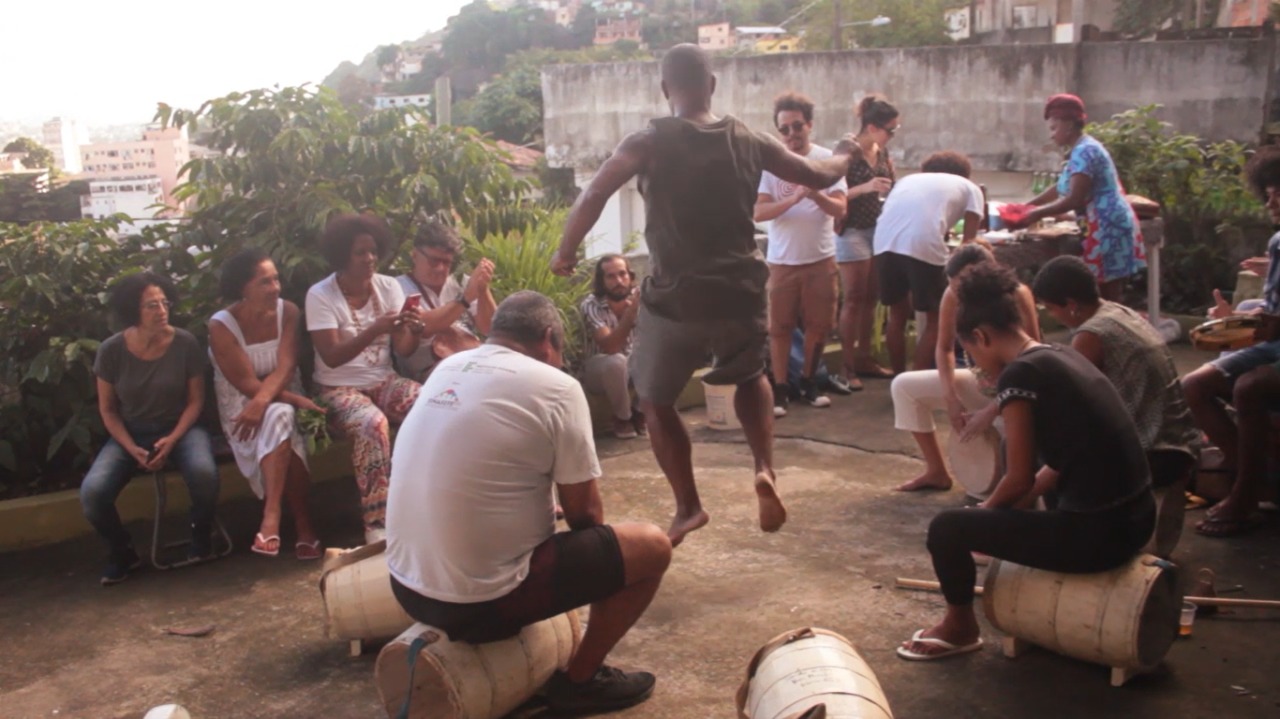
With no interest in a definitive answer, healing is a continuous act and a process of contradictions and superimpositions. Thus it is possible to compose a sequence that goes from the Brazilian flag (with its positivist motto, "Order and Progress") to the poster of the artist's exhibition that states "Trauma is Brazilian". And also compose a whole sequence that asks the viewer about what could be an image of a mermaid. Could it be the young black girl posing and dancing in front of the white and blonde mermaid painted on the wall? Is it the Indian deity picture on this woman's canga?4  More than an image, it is the superposition and the meeting between them.

The film sets up the healing process in time and space as repetition by inserting drawings in red on the black screen that divide the various blocks of the film and subvert the possibilities of understanding what can be the shortest distance between two points (not always a linear straight line). With the Pilgrimage of the Female Testicles through the center of the city of Vitória to the gallery of the exhibition “O trauma é brasileiro”,5 the artist undoes and remakes the meanings of territory and belonging. The Romaria is set against the images of the convent of Nossa Senhora da Penha, resituating the meanings of Catholic architecture over the city. Walking through the city, through Beira-mar Avenue, can also be part of a healing process.

Vitorino Brasileiro's body and the bodies that the artist finds as belonging in the film (human and more-than-human) are ultimately space, time, and healing. The film is not the end, but the very process of remembering, listening, and sometimes seeing.

#See-Unsee-Listen

To the sound of the drumming of the Caboclo Sete Estrelas do Mar Spiritist Center, Vitorino Brasileiro conjures their spell: Eu agora vou falar para todas as moças. Eu agora vou bater, para todas as moças. Para todas as travestis, para todas elas. Eu agora vou fazer macumba para todas as bixas. Para todos os testículos femininos, para todas elas,”6 in Para todas as moças (2019). Guided by her singing, the images follow one another in a montage of rhythm and multiple textures: the heat of the healing room - with candles, stones, shells, and various objects of macumba -, a bluish and shaky recording made with a cell phone in front of the Penedo rock in the bay of Vitória/ES, and an official NASA footage of the Earth seen from space. Thus, between the hot, the cold, and the neutral institutionality are conjured the film-macumba-spell to break colonial vessels.

Thinking about the audiovisual incursions of  Vitorino Brasileiro - an artist, candomblé practitioner and psychologist - is to simultaneously face this gesture of landing on the ascent of the Fonte Grande hill, of sinking into the deep waters of the island of Vitória, and of banishing oneself (“afastar-se da Terra maldita, Terra que a assassina”)7- gestures that are as much embodied (by the performance) as they are immaterial (by maintaining the mystery).

In Para todas as moças, these gestures are transmutations that also destabilize the wandering movement of the camera through the inventory of objects (candle, bone, leaves, stones) - once again in the exercise of a non-hierarchical or anthropocentric audiovisual gaze. Objects, entities, beings, that are always more than can be seen/shown. Just as in Vitorino Brasileiro's performance by the sea, the cell phone camera images play with the appearing and hiding of their choreography - interrupted by a black mask that sometimes shows and sometimes hides what we can see.

Vitorino Brasileiro's creation reminds us that: seeing is not the same as perceiving. Visibility and opacity are not opposites. And listening to voices and sounds are precious portals for the perception of the invisible in the visible.

1. “What if I abandoned all of you?”

2. Mandinga could refer to magic spells, but also, in the context of Capoeira, to the ability of surprising one’s opponent with body movements.

3. "So, what is the cure for people of African descent?"

4. Canga is a piece of cloth commonly wrapped around the waist.

5.  'Trauma is Brazilian' is Castiel Vitorino Brasileiro’s first solo exhibition.

6. "Now I'm going to talk to all the girls. I am now going to hit, for all the girls. For all the transvestites, for all of them. I am now going to make macumba for all the sluts. For all the female testicles, for all of them,"

7.  "To go away from the cursed Earth, the Earth that murders her”

#Human-more-than-human-transmutation

In Uma noite sem lua (Castiel Vitorino Brasileiro, 2020) a voice asks us, “e se eu abandonasse todas vocês?”.1 Abandoning the binarism of polarization, the limit of the human, and anthropocentric separations are the challenges the film takes up. Undoing the idea of the human point of view as the camera's point of view, and merging varied positionalities to film living beings and entities - mixing ways of seeing (and being seen by) the sky, the sea, the earth, plants, animals, human and celestial bodies. Vitorino Brasileiro creates, thus on film, the desire to live the completeness of the hybrid, of the more than human. Their audiovisual creation calls for a perception of sensorial cinema in which the visible and the invisible, the said and the unsaid, overexposure and secrecy are not polarized counterpoints (shot and reverse shot, in-frame and out-of-frame), but are stakes in the invention of another regime of sensibility (hybrid, transhuman, more-than-human).

Vitorino Brasileiro's voice guides us through this uncertain journey of moving bodies, between love, fear, doubts, and pleasures. A voice punctuated by the repetitive strangeness of sounds and noises that run through the film. With more questions than statements, this voice modulates the sensations and possible ways to "dematerialize gender and race in the body," suggests the narration, using for that the unquestionable materiality of the film's images and sounds. There is a game, therefore, with a hyperbolized materiality, which superimposes and mixes textures and senses. Thus, in the dance at the end of the film, the drawings on the wall, the painting on the buttocks, the patterns of the bikini, and the skirt worn by Vitorino Brasileiro come together. Rolling and orbiting terrestrial and sidereal spaces in a non-hierarchical way, the artist announces theirself: "I am the messenger that announces the transvestite transmutation." A presentation that establishes the principles of their cinema.

Those principles seem to mirror Denise Ferreira da Silva's philosophical proposal to imagine "each existing thing (human and more-than-human) as singular expressions of every existing being and also of the all implied in what/how they exist" (A dívida Impagável, p. 43). In many moments of the film, the body (human and more-than-human) dances: singular, erratic, uncontrollable, and sublime. Head, arms, ass, and hands. The body is mandinga2 and transmutation, the artist tells us. The body is fish, turtle, sea plants, stone. Bodies slide at the bottom of the sea, float in the gale, and collide in the cosmos. They are transmuted.

# To (Un)forget-To Show-To Listen

One of the first images of the documentary Lembrar daquilo que esqueci (Castiel Vitorino Brasileiro, 2020) is a letter denouncing a crime against humanity addressed to the government of Espírito Santo for institutional and systemic racism by erasing the Bantu people in the constitution of the history and culture of the state. While we are reading the letter, an off-key voice asks us: “então qual é a cura para o povo afrodescendente?”.3 The question and the document synthesize the investigation of the film: to question what healing can be (through a series of off-screen statements) by creating images that are in themselves a spiritual and therapeutic process of healing. Images that are records of belonging and encounters: a capoeira circle, a celebration for Iemanjá, a youth choir performing in the street. In a junction of public moments, like those of the artist's exhibition, and intimate ones, such as hair being braided at home and the preparations for a birthday party.

With no interest in a definitive answer, healing is a continuous act and a process of contradictions and superimpositions. Thus it is possible to compose a sequence that goes from the Brazilian flag (with its positivist motto, "Order and Progress") to the poster of the artist's exhibition that states "Trauma is Brazilian". And also compose a whole sequence that asks the viewer about what could be an image of a mermaid. Could it be the young black girl posing and dancing in front of the white and blonde mermaid painted on the wall? Is it the Indian deity picture on this woman's canga?4  More than an image, it is the superposition and the meeting between them.

The film sets up the healing process in time and space as repetition by inserting drawings in red on the black screen that divide the various blocks of the film and subvert the possibilities of understanding what can be the shortest distance between two points (not always a linear straight line). With the Pilgrimage of the Female Testicles through the center of the city of Vitória to the gallery of the exhibition “O trauma é brasileiro”,5 the artist undoes and remakes the meanings of territory and belonging. The Romaria is set against the images of the convent of Nossa Senhora da Penha, resituating the meanings of Catholic architecture over the city. Walking through the city, through Beira-mar Avenue, can also be part of a healing process.

Vitorino Brasileiro's body and the bodies that the artist finds as belonging in the film (human and more-than-human) are ultimately space, time, and healing. The film is not the end, but the very process of remembering, listening, and sometimes seeing.

#See-Unsee-Listen

To the sound of the drumming of the Caboclo Sete Estrelas do Mar Spiritist Center, Vitorino Brasileiro conjures their spell: Eu agora vou falar para todas as moças. Eu agora vou bater, para todas as moças. Para todas as travestis, para todas elas. Eu agora vou fazer macumba para todas as bixas. Para todos os testículos femininos, para todas elas,”6 in Para todas as moças (2019). Guided by her singing, the images follow one another in a montage of rhythm and multiple textures: the heat of the healing room - with candles, stones, shells, and various objects of macumba -, a bluish and shaky recording made with a cell phone in front of the Penedo rock in the bay of Vitória/ES, and an official NASA footage of the Earth seen from space. Thus, between the hot, the cold, and the neutral institutionality are conjured the film-macumba-spell to break colonial vessels.

Thinking about the audiovisual incursions of  Vitorino Brasileiro - an artist, candomblé practitioner and psychologist - is to simultaneously face this gesture of landing on the ascent of the Fonte Grande hill, of sinking into the deep waters of the island of Vitória, and of banishing oneself (“afastar-se da Terra maldita, Terra que a assassina”)7- gestures that are as much embodied (by the performance) as they are immaterial (by maintaining the mystery).

In Para todas as moças, these gestures are transmutations that also destabilize the wandering movement of the camera through the inventory of objects (candle, bone, leaves, stones) - once again in the exercise of a non-hierarchical or anthropocentric audiovisual gaze. Objects, entities, beings, that are always more than can be seen/shown. Just as in Vitorino Brasileiro's performance by the sea, the cell phone camera images play with the appearing and hiding of their choreography - interrupted by a black mask that sometimes shows and sometimes hides what we can see.

Vitorino Brasileiro's creation reminds us that: seeing is not the same as perceiving. Visibility and opacity are not opposites. And listening to voices and sounds are precious portals for the perception of the invisible in the visible.

1. “What if I abandoned all of you?”

2. Mandinga could refer to magic spells, but also, in the context of Capoeira, to the ability of surprising one’s opponent with body movements.

3. "So, what is the cure for people of African descent?"

4. Canga is a piece of cloth commonly wrapped around the waist.

5.  'Trauma is Brazilian' is Castiel Vitorino Brasileiro’s first solo exhibition.

6. "Now I'm going to talk to all the girls. I am now going to hit, for all the girls. For all the transvestites, for all of them. I am now going to make macumba for all the sluts. For all the female testicles, for all of them,"

7.  "To go away from the cursed Earth, the Earth that murders her”

PT/ENG
PT/ENG
9/9/2021
By/Por:
Kênia Freitas

# Humano-Mais-que-humano-Transmutação

Em Uma noite sem lua (Castiel Vitorino Brasileiro, 2020) uma voz nos pergunta: “e se eu abandonasse todas vocês?”. Abandonar o binarismo da polarização, o limite do humano e as separações antropocêntricas são os desafios aos quais o filme se lança. Desfazendo a ideia de ponto de vista humano como ponto de vista da câmera, e mesclando posicionalidades variadas para filmar seres vivos e entidades - misturando formas de ver (e ser visto por) o céu, o mar, a terra, as plantas, os animais, os corpos humanos e celestes.  Vitorino Brasileiro cria, assim em filme, o desejo de viver a completude do híbrido, do mais que humano. A sua criação audiovisual convoca a uma percepção de cinema sensorial em que visível e invisível, dito e não dito, superexposição e segredo não são contrapontos polarizados (plano e contraplano, quadro e fora de quadro), mas sim apostas na invenção por um outro regime do sensível (híbrido, transhumano, mais-que-humano).

A voz de Vitorino Brasileiro nos guia por essa jornada incerta dos corpos em movimento, entre amor, medo, dúvidas e prazeres. Uma voz pontuada pela estranheza repetitiva de sons e ruídos que atravessam o filme. Com mais perguntas do que afirmações, essa voz modula as sensações e caminhos possíveis para “desmaterializar o gênero e a raça no corpo”, sugere a narração, usando para isso a materialidade inquestionável das imagens e sons do filme. Há um jogo, portanto, com uma materialidade hiperbolizada, que sobrepõe e mistura texturas e sentidos. Assim, na dança do final do filme juntam-se os desenhos da parede, a pintura na bunda, as estampas do biquíni e da saia vestidas por Vitorino Brasileiro. Rebolando e orbitando espaços terrestres e siderais de forma não hierarquizada, a artista se anuncia: “Eu sou a mensageira que anuncia a transmutação travesti”. Uma apresentação que estabelece os princípios do seu cinema.

Princípios que nos parecem especular com a proposta da filosofia de Denise Ferreira da Silva de imagear “cada coisa existente (humano e mais-que-humano) como expressões singulares de cada um dos outros existentes e também do tudo implicado em que/como elas existem” (A dívida Impagável, p. 43). Em muitos momentos do filme, o corpo (humano e mais-que-humano) dança: singular, errático, incontrolável e sublime. Cabeça, braços, bunda e mãos. O corpo é mandinga e transmutação, nos diz a artista. O corpo é peixe, tartaruga, plantas marinhas, pedra. Corpos deslizam no fundo do mar, flutuam na ventania e colidem no cosmos. Transmutam-se.

# (D)esquecer-Mostrar-Escutar

Uma das primeiras imagens do documentário Lembrar daquilo que esqueci (Castiel Vitorino Brasileiro, 2020) é a de uma carta denúncia de crime de Lesa a humanidade endereçada ao Governo do Espírito Santo por racismo institucional e sistêmico pelo apagamento dos Povos Bantus na constituição da história e da cultura do estado. Enquanto lemos a carta, uma voz em off nos pergunta: “então qual é a cura para o povo afrodescendente?”. A pergunta e o documento sintetizam a investigação do filme: questionar o que pode ser a cura (através de uma série de depoimentos também em off) articulando com um processo de criação de imagens que são em si um processo espiritual e terapêutico de cura. Imagens que são registros de pertencimento e encontros: uma roda de capoeira, uma celebração para Iemanjá, um coral de jovens que se apresenta na rua. Numa junção de momentos públicos, como as da exposição da artista, e de íntimos, o cabelo sendo trançado em casa e os preparativos para uma festa de aniversário.

Sem interesse em uma resposta fechada, a cura é ato e processo contínuo de contradições e sobreposições. Assim é possível compor uma sequência que vai da bandeira do Brasil (com o seu “Ordem e Progresso” positivista) ao cartaz da exposição da artista que afirma “O trauma é brasileiro”. E também compor toda uma sequência que nos questiona sobre o que pode ser uma imagem de sereia. Seria a jovem negra que posa e dança na frente da sereia branca e loira pintada no muro? Seria a divindade indiana na estampa da canga dessa mulher? Mais do que uma imagem, a sobreposição e o encontro entre elas.

O filme instaura o processo de cura no tempo e no espaço como repetição ao inserir desenhos em vermelho na tela preta que dividem os diversos blocos do filme e subvertem as possibilidades de entendimento do que pode ser a menor distância entre dois pontos (nem sempre uma reta linear). Com a Romaria dos Testículos Femininos pelo centro da cidade de Vitória até a galeria da exposição “O trauma é brasileiro”, a artista desfaz e refaz os significados do território e pertencimento. A Romaria é posta  em contraposição às imagens do convento de Nossa Senhora da Penha, ressituando os significados da arquitetura católica sobre a cidade. Andar a cidade, a avenida Beira-mar, pode ser também um processo de cura.

O corpo de Vitorino Brasileiro e os corpos que a artista encontra como pertencimento no filme (humanos e mais-que-humanos) são por fim espaço, tempo e cura. O filme não é o fim, mas o próprio processo de lembrar, escutar e, às vezes, ver.

#Ver-Desver-Ouvir

Ao som do batuque do Centro Espírita Caboclo Sete Estrelas do Mar, Vitorino Brasileiro conjura o seu feitiço : “Eu agora vou falar para todas as moças. Eu agora vou bater, para todas as moças. Para todas as travestis, para todas elas. Eu agora vou fazer macumba para todas as bixas. Para todos os testículos femininos, para todas elas”, em Para todas as moças (2019). Guiada por seu canto, as imagens se sucedem em uma montagem de ritmo e texturas múltiplas: o calor do quarto de cura - com velas, pedras, conchas e objetos diversos de macumba -, uma gravação azulada e tremida feita com celular em frente a pedra do Penedo, na baía de Vitória/ES, e uma filmagem oficial da NASA da Terra vista do espaço. Assim, entre o quente, o frio e a institucionalidade neutra é conjurado o filme-feitiço-macumba para quebrar as embarcações coloniais.

Pensar as incursões audiovisuais da artista, macumbeira e psicóloga é encarar simultaneamente esse gesto de aterrar-se na subida do morro da Fonte Grande, de afundar-se nas águas profundas da ilha de Vitória, e de desterrar-se (“afastar-se da Terra maldita, Terra que a assassina”) - gestos que são tão corporificados (pela performance), quanto imateriais (pela manutenção do mistério).

Em Para todas as moças, esses gestos são transmutações que desestabilizam também o mover errante da câmera pelo inventários de objetos (vela, osso, folhas, pedras) - mais uma vez no exercício de um olhar audiovisual não hierarquizante ou antropocêntrico. Objetos, entidades, seres, que são sempre mais do que se pode ver/mostrar. Assim como na performance de Vitorino Brasileiro a beira mar, as imagens da câmera de celular jogam com o aparecer e esconder-se da sua coreografia - entrecortada por uma máscara preta que ora mostra, ora esconde o que podemos ver.

A criação de Vitorino Brasileiro nos lembra que: ver não é o mesmo que enxergar. Visibilidade e opacidade não são opostos. E a escuta das vozes e sons são portais preciosos de percepção do invisível no visível.

# Humano-Mais-que-humano-Transmutação

Em Uma noite sem lua (Castiel Vitorino Brasileiro, 2020) uma voz nos pergunta: “e se eu abandonasse todas vocês?”. Abandonar o binarismo da polarização, o limite do humano e as separações antropocêntricas são os desafios aos quais o filme se lança. Desfazendo a ideia de ponto de vista humano como ponto de vista da câmera, e mesclando posicionalidades variadas para filmar seres vivos e entidades - misturando formas de ver (e ser visto por) o céu, o mar, a terra, as plantas, os animais, os corpos humanos e celestes.  Vitorino Brasileiro cria, assim em filme, o desejo de viver a completude do híbrido, do mais que humano. A sua criação audiovisual convoca a uma percepção de cinema sensorial em que visível e invisível, dito e não dito, superexposição e segredo não são contrapontos polarizados (plano e contraplano, quadro e fora de quadro), mas sim apostas na invenção por um outro regime do sensível (híbrido, transhumano, mais-que-humano).

A voz de Vitorino Brasileiro nos guia por essa jornada incerta dos corpos em movimento, entre amor, medo, dúvidas e prazeres. Uma voz pontuada pela estranheza repetitiva de sons e ruídos que atravessam o filme. Com mais perguntas do que afirmações, essa voz modula as sensações e caminhos possíveis para “desmaterializar o gênero e a raça no corpo”, sugere a narração, usando para isso a materialidade inquestionável das imagens e sons do filme. Há um jogo, portanto, com uma materialidade hiperbolizada, que sobrepõe e mistura texturas e sentidos. Assim, na dança do final do filme juntam-se os desenhos da parede, a pintura na bunda, as estampas do biquíni e da saia vestidas por Vitorino Brasileiro. Rebolando e orbitando espaços terrestres e siderais de forma não hierarquizada, a artista se anuncia: “Eu sou a mensageira que anuncia a transmutação travesti”. Uma apresentação que estabelece os princípios do seu cinema.

Princípios que nos parecem especular com a proposta da filosofia de Denise Ferreira da Silva de imagear “cada coisa existente (humano e mais-que-humano) como expressões singulares de cada um dos outros existentes e também do tudo implicado em que/como elas existem” (A dívida Impagável, p. 43). Em muitos momentos do filme, o corpo (humano e mais-que-humano) dança: singular, errático, incontrolável e sublime. Cabeça, braços, bunda e mãos. O corpo é mandinga e transmutação, nos diz a artista. O corpo é peixe, tartaruga, plantas marinhas, pedra. Corpos deslizam no fundo do mar, flutuam na ventania e colidem no cosmos. Transmutam-se.

# (D)esquecer-Mostrar-Escutar

Uma das primeiras imagens do documentário Lembrar daquilo que esqueci (Castiel Vitorino Brasileiro, 2020) é a de uma carta denúncia de crime de Lesa a humanidade endereçada ao Governo do Espírito Santo por racismo institucional e sistêmico pelo apagamento dos Povos Bantus na constituição da história e da cultura do estado. Enquanto lemos a carta, uma voz em off nos pergunta: “então qual é a cura para o povo afrodescendente?”. A pergunta e o documento sintetizam a investigação do filme: questionar o que pode ser a cura (através de uma série de depoimentos também em off) articulando com um processo de criação de imagens que são em si um processo espiritual e terapêutico de cura. Imagens que são registros de pertencimento e encontros: uma roda de capoeira, uma celebração para Iemanjá, um coral de jovens que se apresenta na rua. Numa junção de momentos públicos, como as da exposição da artista, e de íntimos, o cabelo sendo trançado em casa e os preparativos para uma festa de aniversário.

Sem interesse em uma resposta fechada, a cura é ato e processo contínuo de contradições e sobreposições. Assim é possível compor uma sequência que vai da bandeira do Brasil (com o seu “Ordem e Progresso” positivista) ao cartaz da exposição da artista que afirma “O trauma é brasileiro”. E também compor toda uma sequência que nos questiona sobre o que pode ser uma imagem de sereia. Seria a jovem negra que posa e dança na frente da sereia branca e loira pintada no muro? Seria a divindade indiana na estampa da canga dessa mulher? Mais do que uma imagem, a sobreposição e o encontro entre elas.

O filme instaura o processo de cura no tempo e no espaço como repetição ao inserir desenhos em vermelho na tela preta que dividem os diversos blocos do filme e subvertem as possibilidades de entendimento do que pode ser a menor distância entre dois pontos (nem sempre uma reta linear). Com a Romaria dos Testículos Femininos pelo centro da cidade de Vitória até a galeria da exposição “O trauma é brasileiro”, a artista desfaz e refaz os significados do território e pertencimento. A Romaria é posta  em contraposição às imagens do convento de Nossa Senhora da Penha, ressituando os significados da arquitetura católica sobre a cidade. Andar a cidade, a avenida Beira-mar, pode ser também um processo de cura.

O corpo de Vitorino Brasileiro e os corpos que a artista encontra como pertencimento no filme (humanos e mais-que-humanos) são por fim espaço, tempo e cura. O filme não é o fim, mas o próprio processo de lembrar, escutar e, às vezes, ver.

#Ver-Desver-Ouvir

Ao som do batuque do Centro Espírita Caboclo Sete Estrelas do Mar, Vitorino Brasileiro conjura o seu feitiço : “Eu agora vou falar para todas as moças. Eu agora vou bater, para todas as moças. Para todas as travestis, para todas elas. Eu agora vou fazer macumba para todas as bixas. Para todos os testículos femininos, para todas elas”, em Para todas as moças (2019). Guiada por seu canto, as imagens se sucedem em uma montagem de ritmo e texturas múltiplas: o calor do quarto de cura - com velas, pedras, conchas e objetos diversos de macumba -, uma gravação azulada e tremida feita com celular em frente a pedra do Penedo, na baía de Vitória/ES, e uma filmagem oficial da NASA da Terra vista do espaço. Assim, entre o quente, o frio e a institucionalidade neutra é conjurado o filme-feitiço-macumba para quebrar as embarcações coloniais.

Pensar as incursões audiovisuais da artista, macumbeira e psicóloga é encarar simultaneamente esse gesto de aterrar-se na subida do morro da Fonte Grande, de afundar-se nas águas profundas da ilha de Vitória, e de desterrar-se (“afastar-se da Terra maldita, Terra que a assassina”) - gestos que são tão corporificados (pela performance), quanto imateriais (pela manutenção do mistério).

Em Para todas as moças, esses gestos são transmutações que desestabilizam também o mover errante da câmera pelo inventários de objetos (vela, osso, folhas, pedras) - mais uma vez no exercício de um olhar audiovisual não hierarquizante ou antropocêntrico. Objetos, entidades, seres, que são sempre mais do que se pode ver/mostrar. Assim como na performance de Vitorino Brasileiro a beira mar, as imagens da câmera de celular jogam com o aparecer e esconder-se da sua coreografia - entrecortada por uma máscara preta que ora mostra, ora esconde o que podemos ver.

A criação de Vitorino Brasileiro nos lembra que: ver não é o mesmo que enxergar. Visibilidade e opacidade não são opostos. E a escuta das vozes e sons são portais preciosos de percepção do invisível no visível.

#Human-more-than-human-transmutation

In Uma noite sem lua (Castiel Vitorino Brasileiro, 2020) a voice asks us, “e se eu abandonasse todas vocês?”.1 Abandoning the binarism of polarization, the limit of the human, and anthropocentric separations are the challenges the film takes up. Undoing the idea of the human point of view as the camera's point of view, and merging varied positionalities to film living beings and entities - mixing ways of seeing (and being seen by) the sky, the sea, the earth, plants, animals, human and celestial bodies. Vitorino Brasileiro creates, thus on film, the desire to live the completeness of the hybrid, of the more than human. Their audiovisual creation calls for a perception of sensorial cinema in which the visible and the invisible, the said and the unsaid, overexposure and secrecy are not polarized counterpoints (shot and reverse shot, in-frame and out-of-frame), but are stakes in the invention of another regime of sensibility (hybrid, transhuman, more-than-human).

Vitorino Brasileiro's voice guides us through this uncertain journey of moving bodies, between love, fear, doubts, and pleasures. A voice punctuated by the repetitive strangeness of sounds and noises that run through the film. With more questions than statements, this voice modulates the sensations and possible ways to "dematerialize gender and race in the body," suggests the narration, using for that the unquestionable materiality of the film's images and sounds. There is a game, therefore, with a hyperbolized materiality, which superimposes and mixes textures and senses. Thus, in the dance at the end of the film, the drawings on the wall, the painting on the buttocks, the patterns of the bikini, and the skirt worn by Vitorino Brasileiro come together. Rolling and orbiting terrestrial and sidereal spaces in a non-hierarchical way, the artist announces theirself: "I am the messenger that announces the transvestite transmutation." A presentation that establishes the principles of their cinema.

Those principles seem to mirror Denise Ferreira da Silva's philosophical proposal to imagine "each existing thing (human and more-than-human) as singular expressions of every existing being and also of the all implied in what/how they exist" (A dívida Impagável, p. 43). In many moments of the film, the body (human and more-than-human) dances: singular, erratic, uncontrollable, and sublime. Head, arms, ass, and hands. The body is mandinga2 and transmutation, the artist tells us. The body is fish, turtle, sea plants, stone. Bodies slide at the bottom of the sea, float in the gale, and collide in the cosmos. They are transmuted.

# To (Un)forget-To Show-To Listen

One of the first images of the documentary Lembrar daquilo que esqueci (Castiel Vitorino Brasileiro, 2020) is a letter denouncing a crime against humanity addressed to the government of Espírito Santo for institutional and systemic racism by erasing the Bantu people in the constitution of the history and culture of the state. While we are reading the letter, an off-key voice asks us: “então qual é a cura para o povo afrodescendente?”.3 The question and the document synthesize the investigation of the film: to question what healing can be (through a series of off-screen statements) by creating images that are in themselves a spiritual and therapeutic process of healing. Images that are records of belonging and encounters: a capoeira circle, a celebration for Iemanjá, a youth choir performing in the street. In a junction of public moments, like those of the artist's exhibition, and intimate ones, such as hair being braided at home and the preparations for a birthday party.

With no interest in a definitive answer, healing is a continuous act and a process of contradictions and superimpositions. Thus it is possible to compose a sequence that goes from the Brazilian flag (with its positivist motto, "Order and Progress") to the poster of the artist's exhibition that states "Trauma is Brazilian". And also compose a whole sequence that asks the viewer about what could be an image of a mermaid. Could it be the young black girl posing and dancing in front of the white and blonde mermaid painted on the wall? Is it the Indian deity picture on this woman's canga?4  More than an image, it is the superposition and the meeting between them.

The film sets up the healing process in time and space as repetition by inserting drawings in red on the black screen that divide the various blocks of the film and subvert the possibilities of understanding what can be the shortest distance between two points (not always a linear straight line). With the Pilgrimage of the Female Testicles through the center of the city of Vitória to the gallery of the exhibition “O trauma é brasileiro”,5 the artist undoes and remakes the meanings of territory and belonging. The Romaria is set against the images of the convent of Nossa Senhora da Penha, resituating the meanings of Catholic architecture over the city. Walking through the city, through Beira-mar Avenue, can also be part of a healing process.

Vitorino Brasileiro's body and the bodies that the artist finds as belonging in the film (human and more-than-human) are ultimately space, time, and healing. The film is not the end, but the very process of remembering, listening, and sometimes seeing.

#See-Unsee-Listen

To the sound of the drumming of the Caboclo Sete Estrelas do Mar Spiritist Center, Vitorino Brasileiro conjures their spell: Eu agora vou falar para todas as moças. Eu agora vou bater, para todas as moças. Para todas as travestis, para todas elas. Eu agora vou fazer macumba para todas as bixas. Para todos os testículos femininos, para todas elas,”6 in Para todas as moças (2019). Guided by her singing, the images follow one another in a montage of rhythm and multiple textures: the heat of the healing room - with candles, stones, shells, and various objects of macumba -, a bluish and shaky recording made with a cell phone in front of the Penedo rock in the bay of Vitória/ES, and an official NASA footage of the Earth seen from space. Thus, between the hot, the cold, and the neutral institutionality are conjured the film-macumba-spell to break colonial vessels.

Thinking about the audiovisual incursions of  Vitorino Brasileiro - an artist, candomblé practitioner and psychologist - is to simultaneously face this gesture of landing on the ascent of the Fonte Grande hill, of sinking into the deep waters of the island of Vitória, and of banishing oneself (“afastar-se da Terra maldita, Terra que a assassina”)7- gestures that are as much embodied (by the performance) as they are immaterial (by maintaining the mystery).

In Para todas as moças, these gestures are transmutations that also destabilize the wandering movement of the camera through the inventory of objects (candle, bone, leaves, stones) - once again in the exercise of a non-hierarchical or anthropocentric audiovisual gaze. Objects, entities, beings, that are always more than can be seen/shown. Just as in Vitorino Brasileiro's performance by the sea, the cell phone camera images play with the appearing and hiding of their choreography - interrupted by a black mask that sometimes shows and sometimes hides what we can see.

Vitorino Brasileiro's creation reminds us that: seeing is not the same as perceiving. Visibility and opacity are not opposites. And listening to voices and sounds are precious portals for the perception of the invisible in the visible.

1. “What if I abandoned all of you?”

2. Mandinga could refer to magic spells, but also, in the context of Capoeira, to the ability of surprising one’s opponent with body movements.

3. "So, what is the cure for people of African descent?"

4. Canga is a piece of cloth commonly wrapped around the waist.

5.  'Trauma is Brazilian' is Castiel Vitorino Brasileiro’s first solo exhibition.

6. "Now I'm going to talk to all the girls. I am now going to hit, for all the girls. For all the transvestites, for all of them. I am now going to make macumba for all the sluts. For all the female testicles, for all of them,"

7.  "To go away from the cursed Earth, the Earth that murders her”

#Human-more-than-human-transmutation

In Uma noite sem lua (Castiel Vitorino Brasileiro, 2020) a voice asks us, “e se eu abandonasse todas vocês?”.1 Abandoning the binarism of polarization, the limit of the human, and anthropocentric separations are the challenges the film takes up. Undoing the idea of the human point of view as the camera's point of view, and merging varied positionalities to film living beings and entities - mixing ways of seeing (and being seen by) the sky, the sea, the earth, plants, animals, human and celestial bodies. Vitorino Brasileiro creates, thus on film, the desire to live the completeness of the hybrid, of the more than human. Their audiovisual creation calls for a perception of sensorial cinema in which the visible and the invisible, the said and the unsaid, overexposure and secrecy are not polarized counterpoints (shot and reverse shot, in-frame and out-of-frame), but are stakes in the invention of another regime of sensibility (hybrid, transhuman, more-than-human).

Vitorino Brasileiro's voice guides us through this uncertain journey of moving bodies, between love, fear, doubts, and pleasures. A voice punctuated by the repetitive strangeness of sounds and noises that run through the film. With more questions than statements, this voice modulates the sensations and possible ways to "dematerialize gender and race in the body," suggests the narration, using for that the unquestionable materiality of the film's images and sounds. There is a game, therefore, with a hyperbolized materiality, which superimposes and mixes textures and senses. Thus, in the dance at the end of the film, the drawings on the wall, the painting on the buttocks, the patterns of the bikini, and the skirt worn by Vitorino Brasileiro come together. Rolling and orbiting terrestrial and sidereal spaces in a non-hierarchical way, the artist announces theirself: "I am the messenger that announces the transvestite transmutation." A presentation that establishes the principles of their cinema.

Those principles seem to mirror Denise Ferreira da Silva's philosophical proposal to imagine "each existing thing (human and more-than-human) as singular expressions of every existing being and also of the all implied in what/how they exist" (A dívida Impagável, p. 43). In many moments of the film, the body (human and more-than-human) dances: singular, erratic, uncontrollable, and sublime. Head, arms, ass, and hands. The body is mandinga2 and transmutation, the artist tells us. The body is fish, turtle, sea plants, stone. Bodies slide at the bottom of the sea, float in the gale, and collide in the cosmos. They are transmuted.

# To (Un)forget-To Show-To Listen

One of the first images of the documentary Lembrar daquilo que esqueci (Castiel Vitorino Brasileiro, 2020) is a letter denouncing a crime against humanity addressed to the government of Espírito Santo for institutional and systemic racism by erasing the Bantu people in the constitution of the history and culture of the state. While we are reading the letter, an off-key voice asks us: “então qual é a cura para o povo afrodescendente?”.3 The question and the document synthesize the investigation of the film: to question what healing can be (through a series of off-screen statements) by creating images that are in themselves a spiritual and therapeutic process of healing. Images that are records of belonging and encounters: a capoeira circle, a celebration for Iemanjá, a youth choir performing in the street. In a junction of public moments, like those of the artist's exhibition, and intimate ones, such as hair being braided at home and the preparations for a birthday party.

With no interest in a definitive answer, healing is a continuous act and a process of contradictions and superimpositions. Thus it is possible to compose a sequence that goes from the Brazilian flag (with its positivist motto, "Order and Progress") to the poster of the artist's exhibition that states "Trauma is Brazilian". And also compose a whole sequence that asks the viewer about what could be an image of a mermaid. Could it be the young black girl posing and dancing in front of the white and blonde mermaid painted on the wall? Is it the Indian deity picture on this woman's canga?4  More than an image, it is the superposition and the meeting between them.

The film sets up the healing process in time and space as repetition by inserting drawings in red on the black screen that divide the various blocks of the film and subvert the possibilities of understanding what can be the shortest distance between two points (not always a linear straight line). With the Pilgrimage of the Female Testicles through the center of the city of Vitória to the gallery of the exhibition “O trauma é brasileiro”,5 the artist undoes and remakes the meanings of territory and belonging. The Romaria is set against the images of the convent of Nossa Senhora da Penha, resituating the meanings of Catholic architecture over the city. Walking through the city, through Beira-mar Avenue, can also be part of a healing process.

Vitorino Brasileiro's body and the bodies that the artist finds as belonging in the film (human and more-than-human) are ultimately space, time, and healing. The film is not the end, but the very process of remembering, listening, and sometimes seeing.

#See-Unsee-Listen

To the sound of the drumming of the Caboclo Sete Estrelas do Mar Spiritist Center, Vitorino Brasileiro conjures their spell: Eu agora vou falar para todas as moças. Eu agora vou bater, para todas as moças. Para todas as travestis, para todas elas. Eu agora vou fazer macumba para todas as bixas. Para todos os testículos femininos, para todas elas,”6 in Para todas as moças (2019). Guided by her singing, the images follow one another in a montage of rhythm and multiple textures: the heat of the healing room - with candles, stones, shells, and various objects of macumba -, a bluish and shaky recording made with a cell phone in front of the Penedo rock in the bay of Vitória/ES, and an official NASA footage of the Earth seen from space. Thus, between the hot, the cold, and the neutral institutionality are conjured the film-macumba-spell to break colonial vessels.

Thinking about the audiovisual incursions of  Vitorino Brasileiro - an artist, candomblé practitioner and psychologist - is to simultaneously face this gesture of landing on the ascent of the Fonte Grande hill, of sinking into the deep waters of the island of Vitória, and of banishing oneself (“afastar-se da Terra maldita, Terra que a assassina”)7- gestures that are as much embodied (by the performance) as they are immaterial (by maintaining the mystery).

In Para todas as moças, these gestures are transmutations that also destabilize the wandering movement of the camera through the inventory of objects (candle, bone, leaves, stones) - once again in the exercise of a non-hierarchical or anthropocentric audiovisual gaze. Objects, entities, beings, that are always more than can be seen/shown. Just as in Vitorino Brasileiro's performance by the sea, the cell phone camera images play with the appearing and hiding of their choreography - interrupted by a black mask that sometimes shows and sometimes hides what we can see.

Vitorino Brasileiro's creation reminds us that: seeing is not the same as perceiving. Visibility and opacity are not opposites. And listening to voices and sounds are precious portals for the perception of the invisible in the visible.

1. “What if I abandoned all of you?”

2. Mandinga could refer to magic spells, but also, in the context of Capoeira, to the ability of surprising one’s opponent with body movements.

3. "So, what is the cure for people of African descent?"

4. Canga is a piece of cloth commonly wrapped around the waist.

5.  'Trauma is Brazilian' is Castiel Vitorino Brasileiro’s first solo exhibition.

6. "Now I'm going to talk to all the girls. I am now going to hit, for all the girls. For all the transvestites, for all of them. I am now going to make macumba for all the sluts. For all the female testicles, for all of them,"

7.  "To go away from the cursed Earth, the Earth that murders her”

PT/ENG
PT/ENG
9/9/2021
By/Por:
Kênia Freitas

# Humano-Mais-que-humano-Transmutação

Em Uma noite sem lua (Castiel Vitorino Brasileiro, 2020) uma voz nos pergunta: “e se eu abandonasse todas vocês?”. Abandonar o binarismo da polarização, o limite do humano e as separações antropocêntricas são os desafios aos quais o filme se lança. Desfazendo a ideia de ponto de vista humano como ponto de vista da câmera, e mesclando posicionalidades variadas para filmar seres vivos e entidades - misturando formas de ver (e ser visto por) o céu, o mar, a terra, as plantas, os animais, os corpos humanos e celestes.  Vitorino Brasileiro cria, assim em filme, o desejo de viver a completude do híbrido, do mais que humano. A sua criação audiovisual convoca a uma percepção de cinema sensorial em que visível e invisível, dito e não dito, superexposição e segredo não são contrapontos polarizados (plano e contraplano, quadro e fora de quadro), mas sim apostas na invenção por um outro regime do sensível (híbrido, transhumano, mais-que-humano).

A voz de Vitorino Brasileiro nos guia por essa jornada incerta dos corpos em movimento, entre amor, medo, dúvidas e prazeres. Uma voz pontuada pela estranheza repetitiva de sons e ruídos que atravessam o filme. Com mais perguntas do que afirmações, essa voz modula as sensações e caminhos possíveis para “desmaterializar o gênero e a raça no corpo”, sugere a narração, usando para isso a materialidade inquestionável das imagens e sons do filme. Há um jogo, portanto, com uma materialidade hiperbolizada, que sobrepõe e mistura texturas e sentidos. Assim, na dança do final do filme juntam-se os desenhos da parede, a pintura na bunda, as estampas do biquíni e da saia vestidas por Vitorino Brasileiro. Rebolando e orbitando espaços terrestres e siderais de forma não hierarquizada, a artista se anuncia: “Eu sou a mensageira que anuncia a transmutação travesti”. Uma apresentação que estabelece os princípios do seu cinema.

Princípios que nos parecem especular com a proposta da filosofia de Denise Ferreira da Silva de imagear “cada coisa existente (humano e mais-que-humano) como expressões singulares de cada um dos outros existentes e também do tudo implicado em que/como elas existem” (A dívida Impagável, p. 43). Em muitos momentos do filme, o corpo (humano e mais-que-humano) dança: singular, errático, incontrolável e sublime. Cabeça, braços, bunda e mãos. O corpo é mandinga e transmutação, nos diz a artista. O corpo é peixe, tartaruga, plantas marinhas, pedra. Corpos deslizam no fundo do mar, flutuam na ventania e colidem no cosmos. Transmutam-se.

# (D)esquecer-Mostrar-Escutar

Uma das primeiras imagens do documentário Lembrar daquilo que esqueci (Castiel Vitorino Brasileiro, 2020) é a de uma carta denúncia de crime de Lesa a humanidade endereçada ao Governo do Espírito Santo por racismo institucional e sistêmico pelo apagamento dos Povos Bantus na constituição da história e da cultura do estado. Enquanto lemos a carta, uma voz em off nos pergunta: “então qual é a cura para o povo afrodescendente?”. A pergunta e o documento sintetizam a investigação do filme: questionar o que pode ser a cura (através de uma série de depoimentos também em off) articulando com um processo de criação de imagens que são em si um processo espiritual e terapêutico de cura. Imagens que são registros de pertencimento e encontros: uma roda de capoeira, uma celebração para Iemanjá, um coral de jovens que se apresenta na rua. Numa junção de momentos públicos, como as da exposição da artista, e de íntimos, o cabelo sendo trançado em casa e os preparativos para uma festa de aniversário.

Sem interesse em uma resposta fechada, a cura é ato e processo contínuo de contradições e sobreposições. Assim é possível compor uma sequência que vai da bandeira do Brasil (com o seu “Ordem e Progresso” positivista) ao cartaz da exposição da artista que afirma “O trauma é brasileiro”. E também compor toda uma sequência que nos questiona sobre o que pode ser uma imagem de sereia. Seria a jovem negra que posa e dança na frente da sereia branca e loira pintada no muro? Seria a divindade indiana na estampa da canga dessa mulher? Mais do que uma imagem, a sobreposição e o encontro entre elas.

O filme instaura o processo de cura no tempo e no espaço como repetição ao inserir desenhos em vermelho na tela preta que dividem os diversos blocos do filme e subvertem as possibilidades de entendimento do que pode ser a menor distância entre dois pontos (nem sempre uma reta linear). Com a Romaria dos Testículos Femininos pelo centro da cidade de Vitória até a galeria da exposição “O trauma é brasileiro”, a artista desfaz e refaz os significados do território e pertencimento. A Romaria é posta  em contraposição às imagens do convento de Nossa Senhora da Penha, ressituando os significados da arquitetura católica sobre a cidade. Andar a cidade, a avenida Beira-mar, pode ser também um processo de cura.

O corpo de Vitorino Brasileiro e os corpos que a artista encontra como pertencimento no filme (humanos e mais-que-humanos) são por fim espaço, tempo e cura. O filme não é o fim, mas o próprio processo de lembrar, escutar e, às vezes, ver.

#Ver-Desver-Ouvir

Ao som do batuque do Centro Espírita Caboclo Sete Estrelas do Mar, Vitorino Brasileiro conjura o seu feitiço : “Eu agora vou falar para todas as moças. Eu agora vou bater, para todas as moças. Para todas as travestis, para todas elas. Eu agora vou fazer macumba para todas as bixas. Para todos os testículos femininos, para todas elas”, em Para todas as moças (2019). Guiada por seu canto, as imagens se sucedem em uma montagem de ritmo e texturas múltiplas: o calor do quarto de cura - com velas, pedras, conchas e objetos diversos de macumba -, uma gravação azulada e tremida feita com celular em frente a pedra do Penedo, na baía de Vitória/ES, e uma filmagem oficial da NASA da Terra vista do espaço. Assim, entre o quente, o frio e a institucionalidade neutra é conjurado o filme-feitiço-macumba para quebrar as embarcações coloniais.

Pensar as incursões audiovisuais da artista, macumbeira e psicóloga é encarar simultaneamente esse gesto de aterrar-se na subida do morro da Fonte Grande, de afundar-se nas águas profundas da ilha de Vitória, e de desterrar-se (“afastar-se da Terra maldita, Terra que a assassina”) - gestos que são tão corporificados (pela performance), quanto imateriais (pela manutenção do mistério).

Em Para todas as moças, esses gestos são transmutações que desestabilizam também o mover errante da câmera pelo inventários de objetos (vela, osso, folhas, pedras) - mais uma vez no exercício de um olhar audiovisual não hierarquizante ou antropocêntrico. Objetos, entidades, seres, que são sempre mais do que se pode ver/mostrar. Assim como na performance de Vitorino Brasileiro a beira mar, as imagens da câmera de celular jogam com o aparecer e esconder-se da sua coreografia - entrecortada por uma máscara preta que ora mostra, ora esconde o que podemos ver.

A criação de Vitorino Brasileiro nos lembra que: ver não é o mesmo que enxergar. Visibilidade e opacidade não são opostos. E a escuta das vozes e sons são portais preciosos de percepção do invisível no visível.

# Humano-Mais-que-humano-Transmutação

Em Uma noite sem lua (Castiel Vitorino Brasileiro, 2020) uma voz nos pergunta: “e se eu abandonasse todas vocês?”. Abandonar o binarismo da polarização, o limite do humano e as separações antropocêntricas são os desafios aos quais o filme se lança. Desfazendo a ideia de ponto de vista humano como ponto de vista da câmera, e mesclando posicionalidades variadas para filmar seres vivos e entidades - misturando formas de ver (e ser visto por) o céu, o mar, a terra, as plantas, os animais, os corpos humanos e celestes.  Vitorino Brasileiro cria, assim em filme, o desejo de viver a completude do híbrido, do mais que humano. A sua criação audiovisual convoca a uma percepção de cinema sensorial em que visível e invisível, dito e não dito, superexposição e segredo não são contrapontos polarizados (plano e contraplano, quadro e fora de quadro), mas sim apostas na invenção por um outro regime do sensível (híbrido, transhumano, mais-que-humano).

A voz de Vitorino Brasileiro nos guia por essa jornada incerta dos corpos em movimento, entre amor, medo, dúvidas e prazeres. Uma voz pontuada pela estranheza repetitiva de sons e ruídos que atravessam o filme. Com mais perguntas do que afirmações, essa voz modula as sensações e caminhos possíveis para “desmaterializar o gênero e a raça no corpo”, sugere a narração, usando para isso a materialidade inquestionável das imagens e sons do filme. Há um jogo, portanto, com uma materialidade hiperbolizada, que sobrepõe e mistura texturas e sentidos. Assim, na dança do final do filme juntam-se os desenhos da parede, a pintura na bunda, as estampas do biquíni e da saia vestidas por Vitorino Brasileiro. Rebolando e orbitando espaços terrestres e siderais de forma não hierarquizada, a artista se anuncia: “Eu sou a mensageira que anuncia a transmutação travesti”. Uma apresentação que estabelece os princípios do seu cinema.

Princípios que nos parecem especular com a proposta da filosofia de Denise Ferreira da Silva de imagear “cada coisa existente (humano e mais-que-humano) como expressões singulares de cada um dos outros existentes e também do tudo implicado em que/como elas existem” (A dívida Impagável, p. 43). Em muitos momentos do filme, o corpo (humano e mais-que-humano) dança: singular, errático, incontrolável e sublime. Cabeça, braços, bunda e mãos. O corpo é mandinga e transmutação, nos diz a artista. O corpo é peixe, tartaruga, plantas marinhas, pedra. Corpos deslizam no fundo do mar, flutuam na ventania e colidem no cosmos. Transmutam-se.

# (D)esquecer-Mostrar-Escutar

Uma das primeiras imagens do documentário Lembrar daquilo que esqueci (Castiel Vitorino Brasileiro, 2020) é a de uma carta denúncia de crime de Lesa a humanidade endereçada ao Governo do Espírito Santo por racismo institucional e sistêmico pelo apagamento dos Povos Bantus na constituição da história e da cultura do estado. Enquanto lemos a carta, uma voz em off nos pergunta: “então qual é a cura para o povo afrodescendente?”. A pergunta e o documento sintetizam a investigação do filme: questionar o que pode ser a cura (através de uma série de depoimentos também em off) articulando com um processo de criação de imagens que são em si um processo espiritual e terapêutico de cura. Imagens que são registros de pertencimento e encontros: uma roda de capoeira, uma celebração para Iemanjá, um coral de jovens que se apresenta na rua. Numa junção de momentos públicos, como as da exposição da artista, e de íntimos, o cabelo sendo trançado em casa e os preparativos para uma festa de aniversário.

Sem interesse em uma resposta fechada, a cura é ato e processo contínuo de contradições e sobreposições. Assim é possível compor uma sequência que vai da bandeira do Brasil (com o seu “Ordem e Progresso” positivista) ao cartaz da exposição da artista que afirma “O trauma é brasileiro”. E também compor toda uma sequência que nos questiona sobre o que pode ser uma imagem de sereia. Seria a jovem negra que posa e dança na frente da sereia branca e loira pintada no muro? Seria a divindade indiana na estampa da canga dessa mulher? Mais do que uma imagem, a sobreposição e o encontro entre elas.

O filme instaura o processo de cura no tempo e no espaço como repetição ao inserir desenhos em vermelho na tela preta que dividem os diversos blocos do filme e subvertem as possibilidades de entendimento do que pode ser a menor distância entre dois pontos (nem sempre uma reta linear). Com a Romaria dos Testículos Femininos pelo centro da cidade de Vitória até a galeria da exposição “O trauma é brasileiro”, a artista desfaz e refaz os significados do território e pertencimento. A Romaria é posta  em contraposição às imagens do convento de Nossa Senhora da Penha, ressituando os significados da arquitetura católica sobre a cidade. Andar a cidade, a avenida Beira-mar, pode ser também um processo de cura.

O corpo de Vitorino Brasileiro e os corpos que a artista encontra como pertencimento no filme (humanos e mais-que-humanos) são por fim espaço, tempo e cura. O filme não é o fim, mas o próprio processo de lembrar, escutar e, às vezes, ver.

#Ver-Desver-Ouvir

Ao som do batuque do Centro Espírita Caboclo Sete Estrelas do Mar, Vitorino Brasileiro conjura o seu feitiço : “Eu agora vou falar para todas as moças. Eu agora vou bater, para todas as moças. Para todas as travestis, para todas elas. Eu agora vou fazer macumba para todas as bixas. Para todos os testículos femininos, para todas elas”, em Para todas as moças (2019). Guiada por seu canto, as imagens se sucedem em uma montagem de ritmo e texturas múltiplas: o calor do quarto de cura - com velas, pedras, conchas e objetos diversos de macumba -, uma gravação azulada e tremida feita com celular em frente a pedra do Penedo, na baía de Vitória/ES, e uma filmagem oficial da NASA da Terra vista do espaço. Assim, entre o quente, o frio e a institucionalidade neutra é conjurado o filme-feitiço-macumba para quebrar as embarcações coloniais.

Pensar as incursões audiovisuais da artista, macumbeira e psicóloga é encarar simultaneamente esse gesto de aterrar-se na subida do morro da Fonte Grande, de afundar-se nas águas profundas da ilha de Vitória, e de desterrar-se (“afastar-se da Terra maldita, Terra que a assassina”) - gestos que são tão corporificados (pela performance), quanto imateriais (pela manutenção do mistério).

Em Para todas as moças, esses gestos são transmutações que desestabilizam também o mover errante da câmera pelo inventários de objetos (vela, osso, folhas, pedras) - mais uma vez no exercício de um olhar audiovisual não hierarquizante ou antropocêntrico. Objetos, entidades, seres, que são sempre mais do que se pode ver/mostrar. Assim como na performance de Vitorino Brasileiro a beira mar, as imagens da câmera de celular jogam com o aparecer e esconder-se da sua coreografia - entrecortada por uma máscara preta que ora mostra, ora esconde o que podemos ver.

A criação de Vitorino Brasileiro nos lembra que: ver não é o mesmo que enxergar. Visibilidade e opacidade não são opostos. E a escuta das vozes e sons são portais preciosos de percepção do invisível no visível.

#Human-more-than-human-transmutation

In Uma noite sem lua (Castiel Vitorino Brasileiro, 2020) a voice asks us, “e se eu abandonasse todas vocês?”.1 Abandoning the binarism of polarization, the limit of the human, and anthropocentric separations are the challenges the film takes up. Undoing the idea of the human point of view as the camera's point of view, and merging varied positionalities to film living beings and entities - mixing ways of seeing (and being seen by) the sky, the sea, the earth, plants, animals, human and celestial bodies. Vitorino Brasileiro creates, thus on film, the desire to live the completeness of the hybrid, of the more than human. Their audiovisual creation calls for a perception of sensorial cinema in which the visible and the invisible, the said and the unsaid, overexposure and secrecy are not polarized counterpoints (shot and reverse shot, in-frame and out-of-frame), but are stakes in the invention of another regime of sensibility (hybrid, transhuman, more-than-human).

Vitorino Brasileiro's voice guides us through this uncertain journey of moving bodies, between love, fear, doubts, and pleasures. A voice punctuated by the repetitive strangeness of sounds and noises that run through the film. With more questions than statements, this voice modulates the sensations and possible ways to "dematerialize gender and race in the body," suggests the narration, using for that the unquestionable materiality of the film's images and sounds. There is a game, therefore, with a hyperbolized materiality, which superimposes and mixes textures and senses. Thus, in the dance at the end of the film, the drawings on the wall, the painting on the buttocks, the patterns of the bikini, and the skirt worn by Vitorino Brasileiro come together. Rolling and orbiting terrestrial and sidereal spaces in a non-hierarchical way, the artist announces theirself: "I am the messenger that announces the transvestite transmutation." A presentation that establishes the principles of their cinema.

Those principles seem to mirror Denise Ferreira da Silva's philosophical proposal to imagine "each existing thing (human and more-than-human) as singular expressions of every existing being and also of the all implied in what/how they exist" (A dívida Impagável, p. 43). In many moments of the film, the body (human and more-than-human) dances: singular, erratic, uncontrollable, and sublime. Head, arms, ass, and hands. The body is mandinga2 and transmutation, the artist tells us. The body is fish, turtle, sea plants, stone. Bodies slide at the bottom of the sea, float in the gale, and collide in the cosmos. They are transmuted.

# To (Un)forget-To Show-To Listen

One of the first images of the documentary Lembrar daquilo que esqueci (Castiel Vitorino Brasileiro, 2020) is a letter denouncing a crime against humanity addressed to the government of Espírito Santo for institutional and systemic racism by erasing the Bantu people in the constitution of the history and culture of the state. While we are reading the letter, an off-key voice asks us: “então qual é a cura para o povo afrodescendente?”.3 The question and the document synthesize the investigation of the film: to question what healing can be (through a series of off-screen statements) by creating images that are in themselves a spiritual and therapeutic process of healing. Images that are records of belonging and encounters: a capoeira circle, a celebration for Iemanjá, a youth choir performing in the street. In a junction of public moments, like those of the artist's exhibition, and intimate ones, such as hair being braided at home and the preparations for a birthday party.

With no interest in a definitive answer, healing is a continuous act and a process of contradictions and superimpositions. Thus it is possible to compose a sequence that goes from the Brazilian flag (with its positivist motto, "Order and Progress") to the poster of the artist's exhibition that states "Trauma is Brazilian". And also compose a whole sequence that asks the viewer about what could be an image of a mermaid. Could it be the young black girl posing and dancing in front of the white and blonde mermaid painted on the wall? Is it the Indian deity picture on this woman's canga?4  More than an image, it is the superposition and the meeting between them.

The film sets up the healing process in time and space as repetition by inserting drawings in red on the black screen that divide the various blocks of the film and subvert the possibilities of understanding what can be the shortest distance between two points (not always a linear straight line). With the Pilgrimage of the Female Testicles through the center of the city of Vitória to the gallery of the exhibition “O trauma é brasileiro”,5 the artist undoes and remakes the meanings of territory and belonging. The Romaria is set against the images of the convent of Nossa Senhora da Penha, resituating the meanings of Catholic architecture over the city. Walking through the city, through Beira-mar Avenue, can also be part of a healing process.

Vitorino Brasileiro's body and the bodies that the artist finds as belonging in the film (human and more-than-human) are ultimately space, time, and healing. The film is not the end, but the very process of remembering, listening, and sometimes seeing.

#See-Unsee-Listen

To the sound of the drumming of the Caboclo Sete Estrelas do Mar Spiritist Center, Vitorino Brasileiro conjures their spell: Eu agora vou falar para todas as moças. Eu agora vou bater, para todas as moças. Para todas as travestis, para todas elas. Eu agora vou fazer macumba para todas as bixas. Para todos os testículos femininos, para todas elas,”6 in Para todas as moças (2019). Guided by her singing, the images follow one another in a montage of rhythm and multiple textures: the heat of the healing room - with candles, stones, shells, and various objects of macumba -, a bluish and shaky recording made with a cell phone in front of the Penedo rock in the bay of Vitória/ES, and an official NASA footage of the Earth seen from space. Thus, between the hot, the cold, and the neutral institutionality are conjured the film-macumba-spell to break colonial vessels.

Thinking about the audiovisual incursions of  Vitorino Brasileiro - an artist, candomblé practitioner and psychologist - is to simultaneously face this gesture of landing on the ascent of the Fonte Grande hill, of sinking into the deep waters of the island of Vitória, and of banishing oneself (“afastar-se da Terra maldita, Terra que a assassina”)7- gestures that are as much embodied (by the performance) as they are immaterial (by maintaining the mystery).

In Para todas as moças, these gestures are transmutations that also destabilize the wandering movement of the camera through the inventory of objects (candle, bone, leaves, stones) - once again in the exercise of a non-hierarchical or anthropocentric audiovisual gaze. Objects, entities, beings, that are always more than can be seen/shown. Just as in Vitorino Brasileiro's performance by the sea, the cell phone camera images play with the appearing and hiding of their choreography - interrupted by a black mask that sometimes shows and sometimes hides what we can see.

Vitorino Brasileiro's creation reminds us that: seeing is not the same as perceiving. Visibility and opacity are not opposites. And listening to voices and sounds are precious portals for the perception of the invisible in the visible.

1. “What if I abandoned all of you?”

2. Mandinga could refer to magic spells, but also, in the context of Capoeira, to the ability of surprising one’s opponent with body movements.

3. "So, what is the cure for people of African descent?"

4. Canga is a piece of cloth commonly wrapped around the waist.

5.  'Trauma is Brazilian' is Castiel Vitorino Brasileiro’s first solo exhibition.

6. "Now I'm going to talk to all the girls. I am now going to hit, for all the girls. For all the transvestites, for all of them. I am now going to make macumba for all the sluts. For all the female testicles, for all of them,"

7.  "To go away from the cursed Earth, the Earth that murders her”

#Human-more-than-human-transmutation

In Uma noite sem lua (Castiel Vitorino Brasileiro, 2020) a voice asks us, “e se eu abandonasse todas vocês?”.1 Abandoning the binarism of polarization, the limit of the human, and anthropocentric separations are the challenges the film takes up. Undoing the idea of the human point of view as the camera's point of view, and merging varied positionalities to film living beings and entities - mixing ways of seeing (and being seen by) the sky, the sea, the earth, plants, animals, human and celestial bodies. Vitorino Brasileiro creates, thus on film, the desire to live the completeness of the hybrid, of the more than human. Their audiovisual creation calls for a perception of sensorial cinema in which the visible and the invisible, the said and the unsaid, overexposure and secrecy are not polarized counterpoints (shot and reverse shot, in-frame and out-of-frame), but are stakes in the invention of another regime of sensibility (hybrid, transhuman, more-than-human).

Vitorino Brasileiro's voice guides us through this uncertain journey of moving bodies, between love, fear, doubts, and pleasures. A voice punctuated by the repetitive strangeness of sounds and noises that run through the film. With more questions than statements, this voice modulates the sensations and possible ways to "dematerialize gender and race in the body," suggests the narration, using for that the unquestionable materiality of the film's images and sounds. There is a game, therefore, with a hyperbolized materiality, which superimposes and mixes textures and senses. Thus, in the dance at the end of the film, the drawings on the wall, the painting on the buttocks, the patterns of the bikini, and the skirt worn by Vitorino Brasileiro come together. Rolling and orbiting terrestrial and sidereal spaces in a non-hierarchical way, the artist announces theirself: "I am the messenger that announces the transvestite transmutation." A presentation that establishes the principles of their cinema.

Those principles seem to mirror Denise Ferreira da Silva's philosophical proposal to imagine "each existing thing (human and more-than-human) as singular expressions of every existing being and also of the all implied in what/how they exist" (A dívida Impagável, p. 43). In many moments of the film, the body (human and more-than-human) dances: singular, erratic, uncontrollable, and sublime. Head, arms, ass, and hands. The body is mandinga2 and transmutation, the artist tells us. The body is fish, turtle, sea plants, stone. Bodies slide at the bottom of the sea, float in the gale, and collide in the cosmos. They are transmuted.

# To (Un)forget-To Show-To Listen

One of the first images of the documentary Lembrar daquilo que esqueci (Castiel Vitorino Brasileiro, 2020) is a letter denouncing a crime against humanity addressed to the government of Espírito Santo for institutional and systemic racism by erasing the Bantu people in the constitution of the history and culture of the state. While we are reading the letter, an off-key voice asks us: “então qual é a cura para o povo afrodescendente?”.3 The question and the document synthesize the investigation of the film: to question what healing can be (through a series of off-screen statements) by creating images that are in themselves a spiritual and therapeutic process of healing. Images that are records of belonging and encounters: a capoeira circle, a celebration for Iemanjá, a youth choir performing in the street. In a junction of public moments, like those of the artist's exhibition, and intimate ones, such as hair being braided at home and the preparations for a birthday party.

With no interest in a definitive answer, healing is a continuous act and a process of contradictions and superimpositions. Thus it is possible to compose a sequence that goes from the Brazilian flag (with its positivist motto, "Order and Progress") to the poster of the artist's exhibition that states "Trauma is Brazilian". And also compose a whole sequence that asks the viewer about what could be an image of a mermaid. Could it be the young black girl posing and dancing in front of the white and blonde mermaid painted on the wall? Is it the Indian deity picture on this woman's canga?4  More than an image, it is the superposition and the meeting between them.

The film sets up the healing process in time and space as repetition by inserting drawings in red on the black screen that divide the various blocks of the film and subvert the possibilities of understanding what can be the shortest distance between two points (not always a linear straight line). With the Pilgrimage of the Female Testicles through the center of the city of Vitória to the gallery of the exhibition “O trauma é brasileiro”,5 the artist undoes and remakes the meanings of territory and belonging. The Romaria is set against the images of the convent of Nossa Senhora da Penha, resituating the meanings of Catholic architecture over the city. Walking through the city, through Beira-mar Avenue, can also be part of a healing process.

Vitorino Brasileiro's body and the bodies that the artist finds as belonging in the film (human and more-than-human) are ultimately space, time, and healing. The film is not the end, but the very process of remembering, listening, and sometimes seeing.

#See-Unsee-Listen

To the sound of the drumming of the Caboclo Sete Estrelas do Mar Spiritist Center, Vitorino Brasileiro conjures their spell: Eu agora vou falar para todas as moças. Eu agora vou bater, para todas as moças. Para todas as travestis, para todas elas. Eu agora vou fazer macumba para todas as bixas. Para todos os testículos femininos, para todas elas,”6 in Para todas as moças (2019). Guided by her singing, the images follow one another in a montage of rhythm and multiple textures: the heat of the healing room - with candles, stones, shells, and various objects of macumba -, a bluish and shaky recording made with a cell phone in front of the Penedo rock in the bay of Vitória/ES, and an official NASA footage of the Earth seen from space. Thus, between the hot, the cold, and the neutral institutionality are conjured the film-macumba-spell to break colonial vessels.

Thinking about the audiovisual incursions of  Vitorino Brasileiro - an artist, candomblé practitioner and psychologist - is to simultaneously face this gesture of landing on the ascent of the Fonte Grande hill, of sinking into the deep waters of the island of Vitória, and of banishing oneself (“afastar-se da Terra maldita, Terra que a assassina”)7- gestures that are as much embodied (by the performance) as they are immaterial (by maintaining the mystery).

In Para todas as moças, these gestures are transmutations that also destabilize the wandering movement of the camera through the inventory of objects (candle, bone, leaves, stones) - once again in the exercise of a non-hierarchical or anthropocentric audiovisual gaze. Objects, entities, beings, that are always more than can be seen/shown. Just as in Vitorino Brasileiro's performance by the sea, the cell phone camera images play with the appearing and hiding of their choreography - interrupted by a black mask that sometimes shows and sometimes hides what we can see.

Vitorino Brasileiro's creation reminds us that: seeing is not the same as perceiving. Visibility and opacity are not opposites. And listening to voices and sounds are precious portals for the perception of the invisible in the visible.

1. “What if I abandoned all of you?”

2. Mandinga could refer to magic spells, but also, in the context of Capoeira, to the ability of surprising one’s opponent with body movements.

3. "So, what is the cure for people of African descent?"

4. Canga is a piece of cloth commonly wrapped around the waist.

5.  'Trauma is Brazilian' is Castiel Vitorino Brasileiro’s first solo exhibition.

6. "Now I'm going to talk to all the girls. I am now going to hit, for all the girls. For all the transvestites, for all of them. I am now going to make macumba for all the sluts. For all the female testicles, for all of them,"

7.  "To go away from the cursed Earth, the Earth that murders her”