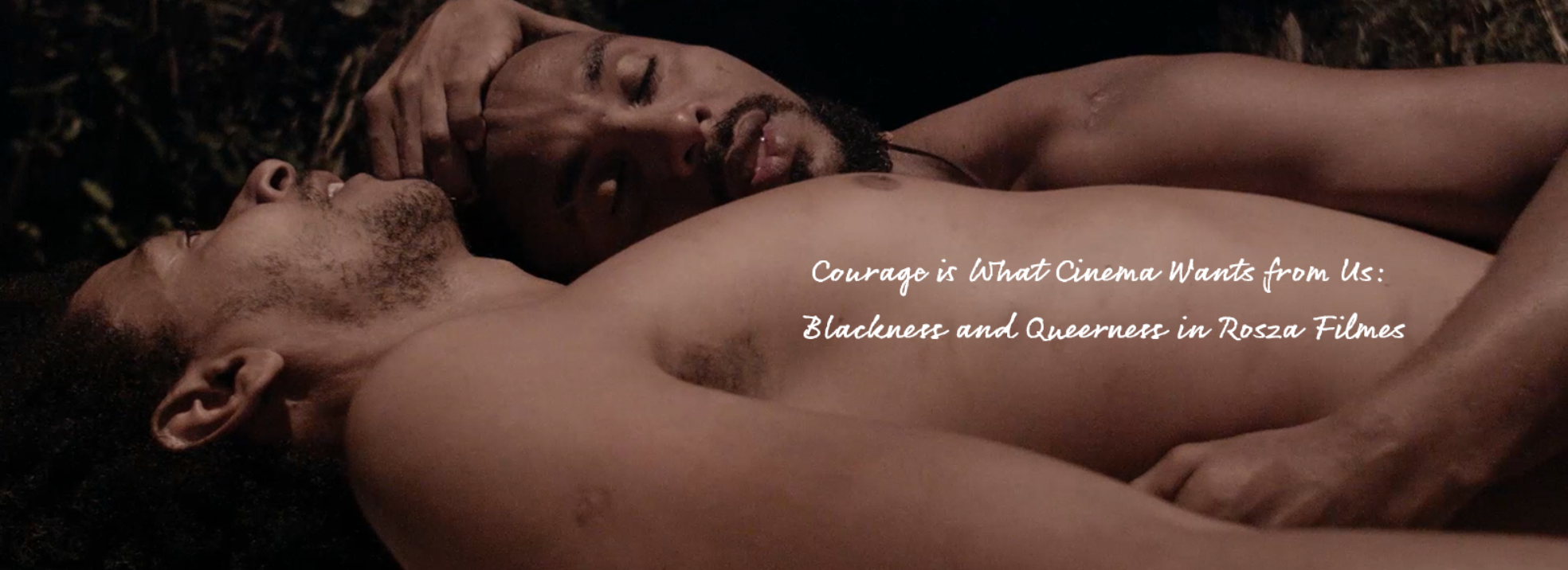
PT/ENG
PT/ENG
24/10/2021
By/Por:
Matheus Araujo dos Santos
Life, after all

Since Rosza Filmes’ Café com Canela (2017) came out, critics and audiences alike noticed that an important movement was taking place in Brazilian Cinema. The first feature film directed by Glenda Nicácio and Ary Rosa won the Audience Prize at the 50º Brasília Film Festival, calling attention to the cinematographic production from Recôncavo Baiano.1 Ilha (2018) and Até o Fim (2019), the other two feature films that came out over the following years, further solidified the importance of Rosza Films to the discussion on Brazilian black and queer cinema, their work suggesting ways in which queerness and blackness can be articulated as methodologies of decolonization through and beyond images.

In Café com Canela, Babu Santana plays Ivan, a black gay doctor who is coping with the death of his husband after twenty years of marriage. The actor is best known for playing roles that associate blackness with violence and vulnerability: he plays a drug dealer in Cidade de Deus (2002), Cidade dos Homens (2007), and Era uma Vez… (2008) and a policeman in Batismo de Sangue (2007) and Os Normais 2 (2009). The invitation to play Dr. Ivan was offered to Santana after Nicácio and Rosa watched an interview where he mentioned his desire to play a gay character in a movie. In the same interview, Santana talked about the ambiguity of his previous work and how he dealt with racism within and outside cinema. He describes one particular confrontation with racism, his classmates in school calling him “baboon” – which he reclaims by taking “Babu” as his artistic name.

Café com Canela narrates the reunion between Violeta (Aline Brunne) and her former teacher Dona Margarida (Valdinéia Soriano). After the death of her son, Dona Margarida lives in isolation, inhabiting an endless cycle of mourning. Surrounded by memories of her son in her home, once familiar rooms quickly turn into psychological mazes, making Dona Margarida experience great anguish within her own living space. Violeta, on the other hand, is married and is the mother of two children. She divides her time between taking care of her grandmother and riding a bicycle through the cities of Cachoeira and São Félix selling coxinhas.2 After Violenta knocks on Dona Margarida’s door by chance to sell the snacks made according to her grandmother’s secret recipe, she quickly takes an interest in the well-being of Dona Margarida.

The rapprochement of these two characters is interspersed with scenes of the daily life of Violeta and her neighbors, including Dr. Ivan, who speaks the first lines in the film, sharing memories with his friends as they gather to drink and celebrate life:

Think about it: a teenager, the son of a repressive father and an overprotective mother, parachuting in the capital to go to college. There was no way it could go well, right? It was six months of pure hell-raising. Think of a slutty person... That was me! I tried everything that I could and that I couldn’t try... I tried everything and a little bit more! And then one day I went to a bar and there was Adolfo. Girl, Adolfo was such a charming daddy, easy to talk to, intelligent... Think of a perfect man. That was Adolfo. He wasn’t rich. He never really was. He even had money, but he spent it all on parties, on trips, on gifts, those sorts of things... He didn’t save a cent. If there’s one thing you can’t say about Adolfo, it's that he was stingy, you hear me? He was not. I went crazy for that man. In fact, I was completely in love... A week later I was living with him, making plans, craziness... The craziest thing of my life. Then, after twenty years the bastard left me alone... Now I just miss him... I just miss him... C’est la vie. I’ll get another beer…

Babu Santana’s first appearance as Dr. Ivan and the lines his character says which convey his queerness directly contrasts with the characters that Santana played in his previous roles. In those past roles, his masculinity and heterosexuality are constantly invoked in order to forge roles that support places of violence and danger in which blackness is always ambiguously positioned.

Studies on black masculinity have tried to expose the ways by which it is built as a nihilistic threat that sustains the fantasy of white fear while also pressuring black men towards self-destruction. According to Frantz Fanon in Black Skin, White Masks, the anti-black violence that sustains the modern world causes black people to live in zones of non-being, experiencing a kind of metaphysical holocaust, a constant fall into an abyss of terror and (self) annihilation. When asking, “What does the black man want?” Fanon introduces the dimension of desire as a fundamental aspect of the ontological (im)possibilities of this abysmal position. As a speculative gesture, I propose that Babu Santana’s desire to play a queer character presents one of the possible answers to this Fanonian question, allowing us to perceive some means of dissolving blackness-as-death by its articulation with queerness and as a method of decolonization of image and matter. It is an intervention in the field of cinematographic representation and sensitivity and in the life of the actor himself. I believe that Babu’s desire must be taken less as a fetishistic drive for becoming minorities than as a move to imagine his own blackness from other angles, so that “queerness” does not compose a field apart from his raciality, but broadens its senses in the infinite directions in which it expands. Beyond this, Rosa and Nicácio’s gesture in actualizing the actor’s desire makes us think about the possibilities of cinema. When building the conditions for Babu Santana to play Dr. Ivan, the directors show an understanding of cinema that goes through and beyond image. A cinema linked to existence, which is able to move not only the sphere of representation, but of life itself in its materiality. In that sense, a cinema implicated in the world and which presents itself as a tool capable of producing other ways of being here and now, with and after/before images.

During the film, we follow the character’s stories, their daily lives, and moments of anguish and happiness. We see the quotidian moments of a black city in Recôncavo and its people who celebrate life and support each other in difficult times, such as when Dr. Ivan finds his husband dead and is consoled by his neighbors. Despite sad moments such as these, the characters in Café com Canela are not destined for tragedy. The pains experienced by them are always underscored by the light moments of everyday life. Café com Canela explores life despite social death as a condition of blackness, realizing in the quotidian of black affection tactics of crossing to a world where (self) destruction is not an irreducible destiny.

Life is Like That: Courage is What it Wants from Us

In Ilha, Rosza Filmes’ second feature film, Emerson (Renan Motta) is a young black resident of an island from which no one can leave. To make a film about his life, he kidnaps Henrique Santos (Aldri Anunciação), a renowned black filmmaker from Bahia, forcing him to film a script he wrote that chronicles the most remarkable moments of his life, including his relationship with an abusive father who torments him because of his sexuality. Throughout the course of the film, we follow the relationship between this always-dreaming young man with unsettling ideas about cinema and his idol, Henrique, who we learn has accommodated himself to the gears of the mainstream film industry. When Henrique asks Emerson why he was chosen for this forced film experiment, Emerson replies: “For me, for my history/story.3 For you, for you to make a movie again”. After the director’s initial resistance, the two begin a relationship that develops slowly, as the character Emerson begins to present a deeper complexity. This figure is a black queer filmmaker/drug dealer who “hijacks cinema” in order to express his feelings, thoughts, and desires that have been stifled by the racist structures of Brazilian audiovisual history. “You gonna have to swallow my subjectivity hard!” he shouts, looking straight into the camera.

Ilha intentionally plays with stereotypes of black masculinity and with cinematographic language. In the opening scene, Emerson is introduced to us as a kidnapper, reproducing the violent image of the black-man-with-a-gun as he tortures Henrique and tries to “convince him” to join his project. Throughout the film, this image is crossed and displaced by the sexual/affective desire that arises among the protagonists. When they finally get to have sex, Nicácio and Rosa’s choices on how to film the scene points to the construction of images of black affectivity, the directors refusing to film them in a fetishistic way. As soon as Henrique and Emerson start kissing, the camera operator rests the camera on the floor and leaves the scene, disappearing on the road behind them. We see the gestures that indicate sex but these gestures are not totally given to visibility, thus erasing a certain iconography of black masculinity centered in strategies of hypersexualization, objectification and animalization of the black body. Once again, queerness and blackness are articulated to produce another image. In the final signs, we read that Ilha is dedicated “to the girls and boys who chose cinema, but who were not chosen by it”. The film brings up the question of black queer authorship and the formation of black queer cinemas in Brazil as a gesture of crossing the historically constructed images and social structures that intend to tie blackness and queerness in positions of vulnerability. “Courage is what cinema wants from us!” says Emerson in one of the scenes as he climbs a ladder towards the sky.4

Até o Fim

Até o Fim narrates the one night reunion of the Arcanjo sisters, Geralda (Wall Diaz), Rose (Arlete Dias), Bel (Maíra Azevedo), and Vilmar (Jenny Müller) who are coming together due to the imminent death of their father in the small town of Recôncavo. The film’s plot is similar to that of Filhas do Vento6 (Joel Zito Araújo, 2005), an important film for black cinema in Brazil. In that film, the sisters Maria Aparecida (Ruth de Souza) and Maria D’Ajuda (Léa Garcia) meet again for their father's funeral after many years apart. Aparecida leaves for Rio de Janeiro where she continues her acting career and D’Ajuda forms her family in the small town in Minas Gerais where the sisters were born. The family reunion in Filhas do Vento brings up past traumas, disagreements, reconciliations and also promotes the rare meeting of black Brazilian actors and actresses of different generations, such as Thalma de Freitas, Taís Araújo, Rocco Pitanga, Maria Ceiça, Dani Ornellas, Zózimo Bulbul, Léa Garcia, Ruth de Souza and Milton Gonçalves. As in Filhas do Vento, the encounter between the Arcanjo sisters in Até o Fim sparks the recollection of their life memories, inciting fresh laughs and tears. The film moves repeatedly between light humor and the weight of the situations of violence that emerge through the memories of a common childhood. One by one, Rose, Bel, and Vilmar arrive at Geralda’s bar, filling the screen with their stories and their bodies amplified through the cinematographic image, constructing a rare event in Brazilian cinema: a feature film in which black women fill each and every frame, in addition to occupying key-positions in the technical team.

Although there are no men in the film, the father being mourned is a central character. While his image is absent, he remains violently present in the memories that the sisters share. One of such memories unearths the fact that Vilmar is the result of Geralda’s rape by the father, who then forced her to hide her motherhood and assume the role as the sister of her own daughter. Vilmar, we learn, ran away from home as a child, her mother eagerly waiting for her return. After Vilmar’s finally arrives to the bar, the conversation mostly revolves around her life as a trans lesbian woman. She enters the scene causing a strong reaction in Geralda, who was unaware of her daughter’s transition. Geralda’s reactions are at first stereotypically transphobic, which does not prevent Vilmar’s angered response to her sister/mother’s violence. Her other sisters’ insistent questions about Vilmar's gender identity repeat these violent choreographies. Despite this, the scenes in which Vilmar answers such questions are extremely didactic, exerting a pedagogical intervention in the dialogue with her family and with the audience. Between the irreducible defense of her right to exist and the moments of affective negotiation with the other black women who make up her ancestry, Vilmar’s speeches show the fictitious and oppressive character of gender and sexuality as colonial norms, allowing not only her experience to be perceived as subjected to white cisheteronormativity, but that of all of her sisters as well.

Café com Canela, Ilha and Até o Fim are films that indicate the transformative power of cinema. Articulating blackness with queerness, the films produced by Rosza Filmes make us think about the necessity of creating a new world in which being black and queer does not mean disappearance and destruction. In focusing on their characters everyday lives, Glenda Nicácio and Ary Rosa film black queer affection as a way to resist the violence that supports modern civilization. There is life, the images tell us. Life, after all. Life despite and beyond death as destination.

1. RecôncavoBaiano is a region of Bahia of great historical, cultural and spiritual importance.

2. Coxinha is a chicken-based Brazilian snack.

3. In Portuguese, the words history and story are pronounced the same way.

4. “Courage is what cinema wants from us” is a line based on Guimarães Rosa’s novel Great Backlands: Paths (Grande Sertão: Veredas, 1956): “The flow of life wraps everything up, life is like that: it heats up and cools, squeezes and then loosens, settles and then rests. Courage is what it wants from us.”

5. The film title makes an explicit reference to Julie Dash’s Daughters of the Dust, 1991.

Life, after all

Since Rosza Filmes’ Café com Canela (2017) came out, critics and audiences alike noticed that an important movement was taking place in Brazilian Cinema. The first feature film directed by Glenda Nicácio and Ary Rosa won the Audience Prize at the 50º Brasília Film Festival, calling attention to the cinematographic production from Recôncavo Baiano.1 Ilha (2018) and Até o Fim (2019), the other two feature films that came out over the following years, further solidified the importance of Rosza Films to the discussion on Brazilian black and queer cinema, their work suggesting ways in which queerness and blackness can be articulated as methodologies of decolonization through and beyond images.

In Café com Canela, Babu Santana plays Ivan, a black gay doctor who is coping with the death of his husband after twenty years of marriage. The actor is best known for playing roles that associate blackness with violence and vulnerability: he plays a drug dealer in Cidade de Deus (2002), Cidade dos Homens (2007), and Era uma Vez… (2008) and a policeman in Batismo de Sangue (2007) and Os Normais 2 (2009). The invitation to play Dr. Ivan was offered to Santana after Nicácio and Rosa watched an interview where he mentioned his desire to play a gay character in a movie. In the same interview, Santana talked about the ambiguity of his previous work and how he dealt with racism within and outside cinema. He describes one particular confrontation with racism, his classmates in school calling him “baboon” – which he reclaims by taking “Babu” as his artistic name.

Café com Canela narrates the reunion between Violeta (Aline Brunne) and her former teacher Dona Margarida (Valdinéia Soriano). After the death of her son, Dona Margarida lives in isolation, inhabiting an endless cycle of mourning. Surrounded by memories of her son in her home, once familiar rooms quickly turn into psychological mazes, making Dona Margarida experience great anguish within her own living space. Violeta, on the other hand, is married and is the mother of two children. She divides her time between taking care of her grandmother and riding a bicycle through the cities of Cachoeira and São Félix selling coxinhas.2 After Violenta knocks on Dona Margarida’s door by chance to sell the snacks made according to her grandmother’s secret recipe, she quickly takes an interest in the well-being of Dona Margarida.

The rapprochement of these two characters is interspersed with scenes of the daily life of Violeta and her neighbors, including Dr. Ivan, who speaks the first lines in the film, sharing memories with his friends as they gather to drink and celebrate life:

Think about it: a teenager, the son of a repressive father and an overprotective mother, parachuting in the capital to go to college. There was no way it could go well, right? It was six months of pure hell-raising. Think of a slutty person... That was me! I tried everything that I could and that I couldn’t try... I tried everything and a little bit more! And then one day I went to a bar and there was Adolfo. Girl, Adolfo was such a charming daddy, easy to talk to, intelligent... Think of a perfect man. That was Adolfo. He wasn’t rich. He never really was. He even had money, but he spent it all on parties, on trips, on gifts, those sorts of things... He didn’t save a cent. If there’s one thing you can’t say about Adolfo, it's that he was stingy, you hear me? He was not. I went crazy for that man. In fact, I was completely in love... A week later I was living with him, making plans, craziness... The craziest thing of my life. Then, after twenty years the bastard left me alone... Now I just miss him... I just miss him... C’est la vie. I’ll get another beer…

Babu Santana’s first appearance as Dr. Ivan and the lines his character says which convey his queerness directly contrasts with the characters that Santana played in his previous roles. In those past roles, his masculinity and heterosexuality are constantly invoked in order to forge roles that support places of violence and danger in which blackness is always ambiguously positioned.

Studies on black masculinity have tried to expose the ways by which it is built as a nihilistic threat that sustains the fantasy of white fear while also pressuring black men towards self-destruction. According to Frantz Fanon in Black Skin, White Masks, the anti-black violence that sustains the modern world causes black people to live in zones of non-being, experiencing a kind of metaphysical holocaust, a constant fall into an abyss of terror and (self) annihilation. When asking, “What does the black man want?” Fanon introduces the dimension of desire as a fundamental aspect of the ontological (im)possibilities of this abysmal position. As a speculative gesture, I propose that Babu Santana’s desire to play a queer character presents one of the possible answers to this Fanonian question, allowing us to perceive some means of dissolving blackness-as-death by its articulation with queerness and as a method of decolonization of image and matter. It is an intervention in the field of cinematographic representation and sensitivity and in the life of the actor himself. I believe that Babu’s desire must be taken less as a fetishistic drive for becoming minorities than as a move to imagine his own blackness from other angles, so that “queerness” does not compose a field apart from his raciality, but broadens its senses in the infinite directions in which it expands. Beyond this, Rosa and Nicácio’s gesture in actualizing the actor’s desire makes us think about the possibilities of cinema. When building the conditions for Babu Santana to play Dr. Ivan, the directors show an understanding of cinema that goes through and beyond image. A cinema linked to existence, which is able to move not only the sphere of representation, but of life itself in its materiality. In that sense, a cinema implicated in the world and which presents itself as a tool capable of producing other ways of being here and now, with and after/before images.

During the film, we follow the character’s stories, their daily lives, and moments of anguish and happiness. We see the quotidian moments of a black city in Recôncavo and its people who celebrate life and support each other in difficult times, such as when Dr. Ivan finds his husband dead and is consoled by his neighbors. Despite sad moments such as these, the characters in Café com Canela are not destined for tragedy. The pains experienced by them are always underscored by the light moments of everyday life. Café com Canela explores life despite social death as a condition of blackness, realizing in the quotidian of black affection tactics of crossing to a world where (self) destruction is not an irreducible destiny.

Life is Like That: Courage is What it Wants from Us

In Ilha, Rosza Filmes’ second feature film, Emerson (Renan Motta) is a young black resident of an island from which no one can leave. To make a film about his life, he kidnaps Henrique Santos (Aldri Anunciação), a renowned black filmmaker from Bahia, forcing him to film a script he wrote that chronicles the most remarkable moments of his life, including his relationship with an abusive father who torments him because of his sexuality. Throughout the course of the film, we follow the relationship between this always-dreaming young man with unsettling ideas about cinema and his idol, Henrique, who we learn has accommodated himself to the gears of the mainstream film industry. When Henrique asks Emerson why he was chosen for this forced film experiment, Emerson replies: “For me, for my history/story.3 For you, for you to make a movie again”. After the director’s initial resistance, the two begin a relationship that develops slowly, as the character Emerson begins to present a deeper complexity. This figure is a black queer filmmaker/drug dealer who “hijacks cinema” in order to express his feelings, thoughts, and desires that have been stifled by the racist structures of Brazilian audiovisual history. “You gonna have to swallow my subjectivity hard!” he shouts, looking straight into the camera.

Ilha intentionally plays with stereotypes of black masculinity and with cinematographic language. In the opening scene, Emerson is introduced to us as a kidnapper, reproducing the violent image of the black-man-with-a-gun as he tortures Henrique and tries to “convince him” to join his project. Throughout the film, this image is crossed and displaced by the sexual/affective desire that arises among the protagonists. When they finally get to have sex, Nicácio and Rosa’s choices on how to film the scene points to the construction of images of black affectivity, the directors refusing to film them in a fetishistic way. As soon as Henrique and Emerson start kissing, the camera operator rests the camera on the floor and leaves the scene, disappearing on the road behind them. We see the gestures that indicate sex but these gestures are not totally given to visibility, thus erasing a certain iconography of black masculinity centered in strategies of hypersexualization, objectification and animalization of the black body. Once again, queerness and blackness are articulated to produce another image. In the final signs, we read that Ilha is dedicated “to the girls and boys who chose cinema, but who were not chosen by it”. The film brings up the question of black queer authorship and the formation of black queer cinemas in Brazil as a gesture of crossing the historically constructed images and social structures that intend to tie blackness and queerness in positions of vulnerability. “Courage is what cinema wants from us!” says Emerson in one of the scenes as he climbs a ladder towards the sky.4

Até o Fim

Até o Fim narrates the one night reunion of the Arcanjo sisters, Geralda (Wall Diaz), Rose (Arlete Dias), Bel (Maíra Azevedo), and Vilmar (Jenny Müller) who are coming together due to the imminent death of their father in the small town of Recôncavo. The film’s plot is similar to that of Filhas do Vento6 (Joel Zito Araújo, 2005), an important film for black cinema in Brazil. In that film, the sisters Maria Aparecida (Ruth de Souza) and Maria D’Ajuda (Léa Garcia) meet again for their father's funeral after many years apart. Aparecida leaves for Rio de Janeiro where she continues her acting career and D’Ajuda forms her family in the small town in Minas Gerais where the sisters were born. The family reunion in Filhas do Vento brings up past traumas, disagreements, reconciliations and also promotes the rare meeting of black Brazilian actors and actresses of different generations, such as Thalma de Freitas, Taís Araújo, Rocco Pitanga, Maria Ceiça, Dani Ornellas, Zózimo Bulbul, Léa Garcia, Ruth de Souza and Milton Gonçalves. As in Filhas do Vento, the encounter between the Arcanjo sisters in Até o Fim sparks the recollection of their life memories, inciting fresh laughs and tears. The film moves repeatedly between light humor and the weight of the situations of violence that emerge through the memories of a common childhood. One by one, Rose, Bel, and Vilmar arrive at Geralda’s bar, filling the screen with their stories and their bodies amplified through the cinematographic image, constructing a rare event in Brazilian cinema: a feature film in which black women fill each and every frame, in addition to occupying key-positions in the technical team.

Although there are no men in the film, the father being mourned is a central character. While his image is absent, he remains violently present in the memories that the sisters share. One of such memories unearths the fact that Vilmar is the result of Geralda’s rape by the father, who then forced her to hide her motherhood and assume the role as the sister of her own daughter. Vilmar, we learn, ran away from home as a child, her mother eagerly waiting for her return. After Vilmar’s finally arrives to the bar, the conversation mostly revolves around her life as a trans lesbian woman. She enters the scene causing a strong reaction in Geralda, who was unaware of her daughter’s transition. Geralda’s reactions are at first stereotypically transphobic, which does not prevent Vilmar’s angered response to her sister/mother’s violence. Her other sisters’ insistent questions about Vilmar's gender identity repeat these violent choreographies. Despite this, the scenes in which Vilmar answers such questions are extremely didactic, exerting a pedagogical intervention in the dialogue with her family and with the audience. Between the irreducible defense of her right to exist and the moments of affective negotiation with the other black women who make up her ancestry, Vilmar’s speeches show the fictitious and oppressive character of gender and sexuality as colonial norms, allowing not only her experience to be perceived as subjected to white cisheteronormativity, but that of all of her sisters as well.

Café com Canela, Ilha and Até o Fim are films that indicate the transformative power of cinema. Articulating blackness with queerness, the films produced by Rosza Filmes make us think about the necessity of creating a new world in which being black and queer does not mean disappearance and destruction. In focusing on their characters everyday lives, Glenda Nicácio and Ary Rosa film black queer affection as a way to resist the violence that supports modern civilization. There is life, the images tell us. Life, after all. Life despite and beyond death as destination.

1. RecôncavoBaiano is a region of Bahia of great historical, cultural and spiritual importance.

2. Coxinha is a chicken-based Brazilian snack.

3. In Portuguese, the words history and story are pronounced the same way.

4. “Courage is what cinema wants from us” is a line based on Guimarães Rosa’s novel Great Backlands: Paths (Grande Sertão: Veredas, 1956): “The flow of life wraps everything up, life is like that: it heats up and cools, squeezes and then loosens, settles and then rests. Courage is what it wants from us.”

5. The film title makes an explicit reference to Julie Dash’s Daughters of the Dust, 1991.

Life, after all

Since Rosza Filmes’ Café com Canela (2017) came out, critics and audiences alike noticed that an important movement was taking place in Brazilian Cinema. The first feature film directed by Glenda Nicácio and Ary Rosa won the Audience Prize at the 50º Brasília Film Festival, calling attention to the cinematographic production from Recôncavo Baiano.1 Ilha (2018) and Até o Fim (2019), the other two feature films that came out over the following years, further solidified the importance of Rosza Films to the discussion on Brazilian black and queer cinema, their work suggesting ways in which queerness and blackness can be articulated as methodologies of decolonization through and beyond images.

In Café com Canela, Babu Santana plays Ivan, a black gay doctor who is coping with the death of his husband after twenty years of marriage. The actor is best known for playing roles that associate blackness with violence and vulnerability: he plays a drug dealer in Cidade de Deus (2002), Cidade dos Homens (2007), and Era uma Vez… (2008) and a policeman in Batismo de Sangue (2007) and Os Normais 2 (2009). The invitation to play Dr. Ivan was offered to Santana after Nicácio and Rosa watched an interview where he mentioned his desire to play a gay character in a movie. In the same interview, Santana talked about the ambiguity of his previous work and how he dealt with racism within and outside cinema. He describes one particular confrontation with racism, his classmates in school calling him “baboon” – which he reclaims by taking “Babu” as his artistic name.

Café com Canela narrates the reunion between Violeta (Aline Brunne) and her former teacher Dona Margarida (Valdinéia Soriano). After the death of her son, Dona Margarida lives in isolation, inhabiting an endless cycle of mourning. Surrounded by memories of her son in her home, once familiar rooms quickly turn into psychological mazes, making Dona Margarida experience great anguish within her own living space. Violeta, on the other hand, is married and is the mother of two children. She divides her time between taking care of her grandmother and riding a bicycle through the cities of Cachoeira and São Félix selling coxinhas.2 After Violenta knocks on Dona Margarida’s door by chance to sell the snacks made according to her grandmother’s secret recipe, she quickly takes an interest in the well-being of Dona Margarida.

The rapprochement of these two characters is interspersed with scenes of the daily life of Violeta and her neighbors, including Dr. Ivan, who speaks the first lines in the film, sharing memories with his friends as they gather to drink and celebrate life:

Think about it: a teenager, the son of a repressive father and an overprotective mother, parachuting in the capital to go to college. There was no way it could go well, right? It was six months of pure hell-raising. Think of a slutty person... That was me! I tried everything that I could and that I couldn’t try... I tried everything and a little bit more! And then one day I went to a bar and there was Adolfo. Girl, Adolfo was such a charming daddy, easy to talk to, intelligent... Think of a perfect man. That was Adolfo. He wasn’t rich. He never really was. He even had money, but he spent it all on parties, on trips, on gifts, those sorts of things... He didn’t save a cent. If there’s one thing you can’t say about Adolfo, it's that he was stingy, you hear me? He was not. I went crazy for that man. In fact, I was completely in love... A week later I was living with him, making plans, craziness... The craziest thing of my life. Then, after twenty years the bastard left me alone... Now I just miss him... I just miss him... C’est la vie. I’ll get another beer…

Babu Santana’s first appearance as Dr. Ivan and the lines his character says which convey his queerness directly contrasts with the characters that Santana played in his previous roles. In those past roles, his masculinity and heterosexuality are constantly invoked in order to forge roles that support places of violence and danger in which blackness is always ambiguously positioned.

Studies on black masculinity have tried to expose the ways by which it is built as a nihilistic threat that sustains the fantasy of white fear while also pressuring black men towards self-destruction. According to Frantz Fanon in Black Skin, White Masks, the anti-black violence that sustains the modern world causes black people to live in zones of non-being, experiencing a kind of metaphysical holocaust, a constant fall into an abyss of terror and (self) annihilation. When asking, “What does the black man want?” Fanon introduces the dimension of desire as a fundamental aspect of the ontological (im)possibilities of this abysmal position. As a speculative gesture, I propose that Babu Santana’s desire to play a queer character presents one of the possible answers to this Fanonian question, allowing us to perceive some means of dissolving blackness-as-death by its articulation with queerness and as a method of decolonization of image and matter. It is an intervention in the field of cinematographic representation and sensitivity and in the life of the actor himself. I believe that Babu’s desire must be taken less as a fetishistic drive for becoming minorities than as a move to imagine his own blackness from other angles, so that “queerness” does not compose a field apart from his raciality, but broadens its senses in the infinite directions in which it expands. Beyond this, Rosa and Nicácio’s gesture in actualizing the actor’s desire makes us think about the possibilities of cinema. When building the conditions for Babu Santana to play Dr. Ivan, the directors show an understanding of cinema that goes through and beyond image. A cinema linked to existence, which is able to move not only the sphere of representation, but of life itself in its materiality. In that sense, a cinema implicated in the world and which presents itself as a tool capable of producing other ways of being here and now, with and after/before images.

During the film, we follow the character’s stories, their daily lives, and moments of anguish and happiness. We see the quotidian moments of a black city in Recôncavo and its people who celebrate life and support each other in difficult times, such as when Dr. Ivan finds his husband dead and is consoled by his neighbors. Despite sad moments such as these, the characters in Café com Canela are not destined for tragedy. The pains experienced by them are always underscored by the light moments of everyday life. Café com Canela explores life despite social death as a condition of blackness, realizing in the quotidian of black affection tactics of crossing to a world where (self) destruction is not an irreducible destiny.

Life is Like That: Courage is What it Wants from Us

In Ilha, Rosza Filmes’ second feature film, Emerson (Renan Motta) is a young black resident of an island from which no one can leave. To make a film about his life, he kidnaps Henrique Santos (Aldri Anunciação), a renowned black filmmaker from Bahia, forcing him to film a script he wrote that chronicles the most remarkable moments of his life, including his relationship with an abusive father who torments him because of his sexuality. Throughout the course of the film, we follow the relationship between this always-dreaming young man with unsettling ideas about cinema and his idol, Henrique, who we learn has accommodated himself to the gears of the mainstream film industry. When Henrique asks Emerson why he was chosen for this forced film experiment, Emerson replies: “For me, for my history/story.3 For you, for you to make a movie again”. After the director’s initial resistance, the two begin a relationship that develops slowly, as the character Emerson begins to present a deeper complexity. This figure is a black queer filmmaker/drug dealer who “hijacks cinema” in order to express his feelings, thoughts, and desires that have been stifled by the racist structures of Brazilian audiovisual history. “You gonna have to swallow my subjectivity hard!” he shouts, looking straight into the camera.

Ilha intentionally plays with stereotypes of black masculinity and with cinematographic language. In the opening scene, Emerson is introduced to us as a kidnapper, reproducing the violent image of the black-man-with-a-gun as he tortures Henrique and tries to “convince him” to join his project. Throughout the film, this image is crossed and displaced by the sexual/affective desire that arises among the protagonists. When they finally get to have sex, Nicácio and Rosa’s choices on how to film the scene points to the construction of images of black affectivity, the directors refusing to film them in a fetishistic way. As soon as Henrique and Emerson start kissing, the camera operator rests the camera on the floor and leaves the scene, disappearing on the road behind them. We see the gestures that indicate sex but these gestures are not totally given to visibility, thus erasing a certain iconography of black masculinity centered in strategies of hypersexualization, objectification and animalization of the black body. Once again, queerness and blackness are articulated to produce another image. In the final signs, we read that Ilha is dedicated “to the girls and boys who chose cinema, but who were not chosen by it”. The film brings up the question of black queer authorship and the formation of black queer cinemas in Brazil as a gesture of crossing the historically constructed images and social structures that intend to tie blackness and queerness in positions of vulnerability. “Courage is what cinema wants from us!” says Emerson in one of the scenes as he climbs a ladder towards the sky.4

Até o Fim

Até o Fim narrates the one night reunion of the Arcanjo sisters, Geralda (Wall Diaz), Rose (Arlete Dias), Bel (Maíra Azevedo), and Vilmar (Jenny Müller) who are coming together due to the imminent death of their father in the small town of Recôncavo. The film’s plot is similar to that of Filhas do Vento6 (Joel Zito Araújo, 2005), an important film for black cinema in Brazil. In that film, the sisters Maria Aparecida (Ruth de Souza) and Maria D’Ajuda (Léa Garcia) meet again for their father's funeral after many years apart. Aparecida leaves for Rio de Janeiro where she continues her acting career and D’Ajuda forms her family in the small town in Minas Gerais where the sisters were born. The family reunion in Filhas do Vento brings up past traumas, disagreements, reconciliations and also promotes the rare meeting of black Brazilian actors and actresses of different generations, such as Thalma de Freitas, Taís Araújo, Rocco Pitanga, Maria Ceiça, Dani Ornellas, Zózimo Bulbul, Léa Garcia, Ruth de Souza and Milton Gonçalves. As in Filhas do Vento, the encounter between the Arcanjo sisters in Até o Fim sparks the recollection of their life memories, inciting fresh laughs and tears. The film moves repeatedly between light humor and the weight of the situations of violence that emerge through the memories of a common childhood. One by one, Rose, Bel, and Vilmar arrive at Geralda’s bar, filling the screen with their stories and their bodies amplified through the cinematographic image, constructing a rare event in Brazilian cinema: a feature film in which black women fill each and every frame, in addition to occupying key-positions in the technical team.

Although there are no men in the film, the father being mourned is a central character. While his image is absent, he remains violently present in the memories that the sisters share. One of such memories unearths the fact that Vilmar is the result of Geralda’s rape by the father, who then forced her to hide her motherhood and assume the role as the sister of her own daughter. Vilmar, we learn, ran away from home as a child, her mother eagerly waiting for her return. After Vilmar’s finally arrives to the bar, the conversation mostly revolves around her life as a trans lesbian woman. She enters the scene causing a strong reaction in Geralda, who was unaware of her daughter’s transition. Geralda’s reactions are at first stereotypically transphobic, which does not prevent Vilmar’s angered response to her sister/mother’s violence. Her other sisters’ insistent questions about Vilmar's gender identity repeat these violent choreographies. Despite this, the scenes in which Vilmar answers such questions are extremely didactic, exerting a pedagogical intervention in the dialogue with her family and with the audience. Between the irreducible defense of her right to exist and the moments of affective negotiation with the other black women who make up her ancestry, Vilmar’s speeches show the fictitious and oppressive character of gender and sexuality as colonial norms, allowing not only her experience to be perceived as subjected to white cisheteronormativity, but that of all of her sisters as well.

Café com Canela, Ilha and Até o Fim are films that indicate the transformative power of cinema. Articulating blackness with queerness, the films produced by Rosza Filmes make us think about the necessity of creating a new world in which being black and queer does not mean disappearance and destruction. In focusing on their characters everyday lives, Glenda Nicácio and Ary Rosa film black queer affection as a way to resist the violence that supports modern civilization. There is life, the images tell us. Life, after all. Life despite and beyond death as destination.

1. RecôncavoBaiano is a region of Bahia of great historical, cultural and spiritual importance.

2. Coxinha is a chicken-based Brazilian snack.

3. In Portuguese, the words history and story are pronounced the same way.

4. “Courage is what cinema wants from us” is a line based on Guimarães Rosa’s novel Great Backlands: Paths (Grande Sertão: Veredas, 1956): “The flow of life wraps everything up, life is like that: it heats up and cools, squeezes and then loosens, settles and then rests. Courage is what it wants from us.”

5. The film title makes an explicit reference to Julie Dash’s Daughters of the Dust, 1991.

Life, after all

Since Rosza Filmes’ Café com Canela (2017) came out, critics and audiences alike noticed that an important movement was taking place in Brazilian Cinema. The first feature film directed by Glenda Nicácio and Ary Rosa won the Audience Prize at the 50º Brasília Film Festival, calling attention to the cinematographic production from Recôncavo Baiano.1 Ilha (2018) and Até o Fim (2019), the other two feature films that came out over the following years, further solidified the importance of Rosza Films to the discussion on Brazilian black and queer cinema, their work suggesting ways in which queerness and blackness can be articulated as methodologies of decolonization through and beyond images.

In Café com Canela, Babu Santana plays Ivan, a black gay doctor who is coping with the death of his husband after twenty years of marriage. The actor is best known for playing roles that associate blackness with violence and vulnerability: he plays a drug dealer in Cidade de Deus (2002), Cidade dos Homens (2007), and Era uma Vez… (2008) and a policeman in Batismo de Sangue (2007) and Os Normais 2 (2009). The invitation to play Dr. Ivan was offered to Santana after Nicácio and Rosa watched an interview where he mentioned his desire to play a gay character in a movie. In the same interview, Santana talked about the ambiguity of his previous work and how he dealt with racism within and outside cinema. He describes one particular confrontation with racism, his classmates in school calling him “baboon” – which he reclaims by taking “Babu” as his artistic name.

Café com Canela narrates the reunion between Violeta (Aline Brunne) and her former teacher Dona Margarida (Valdinéia Soriano). After the death of her son, Dona Margarida lives in isolation, inhabiting an endless cycle of mourning. Surrounded by memories of her son in her home, once familiar rooms quickly turn into psychological mazes, making Dona Margarida experience great anguish within her own living space. Violeta, on the other hand, is married and is the mother of two children. She divides her time between taking care of her grandmother and riding a bicycle through the cities of Cachoeira and São Félix selling coxinhas.2 After Violenta knocks on Dona Margarida’s door by chance to sell the snacks made according to her grandmother’s secret recipe, she quickly takes an interest in the well-being of Dona Margarida.

The rapprochement of these two characters is interspersed with scenes of the daily life of Violeta and her neighbors, including Dr. Ivan, who speaks the first lines in the film, sharing memories with his friends as they gather to drink and celebrate life:

Think about it: a teenager, the son of a repressive father and an overprotective mother, parachuting in the capital to go to college. There was no way it could go well, right? It was six months of pure hell-raising. Think of a slutty person... That was me! I tried everything that I could and that I couldn’t try... I tried everything and a little bit more! And then one day I went to a bar and there was Adolfo. Girl, Adolfo was such a charming daddy, easy to talk to, intelligent... Think of a perfect man. That was Adolfo. He wasn’t rich. He never really was. He even had money, but he spent it all on parties, on trips, on gifts, those sorts of things... He didn’t save a cent. If there’s one thing you can’t say about Adolfo, it's that he was stingy, you hear me? He was not. I went crazy for that man. In fact, I was completely in love... A week later I was living with him, making plans, craziness... The craziest thing of my life. Then, after twenty years the bastard left me alone... Now I just miss him... I just miss him... C’est la vie. I’ll get another beer…

Babu Santana’s first appearance as Dr. Ivan and the lines his character says which convey his queerness directly contrasts with the characters that Santana played in his previous roles. In those past roles, his masculinity and heterosexuality are constantly invoked in order to forge roles that support places of violence and danger in which blackness is always ambiguously positioned.

Studies on black masculinity have tried to expose the ways by which it is built as a nihilistic threat that sustains the fantasy of white fear while also pressuring black men towards self-destruction. According to Frantz Fanon in Black Skin, White Masks, the anti-black violence that sustains the modern world causes black people to live in zones of non-being, experiencing a kind of metaphysical holocaust, a constant fall into an abyss of terror and (self) annihilation. When asking, “What does the black man want?” Fanon introduces the dimension of desire as a fundamental aspect of the ontological (im)possibilities of this abysmal position. As a speculative gesture, I propose that Babu Santana’s desire to play a queer character presents one of the possible answers to this Fanonian question, allowing us to perceive some means of dissolving blackness-as-death by its articulation with queerness and as a method of decolonization of image and matter. It is an intervention in the field of cinematographic representation and sensitivity and in the life of the actor himself. I believe that Babu’s desire must be taken less as a fetishistic drive for becoming minorities than as a move to imagine his own blackness from other angles, so that “queerness” does not compose a field apart from his raciality, but broadens its senses in the infinite directions in which it expands. Beyond this, Rosa and Nicácio’s gesture in actualizing the actor’s desire makes us think about the possibilities of cinema. When building the conditions for Babu Santana to play Dr. Ivan, the directors show an understanding of cinema that goes through and beyond image. A cinema linked to existence, which is able to move not only the sphere of representation, but of life itself in its materiality. In that sense, a cinema implicated in the world and which presents itself as a tool capable of producing other ways of being here and now, with and after/before images.

During the film, we follow the character’s stories, their daily lives, and moments of anguish and happiness. We see the quotidian moments of a black city in Recôncavo and its people who celebrate life and support each other in difficult times, such as when Dr. Ivan finds his husband dead and is consoled by his neighbors. Despite sad moments such as these, the characters in Café com Canela are not destined for tragedy. The pains experienced by them are always underscored by the light moments of everyday life. Café com Canela explores life despite social death as a condition of blackness, realizing in the quotidian of black affection tactics of crossing to a world where (self) destruction is not an irreducible destiny.

Life is Like That: Courage is What it Wants from Us

In Ilha, Rosza Filmes’ second feature film, Emerson (Renan Motta) is a young black resident of an island from which no one can leave. To make a film about his life, he kidnaps Henrique Santos (Aldri Anunciação), a renowned black filmmaker from Bahia, forcing him to film a script he wrote that chronicles the most remarkable moments of his life, including his relationship with an abusive father who torments him because of his sexuality. Throughout the course of the film, we follow the relationship between this always-dreaming young man with unsettling ideas about cinema and his idol, Henrique, who we learn has accommodated himself to the gears of the mainstream film industry. When Henrique asks Emerson why he was chosen for this forced film experiment, Emerson replies: “For me, for my history/story.3 For you, for you to make a movie again”. After the director’s initial resistance, the two begin a relationship that develops slowly, as the character Emerson begins to present a deeper complexity. This figure is a black queer filmmaker/drug dealer who “hijacks cinema” in order to express his feelings, thoughts, and desires that have been stifled by the racist structures of Brazilian audiovisual history. “You gonna have to swallow my subjectivity hard!” he shouts, looking straight into the camera.

Ilha intentionally plays with stereotypes of black masculinity and with cinematographic language. In the opening scene, Emerson is introduced to us as a kidnapper, reproducing the violent image of the black-man-with-a-gun as he tortures Henrique and tries to “convince him” to join his project. Throughout the film, this image is crossed and displaced by the sexual/affective desire that arises among the protagonists. When they finally get to have sex, Nicácio and Rosa’s choices on how to film the scene points to the construction of images of black affectivity, the directors refusing to film them in a fetishistic way. As soon as Henrique and Emerson start kissing, the camera operator rests the camera on the floor and leaves the scene, disappearing on the road behind them. We see the gestures that indicate sex but these gestures are not totally given to visibility, thus erasing a certain iconography of black masculinity centered in strategies of hypersexualization, objectification and animalization of the black body. Once again, queerness and blackness are articulated to produce another image. In the final signs, we read that Ilha is dedicated “to the girls and boys who chose cinema, but who were not chosen by it”. The film brings up the question of black queer authorship and the formation of black queer cinemas in Brazil as a gesture of crossing the historically constructed images and social structures that intend to tie blackness and queerness in positions of vulnerability. “Courage is what cinema wants from us!” says Emerson in one of the scenes as he climbs a ladder towards the sky.4

Até o Fim

Até o Fim narrates the one night reunion of the Arcanjo sisters, Geralda (Wall Diaz), Rose (Arlete Dias), Bel (Maíra Azevedo), and Vilmar (Jenny Müller) who are coming together due to the imminent death of their father in the small town of Recôncavo. The film’s plot is similar to that of Filhas do Vento6 (Joel Zito Araújo, 2005), an important film for black cinema in Brazil. In that film, the sisters Maria Aparecida (Ruth de Souza) and Maria D’Ajuda (Léa Garcia) meet again for their father's funeral after many years apart. Aparecida leaves for Rio de Janeiro where she continues her acting career and D’Ajuda forms her family in the small town in Minas Gerais where the sisters were born. The family reunion in Filhas do Vento brings up past traumas, disagreements, reconciliations and also promotes the rare meeting of black Brazilian actors and actresses of different generations, such as Thalma de Freitas, Taís Araújo, Rocco Pitanga, Maria Ceiça, Dani Ornellas, Zózimo Bulbul, Léa Garcia, Ruth de Souza and Milton Gonçalves. As in Filhas do Vento, the encounter between the Arcanjo sisters in Até o Fim sparks the recollection of their life memories, inciting fresh laughs and tears. The film moves repeatedly between light humor and the weight of the situations of violence that emerge through the memories of a common childhood. One by one, Rose, Bel, and Vilmar arrive at Geralda’s bar, filling the screen with their stories and their bodies amplified through the cinematographic image, constructing a rare event in Brazilian cinema: a feature film in which black women fill each and every frame, in addition to occupying key-positions in the technical team.

Although there are no men in the film, the father being mourned is a central character. While his image is absent, he remains violently present in the memories that the sisters share. One of such memories unearths the fact that Vilmar is the result of Geralda’s rape by the father, who then forced her to hide her motherhood and assume the role as the sister of her own daughter. Vilmar, we learn, ran away from home as a child, her mother eagerly waiting for her return. After Vilmar’s finally arrives to the bar, the conversation mostly revolves around her life as a trans lesbian woman. She enters the scene causing a strong reaction in Geralda, who was unaware of her daughter’s transition. Geralda’s reactions are at first stereotypically transphobic, which does not prevent Vilmar’s angered response to her sister/mother’s violence. Her other sisters’ insistent questions about Vilmar's gender identity repeat these violent choreographies. Despite this, the scenes in which Vilmar answers such questions are extremely didactic, exerting a pedagogical intervention in the dialogue with her family and with the audience. Between the irreducible defense of her right to exist and the moments of affective negotiation with the other black women who make up her ancestry, Vilmar’s speeches show the fictitious and oppressive character of gender and sexuality as colonial norms, allowing not only her experience to be perceived as subjected to white cisheteronormativity, but that of all of her sisters as well.

Café com Canela, Ilha and Até o Fim are films that indicate the transformative power of cinema. Articulating blackness with queerness, the films produced by Rosza Filmes make us think about the necessity of creating a new world in which being black and queer does not mean disappearance and destruction. In focusing on their characters everyday lives, Glenda Nicácio and Ary Rosa film black queer affection as a way to resist the violence that supports modern civilization. There is life, the images tell us. Life, after all. Life despite and beyond death as destination.

1. RecôncavoBaiano is a region of Bahia of great historical, cultural and spiritual importance.

2. Coxinha is a chicken-based Brazilian snack.

3. In Portuguese, the words history and story are pronounced the same way.

4. “Courage is what cinema wants from us” is a line based on Guimarães Rosa’s novel Great Backlands: Paths (Grande Sertão: Veredas, 1956): “The flow of life wraps everything up, life is like that: it heats up and cools, squeezes and then loosens, settles and then rests. Courage is what it wants from us.”

5. The film title makes an explicit reference to Julie Dash’s Daughters of the Dust, 1991.

PT/ENG
PT/ENG
24/10/2021
By/Por:
Matheus Araujo dos Santos
Life, after all

Since Rosza Filmes’ Café com Canela (2017) came out, critics and audiences alike noticed that an important movement was taking place in Brazilian Cinema. The first feature film directed by Glenda Nicácio and Ary Rosa won the Audience Prize at the 50º Brasília Film Festival, calling attention to the cinematographic production from Recôncavo Baiano.1 Ilha (2018) and Até o Fim (2019), the other two feature films that came out over the following years, further solidified the importance of Rosza Films to the discussion on Brazilian black and queer cinema, their work suggesting ways in which queerness and blackness can be articulated as methodologies of decolonization through and beyond images.

In Café com Canela, Babu Santana plays Ivan, a black gay doctor who is coping with the death of his husband after twenty years of marriage. The actor is best known for playing roles that associate blackness with violence and vulnerability: he plays a drug dealer in Cidade de Deus (2002), Cidade dos Homens (2007), and Era uma Vez… (2008) and a policeman in Batismo de Sangue (2007) and Os Normais 2 (2009). The invitation to play Dr. Ivan was offered to Santana after Nicácio and Rosa watched an interview where he mentioned his desire to play a gay character in a movie. In the same interview, Santana talked about the ambiguity of his previous work and how he dealt with racism within and outside cinema. He describes one particular confrontation with racism, his classmates in school calling him “baboon” – which he reclaims by taking “Babu” as his artistic name.

Café com Canela narrates the reunion between Violeta (Aline Brunne) and her former teacher Dona Margarida (Valdinéia Soriano). After the death of her son, Dona Margarida lives in isolation, inhabiting an endless cycle of mourning. Surrounded by memories of her son in her home, once familiar rooms quickly turn into psychological mazes, making Dona Margarida experience great anguish within her own living space. Violeta, on the other hand, is married and is the mother of two children. She divides her time between taking care of her grandmother and riding a bicycle through the cities of Cachoeira and São Félix selling coxinhas.2 After Violenta knocks on Dona Margarida’s door by chance to sell the snacks made according to her grandmother’s secret recipe, she quickly takes an interest in the well-being of Dona Margarida.

The rapprochement of these two characters is interspersed with scenes of the daily life of Violeta and her neighbors, including Dr. Ivan, who speaks the first lines in the film, sharing memories with his friends as they gather to drink and celebrate life:

Think about it: a teenager, the son of a repressive father and an overprotective mother, parachuting in the capital to go to college. There was no way it could go well, right? It was six months of pure hell-raising. Think of a slutty person... That was me! I tried everything that I could and that I couldn’t try... I tried everything and a little bit more! And then one day I went to a bar and there was Adolfo. Girl, Adolfo was such a charming daddy, easy to talk to, intelligent... Think of a perfect man. That was Adolfo. He wasn’t rich. He never really was. He even had money, but he spent it all on parties, on trips, on gifts, those sorts of things... He didn’t save a cent. If there’s one thing you can’t say about Adolfo, it's that he was stingy, you hear me? He was not. I went crazy for that man. In fact, I was completely in love... A week later I was living with him, making plans, craziness... The craziest thing of my life. Then, after twenty years the bastard left me alone... Now I just miss him... I just miss him... C’est la vie. I’ll get another beer…

Babu Santana’s first appearance as Dr. Ivan and the lines his character says which convey his queerness directly contrasts with the characters that Santana played in his previous roles. In those past roles, his masculinity and heterosexuality are constantly invoked in order to forge roles that support places of violence and danger in which blackness is always ambiguously positioned.

Studies on black masculinity have tried to expose the ways by which it is built as a nihilistic threat that sustains the fantasy of white fear while also pressuring black men towards self-destruction. According to Frantz Fanon in Black Skin, White Masks, the anti-black violence that sustains the modern world causes black people to live in zones of non-being, experiencing a kind of metaphysical holocaust, a constant fall into an abyss of terror and (self) annihilation. When asking, “What does the black man want?” Fanon introduces the dimension of desire as a fundamental aspect of the ontological (im)possibilities of this abysmal position. As a speculative gesture, I propose that Babu Santana’s desire to play a queer character presents one of the possible answers to this Fanonian question, allowing us to perceive some means of dissolving blackness-as-death by its articulation with queerness and as a method of decolonization of image and matter. It is an intervention in the field of cinematographic representation and sensitivity and in the life of the actor himself. I believe that Babu’s desire must be taken less as a fetishistic drive for becoming minorities than as a move to imagine his own blackness from other angles, so that “queerness” does not compose a field apart from his raciality, but broadens its senses in the infinite directions in which it expands. Beyond this, Rosa and Nicácio’s gesture in actualizing the actor’s desire makes us think about the possibilities of cinema. When building the conditions for Babu Santana to play Dr. Ivan, the directors show an understanding of cinema that goes through and beyond image. A cinema linked to existence, which is able to move not only the sphere of representation, but of life itself in its materiality. In that sense, a cinema implicated in the world and which presents itself as a tool capable of producing other ways of being here and now, with and after/before images.

During the film, we follow the character’s stories, their daily lives, and moments of anguish and happiness. We see the quotidian moments of a black city in Recôncavo and its people who celebrate life and support each other in difficult times, such as when Dr. Ivan finds his husband dead and is consoled by his neighbors. Despite sad moments such as these, the characters in Café com Canela are not destined for tragedy. The pains experienced by them are always underscored by the light moments of everyday life. Café com Canela explores life despite social death as a condition of blackness, realizing in the quotidian of black affection tactics of crossing to a world where (self) destruction is not an irreducible destiny.

Life is Like That: Courage is What it Wants from Us

In Ilha, Rosza Filmes’ second feature film, Emerson (Renan Motta) is a young black resident of an island from which no one can leave. To make a film about his life, he kidnaps Henrique Santos (Aldri Anunciação), a renowned black filmmaker from Bahia, forcing him to film a script he wrote that chronicles the most remarkable moments of his life, including his relationship with an abusive father who torments him because of his sexuality. Throughout the course of the film, we follow the relationship between this always-dreaming young man with unsettling ideas about cinema and his idol, Henrique, who we learn has accommodated himself to the gears of the mainstream film industry. When Henrique asks Emerson why he was chosen for this forced film experiment, Emerson replies: “For me, for my history/story.3 For you, for you to make a movie again”. After the director’s initial resistance, the two begin a relationship that develops slowly, as the character Emerson begins to present a deeper complexity. This figure is a black queer filmmaker/drug dealer who “hijacks cinema” in order to express his feelings, thoughts, and desires that have been stifled by the racist structures of Brazilian audiovisual history. “You gonna have to swallow my subjectivity hard!” he shouts, looking straight into the camera.

Ilha intentionally plays with stereotypes of black masculinity and with cinematographic language. In the opening scene, Emerson is introduced to us as a kidnapper, reproducing the violent image of the black-man-with-a-gun as he tortures Henrique and tries to “convince him” to join his project. Throughout the film, this image is crossed and displaced by the sexual/affective desire that arises among the protagonists. When they finally get to have sex, Nicácio and Rosa’s choices on how to film the scene points to the construction of images of black affectivity, the directors refusing to film them in a fetishistic way. As soon as Henrique and Emerson start kissing, the camera operator rests the camera on the floor and leaves the scene, disappearing on the road behind them. We see the gestures that indicate sex but these gestures are not totally given to visibility, thus erasing a certain iconography of black masculinity centered in strategies of hypersexualization, objectification and animalization of the black body. Once again, queerness and blackness are articulated to produce another image. In the final signs, we read that Ilha is dedicated “to the girls and boys who chose cinema, but who were not chosen by it”. The film brings up the question of black queer authorship and the formation of black queer cinemas in Brazil as a gesture of crossing the historically constructed images and social structures that intend to tie blackness and queerness in positions of vulnerability. “Courage is what cinema wants from us!” says Emerson in one of the scenes as he climbs a ladder towards the sky.4

Até o Fim

Até o Fim narrates the one night reunion of the Arcanjo sisters, Geralda (Wall Diaz), Rose (Arlete Dias), Bel (Maíra Azevedo), and Vilmar (Jenny Müller) who are coming together due to the imminent death of their father in the small town of Recôncavo. The film’s plot is similar to that of Filhas do Vento6 (Joel Zito Araújo, 2005), an important film for black cinema in Brazil. In that film, the sisters Maria Aparecida (Ruth de Souza) and Maria D’Ajuda (Léa Garcia) meet again for their father's funeral after many years apart. Aparecida leaves for Rio de Janeiro where she continues her acting career and D’Ajuda forms her family in the small town in Minas Gerais where the sisters were born. The family reunion in Filhas do Vento brings up past traumas, disagreements, reconciliations and also promotes the rare meeting of black Brazilian actors and actresses of different generations, such as Thalma de Freitas, Taís Araújo, Rocco Pitanga, Maria Ceiça, Dani Ornellas, Zózimo Bulbul, Léa Garcia, Ruth de Souza and Milton Gonçalves. As in Filhas do Vento, the encounter between the Arcanjo sisters in Até o Fim sparks the recollection of their life memories, inciting fresh laughs and tears. The film moves repeatedly between light humor and the weight of the situations of violence that emerge through the memories of a common childhood. One by one, Rose, Bel, and Vilmar arrive at Geralda’s bar, filling the screen with their stories and their bodies amplified through the cinematographic image, constructing a rare event in Brazilian cinema: a feature film in which black women fill each and every frame, in addition to occupying key-positions in the technical team.

Although there are no men in the film, the father being mourned is a central character. While his image is absent, he remains violently present in the memories that the sisters share. One of such memories unearths the fact that Vilmar is the result of Geralda’s rape by the father, who then forced her to hide her motherhood and assume the role as the sister of her own daughter. Vilmar, we learn, ran away from home as a child, her mother eagerly waiting for her return. After Vilmar’s finally arrives to the bar, the conversation mostly revolves around her life as a trans lesbian woman. She enters the scene causing a strong reaction in Geralda, who was unaware of her daughter’s transition. Geralda’s reactions are at first stereotypically transphobic, which does not prevent Vilmar’s angered response to her sister/mother’s violence. Her other sisters’ insistent questions about Vilmar's gender identity repeat these violent choreographies. Despite this, the scenes in which Vilmar answers such questions are extremely didactic, exerting a pedagogical intervention in the dialogue with her family and with the audience. Between the irreducible defense of her right to exist and the moments of affective negotiation with the other black women who make up her ancestry, Vilmar’s speeches show the fictitious and oppressive character of gender and sexuality as colonial norms, allowing not only her experience to be perceived as subjected to white cisheteronormativity, but that of all of her sisters as well.

Café com Canela, Ilha and Até o Fim are films that indicate the transformative power of cinema. Articulating blackness with queerness, the films produced by Rosza Filmes make us think about the necessity of creating a new world in which being black and queer does not mean disappearance and destruction. In focusing on their characters everyday lives, Glenda Nicácio and Ary Rosa film black queer affection as a way to resist the violence that supports modern civilization. There is life, the images tell us. Life, after all. Life despite and beyond death as destination.

1. RecôncavoBaiano is a region of Bahia of great historical, cultural and spiritual importance.

2. Coxinha is a chicken-based Brazilian snack.

3. In Portuguese, the words history and story are pronounced the same way.

4. “Courage is what cinema wants from us” is a line based on Guimarães Rosa’s novel Great Backlands: Paths (Grande Sertão: Veredas, 1956): “The flow of life wraps everything up, life is like that: it heats up and cools, squeezes and then loosens, settles and then rests. Courage is what it wants from us.”

5. The film title makes an explicit reference to Julie Dash’s Daughters of the Dust, 1991.

Life, after all

Since Rosza Filmes’ Café com Canela (2017) came out, critics and audiences alike noticed that an important movement was taking place in Brazilian Cinema. The first feature film directed by Glenda Nicácio and Ary Rosa won the Audience Prize at the 50º Brasília Film Festival, calling attention to the cinematographic production from Recôncavo Baiano.1 Ilha (2018) and Até o Fim (2019), the other two feature films that came out over the following years, further solidified the importance of Rosza Films to the discussion on Brazilian black and queer cinema, their work suggesting ways in which queerness and blackness can be articulated as methodologies of decolonization through and beyond images.

In Café com Canela, Babu Santana plays Ivan, a black gay doctor who is coping with the death of his husband after twenty years of marriage. The actor is best known for playing roles that associate blackness with violence and vulnerability: he plays a drug dealer in Cidade de Deus (2002), Cidade dos Homens (2007), and Era uma Vez… (2008) and a policeman in Batismo de Sangue (2007) and Os Normais 2 (2009). The invitation to play Dr. Ivan was offered to Santana after Nicácio and Rosa watched an interview where he mentioned his desire to play a gay character in a movie. In the same interview, Santana talked about the ambiguity of his previous work and how he dealt with racism within and outside cinema. He describes one particular confrontation with racism, his classmates in school calling him “baboon” – which he reclaims by taking “Babu” as his artistic name.

Café com Canela narrates the reunion between Violeta (Aline Brunne) and her former teacher Dona Margarida (Valdinéia Soriano). After the death of her son, Dona Margarida lives in isolation, inhabiting an endless cycle of mourning. Surrounded by memories of her son in her home, once familiar rooms quickly turn into psychological mazes, making Dona Margarida experience great anguish within her own living space. Violeta, on the other hand, is married and is the mother of two children. She divides her time between taking care of her grandmother and riding a bicycle through the cities of Cachoeira and São Félix selling coxinhas.2 After Violenta knocks on Dona Margarida’s door by chance to sell the snacks made according to her grandmother’s secret recipe, she quickly takes an interest in the well-being of Dona Margarida.

The rapprochement of these two characters is interspersed with scenes of the daily life of Violeta and her neighbors, including Dr. Ivan, who speaks the first lines in the film, sharing memories with his friends as they gather to drink and celebrate life:

Think about it: a teenager, the son of a repressive father and an overprotective mother, parachuting in the capital to go to college. There was no way it could go well, right? It was six months of pure hell-raising. Think of a slutty person... That was me! I tried everything that I could and that I couldn’t try... I tried everything and a little bit more! And then one day I went to a bar and there was Adolfo. Girl, Adolfo was such a charming daddy, easy to talk to, intelligent... Think of a perfect man. That was Adolfo. He wasn’t rich. He never really was. He even had money, but he spent it all on parties, on trips, on gifts, those sorts of things... He didn’t save a cent. If there’s one thing you can’t say about Adolfo, it's that he was stingy, you hear me? He was not. I went crazy for that man. In fact, I was completely in love... A week later I was living with him, making plans, craziness... The craziest thing of my life. Then, after twenty years the bastard left me alone... Now I just miss him... I just miss him... C’est la vie. I’ll get another beer…

Babu Santana’s first appearance as Dr. Ivan and the lines his character says which convey his queerness directly contrasts with the characters that Santana played in his previous roles. In those past roles, his masculinity and heterosexuality are constantly invoked in order to forge roles that support places of violence and danger in which blackness is always ambiguously positioned.

Studies on black masculinity have tried to expose the ways by which it is built as a nihilistic threat that sustains the fantasy of white fear while also pressuring black men towards self-destruction. According to Frantz Fanon in Black Skin, White Masks, the anti-black violence that sustains the modern world causes black people to live in zones of non-being, experiencing a kind of metaphysical holocaust, a constant fall into an abyss of terror and (self) annihilation. When asking, “What does the black man want?” Fanon introduces the dimension of desire as a fundamental aspect of the ontological (im)possibilities of this abysmal position. As a speculative gesture, I propose that Babu Santana’s desire to play a queer character presents one of the possible answers to this Fanonian question, allowing us to perceive some means of dissolving blackness-as-death by its articulation with queerness and as a method of decolonization of image and matter. It is an intervention in the field of cinematographic representation and sensitivity and in the life of the actor himself. I believe that Babu’s desire must be taken less as a fetishistic drive for becoming minorities than as a move to imagine his own blackness from other angles, so that “queerness” does not compose a field apart from his raciality, but broadens its senses in the infinite directions in which it expands. Beyond this, Rosa and Nicácio’s gesture in actualizing the actor’s desire makes us think about the possibilities of cinema. When building the conditions for Babu Santana to play Dr. Ivan, the directors show an understanding of cinema that goes through and beyond image. A cinema linked to existence, which is able to move not only the sphere of representation, but of life itself in its materiality. In that sense, a cinema implicated in the world and which presents itself as a tool capable of producing other ways of being here and now, with and after/before images.

During the film, we follow the character’s stories, their daily lives, and moments of anguish and happiness. We see the quotidian moments of a black city in Recôncavo and its people who celebrate life and support each other in difficult times, such as when Dr. Ivan finds his husband dead and is consoled by his neighbors. Despite sad moments such as these, the characters in Café com Canela are not destined for tragedy. The pains experienced by them are always underscored by the light moments of everyday life. Café com Canela explores life despite social death as a condition of blackness, realizing in the quotidian of black affection tactics of crossing to a world where (self) destruction is not an irreducible destiny.

Life is Like That: Courage is What it Wants from Us

In Ilha, Rosza Filmes’ second feature film, Emerson (Renan Motta) is a young black resident of an island from which no one can leave. To make a film about his life, he kidnaps Henrique Santos (Aldri Anunciação), a renowned black filmmaker from Bahia, forcing him to film a script he wrote that chronicles the most remarkable moments of his life, including his relationship with an abusive father who torments him because of his sexuality. Throughout the course of the film, we follow the relationship between this always-dreaming young man with unsettling ideas about cinema and his idol, Henrique, who we learn has accommodated himself to the gears of the mainstream film industry. When Henrique asks Emerson why he was chosen for this forced film experiment, Emerson replies: “For me, for my history/story.3 For you, for you to make a movie again”. After the director’s initial resistance, the two begin a relationship that develops slowly, as the character Emerson begins to present a deeper complexity. This figure is a black queer filmmaker/drug dealer who “hijacks cinema” in order to express his feelings, thoughts, and desires that have been stifled by the racist structures of Brazilian audiovisual history. “You gonna have to swallow my subjectivity hard!” he shouts, looking straight into the camera.

Ilha intentionally plays with stereotypes of black masculinity and with cinematographic language. In the opening scene, Emerson is introduced to us as a kidnapper, reproducing the violent image of the black-man-with-a-gun as he tortures Henrique and tries to “convince him” to join his project. Throughout the film, this image is crossed and displaced by the sexual/affective desire that arises among the protagonists. When they finally get to have sex, Nicácio and Rosa’s choices on how to film the scene points to the construction of images of black affectivity, the directors refusing to film them in a fetishistic way. As soon as Henrique and Emerson start kissing, the camera operator rests the camera on the floor and leaves the scene, disappearing on the road behind them. We see the gestures that indicate sex but these gestures are not totally given to visibility, thus erasing a certain iconography of black masculinity centered in strategies of hypersexualization, objectification and animalization of the black body. Once again, queerness and blackness are articulated to produce another image. In the final signs, we read that Ilha is dedicated “to the girls and boys who chose cinema, but who were not chosen by it”. The film brings up the question of black queer authorship and the formation of black queer cinemas in Brazil as a gesture of crossing the historically constructed images and social structures that intend to tie blackness and queerness in positions of vulnerability. “Courage is what cinema wants from us!” says Emerson in one of the scenes as he climbs a ladder towards the sky.4

Até o Fim

Até o Fim narrates the one night reunion of the Arcanjo sisters, Geralda (Wall Diaz), Rose (Arlete Dias), Bel (Maíra Azevedo), and Vilmar (Jenny Müller) who are coming together due to the imminent death of their father in the small town of Recôncavo. The film’s plot is similar to that of Filhas do Vento6 (Joel Zito Araújo, 2005), an important film for black cinema in Brazil. In that film, the sisters Maria Aparecida (Ruth de Souza) and Maria D’Ajuda (Léa Garcia) meet again for their father's funeral after many years apart. Aparecida leaves for Rio de Janeiro where she continues her acting career and D’Ajuda forms her family in the small town in Minas Gerais where the sisters were born. The family reunion in Filhas do Vento brings up past traumas, disagreements, reconciliations and also promotes the rare meeting of black Brazilian actors and actresses of different generations, such as Thalma de Freitas, Taís Araújo, Rocco Pitanga, Maria Ceiça, Dani Ornellas, Zózimo Bulbul, Léa Garcia, Ruth de Souza and Milton Gonçalves. As in Filhas do Vento, the encounter between the Arcanjo sisters in Até o Fim sparks the recollection of their life memories, inciting fresh laughs and tears. The film moves repeatedly between light humor and the weight of the situations of violence that emerge through the memories of a common childhood. One by one, Rose, Bel, and Vilmar arrive at Geralda’s bar, filling the screen with their stories and their bodies amplified through the cinematographic image, constructing a rare event in Brazilian cinema: a feature film in which black women fill each and every frame, in addition to occupying key-positions in the technical team.

Although there are no men in the film, the father being mourned is a central character. While his image is absent, he remains violently present in the memories that the sisters share. One of such memories unearths the fact that Vilmar is the result of Geralda’s rape by the father, who then forced her to hide her motherhood and assume the role as the sister of her own daughter. Vilmar, we learn, ran away from home as a child, her mother eagerly waiting for her return. After Vilmar’s finally arrives to the bar, the conversation mostly revolves around her life as a trans lesbian woman. She enters the scene causing a strong reaction in Geralda, who was unaware of her daughter’s transition. Geralda’s reactions are at first stereotypically transphobic, which does not prevent Vilmar’s angered response to her sister/mother’s violence. Her other sisters’ insistent questions about Vilmar's gender identity repeat these violent choreographies. Despite this, the scenes in which Vilmar answers such questions are extremely didactic, exerting a pedagogical intervention in the dialogue with her family and with the audience. Between the irreducible defense of her right to exist and the moments of affective negotiation with the other black women who make up her ancestry, Vilmar’s speeches show the fictitious and oppressive character of gender and sexuality as colonial norms, allowing not only her experience to be perceived as subjected to white cisheteronormativity, but that of all of her sisters as well.

Café com Canela, Ilha and Até o Fim are films that indicate the transformative power of cinema. Articulating blackness with queerness, the films produced by Rosza Filmes make us think about the necessity of creating a new world in which being black and queer does not mean disappearance and destruction. In focusing on their characters everyday lives, Glenda Nicácio and Ary Rosa film black queer affection as a way to resist the violence that supports modern civilization. There is life, the images tell us. Life, after all. Life despite and beyond death as destination.

1. RecôncavoBaiano is a region of Bahia of great historical, cultural and spiritual importance.

2. Coxinha is a chicken-based Brazilian snack.

3. In Portuguese, the words history and story are pronounced the same way.

4. “Courage is what cinema wants from us” is a line based on Guimarães Rosa’s novel Great Backlands: Paths (Grande Sertão: Veredas, 1956): “The flow of life wraps everything up, life is like that: it heats up and cools, squeezes and then loosens, settles and then rests. Courage is what it wants from us.”

5. The film title makes an explicit reference to Julie Dash’s Daughters of the Dust, 1991.

Life, after all

Since Rosza Filmes’ Café com Canela (2017) came out, critics and audiences alike noticed that an important movement was taking place in Brazilian Cinema. The first feature film directed by Glenda Nicácio and Ary Rosa won the Audience Prize at the 50º Brasília Film Festival, calling attention to the cinematographic production from Recôncavo Baiano.1 Ilha (2018) and Até o Fim (2019), the other two feature films that came out over the following years, further solidified the importance of Rosza Films to the discussion on Brazilian black and queer cinema, their work suggesting ways in which queerness and blackness can be articulated as methodologies of decolonization through and beyond images.

In Café com Canela, Babu Santana plays Ivan, a black gay doctor who is coping with the death of his husband after twenty years of marriage. The actor is best known for playing roles that associate blackness with violence and vulnerability: he plays a drug dealer in Cidade de Deus (2002), Cidade dos Homens (2007), and Era uma Vez… (2008) and a policeman in Batismo de Sangue (2007) and Os Normais 2 (2009). The invitation to play Dr. Ivan was offered to Santana after Nicácio and Rosa watched an interview where he mentioned his desire to play a gay character in a movie. In the same interview, Santana talked about the ambiguity of his previous work and how he dealt with racism within and outside cinema. He describes one particular confrontation with racism, his classmates in school calling him “baboon” – which he reclaims by taking “Babu” as his artistic name.

Café com Canela narrates the reunion between Violeta (Aline Brunne) and her former teacher Dona Margarida (Valdinéia Soriano). After the death of her son, Dona Margarida lives in isolation, inhabiting an endless cycle of mourning. Surrounded by memories of her son in her home, once familiar rooms quickly turn into psychological mazes, making Dona Margarida experience great anguish within her own living space. Violeta, on the other hand, is married and is the mother of two children. She divides her time between taking care of her grandmother and riding a bicycle through the cities of Cachoeira and São Félix selling coxinhas.2 After Violenta knocks on Dona Margarida’s door by chance to sell the snacks made according to her grandmother’s secret recipe, she quickly takes an interest in the well-being of Dona Margarida.

The rapprochement of these two characters is interspersed with scenes of the daily life of Violeta and her neighbors, including Dr. Ivan, who speaks the first lines in the film, sharing memories with his friends as they gather to drink and celebrate life:

Think about it: a teenager, the son of a repressive father and an overprotective mother, parachuting in the capital to go to college. There was no way it could go well, right? It was six months of pure hell-raising. Think of a slutty person... That was me! I tried everything that I could and that I couldn’t try... I tried everything and a little bit more! And then one day I went to a bar and there was Adolfo. Girl, Adolfo was such a charming daddy, easy to talk to, intelligent... Think of a perfect man. That was Adolfo. He wasn’t rich. He never really was. He even had money, but he spent it all on parties, on trips, on gifts, those sorts of things... He didn’t save a cent. If there’s one thing you can’t say about Adolfo, it's that he was stingy, you hear me? He was not. I went crazy for that man. In fact, I was completely in love... A week later I was living with him, making plans, craziness... The craziest thing of my life. Then, after twenty years the bastard left me alone... Now I just miss him... I just miss him... C’est la vie. I’ll get another beer…

Babu Santana’s first appearance as Dr. Ivan and the lines his character says which convey his queerness directly contrasts with the characters that Santana played in his previous roles. In those past roles, his masculinity and heterosexuality are constantly invoked in order to forge roles that support places of violence and danger in which blackness is always ambiguously positioned.

Studies on black masculinity have tried to expose the ways by which it is built as a nihilistic threat that sustains the fantasy of white fear while also pressuring black men towards self-destruction. According to Frantz Fanon in Black Skin, White Masks, the anti-black violence that sustains the modern world causes black people to live in zones of non-being, experiencing a kind of metaphysical holocaust, a constant fall into an abyss of terror and (self) annihilation. When asking, “What does the black man want?” Fanon introduces the dimension of desire as a fundamental aspect of the ontological (im)possibilities of this abysmal position. As a speculative gesture, I propose that Babu Santana’s desire to play a queer character presents one of the possible answers to this Fanonian question, allowing us to perceive some means of dissolving blackness-as-death by its articulation with queerness and as a method of decolonization of image and matter. It is an intervention in the field of cinematographic representation and sensitivity and in the life of the actor himself. I believe that Babu’s desire must be taken less as a fetishistic drive for becoming minorities than as a move to imagine his own blackness from other angles, so that “queerness” does not compose a field apart from his raciality, but broadens its senses in the infinite directions in which it expands. Beyond this, Rosa and Nicácio’s gesture in actualizing the actor’s desire makes us think about the possibilities of cinema. When building the conditions for Babu Santana to play Dr. Ivan, the directors show an understanding of cinema that goes through and beyond image. A cinema linked to existence, which is able to move not only the sphere of representation, but of life itself in its materiality. In that sense, a cinema implicated in the world and which presents itself as a tool capable of producing other ways of being here and now, with and after/before images.

During the film, we follow the character’s stories, their daily lives, and moments of anguish and happiness. We see the quotidian moments of a black city in Recôncavo and its people who celebrate life and support each other in difficult times, such as when Dr. Ivan finds his husband dead and is consoled by his neighbors. Despite sad moments such as these, the characters in Café com Canela are not destined for tragedy. The pains experienced by them are always underscored by the light moments of everyday life. Café com Canela explores life despite social death as a condition of blackness, realizing in the quotidian of black affection tactics of crossing to a world where (self) destruction is not an irreducible destiny.

Life is Like That: Courage is What it Wants from Us

In Ilha, Rosza Filmes’ second feature film, Emerson (Renan Motta) is a young black resident of an island from which no one can leave. To make a film about his life, he kidnaps Henrique Santos (Aldri Anunciação), a renowned black filmmaker from Bahia, forcing him to film a script he wrote that chronicles the most remarkable moments of his life, including his relationship with an abusive father who torments him because of his sexuality. Throughout the course of the film, we follow the relationship between this always-dreaming young man with unsettling ideas about cinema and his idol, Henrique, who we learn has accommodated himself to the gears of the mainstream film industry. When Henrique asks Emerson why he was chosen for this forced film experiment, Emerson replies: “For me, for my history/story.3 For you, for you to make a movie again”. After the director’s initial resistance, the two begin a relationship that develops slowly, as the character Emerson begins to present a deeper complexity. This figure is a black queer filmmaker/drug dealer who “hijacks cinema” in order to express his feelings, thoughts, and desires that have been stifled by the racist structures of Brazilian audiovisual history. “You gonna have to swallow my subjectivity hard!” he shouts, looking straight into the camera.

Ilha intentionally plays with stereotypes of black masculinity and with cinematographic language. In the opening scene, Emerson is introduced to us as a kidnapper, reproducing the violent image of the black-man-with-a-gun as he tortures Henrique and tries to “convince him” to join his project. Throughout the film, this image is crossed and displaced by the sexual/affective desire that arises among the protagonists. When they finally get to have sex, Nicácio and Rosa’s choices on how to film the scene points to the construction of images of black affectivity, the directors refusing to film them in a fetishistic way. As soon as Henrique and Emerson start kissing, the camera operator rests the camera on the floor and leaves the scene, disappearing on the road behind them. We see the gestures that indicate sex but these gestures are not totally given to visibility, thus erasing a certain iconography of black masculinity centered in strategies of hypersexualization, objectification and animalization of the black body. Once again, queerness and blackness are articulated to produce another image. In the final signs, we read that Ilha is dedicated “to the girls and boys who chose cinema, but who were not chosen by it”. The film brings up the question of black queer authorship and the formation of black queer cinemas in Brazil as a gesture of crossing the historically constructed images and social structures that intend to tie blackness and queerness in positions of vulnerability. “Courage is what cinema wants from us!” says Emerson in one of the scenes as he climbs a ladder towards the sky.4

Até o Fim

Até o Fim narrates the one night reunion of the Arcanjo sisters, Geralda (Wall Diaz), Rose (Arlete Dias), Bel (Maíra Azevedo), and Vilmar (Jenny Müller) who are coming together due to the imminent death of their father in the small town of Recôncavo. The film’s plot is similar to that of Filhas do Vento6 (Joel Zito Araújo, 2005), an important film for black cinema in Brazil. In that film, the sisters Maria Aparecida (Ruth de Souza) and Maria D’Ajuda (Léa Garcia) meet again for their father's funeral after many years apart. Aparecida leaves for Rio de Janeiro where she continues her acting career and D’Ajuda forms her family in the small town in Minas Gerais where the sisters were born. The family reunion in Filhas do Vento brings up past traumas, disagreements, reconciliations and also promotes the rare meeting of black Brazilian actors and actresses of different generations, such as Thalma de Freitas, Taís Araújo, Rocco Pitanga, Maria Ceiça, Dani Ornellas, Zózimo Bulbul, Léa Garcia, Ruth de Souza and Milton Gonçalves. As in Filhas do Vento, the encounter between the Arcanjo sisters in Até o Fim sparks the recollection of their life memories, inciting fresh laughs and tears. The film moves repeatedly between light humor and the weight of the situations of violence that emerge through the memories of a common childhood. One by one, Rose, Bel, and Vilmar arrive at Geralda’s bar, filling the screen with their stories and their bodies amplified through the cinematographic image, constructing a rare event in Brazilian cinema: a feature film in which black women fill each and every frame, in addition to occupying key-positions in the technical team.

Although there are no men in the film, the father being mourned is a central character. While his image is absent, he remains violently present in the memories that the sisters share. One of such memories unearths the fact that Vilmar is the result of Geralda’s rape by the father, who then forced her to hide her motherhood and assume the role as the sister of her own daughter. Vilmar, we learn, ran away from home as a child, her mother eagerly waiting for her return. After Vilmar’s finally arrives to the bar, the conversation mostly revolves around her life as a trans lesbian woman. She enters the scene causing a strong reaction in Geralda, who was unaware of her daughter’s transition. Geralda’s reactions are at first stereotypically transphobic, which does not prevent Vilmar’s angered response to her sister/mother’s violence. Her other sisters’ insistent questions about Vilmar's gender identity repeat these violent choreographies. Despite this, the scenes in which Vilmar answers such questions are extremely didactic, exerting a pedagogical intervention in the dialogue with her family and with the audience. Between the irreducible defense of her right to exist and the moments of affective negotiation with the other black women who make up her ancestry, Vilmar’s speeches show the fictitious and oppressive character of gender and sexuality as colonial norms, allowing not only her experience to be perceived as subjected to white cisheteronormativity, but that of all of her sisters as well.

Café com Canela, Ilha and Até o Fim are films that indicate the transformative power of cinema. Articulating blackness with queerness, the films produced by Rosza Filmes make us think about the necessity of creating a new world in which being black and queer does not mean disappearance and destruction. In focusing on their characters everyday lives, Glenda Nicácio and Ary Rosa film black queer affection as a way to resist the violence that supports modern civilization. There is life, the images tell us. Life, after all. Life despite and beyond death as destination.

1. RecôncavoBaiano is a region of Bahia of great historical, cultural and spiritual importance.

2. Coxinha is a chicken-based Brazilian snack.

3. In Portuguese, the words history and story are pronounced the same way.

4. “Courage is what cinema wants from us” is a line based on Guimarães Rosa’s novel Great Backlands: Paths (Grande Sertão: Veredas, 1956): “The flow of life wraps everything up, life is like that: it heats up and cools, squeezes and then loosens, settles and then rests. Courage is what it wants from us.”

5. The film title makes an explicit reference to Julie Dash’s Daughters of the Dust, 1991.

Life, after all

Since Rosza Filmes’ Café com Canela (2017) came out, critics and audiences alike noticed that an important movement was taking place in Brazilian Cinema. The first feature film directed by Glenda Nicácio and Ary Rosa won the Audience Prize at the 50º Brasília Film Festival, calling attention to the cinematographic production from Recôncavo Baiano.1 Ilha (2018) and Até o Fim (2019), the other two feature films that came out over the following years, further solidified the importance of Rosza Films to the discussion on Brazilian black and queer cinema, their work suggesting ways in which queerness and blackness can be articulated as methodologies of decolonization through and beyond images.

In Café com Canela, Babu Santana plays Ivan, a black gay doctor who is coping with the death of his husband after twenty years of marriage. The actor is best known for playing roles that associate blackness with violence and vulnerability: he plays a drug dealer in Cidade de Deus (2002), Cidade dos Homens (2007), and Era uma Vez… (2008) and a policeman in Batismo de Sangue (2007) and Os Normais 2 (2009). The invitation to play Dr. Ivan was offered to Santana after Nicácio and Rosa watched an interview where he mentioned his desire to play a gay character in a movie. In the same interview, Santana talked about the ambiguity of his previous work and how he dealt with racism within and outside cinema. He describes one particular confrontation with racism, his classmates in school calling him “baboon” – which he reclaims by taking “Babu” as his artistic name.

Café com Canela narrates the reunion between Violeta (Aline Brunne) and her former teacher Dona Margarida (Valdinéia Soriano). After the death of her son, Dona Margarida lives in isolation, inhabiting an endless cycle of mourning. Surrounded by memories of her son in her home, once familiar rooms quickly turn into psychological mazes, making Dona Margarida experience great anguish within her own living space. Violeta, on the other hand, is married and is the mother of two children. She divides her time between taking care of her grandmother and riding a bicycle through the cities of Cachoeira and São Félix selling coxinhas.2 After Violenta knocks on Dona Margarida’s door by chance to sell the snacks made according to her grandmother’s secret recipe, she quickly takes an interest in the well-being of Dona Margarida.

The rapprochement of these two characters is interspersed with scenes of the daily life of Violeta and her neighbors, including Dr. Ivan, who speaks the first lines in the film, sharing memories with his friends as they gather to drink and celebrate life:

Think about it: a teenager, the son of a repressive father and an overprotective mother, parachuting in the capital to go to college. There was no way it could go well, right? It was six months of pure hell-raising. Think of a slutty person... That was me! I tried everything that I could and that I couldn’t try... I tried everything and a little bit more! And then one day I went to a bar and there was Adolfo. Girl, Adolfo was such a charming daddy, easy to talk to, intelligent... Think of a perfect man. That was Adolfo. He wasn’t rich. He never really was. He even had money, but he spent it all on parties, on trips, on gifts, those sorts of things... He didn’t save a cent. If there’s one thing you can’t say about Adolfo, it's that he was stingy, you hear me? He was not. I went crazy for that man. In fact, I was completely in love... A week later I was living with him, making plans, craziness... The craziest thing of my life. Then, after twenty years the bastard left me alone... Now I just miss him... I just miss him... C’est la vie. I’ll get another beer…

Babu Santana’s first appearance as Dr. Ivan and the lines his character says which convey his queerness directly contrasts with the characters that Santana played in his previous roles. In those past roles, his masculinity and heterosexuality are constantly invoked in order to forge roles that support places of violence and danger in which blackness is always ambiguously positioned.

Studies on black masculinity have tried to expose the ways by which it is built as a nihilistic threat that sustains the fantasy of white fear while also pressuring black men towards self-destruction. According to Frantz Fanon in Black Skin, White Masks, the anti-black violence that sustains the modern world causes black people to live in zones of non-being, experiencing a kind of metaphysical holocaust, a constant fall into an abyss of terror and (self) annihilation. When asking, “What does the black man want?” Fanon introduces the dimension of desire as a fundamental aspect of the ontological (im)possibilities of this abysmal position. As a speculative gesture, I propose that Babu Santana’s desire to play a queer character presents one of the possible answers to this Fanonian question, allowing us to perceive some means of dissolving blackness-as-death by its articulation with queerness and as a method of decolonization of image and matter. It is an intervention in the field of cinematographic representation and sensitivity and in the life of the actor himself. I believe that Babu’s desire must be taken less as a fetishistic drive for becoming minorities than as a move to imagine his own blackness from other angles, so that “queerness” does not compose a field apart from his raciality, but broadens its senses in the infinite directions in which it expands. Beyond this, Rosa and Nicácio’s gesture in actualizing the actor’s desire makes us think about the possibilities of cinema. When building the conditions for Babu Santana to play Dr. Ivan, the directors show an understanding of cinema that goes through and beyond image. A cinema linked to existence, which is able to move not only the sphere of representation, but of life itself in its materiality. In that sense, a cinema implicated in the world and which presents itself as a tool capable of producing other ways of being here and now, with and after/before images.

During the film, we follow the character’s stories, their daily lives, and moments of anguish and happiness. We see the quotidian moments of a black city in Recôncavo and its people who celebrate life and support each other in difficult times, such as when Dr. Ivan finds his husband dead and is consoled by his neighbors. Despite sad moments such as these, the characters in Café com Canela are not destined for tragedy. The pains experienced by them are always underscored by the light moments of everyday life. Café com Canela explores life despite social death as a condition of blackness, realizing in the quotidian of black affection tactics of crossing to a world where (self) destruction is not an irreducible destiny.

Life is Like That: Courage is What it Wants from Us

In Ilha, Rosza Filmes’ second feature film, Emerson (Renan Motta) is a young black resident of an island from which no one can leave. To make a film about his life, he kidnaps Henrique Santos (Aldri Anunciação), a renowned black filmmaker from Bahia, forcing him to film a script he wrote that chronicles the most remarkable moments of his life, including his relationship with an abusive father who torments him because of his sexuality. Throughout the course of the film, we follow the relationship between this always-dreaming young man with unsettling ideas about cinema and his idol, Henrique, who we learn has accommodated himself to the gears of the mainstream film industry. When Henrique asks Emerson why he was chosen for this forced film experiment, Emerson replies: “For me, for my history/story.3 For you, for you to make a movie again”. After the director’s initial resistance, the two begin a relationship that develops slowly, as the character Emerson begins to present a deeper complexity. This figure is a black queer filmmaker/drug dealer who “hijacks cinema” in order to express his feelings, thoughts, and desires that have been stifled by the racist structures of Brazilian audiovisual history. “You gonna have to swallow my subjectivity hard!” he shouts, looking straight into the camera.

Ilha intentionally plays with stereotypes of black masculinity and with cinematographic language. In the opening scene, Emerson is introduced to us as a kidnapper, reproducing the violent image of the black-man-with-a-gun as he tortures Henrique and tries to “convince him” to join his project. Throughout the film, this image is crossed and displaced by the sexual/affective desire that arises among the protagonists. When they finally get to have sex, Nicácio and Rosa’s choices on how to film the scene points to the construction of images of black affectivity, the directors refusing to film them in a fetishistic way. As soon as Henrique and Emerson start kissing, the camera operator rests the camera on the floor and leaves the scene, disappearing on the road behind them. We see the gestures that indicate sex but these gestures are not totally given to visibility, thus erasing a certain iconography of black masculinity centered in strategies of hypersexualization, objectification and animalization of the black body. Once again, queerness and blackness are articulated to produce another image. In the final signs, we read that Ilha is dedicated “to the girls and boys who chose cinema, but who were not chosen by it”. The film brings up the question of black queer authorship and the formation of black queer cinemas in Brazil as a gesture of crossing the historically constructed images and social structures that intend to tie blackness and queerness in positions of vulnerability. “Courage is what cinema wants from us!” says Emerson in one of the scenes as he climbs a ladder towards the sky.4

Até o Fim

Até o Fim narrates the one night reunion of the Arcanjo sisters, Geralda (Wall Diaz), Rose (Arlete Dias), Bel (Maíra Azevedo), and Vilmar (Jenny Müller) who are coming together due to the imminent death of their father in the small town of Recôncavo. The film’s plot is similar to that of Filhas do Vento6 (Joel Zito Araújo, 2005), an important film for black cinema in Brazil. In that film, the sisters Maria Aparecida (Ruth de Souza) and Maria D’Ajuda (Léa Garcia) meet again for their father's funeral after many years apart. Aparecida leaves for Rio de Janeiro where she continues her acting career and D’Ajuda forms her family in the small town in Minas Gerais where the sisters were born. The family reunion in Filhas do Vento brings up past traumas, disagreements, reconciliations and also promotes the rare meeting of black Brazilian actors and actresses of different generations, such as Thalma de Freitas, Taís Araújo, Rocco Pitanga, Maria Ceiça, Dani Ornellas, Zózimo Bulbul, Léa Garcia, Ruth de Souza and Milton Gonçalves. As in Filhas do Vento, the encounter between the Arcanjo sisters in Até o Fim sparks the recollection of their life memories, inciting fresh laughs and tears. The film moves repeatedly between light humor and the weight of the situations of violence that emerge through the memories of a common childhood. One by one, Rose, Bel, and Vilmar arrive at Geralda’s bar, filling the screen with their stories and their bodies amplified through the cinematographic image, constructing a rare event in Brazilian cinema: a feature film in which black women fill each and every frame, in addition to occupying key-positions in the technical team.

Although there are no men in the film, the father being mourned is a central character. While his image is absent, he remains violently present in the memories that the sisters share. One of such memories unearths the fact that Vilmar is the result of Geralda’s rape by the father, who then forced her to hide her motherhood and assume the role as the sister of her own daughter. Vilmar, we learn, ran away from home as a child, her mother eagerly waiting for her return. After Vilmar’s finally arrives to the bar, the conversation mostly revolves around her life as a trans lesbian woman. She enters the scene causing a strong reaction in Geralda, who was unaware of her daughter’s transition. Geralda’s reactions are at first stereotypically transphobic, which does not prevent Vilmar’s angered response to her sister/mother’s violence. Her other sisters’ insistent questions about Vilmar's gender identity repeat these violent choreographies. Despite this, the scenes in which Vilmar answers such questions are extremely didactic, exerting a pedagogical intervention in the dialogue with her family and with the audience. Between the irreducible defense of her right to exist and the moments of affective negotiation with the other black women who make up her ancestry, Vilmar’s speeches show the fictitious and oppressive character of gender and sexuality as colonial norms, allowing not only her experience to be perceived as subjected to white cisheteronormativity, but that of all of her sisters as well.

Café com Canela, Ilha and Até o Fim are films that indicate the transformative power of cinema. Articulating blackness with queerness, the films produced by Rosza Filmes make us think about the necessity of creating a new world in which being black and queer does not mean disappearance and destruction. In focusing on their characters everyday lives, Glenda Nicácio and Ary Rosa film black queer affection as a way to resist the violence that supports modern civilization. There is life, the images tell us. Life, after all. Life despite and beyond death as destination.

1. RecôncavoBaiano is a region of Bahia of great historical, cultural and spiritual importance.

2. Coxinha is a chicken-based Brazilian snack.

3. In Portuguese, the words history and story are pronounced the same way.

4. “Courage is what cinema wants from us” is a line based on Guimarães Rosa’s novel Great Backlands: Paths (Grande Sertão: Veredas, 1956): “The flow of life wraps everything up, life is like that: it heats up and cools, squeezes and then loosens, settles and then rests. Courage is what it wants from us.”

5. The film title makes an explicit reference to Julie Dash’s Daughters of the Dust, 1991.

PT/ENG
PT/ENG
24/10/2021
By/Por:
Matheus Araujo dos Santos
Life, after all

Since Rosza Filmes’ Café com Canela (2017) came out, critics and audiences alike noticed that an important movement was taking place in Brazilian Cinema. The first feature film directed by Glenda Nicácio and Ary Rosa won the Audience Prize at the 50º Brasília Film Festival, calling attention to the cinematographic production from Recôncavo Baiano.1 Ilha (2018) and Até o Fim (2019), the other two feature films that came out over the following years, further solidified the importance of Rosza Films to the discussion on Brazilian black and queer cinema, their work suggesting ways in which queerness and blackness can be articulated as methodologies of decolonization through and beyond images.

In Café com Canela, Babu Santana plays Ivan, a black gay doctor who is coping with the death of his husband after twenty years of marriage. The actor is best known for playing roles that associate blackness with violence and vulnerability: he plays a drug dealer in Cidade de Deus (2002), Cidade dos Homens (2007), and Era uma Vez… (2008) and a policeman in Batismo de Sangue (2007) and Os Normais 2 (2009). The invitation to play Dr. Ivan was offered to Santana after Nicácio and Rosa watched an interview where he mentioned his desire to play a gay character in a movie. In the same interview, Santana talked about the ambiguity of his previous work and how he dealt with racism within and outside cinema. He describes one particular confrontation with racism, his classmates in school calling him “baboon” – which he reclaims by taking “Babu” as his artistic name.

Café com Canela narrates the reunion between Violeta (Aline Brunne) and her former teacher Dona Margarida (Valdinéia Soriano). After the death of her son, Dona Margarida lives in isolation, inhabiting an endless cycle of mourning. Surrounded by memories of her son in her home, once familiar rooms quickly turn into psychological mazes, making Dona Margarida experience great anguish within her own living space. Violeta, on the other hand, is married and is the mother of two children. She divides her time between taking care of her grandmother and riding a bicycle through the cities of Cachoeira and São Félix selling coxinhas.2 After Violenta knocks on Dona Margarida’s door by chance to sell the snacks made according to her grandmother’s secret recipe, she quickly takes an interest in the well-being of Dona Margarida.

The rapprochement of these two characters is interspersed with scenes of the daily life of Violeta and her neighbors, including Dr. Ivan, who speaks the first lines in the film, sharing memories with his friends as they gather to drink and celebrate life:

Think about it: a teenager, the son of a repressive father and an overprotective mother, parachuting in the capital to go to college. There was no way it could go well, right? It was six months of pure hell-raising. Think of a slutty person... That was me! I tried everything that I could and that I couldn’t try... I tried everything and a little bit more! And then one day I went to a bar and there was Adolfo. Girl, Adolfo was such a charming daddy, easy to talk to, intelligent... Think of a perfect man. That was Adolfo. He wasn’t rich. He never really was. He even had money, but he spent it all on parties, on trips, on gifts, those sorts of things... He didn’t save a cent. If there’s one thing you can’t say about Adolfo, it's that he was stingy, you hear me? He was not. I went crazy for that man. In fact, I was completely in love... A week later I was living with him, making plans, craziness... The craziest thing of my life. Then, after twenty years the bastard left me alone... Now I just miss him... I just miss him... C’est la vie. I’ll get another beer…

Babu Santana’s first appearance as Dr. Ivan and the lines his character says which convey his queerness directly contrasts with the characters that Santana played in his previous roles. In those past roles, his masculinity and heterosexuality are constantly invoked in order to forge roles that support places of violence and danger in which blackness is always ambiguously positioned.

Studies on black masculinity have tried to expose the ways by which it is built as a nihilistic threat that sustains the fantasy of white fear while also pressuring black men towards self-destruction. According to Frantz Fanon in Black Skin, White Masks, the anti-black violence that sustains the modern world causes black people to live in zones of non-being, experiencing a kind of metaphysical holocaust, a constant fall into an abyss of terror and (self) annihilation. When asking, “What does the black man want?” Fanon introduces the dimension of desire as a fundamental aspect of the ontological (im)possibilities of this abysmal position. As a speculative gesture, I propose that Babu Santana’s desire to play a queer character presents one of the possible answers to this Fanonian question, allowing us to perceive some means of dissolving blackness-as-death by its articulation with queerness and as a method of decolonization of image and matter. It is an intervention in the field of cinematographic representation and sensitivity and in the life of the actor himself. I believe that Babu’s desire must be taken less as a fetishistic drive for becoming minorities than as a move to imagine his own blackness from other angles, so that “queerness” does not compose a field apart from his raciality, but broadens its senses in the infinite directions in which it expands. Beyond this, Rosa and Nicácio’s gesture in actualizing the actor’s desire makes us think about the possibilities of cinema. When building the conditions for Babu Santana to play Dr. Ivan, the directors show an understanding of cinema that goes through and beyond image. A cinema linked to existence, which is able to move not only the sphere of representation, but of life itself in its materiality. In that sense, a cinema implicated in the world and which presents itself as a tool capable of producing other ways of being here and now, with and after/before images.

During the film, we follow the character’s stories, their daily lives, and moments of anguish and happiness. We see the quotidian moments of a black city in Recôncavo and its people who celebrate life and support each other in difficult times, such as when Dr. Ivan finds his husband dead and is consoled by his neighbors. Despite sad moments such as these, the characters in Café com Canela are not destined for tragedy. The pains experienced by them are always underscored by the light moments of everyday life. Café com Canela explores life despite social death as a condition of blackness, realizing in the quotidian of black affection tactics of crossing to a world where (self) destruction is not an irreducible destiny.

Life is Like That: Courage is What it Wants from Us

In Ilha, Rosza Filmes’ second feature film, Emerson (Renan Motta) is a young black resident of an island from which no one can leave. To make a film about his life, he kidnaps Henrique Santos (Aldri Anunciação), a renowned black filmmaker from Bahia, forcing him to film a script he wrote that chronicles the most remarkable moments of his life, including his relationship with an abusive father who torments him because of his sexuality. Throughout the course of the film, we follow the relationship between this always-dreaming young man with unsettling ideas about cinema and his idol, Henrique, who we learn has accommodated himself to the gears of the mainstream film industry. When Henrique asks Emerson why he was chosen for this forced film experiment, Emerson replies: “For me, for my history/story.3 For you, for you to make a movie again”. After the director’s initial resistance, the two begin a relationship that develops slowly, as the character Emerson begins to present a deeper complexity. This figure is a black queer filmmaker/drug dealer who “hijacks cinema” in order to express his feelings, thoughts, and desires that have been stifled by the racist structures of Brazilian audiovisual history. “You gonna have to swallow my subjectivity hard!” he shouts, looking straight into the camera.

Ilha intentionally plays with stereotypes of black masculinity and with cinematographic language. In the opening scene, Emerson is introduced to us as a kidnapper, reproducing the violent image of the black-man-with-a-gun as he tortures Henrique and tries to “convince him” to join his project. Throughout the film, this image is crossed and displaced by the sexual/affective desire that arises among the protagonists. When they finally get to have sex, Nicácio and Rosa’s choices on how to film the scene points to the construction of images of black affectivity, the directors refusing to film them in a fetishistic way. As soon as Henrique and Emerson start kissing, the camera operator rests the camera on the floor and leaves the scene, disappearing on the road behind them. We see the gestures that indicate sex but these gestures are not totally given to visibility, thus erasing a certain iconography of black masculinity centered in strategies of hypersexualization, objectification and animalization of the black body. Once again, queerness and blackness are articulated to produce another image. In the final signs, we read that Ilha is dedicated “to the girls and boys who chose cinema, but who were not chosen by it”. The film brings up the question of black queer authorship and the formation of black queer cinemas in Brazil as a gesture of crossing the historically constructed images and social structures that intend to tie blackness and queerness in positions of vulnerability. “Courage is what cinema wants from us!” says Emerson in one of the scenes as he climbs a ladder towards the sky.4

Até o Fim

Até o Fim narrates the one night reunion of the Arcanjo sisters, Geralda (Wall Diaz), Rose (Arlete Dias), Bel (Maíra Azevedo), and Vilmar (Jenny Müller) who are coming together due to the imminent death of their father in the small town of Recôncavo. The film’s plot is similar to that of Filhas do Vento6 (Joel Zito Araújo, 2005), an important film for black cinema in Brazil. In that film, the sisters Maria Aparecida (Ruth de Souza) and Maria D’Ajuda (Léa Garcia) meet again for their father's funeral after many years apart. Aparecida leaves for Rio de Janeiro where she continues her acting career and D’Ajuda forms her family in the small town in Minas Gerais where the sisters were born. The family reunion in Filhas do Vento brings up past traumas, disagreements, reconciliations and also promotes the rare meeting of black Brazilian actors and actresses of different generations, such as Thalma de Freitas, Taís Araújo, Rocco Pitanga, Maria Ceiça, Dani Ornellas, Zózimo Bulbul, Léa Garcia, Ruth de Souza and Milton Gonçalves. As in Filhas do Vento, the encounter between the Arcanjo sisters in Até o Fim sparks the recollection of their life memories, inciting fresh laughs and tears. The film moves repeatedly between light humor and the weight of the situations of violence that emerge through the memories of a common childhood. One by one, Rose, Bel, and Vilmar arrive at Geralda’s bar, filling the screen with their stories and their bodies amplified through the cinematographic image, constructing a rare event in Brazilian cinema: a feature film in which black women fill each and every frame, in addition to occupying key-positions in the technical team.

Although there are no men in the film, the father being mourned is a central character. While his image is absent, he remains violently present in the memories that the sisters share. One of such memories unearths the fact that Vilmar is the result of Geralda’s rape by the father, who then forced her to hide her motherhood and assume the role as the sister of her own daughter. Vilmar, we learn, ran away from home as a child, her mother eagerly waiting for her return. After Vilmar’s finally arrives to the bar, the conversation mostly revolves around her life as a trans lesbian woman. She enters the scene causing a strong reaction in Geralda, who was unaware of her daughter’s transition. Geralda’s reactions are at first stereotypically transphobic, which does not prevent Vilmar’s angered response to her sister/mother’s violence. Her other sisters’ insistent questions about Vilmar's gender identity repeat these violent choreographies. Despite this, the scenes in which Vilmar answers such questions are extremely didactic, exerting a pedagogical intervention in the dialogue with her family and with the audience. Between the irreducible defense of her right to exist and the moments of affective negotiation with the other black women who make up her ancestry, Vilmar’s speeches show the fictitious and oppressive character of gender and sexuality as colonial norms, allowing not only her experience to be perceived as subjected to white cisheteronormativity, but that of all of her sisters as well.

Café com Canela, Ilha and Até o Fim are films that indicate the transformative power of cinema. Articulating blackness with queerness, the films produced by Rosza Filmes make us think about the necessity of creating a new world in which being black and queer does not mean disappearance and destruction. In focusing on their characters everyday lives, Glenda Nicácio and Ary Rosa film black queer affection as a way to resist the violence that supports modern civilization. There is life, the images tell us. Life, after all. Life despite and beyond death as destination.

1. RecôncavoBaiano is a region of Bahia of great historical, cultural and spiritual importance.

2. Coxinha is a chicken-based Brazilian snack.

3. In Portuguese, the words history and story are pronounced the same way.

4. “Courage is what cinema wants from us” is a line based on Guimarães Rosa’s novel Great Backlands: Paths (Grande Sertão: Veredas, 1956): “The flow of life wraps everything up, life is like that: it heats up and cools, squeezes and then loosens, settles and then rests. Courage is what it wants from us.”

5. The film title makes an explicit reference to Julie Dash’s Daughters of the Dust, 1991.

Life, after all

Since Rosza Filmes’ Café com Canela (2017) came out, critics and audiences alike noticed that an important movement was taking place in Brazilian Cinema. The first feature film directed by Glenda Nicácio and Ary Rosa won the Audience Prize at the 50º Brasília Film Festival, calling attention to the cinematographic production from Recôncavo Baiano.1 Ilha (2018) and Até o Fim (2019), the other two feature films that came out over the following years, further solidified the importance of Rosza Films to the discussion on Brazilian black and queer cinema, their work suggesting ways in which queerness and blackness can be articulated as methodologies of decolonization through and beyond images.

In Café com Canela, Babu Santana plays Ivan, a black gay doctor who is coping with the death of his husband after twenty years of marriage. The actor is best known for playing roles that associate blackness with violence and vulnerability: he plays a drug dealer in Cidade de Deus (2002), Cidade dos Homens (2007), and Era uma Vez… (2008) and a policeman in Batismo de Sangue (2007) and Os Normais 2 (2009). The invitation to play Dr. Ivan was offered to Santana after Nicácio and Rosa watched an interview where he mentioned his desire to play a gay character in a movie. In the same interview, Santana talked about the ambiguity of his previous work and how he dealt with racism within and outside cinema. He describes one particular confrontation with racism, his classmates in school calling him “baboon” – which he reclaims by taking “Babu” as his artistic name.

Café com Canela narrates the reunion between Violeta (Aline Brunne) and her former teacher Dona Margarida (Valdinéia Soriano). After the death of her son, Dona Margarida lives in isolation, inhabiting an endless cycle of mourning. Surrounded by memories of her son in her home, once familiar rooms quickly turn into psychological mazes, making Dona Margarida experience great anguish within her own living space. Violeta, on the other hand, is married and is the mother of two children. She divides her time between taking care of her grandmother and riding a bicycle through the cities of Cachoeira and São Félix selling coxinhas.2 After Violenta knocks on Dona Margarida’s door by chance to sell the snacks made according to her grandmother’s secret recipe, she quickly takes an interest in the well-being of Dona Margarida.

The rapprochement of these two characters is interspersed with scenes of the daily life of Violeta and her neighbors, including Dr. Ivan, who speaks the first lines in the film, sharing memories with his friends as they gather to drink and celebrate life:

Think about it: a teenager, the son of a repressive father and an overprotective mother, parachuting in the capital to go to college. There was no way it could go well, right? It was six months of pure hell-raising. Think of a slutty person... That was me! I tried everything that I could and that I couldn’t try... I tried everything and a little bit more! And then one day I went to a bar and there was Adolfo. Girl, Adolfo was such a charming daddy, easy to talk to, intelligent... Think of a perfect man. That was Adolfo. He wasn’t rich. He never really was. He even had money, but he spent it all on parties, on trips, on gifts, those sorts of things... He didn’t save a cent. If there’s one thing you can’t say about Adolfo, it's that he was stingy, you hear me? He was not. I went crazy for that man. In fact, I was completely in love... A week later I was living with him, making plans, craziness... The craziest thing of my life. Then, after twenty years the bastard left me alone... Now I just miss him... I just miss him... C’est la vie. I’ll get another beer…

Babu Santana’s first appearance as Dr. Ivan and the lines his character says which convey his queerness directly contrasts with the characters that Santana played in his previous roles. In those past roles, his masculinity and heterosexuality are constantly invoked in order to forge roles that support places of violence and danger in which blackness is always ambiguously positioned.

Studies on black masculinity have tried to expose the ways by which it is built as a nihilistic threat that sustains the fantasy of white fear while also pressuring black men towards self-destruction. According to Frantz Fanon in Black Skin, White Masks, the anti-black violence that sustains the modern world causes black people to live in zones of non-being, experiencing a kind of metaphysical holocaust, a constant fall into an abyss of terror and (self) annihilation. When asking, “What does the black man want?” Fanon introduces the dimension of desire as a fundamental aspect of the ontological (im)possibilities of this abysmal position. As a speculative gesture, I propose that Babu Santana’s desire to play a queer character presents one of the possible answers to this Fanonian question, allowing us to perceive some means of dissolving blackness-as-death by its articulation with queerness and as a method of decolonization of image and matter. It is an intervention in the field of cinematographic representation and sensitivity and in the life of the actor himself. I believe that Babu’s desire must be taken less as a fetishistic drive for becoming minorities than as a move to imagine his own blackness from other angles, so that “queerness” does not compose a field apart from his raciality, but broadens its senses in the infinite directions in which it expands. Beyond this, Rosa and Nicácio’s gesture in actualizing the actor’s desire makes us think about the possibilities of cinema. When building the conditions for Babu Santana to play Dr. Ivan, the directors show an understanding of cinema that goes through and beyond image. A cinema linked to existence, which is able to move not only the sphere of representation, but of life itself in its materiality. In that sense, a cinema implicated in the world and which presents itself as a tool capable of producing other ways of being here and now, with and after/before images.

During the film, we follow the character’s stories, their daily lives, and moments of anguish and happiness. We see the quotidian moments of a black city in Recôncavo and its people who celebrate life and support each other in difficult times, such as when Dr. Ivan finds his husband dead and is consoled by his neighbors. Despite sad moments such as these, the characters in Café com Canela are not destined for tragedy. The pains experienced by them are always underscored by the light moments of everyday life. Café com Canela explores life despite social death as a condition of blackness, realizing in the quotidian of black affection tactics of crossing to a world where (self) destruction is not an irreducible destiny.

Life is Like That: Courage is What it Wants from Us

In Ilha, Rosza Filmes’ second feature film, Emerson (Renan Motta) is a young black resident of an island from which no one can leave. To make a film about his life, he kidnaps Henrique Santos (Aldri Anunciação), a renowned black filmmaker from Bahia, forcing him to film a script he wrote that chronicles the most remarkable moments of his life, including his relationship with an abusive father who torments him because of his sexuality. Throughout the course of the film, we follow the relationship between this always-dreaming young man with unsettling ideas about cinema and his idol, Henrique, who we learn has accommodated himself to the gears of the mainstream film industry. When Henrique asks Emerson why he was chosen for this forced film experiment, Emerson replies: “For me, for my history/story.3 For you, for you to make a movie again”. After the director’s initial resistance, the two begin a relationship that develops slowly, as the character Emerson begins to present a deeper complexity. This figure is a black queer filmmaker/drug dealer who “hijacks cinema” in order to express his feelings, thoughts, and desires that have been stifled by the racist structures of Brazilian audiovisual history. “You gonna have to swallow my subjectivity hard!” he shouts, looking straight into the camera.

Ilha intentionally plays with stereotypes of black masculinity and with cinematographic language. In the opening scene, Emerson is introduced to us as a kidnapper, reproducing the violent image of the black-man-with-a-gun as he tortures Henrique and tries to “convince him” to join his project. Throughout the film, this image is crossed and displaced by the sexual/affective desire that arises among the protagonists. When they finally get to have sex, Nicácio and Rosa’s choices on how to film the scene points to the construction of images of black affectivity, the directors refusing to film them in a fetishistic way. As soon as Henrique and Emerson start kissing, the camera operator rests the camera on the floor and leaves the scene, disappearing on the road behind them. We see the gestures that indicate sex but these gestures are not totally given to visibility, thus erasing a certain iconography of black masculinity centered in strategies of hypersexualization, objectification and animalization of the black body. Once again, queerness and blackness are articulated to produce another image. In the final signs, we read that Ilha is dedicated “to the girls and boys who chose cinema, but who were not chosen by it”. The film brings up the question of black queer authorship and the formation of black queer cinemas in Brazil as a gesture of crossing the historically constructed images and social structures that intend to tie blackness and queerness in positions of vulnerability. “Courage is what cinema wants from us!” says Emerson in one of the scenes as he climbs a ladder towards the sky.4

Até o Fim

Até o Fim narrates the one night reunion of the Arcanjo sisters, Geralda (Wall Diaz), Rose (Arlete Dias), Bel (Maíra Azevedo), and Vilmar (Jenny Müller) who are coming together due to the imminent death of their father in the small town of Recôncavo. The film’s plot is similar to that of Filhas do Vento6 (Joel Zito Araújo, 2005), an important film for black cinema in Brazil. In that film, the sisters Maria Aparecida (Ruth de Souza) and Maria D’Ajuda (Léa Garcia) meet again for their father's funeral after many years apart. Aparecida leaves for Rio de Janeiro where she continues her acting career and D’Ajuda forms her family in the small town in Minas Gerais where the sisters were born. The family reunion in Filhas do Vento brings up past traumas, disagreements, reconciliations and also promotes the rare meeting of black Brazilian actors and actresses of different generations, such as Thalma de Freitas, Taís Araújo, Rocco Pitanga, Maria Ceiça, Dani Ornellas, Zózimo Bulbul, Léa Garcia, Ruth de Souza and Milton Gonçalves. As in Filhas do Vento, the encounter between the Arcanjo sisters in Até o Fim sparks the recollection of their life memories, inciting fresh laughs and tears. The film moves repeatedly between light humor and the weight of the situations of violence that emerge through the memories of a common childhood. One by one, Rose, Bel, and Vilmar arrive at Geralda’s bar, filling the screen with their stories and their bodies amplified through the cinematographic image, constructing a rare event in Brazilian cinema: a feature film in which black women fill each and every frame, in addition to occupying key-positions in the technical team.

Although there are no men in the film, the father being mourned is a central character. While his image is absent, he remains violently present in the memories that the sisters share. One of such memories unearths the fact that Vilmar is the result of Geralda’s rape by the father, who then forced her to hide her motherhood and assume the role as the sister of her own daughter. Vilmar, we learn, ran away from home as a child, her mother eagerly waiting for her return. After Vilmar’s finally arrives to the bar, the conversation mostly revolves around her life as a trans lesbian woman. She enters the scene causing a strong reaction in Geralda, who was unaware of her daughter’s transition. Geralda’s reactions are at first stereotypically transphobic, which does not prevent Vilmar’s angered response to her sister/mother’s violence. Her other sisters’ insistent questions about Vilmar's gender identity repeat these violent choreographies. Despite this, the scenes in which Vilmar answers such questions are extremely didactic, exerting a pedagogical intervention in the dialogue with her family and with the audience. Between the irreducible defense of her right to exist and the moments of affective negotiation with the other black women who make up her ancestry, Vilmar’s speeches show the fictitious and oppressive character of gender and sexuality as colonial norms, allowing not only her experience to be perceived as subjected to white cisheteronormativity, but that of all of her sisters as well.

Café com Canela, Ilha and Até o Fim are films that indicate the transformative power of cinema. Articulating blackness with queerness, the films produced by Rosza Filmes make us think about the necessity of creating a new world in which being black and queer does not mean disappearance and destruction. In focusing on their characters everyday lives, Glenda Nicácio and Ary Rosa film black queer affection as a way to resist the violence that supports modern civilization. There is life, the images tell us. Life, after all. Life despite and beyond death as destination.

1. RecôncavoBaiano is a region of Bahia of great historical, cultural and spiritual importance.

2. Coxinha is a chicken-based Brazilian snack.

3. In Portuguese, the words history and story are pronounced the same way.

4. “Courage is what cinema wants from us” is a line based on Guimarães Rosa’s novel Great Backlands: Paths (Grande Sertão: Veredas, 1956): “The flow of life wraps everything up, life is like that: it heats up and cools, squeezes and then loosens, settles and then rests. Courage is what it wants from us.”

5. The film title makes an explicit reference to Julie Dash’s Daughters of the Dust, 1991.

Life, after all

Since Rosza Filmes’ Café com Canela (2017) came out, critics and audiences alike noticed that an important movement was taking place in Brazilian Cinema. The first feature film directed by Glenda Nicácio and Ary Rosa won the Audience Prize at the 50º Brasília Film Festival, calling attention to the cinematographic production from Recôncavo Baiano.1 Ilha (2018) and Até o Fim (2019), the other two feature films that came out over the following years, further solidified the importance of Rosza Films to the discussion on Brazilian black and queer cinema, their work suggesting ways in which queerness and blackness can be articulated as methodologies of decolonization through and beyond images.

In Café com Canela, Babu Santana plays Ivan, a black gay doctor who is coping with the death of his husband after twenty years of marriage. The actor is best known for playing roles that associate blackness with violence and vulnerability: he plays a drug dealer in Cidade de Deus (2002), Cidade dos Homens (2007), and Era uma Vez… (2008) and a policeman in Batismo de Sangue (2007) and Os Normais 2 (2009). The invitation to play Dr. Ivan was offered to Santana after Nicácio and Rosa watched an interview where he mentioned his desire to play a gay character in a movie. In the same interview, Santana talked about the ambiguity of his previous work and how he dealt with racism within and outside cinema. He describes one particular confrontation with racism, his classmates in school calling him “baboon” – which he reclaims by taking “Babu” as his artistic name.

Café com Canela narrates the reunion between Violeta (Aline Brunne) and her former teacher Dona Margarida (Valdinéia Soriano). After the death of her son, Dona Margarida lives in isolation, inhabiting an endless cycle of mourning. Surrounded by memories of her son in her home, once familiar rooms quickly turn into psychological mazes, making Dona Margarida experience great anguish within her own living space. Violeta, on the other hand, is married and is the mother of two children. She divides her time between taking care of her grandmother and riding a bicycle through the cities of Cachoeira and São Félix selling coxinhas.2 After Violenta knocks on Dona Margarida’s door by chance to sell the snacks made according to her grandmother’s secret recipe, she quickly takes an interest in the well-being of Dona Margarida.

The rapprochement of these two characters is interspersed with scenes of the daily life of Violeta and her neighbors, including Dr. Ivan, who speaks the first lines in the film, sharing memories with his friends as they gather to drink and celebrate life:

Think about it: a teenager, the son of a repressive father and an overprotective mother, parachuting in the capital to go to college. There was no way it could go well, right? It was six months of pure hell-raising. Think of a slutty person... That was me! I tried everything that I could and that I couldn’t try... I tried everything and a little bit more! And then one day I went to a bar and there was Adolfo. Girl, Adolfo was such a charming daddy, easy to talk to, intelligent... Think of a perfect man. That was Adolfo. He wasn’t rich. He never really was. He even had money, but he spent it all on parties, on trips, on gifts, those sorts of things... He didn’t save a cent. If there’s one thing you can’t say about Adolfo, it's that he was stingy, you hear me? He was not. I went crazy for that man. In fact, I was completely in love... A week later I was living with him, making plans, craziness... The craziest thing of my life. Then, after twenty years the bastard left me alone... Now I just miss him... I just miss him... C’est la vie. I’ll get another beer…

Babu Santana’s first appearance as Dr. Ivan and the lines his character says which convey his queerness directly contrasts with the characters that Santana played in his previous roles. In those past roles, his masculinity and heterosexuality are constantly invoked in order to forge roles that support places of violence and danger in which blackness is always ambiguously positioned.

Studies on black masculinity have tried to expose the ways by which it is built as a nihilistic threat that sustains the fantasy of white fear while also pressuring black men towards self-destruction. According to Frantz Fanon in Black Skin, White Masks, the anti-black violence that sustains the modern world causes black people to live in zones of non-being, experiencing a kind of metaphysical holocaust, a constant fall into an abyss of terror and (self) annihilation. When asking, “What does the black man want?” Fanon introduces the dimension of desire as a fundamental aspect of the ontological (im)possibilities of this abysmal position. As a speculative gesture, I propose that Babu Santana’s desire to play a queer character presents one of the possible answers to this Fanonian question, allowing us to perceive some means of dissolving blackness-as-death by its articulation with queerness and as a method of decolonization of image and matter. It is an intervention in the field of cinematographic representation and sensitivity and in the life of the actor himself. I believe that Babu’s desire must be taken less as a fetishistic drive for becoming minorities than as a move to imagine his own blackness from other angles, so that “queerness” does not compose a field apart from his raciality, but broadens its senses in the infinite directions in which it expands. Beyond this, Rosa and Nicácio’s gesture in actualizing the actor’s desire makes us think about the possibilities of cinema. When building the conditions for Babu Santana to play Dr. Ivan, the directors show an understanding of cinema that goes through and beyond image. A cinema linked to existence, which is able to move not only the sphere of representation, but of life itself in its materiality. In that sense, a cinema implicated in the world and which presents itself as a tool capable of producing other ways of being here and now, with and after/before images.

During the film, we follow the character’s stories, their daily lives, and moments of anguish and happiness. We see the quotidian moments of a black city in Recôncavo and its people who celebrate life and support each other in difficult times, such as when Dr. Ivan finds his husband dead and is consoled by his neighbors. Despite sad moments such as these, the characters in Café com Canela are not destined for tragedy. The pains experienced by them are always underscored by the light moments of everyday life. Café com Canela explores life despite social death as a condition of blackness, realizing in the quotidian of black affection tactics of crossing to a world where (self) destruction is not an irreducible destiny.

Life is Like That: Courage is What it Wants from Us

In Ilha, Rosza Filmes’ second feature film, Emerson (Renan Motta) is a young black resident of an island from which no one can leave. To make a film about his life, he kidnaps Henrique Santos (Aldri Anunciação), a renowned black filmmaker from Bahia, forcing him to film a script he wrote that chronicles the most remarkable moments of his life, including his relationship with an abusive father who torments him because of his sexuality. Throughout the course of the film, we follow the relationship between this always-dreaming young man with unsettling ideas about cinema and his idol, Henrique, who we learn has accommodated himself to the gears of the mainstream film industry. When Henrique asks Emerson why he was chosen for this forced film experiment, Emerson replies: “For me, for my history/story.3 For you, for you to make a movie again”. After the director’s initial resistance, the two begin a relationship that develops slowly, as the character Emerson begins to present a deeper complexity. This figure is a black queer filmmaker/drug dealer who “hijacks cinema” in order to express his feelings, thoughts, and desires that have been stifled by the racist structures of Brazilian audiovisual history. “You gonna have to swallow my subjectivity hard!” he shouts, looking straight into the camera.

Ilha intentionally plays with stereotypes of black masculinity and with cinematographic language. In the opening scene, Emerson is introduced to us as a kidnapper, reproducing the violent image of the black-man-with-a-gun as he tortures Henrique and tries to “convince him” to join his project. Throughout the film, this image is crossed and displaced by the sexual/affective desire that arises among the protagonists. When they finally get to have sex, Nicácio and Rosa’s choices on how to film the scene points to the construction of images of black affectivity, the directors refusing to film them in a fetishistic way. As soon as Henrique and Emerson start kissing, the camera operator rests the camera on the floor and leaves the scene, disappearing on the road behind them. We see the gestures that indicate sex but these gestures are not totally given to visibility, thus erasing a certain iconography of black masculinity centered in strategies of hypersexualization, objectification and animalization of the black body. Once again, queerness and blackness are articulated to produce another image. In the final signs, we read that Ilha is dedicated “to the girls and boys who chose cinema, but who were not chosen by it”. The film brings up the question of black queer authorship and the formation of black queer cinemas in Brazil as a gesture of crossing the historically constructed images and social structures that intend to tie blackness and queerness in positions of vulnerability. “Courage is what cinema wants from us!” says Emerson in one of the scenes as he climbs a ladder towards the sky.4

Até o Fim

Até o Fim narrates the one night reunion of the Arcanjo sisters, Geralda (Wall Diaz), Rose (Arlete Dias), Bel (Maíra Azevedo), and Vilmar (Jenny Müller) who are coming together due to the imminent death of their father in the small town of Recôncavo. The film’s plot is similar to that of Filhas do Vento6 (Joel Zito Araújo, 2005), an important film for black cinema in Brazil. In that film, the sisters Maria Aparecida (Ruth de Souza) and Maria D’Ajuda (Léa Garcia) meet again for their father's funeral after many years apart. Aparecida leaves for Rio de Janeiro where she continues her acting career and D’Ajuda forms her family in the small town in Minas Gerais where the sisters were born. The family reunion in Filhas do Vento brings up past traumas, disagreements, reconciliations and also promotes the rare meeting of black Brazilian actors and actresses of different generations, such as Thalma de Freitas, Taís Araújo, Rocco Pitanga, Maria Ceiça, Dani Ornellas, Zózimo Bulbul, Léa Garcia, Ruth de Souza and Milton Gonçalves. As in Filhas do Vento, the encounter between the Arcanjo sisters in Até o Fim sparks the recollection of their life memories, inciting fresh laughs and tears. The film moves repeatedly between light humor and the weight of the situations of violence that emerge through the memories of a common childhood. One by one, Rose, Bel, and Vilmar arrive at Geralda’s bar, filling the screen with their stories and their bodies amplified through the cinematographic image, constructing a rare event in Brazilian cinema: a feature film in which black women fill each and every frame, in addition to occupying key-positions in the technical team.

Although there are no men in the film, the father being mourned is a central character. While his image is absent, he remains violently present in the memories that the sisters share. One of such memories unearths the fact that Vilmar is the result of Geralda’s rape by the father, who then forced her to hide her motherhood and assume the role as the sister of her own daughter. Vilmar, we learn, ran away from home as a child, her mother eagerly waiting for her return. After Vilmar’s finally arrives to the bar, the conversation mostly revolves around her life as a trans lesbian woman. She enters the scene causing a strong reaction in Geralda, who was unaware of her daughter’s transition. Geralda’s reactions are at first stereotypically transphobic, which does not prevent Vilmar’s angered response to her sister/mother’s violence. Her other sisters’ insistent questions about Vilmar's gender identity repeat these violent choreographies. Despite this, the scenes in which Vilmar answers such questions are extremely didactic, exerting a pedagogical intervention in the dialogue with her family and with the audience. Between the irreducible defense of her right to exist and the moments of affective negotiation with the other black women who make up her ancestry, Vilmar’s speeches show the fictitious and oppressive character of gender and sexuality as colonial norms, allowing not only her experience to be perceived as subjected to white cisheteronormativity, but that of all of her sisters as well.

Café com Canela, Ilha and Até o Fim are films that indicate the transformative power of cinema. Articulating blackness with queerness, the films produced by Rosza Filmes make us think about the necessity of creating a new world in which being black and queer does not mean disappearance and destruction. In focusing on their characters everyday lives, Glenda Nicácio and Ary Rosa film black queer affection as a way to resist the violence that supports modern civilization. There is life, the images tell us. Life, after all. Life despite and beyond death as destination.

1. RecôncavoBaiano is a region of Bahia of great historical, cultural and spiritual importance.

2. Coxinha is a chicken-based Brazilian snack.

3. In Portuguese, the words history and story are pronounced the same way.

4. “Courage is what cinema wants from us” is a line based on Guimarães Rosa’s novel Great Backlands: Paths (Grande Sertão: Veredas, 1956): “The flow of life wraps everything up, life is like that: it heats up and cools, squeezes and then loosens, settles and then rests. Courage is what it wants from us.”

5. The film title makes an explicit reference to Julie Dash’s Daughters of the Dust, 1991.

Life, after all

Since Rosza Filmes’ Café com Canela (2017) came out, critics and audiences alike noticed that an important movement was taking place in Brazilian Cinema. The first feature film directed by Glenda Nicácio and Ary Rosa won the Audience Prize at the 50º Brasília Film Festival, calling attention to the cinematographic production from Recôncavo Baiano.1 Ilha (2018) and Até o Fim (2019), the other two feature films that came out over the following years, further solidified the importance of Rosza Films to the discussion on Brazilian black and queer cinema, their work suggesting ways in which queerness and blackness can be articulated as methodologies of decolonization through and beyond images.

In Café com Canela, Babu Santana plays Ivan, a black gay doctor who is coping with the death of his husband after twenty years of marriage. The actor is best known for playing roles that associate blackness with violence and vulnerability: he plays a drug dealer in Cidade de Deus (2002), Cidade dos Homens (2007), and Era uma Vez… (2008) and a policeman in Batismo de Sangue (2007) and Os Normais 2 (2009). The invitation to play Dr. Ivan was offered to Santana after Nicácio and Rosa watched an interview where he mentioned his desire to play a gay character in a movie. In the same interview, Santana talked about the ambiguity of his previous work and how he dealt with racism within and outside cinema. He describes one particular confrontation with racism, his classmates in school calling him “baboon” – which he reclaims by taking “Babu” as his artistic name.

Café com Canela narrates the reunion between Violeta (Aline Brunne) and her former teacher Dona Margarida (Valdinéia Soriano). After the death of her son, Dona Margarida lives in isolation, inhabiting an endless cycle of mourning. Surrounded by memories of her son in her home, once familiar rooms quickly turn into psychological mazes, making Dona Margarida experience great anguish within her own living space. Violeta, on the other hand, is married and is the mother of two children. She divides her time between taking care of her grandmother and riding a bicycle through the cities of Cachoeira and São Félix selling coxinhas.2 After Violenta knocks on Dona Margarida’s door by chance to sell the snacks made according to her grandmother’s secret recipe, she quickly takes an interest in the well-being of Dona Margarida.

The rapprochement of these two characters is interspersed with scenes of the daily life of Violeta and her neighbors, including Dr. Ivan, who speaks the first lines in the film, sharing memories with his friends as they gather to drink and celebrate life:

Think about it: a teenager, the son of a repressive father and an overprotective mother, parachuting in the capital to go to college. There was no way it could go well, right? It was six months of pure hell-raising. Think of a slutty person... That was me! I tried everything that I could and that I couldn’t try... I tried everything and a little bit more! And then one day I went to a bar and there was Adolfo. Girl, Adolfo was such a charming daddy, easy to talk to, intelligent... Think of a perfect man. That was Adolfo. He wasn’t rich. He never really was. He even had money, but he spent it all on parties, on trips, on gifts, those sorts of things... He didn’t save a cent. If there’s one thing you can’t say about Adolfo, it's that he was stingy, you hear me? He was not. I went crazy for that man. In fact, I was completely in love... A week later I was living with him, making plans, craziness... The craziest thing of my life. Then, after twenty years the bastard left me alone... Now I just miss him... I just miss him... C’est la vie. I’ll get another beer…

Babu Santana’s first appearance as Dr. Ivan and the lines his character says which convey his queerness directly contrasts with the characters that Santana played in his previous roles. In those past roles, his masculinity and heterosexuality are constantly invoked in order to forge roles that support places of violence and danger in which blackness is always ambiguously positioned.

Studies on black masculinity have tried to expose the ways by which it is built as a nihilistic threat that sustains the fantasy of white fear while also pressuring black men towards self-destruction. According to Frantz Fanon in Black Skin, White Masks, the anti-black violence that sustains the modern world causes black people to live in zones of non-being, experiencing a kind of metaphysical holocaust, a constant fall into an abyss of terror and (self) annihilation. When asking, “What does the black man want?” Fanon introduces the dimension of desire as a fundamental aspect of the ontological (im)possibilities of this abysmal position. As a speculative gesture, I propose that Babu Santana’s desire to play a queer character presents one of the possible answers to this Fanonian question, allowing us to perceive some means of dissolving blackness-as-death by its articulation with queerness and as a method of decolonization of image and matter. It is an intervention in the field of cinematographic representation and sensitivity and in the life of the actor himself. I believe that Babu’s desire must be taken less as a fetishistic drive for becoming minorities than as a move to imagine his own blackness from other angles, so that “queerness” does not compose a field apart from his raciality, but broadens its senses in the infinite directions in which it expands. Beyond this, Rosa and Nicácio’s gesture in actualizing the actor’s desire makes us think about the possibilities of cinema. When building the conditions for Babu Santana to play Dr. Ivan, the directors show an understanding of cinema that goes through and beyond image. A cinema linked to existence, which is able to move not only the sphere of representation, but of life itself in its materiality. In that sense, a cinema implicated in the world and which presents itself as a tool capable of producing other ways of being here and now, with and after/before images.

During the film, we follow the character’s stories, their daily lives, and moments of anguish and happiness. We see the quotidian moments of a black city in Recôncavo and its people who celebrate life and support each other in difficult times, such as when Dr. Ivan finds his husband dead and is consoled by his neighbors. Despite sad moments such as these, the characters in Café com Canela are not destined for tragedy. The pains experienced by them are always underscored by the light moments of everyday life. Café com Canela explores life despite social death as a condition of blackness, realizing in the quotidian of black affection tactics of crossing to a world where (self) destruction is not an irreducible destiny.

Life is Like That: Courage is What it Wants from Us

In Ilha, Rosza Filmes’ second feature film, Emerson (Renan Motta) is a young black resident of an island from which no one can leave. To make a film about his life, he kidnaps Henrique Santos (Aldri Anunciação), a renowned black filmmaker from Bahia, forcing him to film a script he wrote that chronicles the most remarkable moments of his life, including his relationship with an abusive father who torments him because of his sexuality. Throughout the course of the film, we follow the relationship between this always-dreaming young man with unsettling ideas about cinema and his idol, Henrique, who we learn has accommodated himself to the gears of the mainstream film industry. When Henrique asks Emerson why he was chosen for this forced film experiment, Emerson replies: “For me, for my history/story.3 For you, for you to make a movie again”. After the director’s initial resistance, the two begin a relationship that develops slowly, as the character Emerson begins to present a deeper complexity. This figure is a black queer filmmaker/drug dealer who “hijacks cinema” in order to express his feelings, thoughts, and desires that have been stifled by the racist structures of Brazilian audiovisual history. “You gonna have to swallow my subjectivity hard!” he shouts, looking straight into the camera.

Ilha intentionally plays with stereotypes of black masculinity and with cinematographic language. In the opening scene, Emerson is introduced to us as a kidnapper, reproducing the violent image of the black-man-with-a-gun as he tortures Henrique and tries to “convince him” to join his project. Throughout the film, this image is crossed and displaced by the sexual/affective desire that arises among the protagonists. When they finally get to have sex, Nicácio and Rosa’s choices on how to film the scene points to the construction of images of black affectivity, the directors refusing to film them in a fetishistic way. As soon as Henrique and Emerson start kissing, the camera operator rests the camera on the floor and leaves the scene, disappearing on the road behind them. We see the gestures that indicate sex but these gestures are not totally given to visibility, thus erasing a certain iconography of black masculinity centered in strategies of hypersexualization, objectification and animalization of the black body. Once again, queerness and blackness are articulated to produce another image. In the final signs, we read that Ilha is dedicated “to the girls and boys who chose cinema, but who were not chosen by it”. The film brings up the question of black queer authorship and the formation of black queer cinemas in Brazil as a gesture of crossing the historically constructed images and social structures that intend to tie blackness and queerness in positions of vulnerability. “Courage is what cinema wants from us!” says Emerson in one of the scenes as he climbs a ladder towards the sky.4

Até o Fim

Até o Fim narrates the one night reunion of the Arcanjo sisters, Geralda (Wall Diaz), Rose (Arlete Dias), Bel (Maíra Azevedo), and Vilmar (Jenny Müller) who are coming together due to the imminent death of their father in the small town of Recôncavo. The film’s plot is similar to that of Filhas do Vento6 (Joel Zito Araújo, 2005), an important film for black cinema in Brazil. In that film, the sisters Maria Aparecida (Ruth de Souza) and Maria D’Ajuda (Léa Garcia) meet again for their father's funeral after many years apart. Aparecida leaves for Rio de Janeiro where she continues her acting career and D’Ajuda forms her family in the small town in Minas Gerais where the sisters were born. The family reunion in Filhas do Vento brings up past traumas, disagreements, reconciliations and also promotes the rare meeting of black Brazilian actors and actresses of different generations, such as Thalma de Freitas, Taís Araújo, Rocco Pitanga, Maria Ceiça, Dani Ornellas, Zózimo Bulbul, Léa Garcia, Ruth de Souza and Milton Gonçalves. As in Filhas do Vento, the encounter between the Arcanjo sisters in Até o Fim sparks the recollection of their life memories, inciting fresh laughs and tears. The film moves repeatedly between light humor and the weight of the situations of violence that emerge through the memories of a common childhood. One by one, Rose, Bel, and Vilmar arrive at Geralda’s bar, filling the screen with their stories and their bodies amplified through the cinematographic image, constructing a rare event in Brazilian cinema: a feature film in which black women fill each and every frame, in addition to occupying key-positions in the technical team.

Although there are no men in the film, the father being mourned is a central character. While his image is absent, he remains violently present in the memories that the sisters share. One of such memories unearths the fact that Vilmar is the result of Geralda’s rape by the father, who then forced her to hide her motherhood and assume the role as the sister of her own daughter. Vilmar, we learn, ran away from home as a child, her mother eagerly waiting for her return. After Vilmar’s finally arrives to the bar, the conversation mostly revolves around her life as a trans lesbian woman. She enters the scene causing a strong reaction in Geralda, who was unaware of her daughter’s transition. Geralda’s reactions are at first stereotypically transphobic, which does not prevent Vilmar’s angered response to her sister/mother’s violence. Her other sisters’ insistent questions about Vilmar's gender identity repeat these violent choreographies. Despite this, the scenes in which Vilmar answers such questions are extremely didactic, exerting a pedagogical intervention in the dialogue with her family and with the audience. Between the irreducible defense of her right to exist and the moments of affective negotiation with the other black women who make up her ancestry, Vilmar’s speeches show the fictitious and oppressive character of gender and sexuality as colonial norms, allowing not only her experience to be perceived as subjected to white cisheteronormativity, but that of all of her sisters as well.

Café com Canela, Ilha and Até o Fim are films that indicate the transformative power of cinema. Articulating blackness with queerness, the films produced by Rosza Filmes make us think about the necessity of creating a new world in which being black and queer does not mean disappearance and destruction. In focusing on their characters everyday lives, Glenda Nicácio and Ary Rosa film black queer affection as a way to resist the violence that supports modern civilization. There is life, the images tell us. Life, after all. Life despite and beyond death as destination.

1. RecôncavoBaiano is a region of Bahia of great historical, cultural and spiritual importance.

2. Coxinha is a chicken-based Brazilian snack.

3. In Portuguese, the words history and story are pronounced the same way.

4. “Courage is what cinema wants from us” is a line based on Guimarães Rosa’s novel Great Backlands: Paths (Grande Sertão: Veredas, 1956): “The flow of life wraps everything up, life is like that: it heats up and cools, squeezes and then loosens, settles and then rests. Courage is what it wants from us.”

5. The film title makes an explicit reference to Julie Dash’s Daughters of the Dust, 1991.