PT/ENG
PT/ENG
9/12/2021
By/Por:
Fábio Andrade

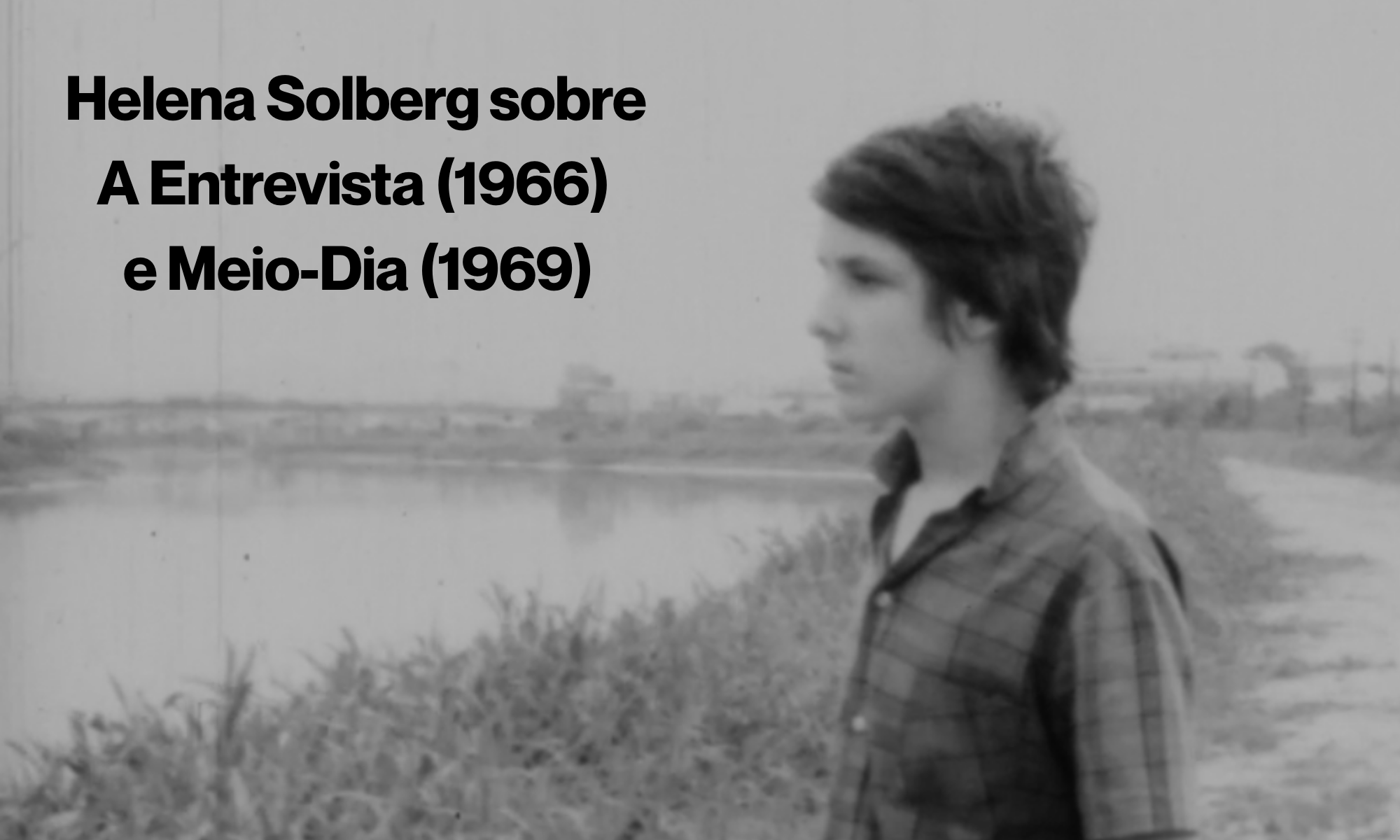
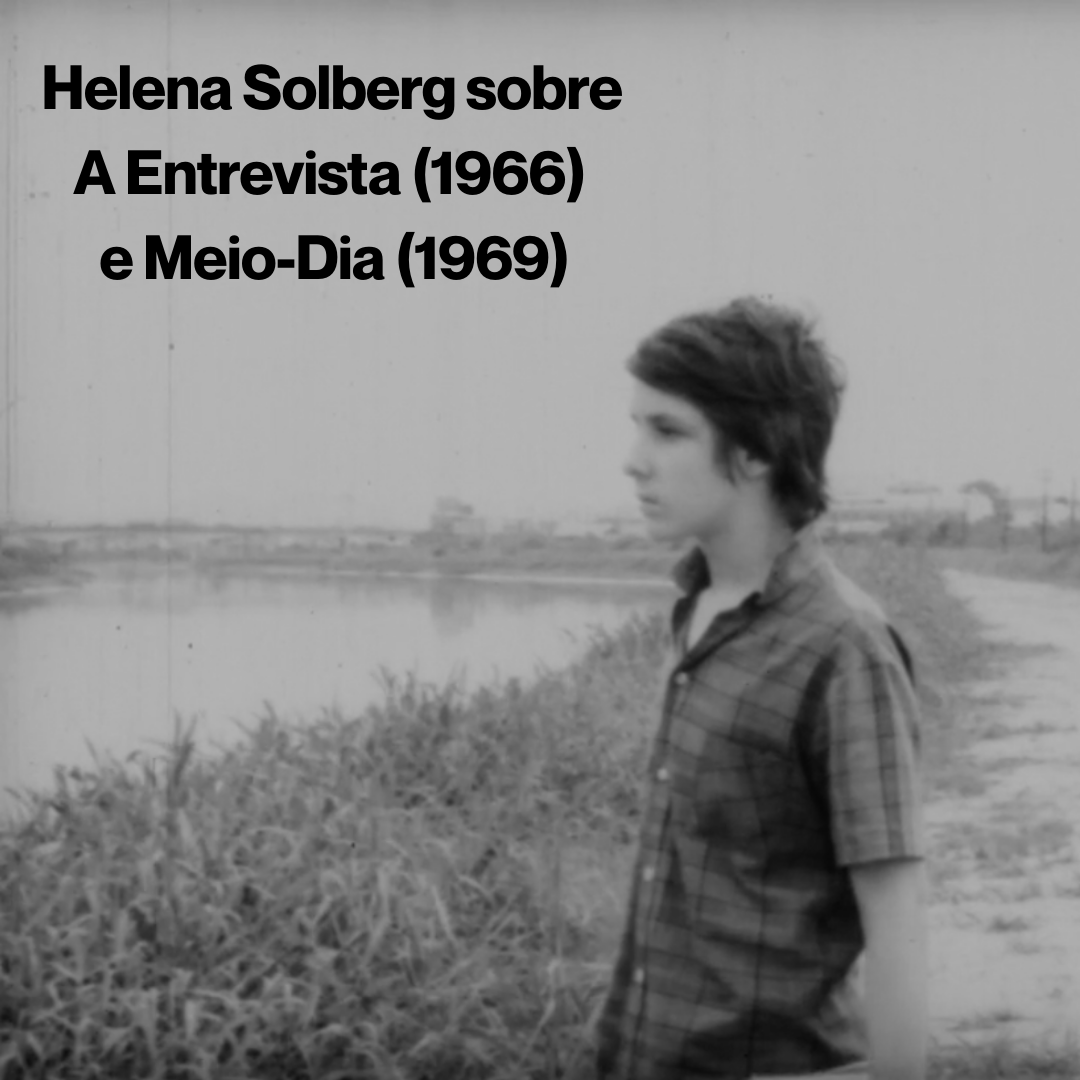
A importância de A Entrevista (1966) e Meio-Dia (1970), os dois primeiros filmes dirigidos por Helena Solberg, em muito transcende a posição de exceção ocupada por Helena Solberg como rara diretora mulher em um dos mais férteis períodos do cinema brasileiro. Os filmes são ótima porta de entrada em universo artístico singular que continuaria se desenvolvendo nas cinco décadas seguintes, com filmes de ficção e documentários, por vezes combinando elementos de ambos, deixando uma marca no Cinema Novo e no cinema marginal antes de se reestabelecer nos EUA, onde Solberg realizou notáveis documentários políticos. Nesta entrevista, conversamos sobre suas lembranças desses dois primeiros curtas, e como eles se relacionam com o momento político, cutural, e social desua realização, e anunciam preocupações que continuarão presentes em seu trabalho posterior.

Fábio Andrade: Antes de começar a fazer cinema, já no curso de Línguas Neolatinas da PUC do Rio de Janeiro, você trabalha como repórter no O Metropolitano. Como você percebe essa passagem do jornalismo ao cinema? Naturalmente, pergunto isso levando em conta A Entrevista (1966), mas não necessariamente como inspiração direta para o filme, uma vez que a trajetória do jornalismo e da crítica para o cinema já era razoavelmente comum.

Helena Solberg: A relação da minha geração com a literatura foi muito forte. A escrita foi minha primeira ferramenta de expressão. Aos 16 anos escrevi uma pequena novela que infelizmente destruí num gesto dramático adolescente. O Jornalismo satisfazia, de certa forma, essa necessidade. Na época, entrevistei, para a revista Manchete, Clarice Lispector, pela qual tinha imensa admiração. Também Lygia Fagundes Telles, Zulmira Ribeiro Tavares, Edla Van Steen foram referências naquele momento. Para o jornal Metropolitano entrevistei Graham Greene, Aldous Huxley, Simone de Beauvoir e Camus, que era um ídolo. Cheguei a traduzir um capítulo do Homem Revoltado para o jornal. A literatura francesa foi a primeira paixão; na faculdade foi a descoberta da brasileira e da latino-americana.

Acho que são momentos de conjunção. O cinema parecia uma opção válida e possível. O surgimento do Cinema Novo  foi uma fonte de inspiração, a cinefilia e o cineclubismo, como você mencionou, tiveram também um papel importante naquele momento. A Nouvelle Vague, o Neorrealismo Italiano, o ISEB (Instituto Superior de Estudos Brasileiros), com suas palestras com professores que admirávamos, também trouxeram uma efervescência intelectual e contribuíram para esse momento, apesar de estarmos vivendo uma ditadura.

Éramos jovens e achávamos que podíamos mudar o mundo!

FA: Para realizar A Entrevista, você conversou com cerca de 70 mulheres que compartilhavam com você alguns dados de origem social. Como foi o processo de estruturação do filme a partir desse material? Havia muitas dissonâncias, muitos filmes possíveis além do filme que você escolheu fazer? Ou o conceito já estava delineado antes da gravação dessas conversas?

HS: Pensei inicialmente em um filme de depoimentos filmados.

Como acontece muitas vezes no documentário, o inesperado me obrigou a encontrar outra solução, que afinal foi muito melhor.

Eu não quis abandonar o projeto com a recusa das moças serem filmadas. Gravei eu mesma as entrevistas (dá pra notar que o som é muito ruim!) com um gravador Nagra (o único no RJ naquele momento) disponibilizado por Arne Sucksdorff. Com a transcrição das entrevistas que me pareciam mais relevantes e a ajuda de uma psicóloga e uma socióloga que eram minhas amigas, estabeleci os temas comuns. Aí decidi centralizar a ação numa única mulher, executando o conhecido ritual que dela esperava sua classe: “colégio certo”, formatura de “enfeite” e casamento conveniente de grande estilo. Eu queria desconstruir e criar um assincronismo entre a imagem e o som, e assim acentuar todas as incoerências, as ideias mal digeridas, as contradições.

FA: Fico curioso também como formato das entrevistas. As perguntas eram sempreas mesmas? As entrevistas eramsempre individuais, ou em algum momento você reuniu mais de uma personagem namesma conversa?  

HS: As perguntas eram as mesmas. Eu as havia organizado e as tinha em mãos. As entrevistas eram sempre individuais, mas às vezes a entrevistada se emocionava ou se entusiasmava e explorava outros assuntos. Senti, muitas vezes, que eram desabafos, uma necessidade de botar pra fora. Muitos outros filmes poderiam ter sido feitos daquele material riquíssimo!

FA: Há um conservadorismo latente no imaginário das mulheres que conversam com você nesse filme. Isso foi algo que te surpreendeu no processo de filmagem, ou era justamente uma percepção que você já tinha e buscou registrar?

HS: Eu já intuía o conservadorismo com o qual já havia convivido bastante ao meu redor . Na abertura do filme, o álbum de família  com imagens da celebração de aniversários, casamentos, formaturas etc… que é uma síntese do filme.  Coloquei na trilha sonora a gargalhada de uma bruxa sinistra que diz que irá anunciar suas profecias no final. E realmente elas se realizam nas últimas imagens do filme!

Esses álbuns que utilizei eram de pessoas conhecidas com as quais eu havia convivido no colégio ou na faculdade.

FA: Arnaldo Jabor's A Opinião Pública (1967), de Arnaldo Jabor, é frequentemente apontado como o primeiro documentário do Cinema Novo que se debruça sobre o imaginário da classe média brasileira. No entanto, A Entrevista já realiza esse mergulho um ano antes, algo que talvez tenha ficado historicamente ofuscado por esse universo ser também feminino, o que o torna ainda mais específico. Como você percebia as intersecções entre classe e gênero na concepção e realização do filme?

HS: Faço questão de esclarecer no início do filme que as entrevistas foram feitas com mulheres de uma mesma classe social. As questões de classe e gênero estão presentes na trilogia dos filmes que fiz fora do Brasil, The Emerging Woman (1974), The Double Day (1975) and Simplesmente Jenny (1977). Foi sempre uma preocupação procurar não generalizar, já que as realidades são distintas e acarretam diferentes experiências e narrativas.

Gosto muito de A Opinião Pública e Jabor é um velho amigo. Eu estava morando fora do Brasil quando foi lançado e não me lembro de termos, alguma vez, conversado a respeito. Glauber foi fundamental pois me deu a dica sobre a CAIC, onde poderia conseguir algum apoio e me mostrou o caminho das pedras…

O foco na classe média já havia sido apontado no Cinema Novo em filmes como O Desafio (1965), de Saraceni. Mas a ênfase era em personagens masculinos.

Em Capitu (1968), de Saraceni, fiz continuidade, e ficou provado que ser continuísta não era minha vocação, já que perdia a claquete o tempo todo! Mas foi aí que Mário Carneiro, que era o diretor de fotografia, e eu, nos tornamos amigos e o convidei para trabalhar na A Entrevista.

A Entrevista nunca teve qualquer tipo de distribuição ou lançamento oficial. Eram sessões quase privadas. Concorreu a  alguns festivais internacionais, como o Festival Dei Popoli, em Firenze. Ele foi enviado pelo Cosme Alves Netto, diretor da Cinemateca do Museu De Arte Moderna na época, que gostava muito do filme.

Recentemente recebi um surpreendente email de Este, uma pequena cidade na província de Pádua, perto de Veneza, com 17.000 habitantes. O email me comunicava que haviam encontrado, dentro de um armário, em uma pequena escola elementar, fechada há muitos anos, uma cópia do meu filme A Entrevista. Era comum cópias de filmes se perderem em festivais! Este, a cidade, tem um centro cultural - La Medusa - e resolveram fazer uma projeção lá do filme, com convidados e alguns críticos de cinema. Achei a história surreal e maravilhosa, que meu filme havia sobrevivido 50 anos num armário na Itália! Fiquei amiga de Beatrice e Jacomo do Centro, que, através de algumas reuniões no Zoom, me pediram que respondesse algumas perguntas sobre o filme. A principal sendo "como vão as mulheres hoje no Brasil?" Pergunta imensa que talvez vou tentar examinar em um próximo filme. Talvez…

FA: Há também um gesto muito forte do filme de transitar entre o específico e o comum. Muito embora a cartela identifique o recorte social das entrevistas, as vozes são "trançadas" - para usar uma bela imagem do próprio filme - sem alguma distinção mais objetiva entre elas (créditos ou mesmo imagens), e a presença física de Glória Solberg é singularizada ao mesmo tempo que parece representar todas aquelas mulheres, de forma que a própria ideia de indivíduo se complique. Uma vez que o filme é, também, um estudo de classe, como você percebia ou percebe hoje esse atravessamento entre o individual e o comum? (É inevitável reparar como isso permanece no seu horizonte em filmes como Simplesmente Jenny e Bananas is my Business, entre outros).

HS: Gosto muito dessa pergunta. É dessas perguntas que nos denunciam revelando a nós mesmos às vezes alguns mecanismos inconscientes ou não, uma estratégia recorrente que não sei se é bom ser denunciada. Pensei em Alberto Cavalcanti, quando nos ensinou que se quisermos fazer um filme sobre os Correios devemos seguir uma carta, um recurso de narrativa que permite a síntese, ideias e conceitos que queremos explorar… Enfim, acho que tem sido usado desde que o mundo é mundo!

FA: Vistos em conjunto, Meio-Dia (1968) e A Entrevista formam um par interessante tanto pelo que eles compartilham quanto por onde divergem. A primeira coisa que chama atenção é a recorrência da educação como um agente organizador das sensibilidades. Isso era algo que te interessava já na concepção dos projetos, ou ele decorre de outras decisões do processo de realização?

HS: Falo de um momento onde a educação era rígida e tinha um papel fundamental, assim como a religião.

Minha educação foi, de certa maneira, singular. Uma mãe extremamente católica e um pai norueguês que não se opunha às carolices dela e procurava seguir os rituais da sociedade a que elegeu se integrar. Mas percebíamos uma falta de convicção que permitia uma brecha para duvidarmos dos rituais que deviam ser observados, uma certa ironia… Também acredito que o fato de ter três irmãos homens, o ambiente em casa, diria que era muito “masculino”. Sempre desejei ter uma irmã em casa para aliviar o clima. Minha mãe, bem tarde na vida, leu um livro que lhe dei de Jacques e Raissa Maritain (católicos de esquerda) e também de Alceu de Amoroso Lima, que colocaram em dúvida muitas de suas crenças e acho que abriu uma janela! Dos cinco aos doze anos, estive em um semi-internato de freiras, o Sacre Coeur de Jesus, depois as Ursulinas e o Notre Dame. Só na Faculdade fui conviver na sala de aula com meninos. Acho que a educação deixa, sim, marcas em nossa formação.

A religião foi a primeira explicação do mundo que me foi dada, e bem cedo não bastou.

FA: Há também uma presença lateral da religião no filme, seja pela imagem da santa ou pela oração que acompanha os créditos. Qual era o papel da religião pra você nesse imaginário que estava retratando?

HS: Como disse, a religião teve um papel importante na minha infância e início da adolescência. Mas logo tornou-se insuficiente. Mas continuou a existir acho que na minha mitologia pessoal, por assim dizer. Fiz um filme chamado A Terra Proibida sobre a Teologia da Libertação, as invasões de terra e a tentativa do Vaticano de proibir esse movimento. Foi uma experiência muito forte de estar em contato com pessoas como Dom Pedro Casaldáliga no Araguaia e o chamado Povo de Deus nas invasões de terra onde filmamos. Estou com um projeto que não sei se será realizado, por causa da situação política atual, sobre a Teologia da Prosperidade e os evangélicos.

FA: Há um interesse comum pela juventude em ambos os filmes que parece apontar para diferentes atitudes diante do futuro - no caso de A Entrevista, a assimilação pela TFP (Tradição Família e Propriedade) e o que ela representava naquele momento político, para aquele grupo social; em Meio-Dia, o confronto com a autoridade, encarnada pelo professor, que é também representante de uma outra geração dentro do filme. Talvez uma das vozes de A Entrevista diria que há um "excesso de liberdade" na vida dos personagens de Meio-Dia. Você acha que entre os dois filmes houve uma mudança na percepção de como diferentes gerações lidavam com a presença duradoura da ditadura militar?

HS: Certamente, no mundo todo havia uma sede de mudança e 68 foi um ano em que a juventude foi às ruas, um ano libertário e também de grandes confrontos. O movimento hippie mexeu com a questão do corpo e da sexualidade. A pílula anticoncepcional foi fundamental para as mulheres da geração da década seguinte à minha.

Leila Diniz e Dina Sfat foram exemplos dessa nova mulher! Helena Ignez as antecedeu com os personagens que assumiu nos filmes de Rogério Sganzerla.

FA: Há também curiosas divergências de método. A Entrevista parte de um material de som direto, conferindo a ele inclusive a importância de estar no título. No entanto, ao final, a promessa documental é quebrada pela encenação que se revela. Já Meio-Dia cria um desenho sonoro em pós-produção que acentua o caráter encenado do filme. No entanto, há referências diretas ao momento político do Brasil naquele momento - como a pixação no muro sobre a ditadura militar - que investem numa tensão documental. Esse trânsito entre o documentário e a ficção permanecerá em sua obra, e estes primeiros filmes já mostram um tensionamento extremo dessas fronteiras. Era possível fazer ficção sem documentário no Brasil naquele momento, ou vice-versa?

HS: Na A Entrevista a referência é 64. No Meio-Dia estávamos às vésperas do AI-5, em 68. O recrudescimento da ditadura era evidente e aterrador. Eu morava em São Paulo e tinha recebido de um grupo de ativistas, um militante, cujo nome não nos foi revelado, e que acolhemos por um mês, até que seus documentos estivessem prontos para sair com segurança do país. Eu já havia sido detida por 24 horas em uma manifestação.

Amigos próximos tiveram filhos presos por estarem pichando nas ruas slogans contra o governo. Meus filhos eram pequenos, mas pensei que poderiam ser eles.

Havia uma grande efervescência política entre os cineastas. A casa de Thomaz Farkas era um centro de encontro, e, junto com Melanie, sua mulher, conseguia reunir intelectuais, cineastas e artistas plásticos.Vinda do Rio de Janeiro, foi aí que passei a conhecer a turma de São Paulo. Assisti um curso de Paulo Emílio Salles Gomes, que foi a única experiência formal que tive sobre a história do cinema.

O recurso da ficção, das metáforas, era uma maneira de expressarmos o que sentíamos e estávamos impedidos de falar. Logo na primeira cena do filme, o personagem (João Farkas, filho de Tomaz Farkas) coloca um saco de plástico no rosto, simulando um sufocamento, uma alusão direta à censura e à tortura.

Penso não ser coincidência ter realizado meu curta Meio-Dia nesse momento em que a música de Caetano era uma inspiração. No meu roteiro, a sequência da rebelião na sala de aula, o ataque ao professor, a destruição da escola, acontece na imaginação do menino, depois de jogar seus livros nas águas de um rio e o vento nas suas folhas nos carregar para outro lugar. Era pelo menos essa a intenção.

Durante muito tempo guardei esse filme, pois viajei logo depois para fora do Brasil. Com a Abertura, fiquei preocupada achando que ele tinha características anarquistas e incentivava a violência em um momento de reconstrução. Hoje, gosto de chamá-lo um ensaio poético. Em 82, fizemos o The Brazilian Connection, sobre a Abertura, e foi uma alegria sentir a volta à democracia no país. Entrevistamos um Lula ainda líder sindical, Fernando Henrique candidato a senador, Severo Gomez e muitos outros.

FA: Fico também curioso com o trabalho sonoro. Uma vez que os filmes vistos em conjunto parecem ressaltar uma investigação sobre os gêneros masculino (em Meio-Dia) e feminino (em A Entrevista), me interessa saber o papel que o tratamento sonoro desempenhava nesse seu olhar sobre essas questões. É curioso que A Entrevista seja tão focado na palavra falada, por exemplo, enquanto em Meio-Dia ela é uma espécie de pontuação poética, música e gráfica num universo primordialmente masculino onde a voz não é tão determinante.

HS: Sinceramente, nunca havia pensado nisso. Meio-Dia foi realizado tipo “guerrilha”, com tremenda urgência. Fiz um crowdfunding entre amigos para o aluguel da câmera, o negativo, moviola e o fotógrafo. Filmamos em 35mm e José Marreco fez a fotografia. Acho que Teresa Trautman, casada com o Marreco, fez o som. Eu mesma montei, com ajuda de um operador. A música de Caetano era perfeita e foi a inspiração do projeto. Meio-Dia é um delírio! As palavras são as de Caetano, que nos dizia que era proibido proibir.

FA: Muito foi escrito e dito sobre seu posicionamento pioneiro como cineasta mulher dentro do Cinema Novo e do cinema brasileiro. Existiam referências femininas fazendo filmes no mundo naquele momento que eram importantes para você?

HS: Agnès Varda certamente foi uma inspiração. O seu filme Le Bonheur (1965) é surpreendente. A imagem da felicidade, do ritual de um casamento perfeito que é desfeito de uma forma perversa, casual, me pegou desprevenida. Todos os seus filmes são originais. Chantal Akerman, Claire Denis, Lucrécia Martel são cineastas mulheres cujos filmes sempre me interessaram.

FA: É clara a dominação masculina no Cinema Novo levando em conta os diretores e criadores mais pronunciados dos filmes. A sua posição ali de fato era solitária, ou existiam outras mulheres artistas e intelectuais que circulavam pelo grupo em outras posições, materializadas em filmes ou não, que não tiveram seu devido reconhecimento histórico?

HS: As mulheres em geral naquele momento tinham mais destaque no cinema como atrizes, produtoras e montadoras.

Não conhecia a diretora Adélia Sampaio. Vou conhecê-la agora em um festival, numa mesa que vamos participar em Minas Gerais, e parece que somos contemporâneas. Vai ser interessante termos a chance de dialogar.

Ana Carolina era fotógrafa quando a conheci em São Paulo. Quando fiz o The Double Day e Simplesmente Jenny, filmados em quatro países da America do Sul, quis incluir brasileiros no projeto. Affonso Beato foi o diretor de fotografia, Tetê Moraes e Rose Lacreta trabalharam na pesquisa, e até Ana Carolina se uniu a nós por um momento. No cinema brasileiro, pesquisadoras que examinaram esses anos não apontam outros nomes, que eu saiba.

FA: Para finalizar, gostaria de saber sobre o uso da canção de Caetano Veloso em Meio-Dia. Há naturalmente um aspecto textual ali, mas é inevitável pensar em como uma intersecção com a Tropicália está também presente no seu imaginário, levando a um filme como Bananas is my Business.

Incontornável tanto no Cinema Novo quanto no cinema marginal, pela relação de trabalho com Sganzerla em A Entrevista e em A Mulher de Todos (1969), mas fico curioso em saber sua percepção do projeto político e artístico da Tropicália também como leitura do Brasil.

HS: Nos anos mais importantes da Tropicália, eu estava fora do Brasil, fazendo filmes no exterior. Quando retorno definitivamente, faço, entre outros filmes, o Palavra (En)cantada (2008), que é um olhar abrangente sobre a música popular brasileira, onde a Tropicália tem o lugar de honra que merece.  

Rogério Sganzerla foi uma pessoa importante na sua irreverência, ironia e imensa criatividade. Fomos grandes amigos até o final, quando estava muito doente. A Mulher de Todos teve algumas sequências filmadas em minha casa em São Paulo. Acompanhei as filmagens também em Santos. Com dois filhos pequenos, era impossível me envolver mais naquele momento.

A importância de A Entrevista (1966) e Meio-Dia (1970), os dois primeiros filmes dirigidos por Helena Solberg, em muito transcende a posição de exceção ocupada por Helena Solberg como rara diretora mulher em um dos mais férteis períodos do cinema brasileiro. Os filmes são ótima porta de entrada em universo artístico singular que continuaria se desenvolvendo nas cinco décadas seguintes, com filmes de ficção e documentários, por vezes combinando elementos de ambos, deixando uma marca no Cinema Novo e no cinema marginal antes de se reestabelecer nos EUA, onde Solberg realizou notáveis documentários políticos. Nesta entrevista, conversamos sobre suas lembranças desses dois primeiros curtas, e como eles se relacionam com o momento político, cutural, e social desua realização, e anunciam preocupações que continuarão presentes em seu trabalho posterior.

Fábio Andrade: Antes de começar a fazer cinema, já no curso de Línguas Neolatinas da PUC do Rio de Janeiro, você trabalha como repórter no O Metropolitano. Como você percebe essa passagem do jornalismo ao cinema? Naturalmente, pergunto isso levando em conta A Entrevista (1966), mas não necessariamente como inspiração direta para o filme, uma vez que a trajetória do jornalismo e da crítica para o cinema já era razoavelmente comum.

Helena Solberg: A relação da minha geração com a literatura foi muito forte. A escrita foi minha primeira ferramenta de expressão. Aos 16 anos escrevi uma pequena novela que infelizmente destruí num gesto dramático adolescente. O Jornalismo satisfazia, de certa forma, essa necessidade. Na época, entrevistei, para a revista Manchete, Clarice Lispector, pela qual tinha imensa admiração. Também Lygia Fagundes Telles, Zulmira Ribeiro Tavares, Edla Van Steen foram referências naquele momento. Para o jornal Metropolitano entrevistei Graham Greene, Aldous Huxley, Simone de Beauvoir e Camus, que era um ídolo. Cheguei a traduzir um capítulo do Homem Revoltado para o jornal. A literatura francesa foi a primeira paixão; na faculdade foi a descoberta da brasileira e da latino-americana.

Acho que são momentos de conjunção. O cinema parecia uma opção válida e possível. O surgimento do Cinema Novo  foi uma fonte de inspiração, a cinefilia e o cineclubismo, como você mencionou, tiveram também um papel importante naquele momento. A Nouvelle Vague, o Neorrealismo Italiano, o ISEB (Instituto Superior de Estudos Brasileiros), com suas palestras com professores que admirávamos, também trouxeram uma efervescência intelectual e contribuíram para esse momento, apesar de estarmos vivendo uma ditadura.

Éramos jovens e achávamos que podíamos mudar o mundo!

FA: Para realizar A Entrevista, você conversou com cerca de 70 mulheres que compartilhavam com você alguns dados de origem social. Como foi o processo de estruturação do filme a partir desse material? Havia muitas dissonâncias, muitos filmes possíveis além do filme que você escolheu fazer? Ou o conceito já estava delineado antes da gravação dessas conversas?

HS: Pensei inicialmente em um filme de depoimentos filmados.

Como acontece muitas vezes no documentário, o inesperado me obrigou a encontrar outra solução, que afinal foi muito melhor.

Eu não quis abandonar o projeto com a recusa das moças serem filmadas. Gravei eu mesma as entrevistas (dá pra notar que o som é muito ruim!) com um gravador Nagra (o único no RJ naquele momento) disponibilizado por Arne Sucksdorff. Com a transcrição das entrevistas que me pareciam mais relevantes e a ajuda de uma psicóloga e uma socióloga que eram minhas amigas, estabeleci os temas comuns. Aí decidi centralizar a ação numa única mulher, executando o conhecido ritual que dela esperava sua classe: “colégio certo”, formatura de “enfeite” e casamento conveniente de grande estilo. Eu queria desconstruir e criar um assincronismo entre a imagem e o som, e assim acentuar todas as incoerências, as ideias mal digeridas, as contradições.

FA: Fico curioso também como formato das entrevistas. As perguntas eram sempreas mesmas? As entrevistas eramsempre individuais, ou em algum momento você reuniu mais de uma personagem namesma conversa?  

HS: As perguntas eram as mesmas. Eu as havia organizado e as tinha em mãos. As entrevistas eram sempre individuais, mas às vezes a entrevistada se emocionava ou se entusiasmava e explorava outros assuntos. Senti, muitas vezes, que eram desabafos, uma necessidade de botar pra fora. Muitos outros filmes poderiam ter sido feitos daquele material riquíssimo!

FA: Há um conservadorismo latente no imaginário das mulheres que conversam com você nesse filme. Isso foi algo que te surpreendeu no processo de filmagem, ou era justamente uma percepção que você já tinha e buscou registrar?

HS: Eu já intuía o conservadorismo com o qual já havia convivido bastante ao meu redor . Na abertura do filme, o álbum de família  com imagens da celebração de aniversários, casamentos, formaturas etc… que é uma síntese do filme.  Coloquei na trilha sonora a gargalhada de uma bruxa sinistra que diz que irá anunciar suas profecias no final. E realmente elas se realizam nas últimas imagens do filme!

Esses álbuns que utilizei eram de pessoas conhecidas com as quais eu havia convivido no colégio ou na faculdade.

FA: Arnaldo Jabor's A Opinião Pública (1967), de Arnaldo Jabor, é frequentemente apontado como o primeiro documentário do Cinema Novo que se debruça sobre o imaginário da classe média brasileira. No entanto, A Entrevista já realiza esse mergulho um ano antes, algo que talvez tenha ficado historicamente ofuscado por esse universo ser também feminino, o que o torna ainda mais específico. Como você percebia as intersecções entre classe e gênero na concepção e realização do filme?

HS: Faço questão de esclarecer no início do filme que as entrevistas foram feitas com mulheres de uma mesma classe social. As questões de classe e gênero estão presentes na trilogia dos filmes que fiz fora do Brasil, The Emerging Woman (1974), The Double Day (1975) and Simplesmente Jenny (1977). Foi sempre uma preocupação procurar não generalizar, já que as realidades são distintas e acarretam diferentes experiências e narrativas.

Gosto muito de A Opinião Pública e Jabor é um velho amigo. Eu estava morando fora do Brasil quando foi lançado e não me lembro de termos, alguma vez, conversado a respeito. Glauber foi fundamental pois me deu a dica sobre a CAIC, onde poderia conseguir algum apoio e me mostrou o caminho das pedras…

O foco na classe média já havia sido apontado no Cinema Novo em filmes como O Desafio (1965), de Saraceni. Mas a ênfase era em personagens masculinos.

Em Capitu (1968), de Saraceni, fiz continuidade, e ficou provado que ser continuísta não era minha vocação, já que perdia a claquete o tempo todo! Mas foi aí que Mário Carneiro, que era o diretor de fotografia, e eu, nos tornamos amigos e o convidei para trabalhar na A Entrevista.

A Entrevista nunca teve qualquer tipo de distribuição ou lançamento oficial. Eram sessões quase privadas. Concorreu a  alguns festivais internacionais, como o Festival Dei Popoli, em Firenze. Ele foi enviado pelo Cosme Alves Netto, diretor da Cinemateca do Museu De Arte Moderna na época, que gostava muito do filme.

Recentemente recebi um surpreendente email de Este, uma pequena cidade na província de Pádua, perto de Veneza, com 17.000 habitantes. O email me comunicava que haviam encontrado, dentro de um armário, em uma pequena escola elementar, fechada há muitos anos, uma cópia do meu filme A Entrevista. Era comum cópias de filmes se perderem em festivais! Este, a cidade, tem um centro cultural - La Medusa - e resolveram fazer uma projeção lá do filme, com convidados e alguns críticos de cinema. Achei a história surreal e maravilhosa, que meu filme havia sobrevivido 50 anos num armário na Itália! Fiquei amiga de Beatrice e Jacomo do Centro, que, através de algumas reuniões no Zoom, me pediram que respondesse algumas perguntas sobre o filme. A principal sendo "como vão as mulheres hoje no Brasil?" Pergunta imensa que talvez vou tentar examinar em um próximo filme. Talvez…

FA: Há também um gesto muito forte do filme de transitar entre o específico e o comum. Muito embora a cartela identifique o recorte social das entrevistas, as vozes são "trançadas" - para usar uma bela imagem do próprio filme - sem alguma distinção mais objetiva entre elas (créditos ou mesmo imagens), e a presença física de Glória Solberg é singularizada ao mesmo tempo que parece representar todas aquelas mulheres, de forma que a própria ideia de indivíduo se complique. Uma vez que o filme é, também, um estudo de classe, como você percebia ou percebe hoje esse atravessamento entre o individual e o comum? (É inevitável reparar como isso permanece no seu horizonte em filmes como Simplesmente Jenny e Bananas is my Business, entre outros).

HS: Gosto muito dessa pergunta. É dessas perguntas que nos denunciam revelando a nós mesmos às vezes alguns mecanismos inconscientes ou não, uma estratégia recorrente que não sei se é bom ser denunciada. Pensei em Alberto Cavalcanti, quando nos ensinou que se quisermos fazer um filme sobre os Correios devemos seguir uma carta, um recurso de narrativa que permite a síntese, ideias e conceitos que queremos explorar… Enfim, acho que tem sido usado desde que o mundo é mundo!

FA: Vistos em conjunto, Meio-Dia (1968) e A Entrevista formam um par interessante tanto pelo que eles compartilham quanto por onde divergem. A primeira coisa que chama atenção é a recorrência da educação como um agente organizador das sensibilidades. Isso era algo que te interessava já na concepção dos projetos, ou ele decorre de outras decisões do processo de realização?

HS: Falo de um momento onde a educação era rígida e tinha um papel fundamental, assim como a religião.

Minha educação foi, de certa maneira, singular. Uma mãe extremamente católica e um pai norueguês que não se opunha às carolices dela e procurava seguir os rituais da sociedade a que elegeu se integrar. Mas percebíamos uma falta de convicção que permitia uma brecha para duvidarmos dos rituais que deviam ser observados, uma certa ironia… Também acredito que o fato de ter três irmãos homens, o ambiente em casa, diria que era muito “masculino”. Sempre desejei ter uma irmã em casa para aliviar o clima. Minha mãe, bem tarde na vida, leu um livro que lhe dei de Jacques e Raissa Maritain (católicos de esquerda) e também de Alceu de Amoroso Lima, que colocaram em dúvida muitas de suas crenças e acho que abriu uma janela! Dos cinco aos doze anos, estive em um semi-internato de freiras, o Sacre Coeur de Jesus, depois as Ursulinas e o Notre Dame. Só na Faculdade fui conviver na sala de aula com meninos. Acho que a educação deixa, sim, marcas em nossa formação.

A religião foi a primeira explicação do mundo que me foi dada, e bem cedo não bastou.

FA: Há também uma presença lateral da religião no filme, seja pela imagem da santa ou pela oração que acompanha os créditos. Qual era o papel da religião pra você nesse imaginário que estava retratando?

HS: Como disse, a religião teve um papel importante na minha infância e início da adolescência. Mas logo tornou-se insuficiente. Mas continuou a existir acho que na minha mitologia pessoal, por assim dizer. Fiz um filme chamado A Terra Proibida sobre a Teologia da Libertação, as invasões de terra e a tentativa do Vaticano de proibir esse movimento. Foi uma experiência muito forte de estar em contato com pessoas como Dom Pedro Casaldáliga no Araguaia e o chamado Povo de Deus nas invasões de terra onde filmamos. Estou com um projeto que não sei se será realizado, por causa da situação política atual, sobre a Teologia da Prosperidade e os evangélicos.

FA: Há um interesse comum pela juventude em ambos os filmes que parece apontar para diferentes atitudes diante do futuro - no caso de A Entrevista, a assimilação pela TFP (Tradição Família e Propriedade) e o que ela representava naquele momento político, para aquele grupo social; em Meio-Dia, o confronto com a autoridade, encarnada pelo professor, que é também representante de uma outra geração dentro do filme. Talvez uma das vozes de A Entrevista diria que há um "excesso de liberdade" na vida dos personagens de Meio-Dia. Você acha que entre os dois filmes houve uma mudança na percepção de como diferentes gerações lidavam com a presença duradoura da ditadura militar?

HS: Certamente, no mundo todo havia uma sede de mudança e 68 foi um ano em que a juventude foi às ruas, um ano libertário e também de grandes confrontos. O movimento hippie mexeu com a questão do corpo e da sexualidade. A pílula anticoncepcional foi fundamental para as mulheres da geração da década seguinte à minha.

Leila Diniz e Dina Sfat foram exemplos dessa nova mulher! Helena Ignez as antecedeu com os personagens que assumiu nos filmes de Rogério Sganzerla.

FA: Há também curiosas divergências de método. A Entrevista parte de um material de som direto, conferindo a ele inclusive a importância de estar no título. No entanto, ao final, a promessa documental é quebrada pela encenação que se revela. Já Meio-Dia cria um desenho sonoro em pós-produção que acentua o caráter encenado do filme. No entanto, há referências diretas ao momento político do Brasil naquele momento - como a pixação no muro sobre a ditadura militar - que investem numa tensão documental. Esse trânsito entre o documentário e a ficção permanecerá em sua obra, e estes primeiros filmes já mostram um tensionamento extremo dessas fronteiras. Era possível fazer ficção sem documentário no Brasil naquele momento, ou vice-versa?

HS: Na A Entrevista a referência é 64. No Meio-Dia estávamos às vésperas do AI-5, em 68. O recrudescimento da ditadura era evidente e aterrador. Eu morava em São Paulo e tinha recebido de um grupo de ativistas, um militante, cujo nome não nos foi revelado, e que acolhemos por um mês, até que seus documentos estivessem prontos para sair com segurança do país. Eu já havia sido detida por 24 horas em uma manifestação.

Amigos próximos tiveram filhos presos por estarem pichando nas ruas slogans contra o governo. Meus filhos eram pequenos, mas pensei que poderiam ser eles.

Havia uma grande efervescência política entre os cineastas. A casa de Thomaz Farkas era um centro de encontro, e, junto com Melanie, sua mulher, conseguia reunir intelectuais, cineastas e artistas plásticos.Vinda do Rio de Janeiro, foi aí que passei a conhecer a turma de São Paulo. Assisti um curso de Paulo Emílio Salles Gomes, que foi a única experiência formal que tive sobre a história do cinema.

O recurso da ficção, das metáforas, era uma maneira de expressarmos o que sentíamos e estávamos impedidos de falar. Logo na primeira cena do filme, o personagem (João Farkas, filho de Tomaz Farkas) coloca um saco de plástico no rosto, simulando um sufocamento, uma alusão direta à censura e à tortura.

Penso não ser coincidência ter realizado meu curta Meio-Dia nesse momento em que a música de Caetano era uma inspiração. No meu roteiro, a sequência da rebelião na sala de aula, o ataque ao professor, a destruição da escola, acontece na imaginação do menino, depois de jogar seus livros nas águas de um rio e o vento nas suas folhas nos carregar para outro lugar. Era pelo menos essa a intenção.

Durante muito tempo guardei esse filme, pois viajei logo depois para fora do Brasil. Com a Abertura, fiquei preocupada achando que ele tinha características anarquistas e incentivava a violência em um momento de reconstrução. Hoje, gosto de chamá-lo um ensaio poético. Em 82, fizemos o The Brazilian Connection, sobre a Abertura, e foi uma alegria sentir a volta à democracia no país. Entrevistamos um Lula ainda líder sindical, Fernando Henrique candidato a senador, Severo Gomez e muitos outros.

FA: Fico também curioso com o trabalho sonoro. Uma vez que os filmes vistos em conjunto parecem ressaltar uma investigação sobre os gêneros masculino (em Meio-Dia) e feminino (em A Entrevista), me interessa saber o papel que o tratamento sonoro desempenhava nesse seu olhar sobre essas questões. É curioso que A Entrevista seja tão focado na palavra falada, por exemplo, enquanto em Meio-Dia ela é uma espécie de pontuação poética, música e gráfica num universo primordialmente masculino onde a voz não é tão determinante.

HS: Sinceramente, nunca havia pensado nisso. Meio-Dia foi realizado tipo “guerrilha”, com tremenda urgência. Fiz um crowdfunding entre amigos para o aluguel da câmera, o negativo, moviola e o fotógrafo. Filmamos em 35mm e José Marreco fez a fotografia. Acho que Teresa Trautman, casada com o Marreco, fez o som. Eu mesma montei, com ajuda de um operador. A música de Caetano era perfeita e foi a inspiração do projeto. Meio-Dia é um delírio! As palavras são as de Caetano, que nos dizia que era proibido proibir.

FA: Muito foi escrito e dito sobre seu posicionamento pioneiro como cineasta mulher dentro do Cinema Novo e do cinema brasileiro. Existiam referências femininas fazendo filmes no mundo naquele momento que eram importantes para você?

HS: Agnès Varda certamente foi uma inspiração. O seu filme Le Bonheur (1965) é surpreendente. A imagem da felicidade, do ritual de um casamento perfeito que é desfeito de uma forma perversa, casual, me pegou desprevenida. Todos os seus filmes são originais. Chantal Akerman, Claire Denis, Lucrécia Martel são cineastas mulheres cujos filmes sempre me interessaram.

FA: É clara a dominação masculina no Cinema Novo levando em conta os diretores e criadores mais pronunciados dos filmes. A sua posição ali de fato era solitária, ou existiam outras mulheres artistas e intelectuais que circulavam pelo grupo em outras posições, materializadas em filmes ou não, que não tiveram seu devido reconhecimento histórico?

HS: As mulheres em geral naquele momento tinham mais destaque no cinema como atrizes, produtoras e montadoras.

Não conhecia a diretora Adélia Sampaio. Vou conhecê-la agora em um festival, numa mesa que vamos participar em Minas Gerais, e parece que somos contemporâneas. Vai ser interessante termos a chance de dialogar.

Ana Carolina era fotógrafa quando a conheci em São Paulo. Quando fiz o The Double Day e Simplesmente Jenny, filmados em quatro países da America do Sul, quis incluir brasileiros no projeto. Affonso Beato foi o diretor de fotografia, Tetê Moraes e Rose Lacreta trabalharam na pesquisa, e até Ana Carolina se uniu a nós por um momento. No cinema brasileiro, pesquisadoras que examinaram esses anos não apontam outros nomes, que eu saiba.

FA: Para finalizar, gostaria de saber sobre o uso da canção de Caetano Veloso em Meio-Dia. Há naturalmente um aspecto textual ali, mas é inevitável pensar em como uma intersecção com a Tropicália está também presente no seu imaginário, levando a um filme como Bananas is my Business.

Incontornável tanto no Cinema Novo quanto no cinema marginal, pela relação de trabalho com Sganzerla em A Entrevista e em A Mulher de Todos (1969), mas fico curioso em saber sua percepção do projeto político e artístico da Tropicália também como leitura do Brasil.

HS: Nos anos mais importantes da Tropicália, eu estava fora do Brasil, fazendo filmes no exterior. Quando retorno definitivamente, faço, entre outros filmes, o Palavra (En)cantada (2008), que é um olhar abrangente sobre a música popular brasileira, onde a Tropicália tem o lugar de honra que merece.  

Rogério Sganzerla foi uma pessoa importante na sua irreverência, ironia e imensa criatividade. Fomos grandes amigos até o final, quando estava muito doente. A Mulher de Todos teve algumas sequências filmadas em minha casa em São Paulo. Acompanhei as filmagens também em Santos. Com dois filhos pequenos, era impossível me envolver mais naquele momento.

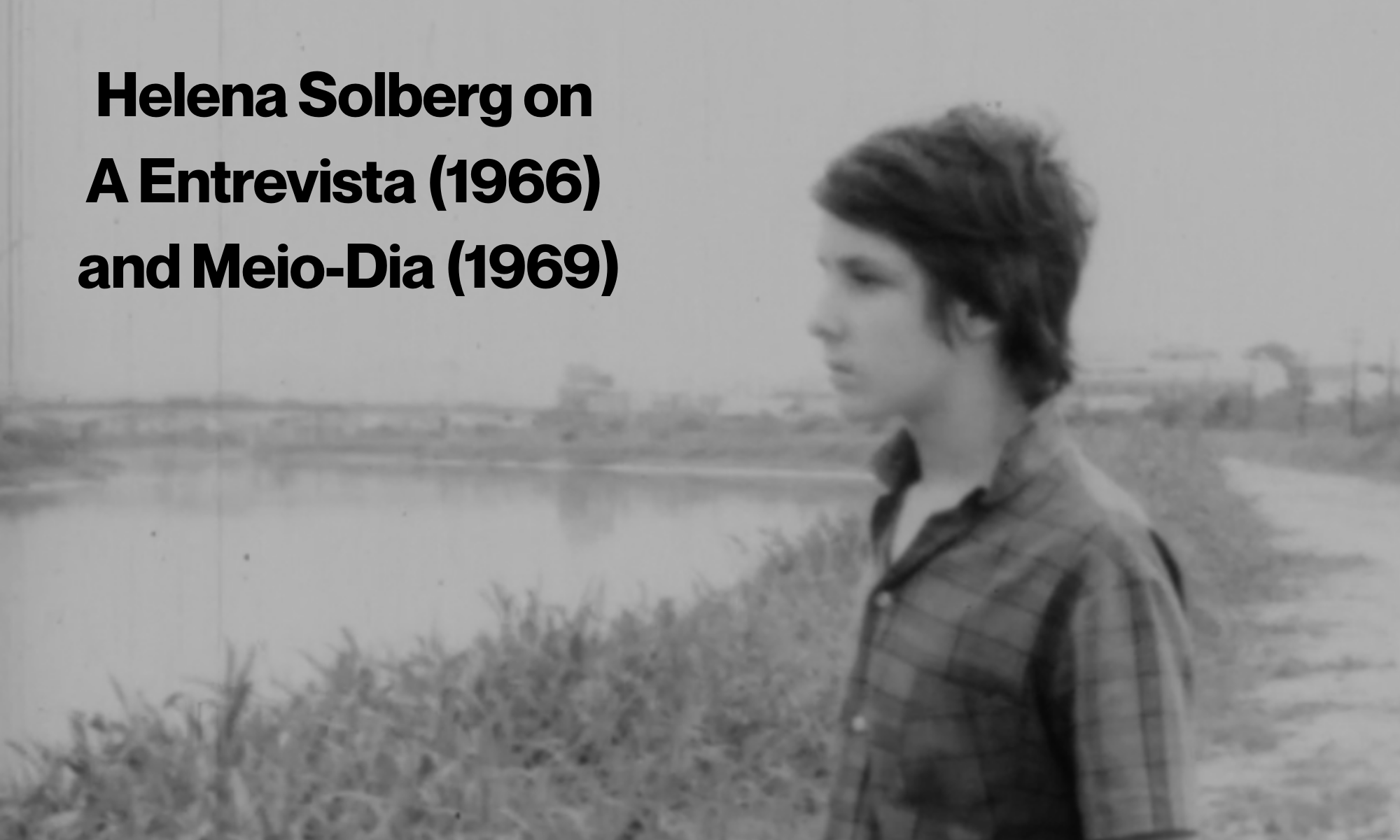
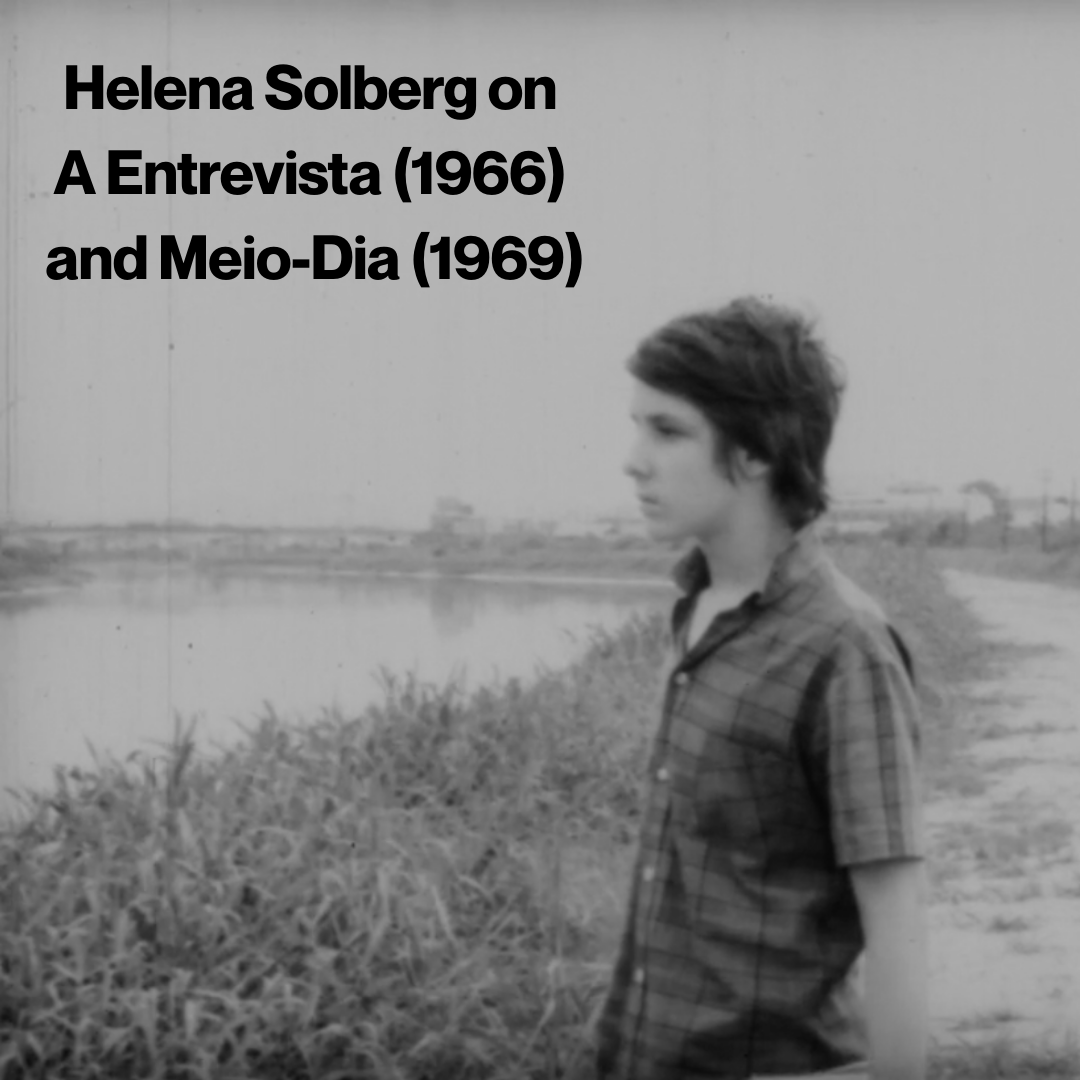
The importance of A Entrevista (1966) and Meio-Dia (1970),the two first films directed by Helena Solberg, far transcends itself exceptional position occupied by Helena Solberg as a rare case of a woman director in one of the most fertile periods of Brazilian cinema. The films are great introductions to a singular artistic world that would be developed in the following five decades in documentary and fiction films, sometimes combining elements of both, and that would leave a mark in both Cinema Novo and cinema marginal in Brazil before relocating to the United States, where Solberg made a number of remarkable political documentaries. In this interview, we talked about her memories of these two first short films, and how they overlapped with the political, cultural and social life of their moment, as well as announced preoccupations that would keep being explored in her later work.

Fábio Andrade: Before you started making films, you were studying Romance languages at PUC university in Rio de Janeiro. During the same time, you worked as a reporter at O Metropolitano. How do you perceive this transition from journalism to cinema? Of course, while I ask this with A Entrevista (1966) in mind, I’m not necessarily implying that transition was a direct inspiration for the film. Especially since the trajectory from journalism and criticism to cinema was already fairly widespread.  

Helena Solberg: My generation's relationship with literature was very strong. Writing was my first tool of expression. At 16, I wrote a short novel that I unfortunately destroyed in a dramatic adolescent gesture. At the time, I interviewed Clarice Lispector, who I admired immensely, for Manchete magazine, as well as Lygia Fagundes Telles, Zulmira Ribeiro Tavares and Edla Van Steen, who were my literary references at that moment. For the Metropolitano newspaper I interviewed Graham Greene, Aldous Huxley, Simone de Beauvoir and Camus, who was one of my idols.  I even translated a chapter of The Rebel for that same newspaper. French literature was my first passion; in college I discovered Brazilian and Latin American literature.

The emergence of Cinema Novo was a source of inspiration, cinephilia and the cine-clubs, as you mentioned, also played an important role at that moment. The Nouvelle Vague, the Italian Neorealism, and the ISEB (Instituto Superior de Estudos Brasileiros) with its lectures by professors we admired, also brought an intellectual effervescence and contributed to that moment. Even though we were living in a dictatorship.

We were young and we thought we could change the world!

FA: To make A Entrevista, you talked to about seventy women who shared details about their social backgrounds. How was the process of structuring the film based on this material? Were there many dissonances, many possible films other than the one you chose to make? Or was the concept already outlined before recording these conversations?

HS: Initially, I thought of making a film of recorded testimonials. As is often the case with documentaries, the unexpected forced me to find another way forward, which turned out to be much better.

I didn't want to abandon the project because the girls refused to be filmed. I recorded the interviews myself (you can tell the sound is very bad!) with a Nagra recorder provided by Arne Sucksdorff (the only one in Rio de Janeiro at the time). After transcribing the interviews that seemed most relevant to me and receiving the help of a psychologist and a sociologist who were friends of mine, I was able to establish the common themes of the film. Then I decided to center the action on a single woman who was fulfilling the well-known role that her social class expected of her: going to the "proper school", having a pretty graduation ceremony and marrying for convenience with a big wedding. I wanted to deconstruct and create an asynchronism between image and sound and thus accentuate all the incoherences, the poorly digested ideas, the contradictions.

FA: I am also curious about the format of the interviews. Were the questions always the same? Were the interviews always with an individual, or did you at some point bring more than one character together in the same conversation?  

HS: The questions were the same. I had organized them and had them in hand. The interviews were always with an individual, but sometimes the interviewee would get emotional or excited and explore other subjects. I often felt that these were outbursts, a need to get things out in the open. Many other films could have been made from this very rich material!

FA: There is a latent conservatism in the mentality of the women who talk to you in this film. Was this something that surprised you in the filming process, or was it precisely a perception that you already had and sought to register?

HS: I already sensed the conservatism that I had lived with around me. At the opening of the film, there is the family album with images of celebrating birthdays, weddings, graduations, etc... which is a synthesis of the film. I put on the soundtrack the laughter of a sinister witch who says she will announce her prophecies at the end. And they really come true in the last images of the film!

These albums that I used were by people I knew that I had lived with in high school or college.

FA: Arnaldo Jabor's A Opinião Pública (1967) is often pointed as the first Cinema Novo documentary that delves into the mentality of the Brazilian middle class. However, A Entrevista already carried that out a year earlier, something that perhaps has been historically overshadowed by the fact that its universe is also female, which makes it even more specific. How did you perceive the intersections between class and gender in the conception and making of the film?

HS: In A Entrevista I make a point of clarifying at the beginning of the film that the interviews were made with women of the same social class. The issues of class and gender are present in the trilogy of films that I made outside of Brazil, The Emerging Woman (1974), The Double Day (1975) and Simplesmente Jenny (1977). I was always aware to avoid generalizing, since the realities of those women were distinct and brought about different experiences and narratives.

I really like A Opinião Publica and Jabor is an old friend. I was living outside Brazil when it was released and I don't remember us ever discussing it. Glauber was more fundamental because he gave me a hint about the CAIC (Comissão de Auxílio à Indústria Cinematográfica) where I could get some support, and he showed me the ropes...

The middle class had already been the focus in Cinema Novo, in films like Saraceni's O Desafio (1965). But the emphasis in those films was on male characters.

In Saraceni's Capitu (1968), I was the continuity supervisor. I realised that was not my vocation since I lost the clapperboard all the time! But it was during Capitu that Mário Carneiro (who was the Director of Photography) and I became friends and I invited him to work on A Entrevista.

A Entrevista never had any kind of distribution or official release. Only almost-private sessions. It competed in some international festivals like Festival Dei Popoli in Firenze. It was submitted by Cosme Alves Netto, the director of the Cinemateca of the Museum of Modern Art at the time, who liked the film a lot.

Recently I received a surprising email from Este, a small town in the province of Padua, near Venice, with 17,000 inhabitants. The email informed me that they had found a copy of my film A Entrevista inside a cupboard in a small elementary school, which had remained closed for many years. It was common for copies of films to be lost at festivals! This town has a cultural center - La Medusa - and they decided to hold a screening of the film there, with guests and some film critics. I found it surreal and wonderful that my film had survived 50 years in a cupboard in Italy! I became friends with Beatrice and Jacomo from the Center who, through some meetings over Zoom, asked me to answer some questions about the film. The main one was how are women doing today in Brazil? This is a huge question that maybe I will try to examine in a future film...

FA: There is also a very strong gesture in the film of moving between the specific and the common. Even though the title card identifies the social approach of the interviews, the voices are "braided" - to use a beautiful image from the film itself - without any more objective distinction between them (credits or even images), and the physical presence of Glória Solberg is singularized at the same time that it seems to represent all those women, so that the very idea of individual is complicated. Since the film is also a study of class, how did you perceive or do you perceive today this crossing between the individual and the common? (It is inevitable to notice how this remains on your horizon in films like Simply Jenny and Bananas is my Business, among others).

HS: I really like this question. It is one of those questions which reveal to ourselves some mechanisms that may be unconscious, a recurring strategy that I don't know if it is good to be brought to light. It reminds me of Alberto Cavalcanti, who taught us that if we want to make a film about the Postal Service we should follow the trajectory of a letter, a narrative resource that allows for a synthesis of ideas and concepts that we want to explore... Anyway, I think that has been used since the beginning of time.

FA: Seen together, Meio-Dia (1968) and A Entrevista form an interesting pair both in what they share and where they diverge. The first thing that strikes me is the recurrence of education as an organizing agent of sensibilities. Was this something that interested you already in the conception of the projects, or does it stem from other decisions in the realization process?

HS: I speak of a time when education was strict and played a fundamental role, as did religion.

My upbringing was somewhat unique. An extremely Catholic mother and a Norwegian father who was not opposed to her quirks and tried to follow the rituals of the society he chose to integrate within. But we noticed that our father did things with a lack of conviction that allowed us to doubt the rituals that had to be observed, a certain irony... I also believe that the fact of having three male siblings made the atmosphere at home, I would say, very "masculine". I always wished I had a sister at home to lighten the atmosphere. My mother, very late in life, read a book I gave her by Jacques and Raissa Maritain (leftist Catholics) and another by Alceu de Amoroso Lima, which called into question many of her beliefs. I think these books opened a window for her!          

From the ages of 5 to 12 I was in a semi-boarding school for nuns, the Sacre Coeur de Jesus, and then the Ursulines and the Notre Dame. It was only in college that I had classes together with boys. I think that education does leave its mark on our formation.

Religion was the first explanation of the world that was given to me and very early on, it was not enough.

FA: There is also a lateral presence of religion in the film, be it through the image of the saint or the prayer that accompanies the credits. What was the role of religion for you in this imagery that you were portraying?

HS: As I said, religion played an important role in my childhood and early adolescence. But soon it became insufficient. But it continued to exist, I guess in my personal mythology, so to speak. I made a film called The Forbidden Land about Liberation Theology, the land invasions and the Vatican's attempt to ban that movement. It was a very strong experience to be in contact with people like Don Pedro Casaldáliga in Araguaia and the so-called People of God in the land invasions where we filmed. I have another project that may never be realized because of the current political situation about Prosperity Theology and Evangelicals.

FA: There is a common interest in youth in both films that seems to point to different attitudes towards the future - in the case of A Entrevista, the assimilation by the TFP1 and what it represented at that political moment, for that social group. In Meio-Dia, the confrontation with authority was embodied in the film by the teacher, who is also a representative of another generation within the film. Perhaps one of the voices in A Entrevista would say that there is an "excess of freedom" in the lives of the characters in Meio-Dia. Do you think that between the two films there was a change in the perception of how different generations dealt with the lasting presence of the military dictatorship?

HS: Certainly, all over the world there was a thirst for change, and '68 was a year that the youth took to the streets, a year of liberation and also of great confrontations. The hippie movement stirred the question of the body and sexuality. The contraceptive pill was fundamental for the women of the generation of the decade following mine.

Leila Diniz, Dina Sfat were examples of this new woman! Helena Ignez preceded them with the characters she took on in Rogério Sganzerla's films.

FA: There are also curious divergences in method. A Entrevista starts from direct sound material, conferring on it even the importance of being in the title. However, at the end, the documentary promise is broken when the staging is revealed. Meio-Dia creates a sound design in post-production that accentuates the staged nature of the film, yet there are direct references to the political moment in Brazil at that time - such as the graffiti on the wall about the military dictatorship - that invest in a documentary tension. This transit between documentary and fiction remains throughout your work, and these first films already show an extreme tension in these frontiers. Was it possible to make fiction without documentary in Brazil at that time, or vice-versa?

HS: In A Entrevista the reference is 1964, the year of the military coup. When we were making Meio-Dia, it was 1968, we were on the eve of the AI-5. The intensification of the dictatorship was evident and terrifying… I lived in São Paulo and I took in a militant from a group of activists whose name was not revealed to us, and whom we welcomed for a month until his documents were ready for him to leave the country safely. By then I had already been detained for 24 hours for participating in a demonstration.

Close friends saw their children arrested for spraying anti-government slogans on public walls. My children were small but I thought it could happen to them.

There was a great political effervescence among filmmakers. Thomaz Farkas' house was a meeting place and, together with his wife Melanie, they managed to bring together intellectuals, filmmakers and visual artists. I attended a course by Paulo Emilio Salles Gomes, which was the only formal experience I had about the history of cinema.

The resource of fiction, of metaphors, was a way for us to express what we felt and were unable to say. In the very first scene of the film, the character João Farkas (the son of Tomaz Farkas) puts a plastic bag over his face, simulating suffocation. This was a direct allusion to censorship and torture.  

I think it is no coincidence that I made my short film Meio-Dia at that moment when Caetano Veloso's music was an inspiration. In my script, the sequence of the rebellion in the classroom, the attack on the teacher, and the destruction of the school takes place in the boy's imagination, after he throws his books into a river and the wind in their pages carries us to another place! At least that was the intention!

I didn’t show that film for a long time, because I got out of Brazil soon after making it. When the Abertura2 came, I was worried that it had anarchist characteristics and encouraged violence in a moment of reconstruction! Today I like to consider it a poetic essay. In 82 we did The Brazilian Connection (1982) about the abertura and it was a joy to feel the return to democracy in the country. We interviewed Lula, still a union leader, Fernando Henrique, candidate for the senatorial elections, Severo Gomez and many others.

FA: I am also curious about the sound work. Since the films seen together seem to highlight an investigation into the masculine (in Meio-Dia) and feminine (in A Entrevista) genders, I'm interested in what role the sound treatment played in looking at these issues. It is curious that A Entrevista is so focused on the spoken word, for example, while in Meio-Dia it is a kind of poetic, musical and graphic punctuation in a primarily male universe where the voice is not so determinant.

HS: Honestly, I had never thought of that! Meio-Dia was made as a "guerrilla" film with tremendous urgency. I crowdfunded from friends to rent the camera, the negative, the moviola and the photographer. We shot in 35mm and José Marreco did the photography. I think Theresa Trautman, married to Marreco, did the sound. I put it together myself with the help of an operator. Caetano's music was perfect and was the inspiration for the project. Meio-Dia is a delirium! The words are those of Caetano who told us that it was forbidden to forbid!

FA: Much has been written and said about your pioneering position as a woman filmmaker within Cinema Novo, and Brazilian cinema. Were there any female filmmaking references in the world at that time that were important to you?

HS: Agnès Varda was certainly an inspiration. Her film Le Bonheur (1965) is amazing. The image of happiness, of the ritual of a perfect marriage that is undone in a perverse, casual way, caught me off guard. All her films are original. Chantal Akerman, Clare Denis, and Lucrecia Martel are other women filmmakers whose work have always interested me.

FA: The male domination in Cinema Novo is clear, taking into account the most pronounced directors and creators of the films. Was your position there in fact solitary, or were there other women artists and intellectuals circulating in the group in other positions, materialized in films or not, who did not get their due historical recognition?

HS: Women in general at that time were more prominent in filmmaking as actresses, producers, and editors.

I didn't know the director Adélia Sampaio, and now I'm going to meet her at a festival in a panel that we are both attending as guests in Minas Gerais and it seems that we are contemporaries. It will be interesting to have the chance to talk film with her.

Ana Carolina was a photographer when I met her in São Paulo. When I made The Double Day and Simplemente Jenny, which was shot in four South American countries, I wanted to include Brazilians in the project. Affonso Beato was the director of photography, Tetê Morais and Rose Lacreta worked on the research, and even Ana Carolina joined us for a moment. Researchers who have examined those years of Brazilian cinema don't point out any other names, as far as I know.

FA: To conclude, I would like to know about the use of Caetano Veloso's song in Meio-Dia. There is of course a textual aspect there, but it is inevitable to think about how an intersection with Tropicália is also present in your visual conception, leading to a film like Bananas is my Business.

Your name is of course associated with both Cinema Novo and cinema marginal, because of your working relationship with Sganzerla in A Entrevista and in A Mulher de Todos(1969), but I am curious about your perception of the political and artistic project of Tropicália also as a reading of Brazil.

HS: During the most important years of Tropicalia I was out of Brazil making films abroad, but when I returned, I made, among other films, Palavra (En)cantada, which is a comprehensive look at Brazilian popular music in which Tropicalia has the place of honor it deserves.  

Rogério Sganzerla was an important person with his irreverence, irony, and immense creativity. We were great friends until the end, when he was very ill. A Mulher de Todos had some sequences filmed in my house in São Paulo. I also accompanied the filming in Santos, but, with two small children, it was impossible for me to get more involved at that moment.

1. Tradição, Família e Propriedade is a conservative organization which supported the military dictatorship.

2. Abertura (opening) was the political process of democratization which started in 1974, led to the amnesty of all political prisoners and exiles in 1979, to the end of the military dictatorship in 1985, and ended in 1988 with the promulgation of the current Brazilian Constitution.

The importance of A Entrevista (1966) and Meio-Dia (1970),the two first films directed by Helena Solberg, far transcends itself exceptional position occupied by Helena Solberg as a rare case of a woman director in one of the most fertile periods of Brazilian cinema. The films are great introductions to a singular artistic world that would be developed in the following five decades in documentary and fiction films, sometimes combining elements of both, and that would leave a mark in both Cinema Novo and cinema marginal in Brazil before relocating to the United States, where Solberg made a number of remarkable political documentaries. In this interview, we talked about her memories of these two first short films, and how they overlapped with the political, cultural and social life of their moment, as well as announced preoccupations that would keep being explored in her later work.

Fábio Andrade: Before you started making films, you were studying Romance languages at PUC university in Rio de Janeiro. During the same time, you worked as a reporter at O Metropolitano. How do you perceive this transition from journalism to cinema? Of course, while I ask this with A Entrevista (1966) in mind, I’m not necessarily implying that transition was a direct inspiration for the film. Especially since the trajectory from journalism and criticism to cinema was already fairly widespread.  

Helena Solberg: My generation's relationship with literature was very strong. Writing was my first tool of expression. At 16, I wrote a short novel that I unfortunately destroyed in a dramatic adolescent gesture. At the time, I interviewed Clarice Lispector, who I admired immensely, for Manchete magazine, as well as Lygia Fagundes Telles, Zulmira Ribeiro Tavares and Edla Van Steen, who were my literary references at that moment. For the Metropolitano newspaper I interviewed Graham Greene, Aldous Huxley, Simone de Beauvoir and Camus, who was one of my idols.  I even translated a chapter of The Rebel for that same newspaper. French literature was my first passion; in college I discovered Brazilian and Latin American literature.

The emergence of Cinema Novo was a source of inspiration, cinephilia and the cine-clubs, as you mentioned, also played an important role at that moment. The Nouvelle Vague, the Italian Neorealism, and the ISEB (Instituto Superior de Estudos Brasileiros) with its lectures by professors we admired, also brought an intellectual effervescence and contributed to that moment. Even though we were living in a dictatorship.

We were young and we thought we could change the world!

FA: To make A Entrevista, you talked to about seventy women who shared details about their social backgrounds. How was the process of structuring the film based on this material? Were there many dissonances, many possible films other than the one you chose to make? Or was the concept already outlined before recording these conversations?

HS: Initially, I thought of making a film of recorded testimonials. As is often the case with documentaries, the unexpected forced me to find another way forward, which turned out to be much better.

I didn't want to abandon the project because the girls refused to be filmed. I recorded the interviews myself (you can tell the sound is very bad!) with a Nagra recorder provided by Arne Sucksdorff (the only one in Rio de Janeiro at the time). After transcribing the interviews that seemed most relevant to me and receiving the help of a psychologist and a sociologist who were friends of mine, I was able to establish the common themes of the film. Then I decided to center the action on a single woman who was fulfilling the well-known role that her social class expected of her: going to the "proper school", having a pretty graduation ceremony and marrying for convenience with a big wedding. I wanted to deconstruct and create an asynchronism between image and sound and thus accentuate all the incoherences, the poorly digested ideas, the contradictions.

FA: I am also curious about the format of the interviews. Were the questions always the same? Were the interviews always with an individual, or did you at some point bring more than one character together in the same conversation?  

HS: The questions were the same. I had organized them and had them in hand. The interviews were always with an individual, but sometimes the interviewee would get emotional or excited and explore other subjects. I often felt that these were outbursts, a need to get things out in the open. Many other films could have been made from this very rich material!

FA: There is a latent conservatism in the mentality of the women who talk to you in this film. Was this something that surprised you in the filming process, or was it precisely a perception that you already had and sought to register?

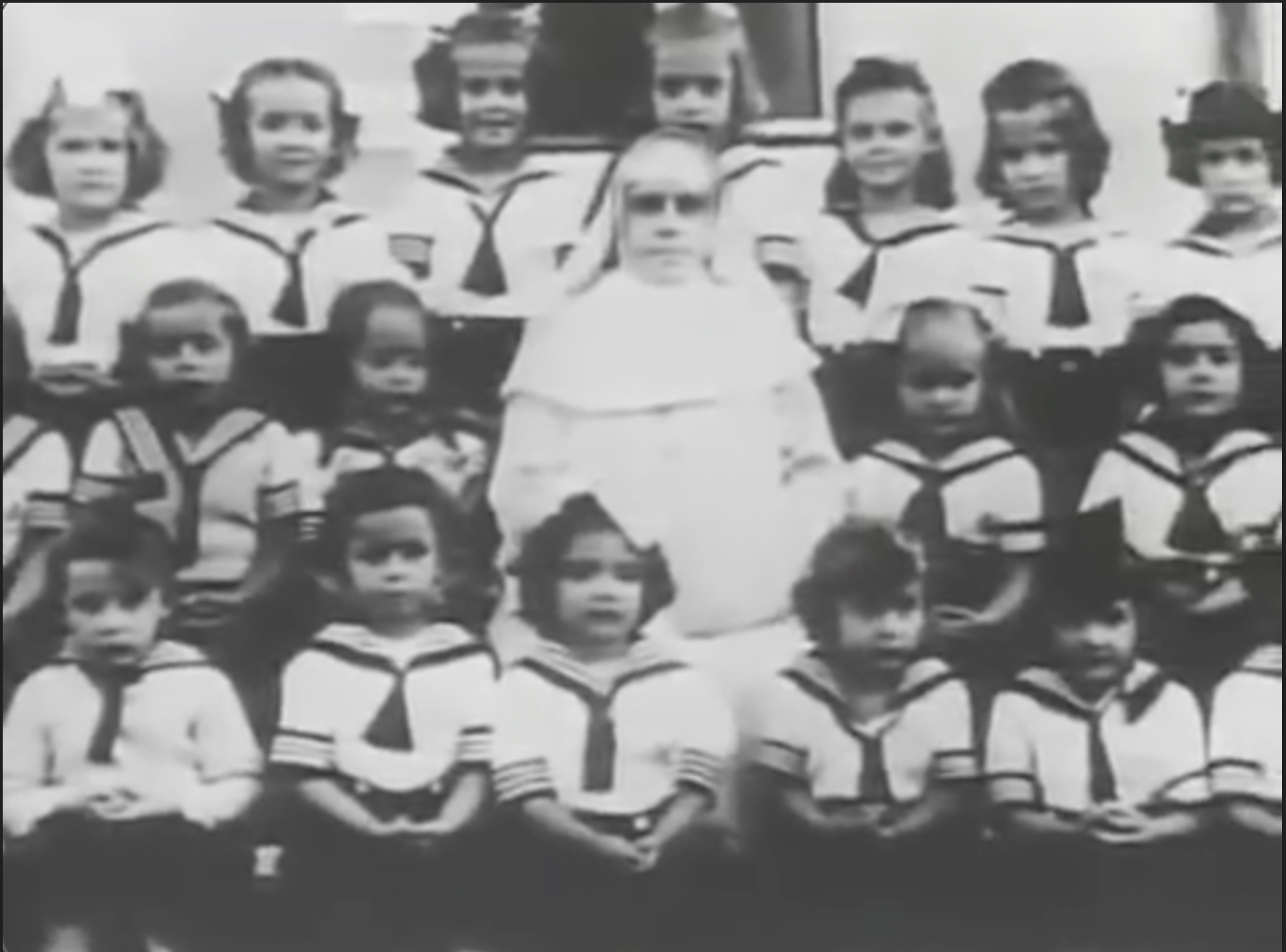
HS: I already sensed the conservatism that I had lived with around me. At the opening of the film, there is the family album with images of celebrating birthdays, weddings, graduations, etc... which is a synthesis of the film. I put on the soundtrack the laughter of a sinister witch who says she will announce her prophecies at the end. And they really come true in the last images of the film!

These albums that I used were by people I knew that I had lived with in high school or college.
FA: Arnaldo Jabor's A Opinião Pública (1967) is often pointed as the first Cinema Novo documentary that delves into the mentality of the Brazilian middle class. However, A Entrevista already carried that out a year earlier, something that perhaps has been historically overshadowed by the fact that its universe is also female, which makes it even more specific. How did you perceive the intersections between class and gender in the conception and making of the film?

HS: In A Entrevista I make a point of clarifying at the beginning of the film that the interviews were made with women of the same social class. The issues of class and gender are present in the trilogy of films that I made outside of Brazil, The Emerging Woman (1974), The Double Day (1975) and Simplesmente Jenny (1977). I was always aware to avoid generalizing, since the realities of those women were distinct and brought about different experiences and narratives.

I really like A Opinião Publica and Jabor is an old friend. I was living outside Brazil when it was released and I don't remember us ever discussing it. Glauber was more fundamental because he gave me a hint about the CAIC (Comissão de Auxílio à Indústria Cinematográfica) where I could get some support, and he showed me the ropes...

The middle class had already been the focus in Cinema Novo, in films like Saraceni's O Desafio (1965). But the emphasis in those films was on male characters.

In Saraceni's Capitu (1968), I was the continuity supervisor. I realised that was not my vocation since I lost the clapperboard all the time! But it was during Capitu that Mário Carneiro (who was the Director of Photography) and I became friends and I invited him to work on A Entrevista.

A Entrevista never had any kind of distribution or official release. Only almost-private sessions. It competed in some international festivals like Festival Dei Popoli in Firenze. It was submitted by Cosme Alves Netto, the director of the Cinemateca of the Museum of Modern Art at the time, who liked the film a lot.

Recently I received a surprising email from Este, a small town in the province of Padua, near Venice, with 17,000 inhabitants. The email informed me that they had found a copy of my film A Entrevista inside a cupboard in a small elementary school, which had remained closed for many years. It was common for copies of films to be lost at festivals! This town has a cultural center - La Medusa - and they decided to hold a screening of the film there, with guests and some film critics. I found it surreal and wonderful that my film had survived 50 years in a cupboard in Italy! I became friends with Beatrice and Jacomo from the Center who, through some meetings over Zoom, asked me to answer some questions about the film. The main one was how are women doing today in Brazil? This is a huge question that maybe I will try to examine in a future film...

FA: There is also a very strong gesture in the film of moving between the specific and the common. Even though the title card identifies the social approach of the interviews, the voices are "braided" - to use a beautiful image from the film itself - without any more objective distinction between them (credits or even images), and the physical presence of Glória Solberg is singularized at the same time that it seems to represent all those women, so that the very idea of individual is complicated. Since the film is also a study of class, how did you perceive or do you perceive today this crossing between the individual and the common? (It is inevitable to notice how this remains on your horizon in films like Simply Jenny and Bananas is my Business, among others).

HS: I really like this question. It is one of those questions which reveal to ourselves some mechanisms that may be unconscious, a recurring strategy that I don't know if it is good to be brought to light. It reminds me of Alberto Cavalcanti, who taught us that if we want to make a film about the Postal Service we should follow the trajectory of a letter, a narrative resource that allows for a synthesis of ideas and concepts that we want to explore... Anyway, I think that has been used since the beginning of time.

FA: Seen together, Meio-Dia (1968) and A Entrevista form an interesting pair both in what they share and where they diverge. The first thing that strikes me is the recurrence of education as an organizing agent of sensibilities. Was this something that interested you already in the conception of the projects, or does it stem from other decisions in the realization process?

HS: I speak of a time when education was strict and played a fundamental role, as did religion.

My upbringing was somewhat unique. An extremely Catholic mother and a Norwegian father who was not opposed to her quirks and tried to follow the rituals of the society he chose to integrate within. But we noticed that our father did things with a lack of conviction that allowed us to doubt the rituals that had to be observed, a certain irony... I also believe that the fact of having three male siblings made the atmosphere at home, I would say, very "masculine". I always wished I had a sister at home to lighten the atmosphere. My mother, very late in life, read a book I gave her by Jacques and Raissa Maritain (leftist Catholics) and another by Alceu de Amoroso Lima, which called into question many of her beliefs. I think these books opened a window for her!          

From the ages of 5 to 12 I was in a semi-boarding school for nuns, the Sacre Coeur de Jesus, and then the Ursulines and the Notre Dame. It was only in college that I had classes together with boys. I think that education does leave its mark on our formation.

Religion was the first explanation of the world that was given to me and very early on, it was not enough.

FA: There is also a lateral presence of religion in the film, be it through the image of the saint or the prayer that accompanies the credits. What was the role of religion for you in this imagery that you were portraying?

HS: As I said, religion played an important role in my childhood and early adolescence. But soon it became insufficient. But it continued to exist, I guess in my personal mythology, so to speak. I made a film called The Forbidden Land about Liberation Theology, the land invasions and the Vatican's attempt to ban that movement. It was a very strong experience to be in contact with people like Don Pedro Casaldáliga in Araguaia and the so-called People of God in the land invasions where we filmed. I have another project that may never be realized because of the current political situation about Prosperity Theology and Evangelicals.

FA: There is a common interest in youth in both films that seems to point to different attitudes towards the future - in the case of A Entrevista, the assimilation by the TFP1 and what it represented at that political moment, for that social group. In Meio-Dia, the confrontation with authority was embodied in the film by the teacher, who is also a representative of another generation within the film. Perhaps one of the voices in A Entrevista would say that there is an "excess of freedom" in the lives of the characters in Meio-Dia. Do you think that between the two films there was a change in the perception of how different generations dealt with the lasting presence of the military dictatorship?

HS: Certainly, all over the world there was a thirst for change, and '68 was a year that the youth took to the streets, a year of liberation and also of great confrontations. The hippie movement stirred the question of the body and sexuality. The contraceptive pill was fundamental for the women of the generation of the decade following mine.

Leila Diniz, Dina Sfat were examples of this new woman! Helena Ignez preceded them with the characters she took on in Rogério Sganzerla's films.

FA: There are also curious divergences in method. A Entrevista starts from direct sound material, conferring on it even the importance of being in the title. However, at the end, the documentary promise is broken when the staging is revealed. Meio-Dia creates a sound design in post-production that accentuates the staged nature of the film, yet there are direct references to the political moment in Brazil at that time - such as the graffiti on the wall about the military dictatorship - that invest in a documentary tension. This transit between documentary and fiction remains throughout your work, and these first films already show an extreme tension in these frontiers. Was it possible to make fiction without documentary in Brazil at that time, or vice-versa?

HS: In A Entrevista the reference is 1964, the year of the military coup. When we were making Meio-Dia, it was 1968, we were on the eve of the AI-5. The intensification of the dictatorship was evident and terrifying… I lived in São Paulo and I took in a militant from a group of activists whose name was not revealed to us, and whom we welcomed for a month until his documents were ready for him to leave the country safely. By then I had already been detained for 24 hours for participating in a demonstration.

Close friends saw their children arrested for spraying anti-government slogans on public walls. My children were small but I thought it could happen to them.

There was a great political effervescence among filmmakers. Thomaz Farkas' house was a meeting place and, together with his wife Melanie, they managed to bring together intellectuals, filmmakers and visual artists. I attended a course by Paulo Emilio Salles Gomes, which was the only formal experience I had about the history of cinema.

The resource of fiction, of metaphors, was a way for us to express what we felt and were unable to say. In the very first scene of the film, the character João Farkas (the son of Tomaz Farkas) puts a plastic bag over his face, simulating suffocation. This was a direct allusion to censorship and torture.  

I think it is no coincidence that I made my short film Meio-Dia at that moment when Caetano Veloso's music was an inspiration. In my script, the sequence of the rebellion in the classroom, the attack on the teacher, and the destruction of the school takes place in the boy's imagination, after he throws his books into a river and the wind in their pages carries us to another place! At least that was the intention!

I didn’t show that film for a long time, because I got out of Brazil soon after making it. When the Abertura2 came, I was worried that it had anarchist characteristics and encouraged violence in a moment of reconstruction! Today I like to consider it a poetic essay. In 82 we did The Brazilian Connection (1982) about the abertura and it was a joy to feel the return to democracy in the country. We interviewed Lula, still a union leader, Fernando Henrique, candidate for the senatorial elections, Severo Gomez and many others.

FA: I am also curious about the sound work. Since the films seen together seem to highlight an investigation into the masculine (in Meio-Dia) and feminine (in A Entrevista) genders, I'm interested in what role the sound treatment played in looking at these issues. It is curious that A Entrevista is so focused on the spoken word, for example, while in Meio-Dia it is a kind of poetic, musical and graphic punctuation in a primarily male universe where the voice is not so determinant.

HS: Honestly, I had never thought of that! Meio-Dia was made as a "guerrilla" film with tremendous urgency. I crowdfunded from friends to rent the camera, the negative, the moviola and the photographer. We shot in 35mm and José Marreco did the photography. I think Theresa Trautman, married to Marreco, did the sound. I put it together myself with the help of an operator. Caetano's music was perfect and was the inspiration for the project. Meio-Dia is a delirium! The words are those of Caetano who told us that it was forbidden to forbid!

FA: Much has been written and said about your pioneering position as a woman filmmaker within Cinema Novo, and Brazilian cinema. Were there any female filmmaking references in the world at that time that were important to you?

HS: Agnès Varda was certainly an inspiration. Her film Le Bonheur (1965) is amazing. The image of happiness, of the ritual of a perfect marriage that is undone in a perverse, casual way, caught me off guard. All her films are original. Chantal Akerman, Clare Denis, and Lucrecia Martel are other women filmmakers whose work have always interested me.

FA: The male domination in Cinema Novo is clear, taking into account the most pronounced directors and creators of the films. Was your position there in fact solitary, or were there other women artists and intellectuals circulating in the group in other positions, materialized in films or not, who did not get their due historical recognition?

HS: Women in general at that time were more prominent in filmmaking as actresses, producers, and editors.

I didn't know the director Adélia Sampaio, and now I'm going to meet her at a festival in a panel that we are both attending as guests in Minas Gerais and it seems that we are contemporaries. It will be interesting to have the chance to talk film with her.

Ana Carolina was a photographer when I met her in São Paulo. When I made The Double Day and Simplemente Jenny, which was shot in four South American countries, I wanted to include Brazilians in the project. Affonso Beato was the director of photography, Tetê Morais and Rose Lacreta worked on the research, and even Ana Carolina joined us for a moment. Researchers who have examined those years of Brazilian cinema don't point out any other names, as far as I know.

FA: To conclude, I would like to know about the use of Caetano Veloso's song in Meio-Dia. There is of course a textual aspect there, but it is inevitable to think about how an intersection with Tropicália is also present in your visual conception, leading to a film like Bananas is my Business.

Your name is of course associated with both Cinema Novo and cinema marginal, because of your working relationship with Sganzerla in A Entrevista and in A Mulher de Todos(1969), but I am curious about your perception of the political and artistic project of Tropicália also as a reading of Brazil.

HS: During the most important years of Tropicalia I was out of Brazil making films abroad, but when I returned, I made, among other films, Palavra (En)cantada, which is a comprehensive look at Brazilian popular music in which Tropicalia has the place of honor it deserves.  

Rogério Sganzerla was an important person with his irreverence, irony, and immense creativity. We were great friends until the end, when he was very ill. A Mulher de Todos had some sequences filmed in my house in São Paulo. I also accompanied the filming in Santos, but, with two small children, it was impossible for me to get more involved at that moment.

1. Tradição, Família e Propriedade is a conservative organization which supported the military dictatorship.

2. Abertura (opening) was the political process of democratization which started in 1974, led to the amnesty of all political prisoners and exiles in 1979, to the end of the military dictatorship in 1985, and ended in 1988 with the promulgation of the current Brazilian Constitution.

PT/ENG
PT/ENG
9/12/2021
By/Por:
Fábio Andrade

A importância de A Entrevista (1966) e Meio-Dia (1970), os dois primeiros filmes dirigidos por Helena Solberg, em muito transcende a posição de exceção ocupada por Helena Solberg como rara diretora mulher em um dos mais férteis períodos do cinema brasileiro. Os filmes são ótima porta de entrada em universo artístico singular que continuaria se desenvolvendo nas cinco décadas seguintes, com filmes de ficção e documentários, por vezes combinando elementos de ambos, deixando uma marca no Cinema Novo e no cinema marginal antes de se reestabelecer nos EUA, onde Solberg realizou notáveis documentários políticos. Nesta entrevista, conversamos sobre suas lembranças desses dois primeiros curtas, e como eles se relacionam com o momento político, cutural, e social desua realização, e anunciam preocupações que continuarão presentes em seu trabalho posterior.

Fábio Andrade: Antes de começar a fazer cinema, já no curso de Línguas Neolatinas da PUC do Rio de Janeiro, você trabalha como repórter no O Metropolitano. Como você percebe essa passagem do jornalismo ao cinema? Naturalmente, pergunto isso levando em conta A Entrevista (1966), mas não necessariamente como inspiração direta para o filme, uma vez que a trajetória do jornalismo e da crítica para o cinema já era razoavelmente comum.

Helena Solberg: A relação da minha geração com a literatura foi muito forte. A escrita foi minha primeira ferramenta de expressão. Aos 16 anos escrevi uma pequena novela que infelizmente destruí num gesto dramático adolescente. O Jornalismo satisfazia, de certa forma, essa necessidade. Na época, entrevistei, para a revista Manchete, Clarice Lispector, pela qual tinha imensa admiração. Também Lygia Fagundes Telles, Zulmira Ribeiro Tavares, Edla Van Steen foram referências naquele momento. Para o jornal Metropolitano entrevistei Graham Greene, Aldous Huxley, Simone de Beauvoir e Camus, que era um ídolo. Cheguei a traduzir um capítulo do Homem Revoltado para o jornal. A literatura francesa foi a primeira paixão; na faculdade foi a descoberta da brasileira e da latino-americana.

Acho que são momentos de conjunção. O cinema parecia uma opção válida e possível. O surgimento do Cinema Novo  foi uma fonte de inspiração, a cinefilia e o cineclubismo, como você mencionou, tiveram também um papel importante naquele momento. A Nouvelle Vague, o Neorrealismo Italiano, o ISEB (Instituto Superior de Estudos Brasileiros), com suas palestras com professores que admirávamos, também trouxeram uma efervescência intelectual e contribuíram para esse momento, apesar de estarmos vivendo uma ditadura.

Éramos jovens e achávamos que podíamos mudar o mundo!

FA: Para realizar A Entrevista, você conversou com cerca de 70 mulheres que compartilhavam com você alguns dados de origem social. Como foi o processo de estruturação do filme a partir desse material? Havia muitas dissonâncias, muitos filmes possíveis além do filme que você escolheu fazer? Ou o conceito já estava delineado antes da gravação dessas conversas?

HS: Pensei inicialmente em um filme de depoimentos filmados.

Como acontece muitas vezes no documentário, o inesperado me obrigou a encontrar outra solução, que afinal foi muito melhor.

Eu não quis abandonar o projeto com a recusa das moças serem filmadas. Gravei eu mesma as entrevistas (dá pra notar que o som é muito ruim!) com um gravador Nagra (o único no RJ naquele momento) disponibilizado por Arne Sucksdorff. Com a transcrição das entrevistas que me pareciam mais relevantes e a ajuda de uma psicóloga e uma socióloga que eram minhas amigas, estabeleci os temas comuns. Aí decidi centralizar a ação numa única mulher, executando o conhecido ritual que dela esperava sua classe: “colégio certo”, formatura de “enfeite” e casamento conveniente de grande estilo. Eu queria desconstruir e criar um assincronismo entre a imagem e o som, e assim acentuar todas as incoerências, as ideias mal digeridas, as contradições.

FA: Fico curioso também como formato das entrevistas. As perguntas eram sempreas mesmas? As entrevistas eramsempre individuais, ou em algum momento você reuniu mais de uma personagem namesma conversa?  

HS: As perguntas eram as mesmas. Eu as havia organizado e as tinha em mãos. As entrevistas eram sempre individuais, mas às vezes a entrevistada se emocionava ou se entusiasmava e explorava outros assuntos. Senti, muitas vezes, que eram desabafos, uma necessidade de botar pra fora. Muitos outros filmes poderiam ter sido feitos daquele material riquíssimo!

FA: Há um conservadorismo latente no imaginário das mulheres que conversam com você nesse filme. Isso foi algo que te surpreendeu no processo de filmagem, ou era justamente uma percepção que você já tinha e buscou registrar?

HS: Eu já intuía o conservadorismo com o qual já havia convivido bastante ao meu redor . Na abertura do filme, o álbum de família  com imagens da celebração de aniversários, casamentos, formaturas etc… que é uma síntese do filme.  Coloquei na trilha sonora a gargalhada de uma bruxa sinistra que diz que irá anunciar suas profecias no final. E realmente elas se realizam nas últimas imagens do filme!

Esses álbuns que utilizei eram de pessoas conhecidas com as quais eu havia convivido no colégio ou na faculdade.

FA: Arnaldo Jabor's A Opinião Pública (1967), de Arnaldo Jabor, é frequentemente apontado como o primeiro documentário do Cinema Novo que se debruça sobre o imaginário da classe média brasileira. No entanto, A Entrevista já realiza esse mergulho um ano antes, algo que talvez tenha ficado historicamente ofuscado por esse universo ser também feminino, o que o torna ainda mais específico. Como você percebia as intersecções entre classe e gênero na concepção e realização do filme?

HS: Faço questão de esclarecer no início do filme que as entrevistas foram feitas com mulheres de uma mesma classe social. As questões de classe e gênero estão presentes na trilogia dos filmes que fiz fora do Brasil, The Emerging Woman (1974), The Double Day (1975) and Simplesmente Jenny (1977). Foi sempre uma preocupação procurar não generalizar, já que as realidades são distintas e acarretam diferentes experiências e narrativas.

Gosto muito de A Opinião Pública e Jabor é um velho amigo. Eu estava morando fora do Brasil quando foi lançado e não me lembro de termos, alguma vez, conversado a respeito. Glauber foi fundamental pois me deu a dica sobre a CAIC, onde poderia conseguir algum apoio e me mostrou o caminho das pedras…

O foco na classe média já havia sido apontado no Cinema Novo em filmes como O Desafio (1965), de Saraceni. Mas a ênfase era em personagens masculinos.

Em Capitu (1968), de Saraceni, fiz continuidade, e ficou provado que ser continuísta não era minha vocação, já que perdia a claquete o tempo todo! Mas foi aí que Mário Carneiro, que era o diretor de fotografia, e eu, nos tornamos amigos e o convidei para trabalhar na A Entrevista.

A Entrevista nunca teve qualquer tipo de distribuição ou lançamento oficial. Eram sessões quase privadas. Concorreu a  alguns festivais internacionais, como o Festival Dei Popoli, em Firenze. Ele foi enviado pelo Cosme Alves Netto, diretor da Cinemateca do Museu De Arte Moderna na época, que gostava muito do filme.

Recentemente recebi um surpreendente email de Este, uma pequena cidade na província de Pádua, perto de Veneza, com 17.000 habitantes. O email me comunicava que haviam encontrado, dentro de um armário, em uma pequena escola elementar, fechada há muitos anos, uma cópia do meu filme A Entrevista. Era comum cópias de filmes se perderem em festivais! Este, a cidade, tem um centro cultural - La Medusa - e resolveram fazer uma projeção lá do filme, com convidados e alguns críticos de cinema. Achei a história surreal e maravilhosa, que meu filme havia sobrevivido 50 anos num armário na Itália! Fiquei amiga de Beatrice e Jacomo do Centro, que, através de algumas reuniões no Zoom, me pediram que respondesse algumas perguntas sobre o filme. A principal sendo "como vão as mulheres hoje no Brasil?" Pergunta imensa que talvez vou tentar examinar em um próximo filme. Talvez…

FA: Há também um gesto muito forte do filme de transitar entre o específico e o comum. Muito embora a cartela identifique o recorte social das entrevistas, as vozes são "trançadas" - para usar uma bela imagem do próprio filme - sem alguma distinção mais objetiva entre elas (créditos ou mesmo imagens), e a presença física de Glória Solberg é singularizada ao mesmo tempo que parece representar todas aquelas mulheres, de forma que a própria ideia de indivíduo se complique. Uma vez que o filme é, também, um estudo de classe, como você percebia ou percebe hoje esse atravessamento entre o individual e o comum? (É inevitável reparar como isso permanece no seu horizonte em filmes como Simplesmente Jenny e Bananas is my Business, entre outros).

HS: Gosto muito dessa pergunta. É dessas perguntas que nos denunciam revelando a nós mesmos às vezes alguns mecanismos inconscientes ou não, uma estratégia recorrente que não sei se é bom ser denunciada. Pensei em Alberto Cavalcanti, quando nos ensinou que se quisermos fazer um filme sobre os Correios devemos seguir uma carta, um recurso de narrativa que permite a síntese, ideias e conceitos que queremos explorar… Enfim, acho que tem sido usado desde que o mundo é mundo!

FA: Vistos em conjunto, Meio-Dia (1968) e A Entrevista formam um par interessante tanto pelo que eles compartilham quanto por onde divergem. A primeira coisa que chama atenção é a recorrência da educação como um agente organizador das sensibilidades. Isso era algo que te interessava já na concepção dos projetos, ou ele decorre de outras decisões do processo de realização?

HS: Falo de um momento onde a educação era rígida e tinha um papel fundamental, assim como a religião.

Minha educação foi, de certa maneira, singular. Uma mãe extremamente católica e um pai norueguês que não se opunha às carolices dela e procurava seguir os rituais da sociedade a que elegeu se integrar. Mas percebíamos uma falta de convicção que permitia uma brecha para duvidarmos dos rituais que deviam ser observados, uma certa ironia… Também acredito que o fato de ter três irmãos homens, o ambiente em casa, diria que era muito “masculino”. Sempre desejei ter uma irmã em casa para aliviar o clima. Minha mãe, bem tarde na vida, leu um livro que lhe dei de Jacques e Raissa Maritain (católicos de esquerda) e também de Alceu de Amoroso Lima, que colocaram em dúvida muitas de suas crenças e acho que abriu uma janela! Dos cinco aos doze anos, estive em um semi-internato de freiras, o Sacre Coeur de Jesus, depois as Ursulinas e o Notre Dame. Só na Faculdade fui conviver na sala de aula com meninos. Acho que a educação deixa, sim, marcas em nossa formação.

A religião foi a primeira explicação do mundo que me foi dada, e bem cedo não bastou.

FA: Há também uma presença lateral da religião no filme, seja pela imagem da santa ou pela oração que acompanha os créditos. Qual era o papel da religião pra você nesse imaginário que estava retratando?

HS: Como disse, a religião teve um papel importante na minha infância e início da adolescência. Mas logo tornou-se insuficiente. Mas continuou a existir acho que na minha mitologia pessoal, por assim dizer. Fiz um filme chamado A Terra Proibida sobre a Teologia da Libertação, as invasões de terra e a tentativa do Vaticano de proibir esse movimento. Foi uma experiência muito forte de estar em contato com pessoas como Dom Pedro Casaldáliga no Araguaia e o chamado Povo de Deus nas invasões de terra onde filmamos. Estou com um projeto que não sei se será realizado, por causa da situação política atual, sobre a Teologia da Prosperidade e os evangélicos.

FA: Há um interesse comum pela juventude em ambos os filmes que parece apontar para diferentes atitudes diante do futuro - no caso de A Entrevista, a assimilação pela TFP (Tradição Família e Propriedade) e o que ela representava naquele momento político, para aquele grupo social; em Meio-Dia, o confronto com a autoridade, encarnada pelo professor, que é também representante de uma outra geração dentro do filme. Talvez uma das vozes de A Entrevista diria que há um "excesso de liberdade" na vida dos personagens de Meio-Dia. Você acha que entre os dois filmes houve uma mudança na percepção de como diferentes gerações lidavam com a presença duradoura da ditadura militar?

HS: Certamente, no mundo todo havia uma sede de mudança e 68 foi um ano em que a juventude foi às ruas, um ano libertário e também de grandes confrontos. O movimento hippie mexeu com a questão do corpo e da sexualidade. A pílula anticoncepcional foi fundamental para as mulheres da geração da década seguinte à minha.

Leila Diniz e Dina Sfat foram exemplos dessa nova mulher! Helena Ignez as antecedeu com os personagens que assumiu nos filmes de Rogério Sganzerla.

FA: Há também curiosas divergências de método. A Entrevista parte de um material de som direto, conferindo a ele inclusive a importância de estar no título. No entanto, ao final, a promessa documental é quebrada pela encenação que se revela. Já Meio-Dia cria um desenho sonoro em pós-produção que acentua o caráter encenado do filme. No entanto, há referências diretas ao momento político do Brasil naquele momento - como a pixação no muro sobre a ditadura militar - que investem numa tensão documental. Esse trânsito entre o documentário e a ficção permanecerá em sua obra, e estes primeiros filmes já mostram um tensionamento extremo dessas fronteiras. Era possível fazer ficção sem documentário no Brasil naquele momento, ou vice-versa?

HS: Na A Entrevista a referência é 64. No Meio-Dia estávamos às vésperas do AI-5, em 68. O recrudescimento da ditadura era evidente e aterrador. Eu morava em São Paulo e tinha recebido de um grupo de ativistas, um militante, cujo nome não nos foi revelado, e que acolhemos por um mês, até que seus documentos estivessem prontos para sair com segurança do país. Eu já havia sido detida por 24 horas em uma manifestação.

Amigos próximos tiveram filhos presos por estarem pichando nas ruas slogans contra o governo. Meus filhos eram pequenos, mas pensei que poderiam ser eles.

Havia uma grande efervescência política entre os cineastas. A casa de Thomaz Farkas era um centro de encontro, e, junto com Melanie, sua mulher, conseguia reunir intelectuais, cineastas e artistas plásticos.Vinda do Rio de Janeiro, foi aí que passei a conhecer a turma de São Paulo. Assisti um curso de Paulo Emílio Salles Gomes, que foi a única experiência formal que tive sobre a história do cinema.

O recurso da ficção, das metáforas, era uma maneira de expressarmos o que sentíamos e estávamos impedidos de falar. Logo na primeira cena do filme, o personagem (João Farkas, filho de Tomaz Farkas) coloca um saco de plástico no rosto, simulando um sufocamento, uma alusão direta à censura e à tortura.

Penso não ser coincidência ter realizado meu curta Meio-Dia nesse momento em que a música de Caetano era uma inspiração. No meu roteiro, a sequência da rebelião na sala de aula, o ataque ao professor, a destruição da escola, acontece na imaginação do menino, depois de jogar seus livros nas águas de um rio e o vento nas suas folhas nos carregar para outro lugar. Era pelo menos essa a intenção.

Durante muito tempo guardei esse filme, pois viajei logo depois para fora do Brasil. Com a Abertura, fiquei preocupada achando que ele tinha características anarquistas e incentivava a violência em um momento de reconstrução. Hoje, gosto de chamá-lo um ensaio poético. Em 82, fizemos o The Brazilian Connection, sobre a Abertura, e foi uma alegria sentir a volta à democracia no país. Entrevistamos um Lula ainda líder sindical, Fernando Henrique candidato a senador, Severo Gomez e muitos outros.

FA: Fico também curioso com o trabalho sonoro. Uma vez que os filmes vistos em conjunto parecem ressaltar uma investigação sobre os gêneros masculino (em Meio-Dia) e feminino (em A Entrevista), me interessa saber o papel que o tratamento sonoro desempenhava nesse seu olhar sobre essas questões. É curioso que A Entrevista seja tão focado na palavra falada, por exemplo, enquanto em Meio-Dia ela é uma espécie de pontuação poética, música e gráfica num universo primordialmente masculino onde a voz não é tão determinante.

HS: Sinceramente, nunca havia pensado nisso. Meio-Dia foi realizado tipo “guerrilha”, com tremenda urgência. Fiz um crowdfunding entre amigos para o aluguel da câmera, o negativo, moviola e o fotógrafo. Filmamos em 35mm e José Marreco fez a fotografia. Acho que Teresa Trautman, casada com o Marreco, fez o som. Eu mesma montei, com ajuda de um operador. A música de Caetano era perfeita e foi a inspiração do projeto. Meio-Dia é um delírio! As palavras são as de Caetano, que nos dizia que era proibido proibir.

FA: Muito foi escrito e dito sobre seu posicionamento pioneiro como cineasta mulher dentro do Cinema Novo e do cinema brasileiro. Existiam referências femininas fazendo filmes no mundo naquele momento que eram importantes para você?

HS: Agnès Varda certamente foi uma inspiração. O seu filme Le Bonheur (1965) é surpreendente. A imagem da felicidade, do ritual de um casamento perfeito que é desfeito de uma forma perversa, casual, me pegou desprevenida. Todos os seus filmes são originais. Chantal Akerman, Claire Denis, Lucrécia Martel são cineastas mulheres cujos filmes sempre me interessaram.

FA: É clara a dominação masculina no Cinema Novo levando em conta os diretores e criadores mais pronunciados dos filmes. A sua posição ali de fato era solitária, ou existiam outras mulheres artistas e intelectuais que circulavam pelo grupo em outras posições, materializadas em filmes ou não, que não tiveram seu devido reconhecimento histórico?

HS: As mulheres em geral naquele momento tinham mais destaque no cinema como atrizes, produtoras e montadoras.

Não conhecia a diretora Adélia Sampaio. Vou conhecê-la agora em um festival, numa mesa que vamos participar em Minas Gerais, e parece que somos contemporâneas. Vai ser interessante termos a chance de dialogar.

Ana Carolina era fotógrafa quando a conheci em São Paulo. Quando fiz o The Double Day e Simplesmente Jenny, filmados em quatro países da America do Sul, quis incluir brasileiros no projeto. Affonso Beato foi o diretor de fotografia, Tetê Moraes e Rose Lacreta trabalharam na pesquisa, e até Ana Carolina se uniu a nós por um momento. No cinema brasileiro, pesquisadoras que examinaram esses anos não apontam outros nomes, que eu saiba.

FA: Para finalizar, gostaria de saber sobre o uso da canção de Caetano Veloso em Meio-Dia. Há naturalmente um aspecto textual ali, mas é inevitável pensar em como uma intersecção com a Tropicália está também presente no seu imaginário, levando a um filme como Bananas is my Business.

Incontornável tanto no Cinema Novo quanto no cinema marginal, pela relação de trabalho com Sganzerla em A Entrevista e em A Mulher de Todos (1969), mas fico curioso em saber sua percepção do projeto político e artístico da Tropicália também como leitura do Brasil.

HS: Nos anos mais importantes da Tropicália, eu estava fora do Brasil, fazendo filmes no exterior. Quando retorno definitivamente, faço, entre outros filmes, o Palavra (En)cantada (2008), que é um olhar abrangente sobre a música popular brasileira, onde a Tropicália tem o lugar de honra que merece.  

Rogério Sganzerla foi uma pessoa importante na sua irreverência, ironia e imensa criatividade. Fomos grandes amigos até o final, quando estava muito doente. A Mulher de Todos teve algumas sequências filmadas em minha casa em São Paulo. Acompanhei as filmagens também em Santos. Com dois filhos pequenos, era impossível me envolver mais naquele momento.

A importância de A Entrevista (1966) e Meio-Dia (1970), os dois primeiros filmes dirigidos por Helena Solberg, em muito transcende a posição de exceção ocupada por Helena Solberg como rara diretora mulher em um dos mais férteis períodos do cinema brasileiro. Os filmes são ótima porta de entrada em universo artístico singular que continuaria se desenvolvendo nas cinco décadas seguintes, com filmes de ficção e documentários, por vezes combinando elementos de ambos, deixando uma marca no Cinema Novo e no cinema marginal antes de se reestabelecer nos EUA, onde Solberg realizou notáveis documentários políticos. Nesta entrevista, conversamos sobre suas lembranças desses dois primeiros curtas, e como eles se relacionam com o momento político, cutural, e social desua realização, e anunciam preocupações que continuarão presentes em seu trabalho posterior.

Fábio Andrade: Antes de começar a fazer cinema, já no curso de Línguas Neolatinas da PUC do Rio de Janeiro, você trabalha como repórter no O Metropolitano. Como você percebe essa passagem do jornalismo ao cinema? Naturalmente, pergunto isso levando em conta A Entrevista (1966), mas não necessariamente como inspiração direta para o filme, uma vez que a trajetória do jornalismo e da crítica para o cinema já era razoavelmente comum.

Helena Solberg: A relação da minha geração com a literatura foi muito forte. A escrita foi minha primeira ferramenta de expressão. Aos 16 anos escrevi uma pequena novela que infelizmente destruí num gesto dramático adolescente. O Jornalismo satisfazia, de certa forma, essa necessidade. Na época, entrevistei, para a revista Manchete, Clarice Lispector, pela qual tinha imensa admiração. Também Lygia Fagundes Telles, Zulmira Ribeiro Tavares, Edla Van Steen foram referências naquele momento. Para o jornal Metropolitano entrevistei Graham Greene, Aldous Huxley, Simone de Beauvoir e Camus, que era um ídolo. Cheguei a traduzir um capítulo do Homem Revoltado para o jornal. A literatura francesa foi a primeira paixão; na faculdade foi a descoberta da brasileira e da latino-americana.

Acho que são momentos de conjunção. O cinema parecia uma opção válida e possível. O surgimento do Cinema Novo  foi uma fonte de inspiração, a cinefilia e o cineclubismo, como você mencionou, tiveram também um papel importante naquele momento. A Nouvelle Vague, o Neorrealismo Italiano, o ISEB (Instituto Superior de Estudos Brasileiros), com suas palestras com professores que admirávamos, também trouxeram uma efervescência intelectual e contribuíram para esse momento, apesar de estarmos vivendo uma ditadura.

Éramos jovens e achávamos que podíamos mudar o mundo!

FA: Para realizar A Entrevista, você conversou com cerca de 70 mulheres que compartilhavam com você alguns dados de origem social. Como foi o processo de estruturação do filme a partir desse material? Havia muitas dissonâncias, muitos filmes possíveis além do filme que você escolheu fazer? Ou o conceito já estava delineado antes da gravação dessas conversas?

HS: Pensei inicialmente em um filme de depoimentos filmados.

Como acontece muitas vezes no documentário, o inesperado me obrigou a encontrar outra solução, que afinal foi muito melhor.

Eu não quis abandonar o projeto com a recusa das moças serem filmadas. Gravei eu mesma as entrevistas (dá pra notar que o som é muito ruim!) com um gravador Nagra (o único no RJ naquele momento) disponibilizado por Arne Sucksdorff. Com a transcrição das entrevistas que me pareciam mais relevantes e a ajuda de uma psicóloga e uma socióloga que eram minhas amigas, estabeleci os temas comuns. Aí decidi centralizar a ação numa única mulher, executando o conhecido ritual que dela esperava sua classe: “colégio certo”, formatura de “enfeite” e casamento conveniente de grande estilo. Eu queria desconstruir e criar um assincronismo entre a imagem e o som, e assim acentuar todas as incoerências, as ideias mal digeridas, as contradições.

FA: Fico curioso também como formato das entrevistas. As perguntas eram sempreas mesmas? As entrevistas eramsempre individuais, ou em algum momento você reuniu mais de uma personagem namesma conversa?  

HS: As perguntas eram as mesmas. Eu as havia organizado e as tinha em mãos. As entrevistas eram sempre individuais, mas às vezes a entrevistada se emocionava ou se entusiasmava e explorava outros assuntos. Senti, muitas vezes, que eram desabafos, uma necessidade de botar pra fora. Muitos outros filmes poderiam ter sido feitos daquele material riquíssimo!

FA: Há um conservadorismo latente no imaginário das mulheres que conversam com você nesse filme. Isso foi algo que te surpreendeu no processo de filmagem, ou era justamente uma percepção que você já tinha e buscou registrar?

HS: Eu já intuía o conservadorismo com o qual já havia convivido bastante ao meu redor . Na abertura do filme, o álbum de família  com imagens da celebração de aniversários, casamentos, formaturas etc… que é uma síntese do filme.  Coloquei na trilha sonora a gargalhada de uma bruxa sinistra que diz que irá anunciar suas profecias no final. E realmente elas se realizam nas últimas imagens do filme!

Esses álbuns que utilizei eram de pessoas conhecidas com as quais eu havia convivido no colégio ou na faculdade.

FA: Arnaldo Jabor's A Opinião Pública (1967), de Arnaldo Jabor, é frequentemente apontado como o primeiro documentário do Cinema Novo que se debruça sobre o imaginário da classe média brasileira. No entanto, A Entrevista já realiza esse mergulho um ano antes, algo que talvez tenha ficado historicamente ofuscado por esse universo ser também feminino, o que o torna ainda mais específico. Como você percebia as intersecções entre classe e gênero na concepção e realização do filme?

HS: Faço questão de esclarecer no início do filme que as entrevistas foram feitas com mulheres de uma mesma classe social. As questões de classe e gênero estão presentes na trilogia dos filmes que fiz fora do Brasil, The Emerging Woman (1974), The Double Day (1975) and Simplesmente Jenny (1977). Foi sempre uma preocupação procurar não generalizar, já que as realidades são distintas e acarretam diferentes experiências e narrativas.

Gosto muito de A Opinião Pública e Jabor é um velho amigo. Eu estava morando fora do Brasil quando foi lançado e não me lembro de termos, alguma vez, conversado a respeito. Glauber foi fundamental pois me deu a dica sobre a CAIC, onde poderia conseguir algum apoio e me mostrou o caminho das pedras…

O foco na classe média já havia sido apontado no Cinema Novo em filmes como O Desafio (1965), de Saraceni. Mas a ênfase era em personagens masculinos.

Em Capitu (1968), de Saraceni, fiz continuidade, e ficou provado que ser continuísta não era minha vocação, já que perdia a claquete o tempo todo! Mas foi aí que Mário Carneiro, que era o diretor de fotografia, e eu, nos tornamos amigos e o convidei para trabalhar na A Entrevista.

A Entrevista nunca teve qualquer tipo de distribuição ou lançamento oficial. Eram sessões quase privadas. Concorreu a  alguns festivais internacionais, como o Festival Dei Popoli, em Firenze. Ele foi enviado pelo Cosme Alves Netto, diretor da Cinemateca do Museu De Arte Moderna na época, que gostava muito do filme.

Recentemente recebi um surpreendente email de Este, uma pequena cidade na província de Pádua, perto de Veneza, com 17.000 habitantes. O email me comunicava que haviam encontrado, dentro de um armário, em uma pequena escola elementar, fechada há muitos anos, uma cópia do meu filme A Entrevista. Era comum cópias de filmes se perderem em festivais! Este, a cidade, tem um centro cultural - La Medusa - e resolveram fazer uma projeção lá do filme, com convidados e alguns críticos de cinema. Achei a história surreal e maravilhosa, que meu filme havia sobrevivido 50 anos num armário na Itália! Fiquei amiga de Beatrice e Jacomo do Centro, que, através de algumas reuniões no Zoom, me pediram que respondesse algumas perguntas sobre o filme. A principal sendo "como vão as mulheres hoje no Brasil?" Pergunta imensa que talvez vou tentar examinar em um próximo filme. Talvez…

FA: Há também um gesto muito forte do filme de transitar entre o específico e o comum. Muito embora a cartela identifique o recorte social das entrevistas, as vozes são "trançadas" - para usar uma bela imagem do próprio filme - sem alguma distinção mais objetiva entre elas (créditos ou mesmo imagens), e a presença física de Glória Solberg é singularizada ao mesmo tempo que parece representar todas aquelas mulheres, de forma que a própria ideia de indivíduo se complique. Uma vez que o filme é, também, um estudo de classe, como você percebia ou percebe hoje esse atravessamento entre o individual e o comum? (É inevitável reparar como isso permanece no seu horizonte em filmes como Simplesmente Jenny e Bananas is my Business, entre outros).

HS: Gosto muito dessa pergunta. É dessas perguntas que nos denunciam revelando a nós mesmos às vezes alguns mecanismos inconscientes ou não, uma estratégia recorrente que não sei se é bom ser denunciada. Pensei em Alberto Cavalcanti, quando nos ensinou que se quisermos fazer um filme sobre os Correios devemos seguir uma carta, um recurso de narrativa que permite a síntese, ideias e conceitos que queremos explorar… Enfim, acho que tem sido usado desde que o mundo é mundo!

FA: Vistos em conjunto, Meio-Dia (1968) e A Entrevista formam um par interessante tanto pelo que eles compartilham quanto por onde divergem. A primeira coisa que chama atenção é a recorrência da educação como um agente organizador das sensibilidades. Isso era algo que te interessava já na concepção dos projetos, ou ele decorre de outras decisões do processo de realização?

HS: Falo de um momento onde a educação era rígida e tinha um papel fundamental, assim como a religião.

Minha educação foi, de certa maneira, singular. Uma mãe extremamente católica e um pai norueguês que não se opunha às carolices dela e procurava seguir os rituais da sociedade a que elegeu se integrar. Mas percebíamos uma falta de convicção que permitia uma brecha para duvidarmos dos rituais que deviam ser observados, uma certa ironia… Também acredito que o fato de ter três irmãos homens, o ambiente em casa, diria que era muito “masculino”. Sempre desejei ter uma irmã em casa para aliviar o clima. Minha mãe, bem tarde na vida, leu um livro que lhe dei de Jacques e Raissa Maritain (católicos de esquerda) e também de Alceu de Amoroso Lima, que colocaram em dúvida muitas de suas crenças e acho que abriu uma janela! Dos cinco aos doze anos, estive em um semi-internato de freiras, o Sacre Coeur de Jesus, depois as Ursulinas e o Notre Dame. Só na Faculdade fui conviver na sala de aula com meninos. Acho que a educação deixa, sim, marcas em nossa formação.

A religião foi a primeira explicação do mundo que me foi dada, e bem cedo não bastou.

FA: Há também uma presença lateral da religião no filme, seja pela imagem da santa ou pela oração que acompanha os créditos. Qual era o papel da religião pra você nesse imaginário que estava retratando?

HS: Como disse, a religião teve um papel importante na minha infância e início da adolescência. Mas logo tornou-se insuficiente. Mas continuou a existir acho que na minha mitologia pessoal, por assim dizer. Fiz um filme chamado A Terra Proibida sobre a Teologia da Libertação, as invasões de terra e a tentativa do Vaticano de proibir esse movimento. Foi uma experiência muito forte de estar em contato com pessoas como Dom Pedro Casaldáliga no Araguaia e o chamado Povo de Deus nas invasões de terra onde filmamos. Estou com um projeto que não sei se será realizado, por causa da situação política atual, sobre a Teologia da Prosperidade e os evangélicos.

FA: Há um interesse comum pela juventude em ambos os filmes que parece apontar para diferentes atitudes diante do futuro - no caso de A Entrevista, a assimilação pela TFP (Tradição Família e Propriedade) e o que ela representava naquele momento político, para aquele grupo social; em Meio-Dia, o confronto com a autoridade, encarnada pelo professor, que é também representante de uma outra geração dentro do filme. Talvez uma das vozes de A Entrevista diria que há um "excesso de liberdade" na vida dos personagens de Meio-Dia. Você acha que entre os dois filmes houve uma mudança na percepção de como diferentes gerações lidavam com a presença duradoura da ditadura militar?

HS: Certamente, no mundo todo havia uma sede de mudança e 68 foi um ano em que a juventude foi às ruas, um ano libertário e também de grandes confrontos. O movimento hippie mexeu com a questão do corpo e da sexualidade. A pílula anticoncepcional foi fundamental para as mulheres da geração da década seguinte à minha.

Leila Diniz e Dina Sfat foram exemplos dessa nova mulher! Helena Ignez as antecedeu com os personagens que assumiu nos filmes de Rogério Sganzerla.

FA: Há também curiosas divergências de método. A Entrevista parte de um material de som direto, conferindo a ele inclusive a importância de estar no título. No entanto, ao final, a promessa documental é quebrada pela encenação que se revela. Já Meio-Dia cria um desenho sonoro em pós-produção que acentua o caráter encenado do filme. No entanto, há referências diretas ao momento político do Brasil naquele momento - como a pixação no muro sobre a ditadura militar - que investem numa tensão documental. Esse trânsito entre o documentário e a ficção permanecerá em sua obra, e estes primeiros filmes já mostram um tensionamento extremo dessas fronteiras. Era possível fazer ficção sem documentário no Brasil naquele momento, ou vice-versa?

HS: Na A Entrevista a referência é 64. No Meio-Dia estávamos às vésperas do AI-5, em 68. O recrudescimento da ditadura era evidente e aterrador. Eu morava em São Paulo e tinha recebido de um grupo de ativistas, um militante, cujo nome não nos foi revelado, e que acolhemos por um mês, até que seus documentos estivessem prontos para sair com segurança do país. Eu já havia sido detida por 24 horas em uma manifestação.

Amigos próximos tiveram filhos presos por estarem pichando nas ruas slogans contra o governo. Meus filhos eram pequenos, mas pensei que poderiam ser eles.

Havia uma grande efervescência política entre os cineastas. A casa de Thomaz Farkas era um centro de encontro, e, junto com Melanie, sua mulher, conseguia reunir intelectuais, cineastas e artistas plásticos.Vinda do Rio de Janeiro, foi aí que passei a conhecer a turma de São Paulo. Assisti um curso de Paulo Emílio Salles Gomes, que foi a única experiência formal que tive sobre a história do cinema.

O recurso da ficção, das metáforas, era uma maneira de expressarmos o que sentíamos e estávamos impedidos de falar. Logo na primeira cena do filme, o personagem (João Farkas, filho de Tomaz Farkas) coloca um saco de plástico no rosto, simulando um sufocamento, uma alusão direta à censura e à tortura.

Penso não ser coincidência ter realizado meu curta Meio-Dia nesse momento em que a música de Caetano era uma inspiração. No meu roteiro, a sequência da rebelião na sala de aula, o ataque ao professor, a destruição da escola, acontece na imaginação do menino, depois de jogar seus livros nas águas de um rio e o vento nas suas folhas nos carregar para outro lugar. Era pelo menos essa a intenção.

Durante muito tempo guardei esse filme, pois viajei logo depois para fora do Brasil. Com a Abertura, fiquei preocupada achando que ele tinha características anarquistas e incentivava a violência em um momento de reconstrução. Hoje, gosto de chamá-lo um ensaio poético. Em 82, fizemos o The Brazilian Connection, sobre a Abertura, e foi uma alegria sentir a volta à democracia no país. Entrevistamos um Lula ainda líder sindical, Fernando Henrique candidato a senador, Severo Gomez e muitos outros.

FA: Fico também curioso com o trabalho sonoro. Uma vez que os filmes vistos em conjunto parecem ressaltar uma investigação sobre os gêneros masculino (em Meio-Dia) e feminino (em A Entrevista), me interessa saber o papel que o tratamento sonoro desempenhava nesse seu olhar sobre essas questões. É curioso que A Entrevista seja tão focado na palavra falada, por exemplo, enquanto em Meio-Dia ela é uma espécie de pontuação poética, música e gráfica num universo primordialmente masculino onde a voz não é tão determinante.

HS: Sinceramente, nunca havia pensado nisso. Meio-Dia foi realizado tipo “guerrilha”, com tremenda urgência. Fiz um crowdfunding entre amigos para o aluguel da câmera, o negativo, moviola e o fotógrafo. Filmamos em 35mm e José Marreco fez a fotografia. Acho que Teresa Trautman, casada com o Marreco, fez o som. Eu mesma montei, com ajuda de um operador. A música de Caetano era perfeita e foi a inspiração do projeto. Meio-Dia é um delírio! As palavras são as de Caetano, que nos dizia que era proibido proibir.

FA: Muito foi escrito e dito sobre seu posicionamento pioneiro como cineasta mulher dentro do Cinema Novo e do cinema brasileiro. Existiam referências femininas fazendo filmes no mundo naquele momento que eram importantes para você?

HS: Agnès Varda certamente foi uma inspiração. O seu filme Le Bonheur (1965) é surpreendente. A imagem da felicidade, do ritual de um casamento perfeito que é desfeito de uma forma perversa, casual, me pegou desprevenida. Todos os seus filmes são originais. Chantal Akerman, Claire Denis, Lucrécia Martel são cineastas mulheres cujos filmes sempre me interessaram.

FA: É clara a dominação masculina no Cinema Novo levando em conta os diretores e criadores mais pronunciados dos filmes. A sua posição ali de fato era solitária, ou existiam outras mulheres artistas e intelectuais que circulavam pelo grupo em outras posições, materializadas em filmes ou não, que não tiveram seu devido reconhecimento histórico?

HS: As mulheres em geral naquele momento tinham mais destaque no cinema como atrizes, produtoras e montadoras.

Não conhecia a diretora Adélia Sampaio. Vou conhecê-la agora em um festival, numa mesa que vamos participar em Minas Gerais, e parece que somos contemporâneas. Vai ser interessante termos a chance de dialogar.

Ana Carolina era fotógrafa quando a conheci em São Paulo. Quando fiz o The Double Day e Simplesmente Jenny, filmados em quatro países da America do Sul, quis incluir brasileiros no projeto. Affonso Beato foi o diretor de fotografia, Tetê Moraes e Rose Lacreta trabalharam na pesquisa, e até Ana Carolina se uniu a nós por um momento. No cinema brasileiro, pesquisadoras que examinaram esses anos não apontam outros nomes, que eu saiba.

FA: Para finalizar, gostaria de saber sobre o uso da canção de Caetano Veloso em Meio-Dia. Há naturalmente um aspecto textual ali, mas é inevitável pensar em como uma intersecção com a Tropicália está também presente no seu imaginário, levando a um filme como Bananas is my Business.

Incontornável tanto no Cinema Novo quanto no cinema marginal, pela relação de trabalho com Sganzerla em A Entrevista e em A Mulher de Todos (1969), mas fico curioso em saber sua percepção do projeto político e artístico da Tropicália também como leitura do Brasil.

HS: Nos anos mais importantes da Tropicália, eu estava fora do Brasil, fazendo filmes no exterior. Quando retorno definitivamente, faço, entre outros filmes, o Palavra (En)cantada (2008), que é um olhar abrangente sobre a música popular brasileira, onde a Tropicália tem o lugar de honra que merece.  

Rogério Sganzerla foi uma pessoa importante na sua irreverência, ironia e imensa criatividade. Fomos grandes amigos até o final, quando estava muito doente. A Mulher de Todos teve algumas sequências filmadas em minha casa em São Paulo. Acompanhei as filmagens também em Santos. Com dois filhos pequenos, era impossível me envolver mais naquele momento.

The importance of A Entrevista (1966) and Meio-Dia (1970),the two first films directed by Helena Solberg, far transcends itself exceptional position occupied by Helena Solberg as a rare case of a woman director in one of the most fertile periods of Brazilian cinema. The films are great introductions to a singular artistic world that would be developed in the following five decades in documentary and fiction films, sometimes combining elements of both, and that would leave a mark in both Cinema Novo and cinema marginal in Brazil before relocating to the United States, where Solberg made a number of remarkable political documentaries. In this interview, we talked about her memories of these two first short films, and how they overlapped with the political, cultural and social life of their moment, as well as announced preoccupations that would keep being explored in her later work.

Fábio Andrade: Before you started making films, you were studying Romance languages at PUC university in Rio de Janeiro. During the same time, you worked as a reporter at O Metropolitano. How do you perceive this transition from journalism to cinema? Of course, while I ask this with A Entrevista (1966) in mind, I’m not necessarily implying that transition was a direct inspiration for the film. Especially since the trajectory from journalism and criticism to cinema was already fairly widespread.  

Helena Solberg: My generation's relationship with literature was very strong. Writing was my first tool of expression. At 16, I wrote a short novel that I unfortunately destroyed in a dramatic adolescent gesture. At the time, I interviewed Clarice Lispector, who I admired immensely, for Manchete magazine, as well as Lygia Fagundes Telles, Zulmira Ribeiro Tavares and Edla Van Steen, who were my literary references at that moment. For the Metropolitano newspaper I interviewed Graham Greene, Aldous Huxley, Simone de Beauvoir and Camus, who was one of my idols.  I even translated a chapter of The Rebel for that same newspaper. French literature was my first passion; in college I discovered Brazilian and Latin American literature.

The emergence of Cinema Novo was a source of inspiration, cinephilia and the cine-clubs, as you mentioned, also played an important role at that moment. The Nouvelle Vague, the Italian Neorealism, and the ISEB (Instituto Superior de Estudos Brasileiros) with its lectures by professors we admired, also brought an intellectual effervescence and contributed to that moment. Even though we were living in a dictatorship.

We were young and we thought we could change the world!

FA: To make A Entrevista, you talked to about seventy women who shared details about their social backgrounds. How was the process of structuring the film based on this material? Were there many dissonances, many possible films other than the one you chose to make? Or was the concept already outlined before recording these conversations?

HS: Initially, I thought of making a film of recorded testimonials. As is often the case with documentaries, the unexpected forced me to find another way forward, which turned out to be much better.

I didn't want to abandon the project because the girls refused to be filmed. I recorded the interviews myself (you can tell the sound is very bad!) with a Nagra recorder provided by Arne Sucksdorff (the only one in Rio de Janeiro at the time). After transcribing the interviews that seemed most relevant to me and receiving the help of a psychologist and a sociologist who were friends of mine, I was able to establish the common themes of the film. Then I decided to center the action on a single woman who was fulfilling the well-known role that her social class expected of her: going to the "proper school", having a pretty graduation ceremony and marrying for convenience with a big wedding. I wanted to deconstruct and create an asynchronism between image and sound and thus accentuate all the incoherences, the poorly digested ideas, the contradictions.

FA: I am also curious about the format of the interviews. Were the questions always the same? Were the interviews always with an individual, or did you at some point bring more than one character together in the same conversation?  

HS: The questions were the same. I had organized them and had them in hand. The interviews were always with an individual, but sometimes the interviewee would get emotional or excited and explore other subjects. I often felt that these were outbursts, a need to get things out in the open. Many other films could have been made from this very rich material!

FA: There is a latent conservatism in the mentality of the women who talk to you in this film. Was this something that surprised you in the filming process, or was it precisely a perception that you already had and sought to register?

HS: I already sensed the conservatism that I had lived with around me. At the opening of the film, there is the family album with images of celebrating birthdays, weddings, graduations, etc... which is a synthesis of the film. I put on the soundtrack the laughter of a sinister witch who says she will announce her prophecies at the end. And they really come true in the last images of the film!

These albums that I used were by people I knew that I had lived with in high school or college.

FA: Arnaldo Jabor's A Opinião Pública (1967) is often pointed as the first Cinema Novo documentary that delves into the mentality of the Brazilian middle class. However, A Entrevista already carried that out a year earlier, something that perhaps has been historically overshadowed by the fact that its universe is also female, which makes it even more specific. How did you perceive the intersections between class and gender in the conception and making of the film?

HS: In A Entrevista I make a point of clarifying at the beginning of the film that the interviews were made with women of the same social class. The issues of class and gender are present in the trilogy of films that I made outside of Brazil, The Emerging Woman (1974), The Double Day (1975) and Simplesmente Jenny (1977). I was always aware to avoid generalizing, since the realities of those women were distinct and brought about different experiences and narratives.

I really like A Opinião Publica and Jabor is an old friend. I was living outside Brazil when it was released and I don't remember us ever discussing it. Glauber was more fundamental because he gave me a hint about the CAIC (Comissão de Auxílio à Indústria Cinematográfica) where I could get some support, and he showed me the ropes...

The middle class had already been the focus in Cinema Novo, in films like Saraceni's O Desafio (1965). But the emphasis in those films was on male characters.

In Saraceni's Capitu (1968), I was the continuity supervisor. I realised that was not my vocation since I lost the clapperboard all the time! But it was during Capitu that Mário Carneiro (who was the Director of Photography) and I became friends and I invited him to work on A Entrevista.

A Entrevista never had any kind of distribution or official release. Only almost-private sessions. It competed in some international festivals like Festival Dei Popoli in Firenze. It was submitted by Cosme Alves Netto, the director of the Cinemateca of the Museum of Modern Art at the time, who liked the film a lot.

Recently I received a surprising email from Este, a small town in the province of Padua, near Venice, with 17,000 inhabitants. The email informed me that they had found a copy of my film A Entrevista inside a cupboard in a small elementary school, which had remained closed for many years. It was common for copies of films to be lost at festivals! This town has a cultural center - La Medusa - and they decided to hold a screening of the film there, with guests and some film critics. I found it surreal and wonderful that my film had survived 50 years in a cupboard in Italy! I became friends with Beatrice and Jacomo from the Center who, through some meetings over Zoom, asked me to answer some questions about the film. The main one was how are women doing today in Brazil? This is a huge question that maybe I will try to examine in a future film...

FA: There is also a very strong gesture in the film of moving between the specific and the common. Even though the title card identifies the social approach of the interviews, the voices are "braided" - to use a beautiful image from the film itself - without any more objective distinction between them (credits or even images), and the physical presence of Glória Solberg is singularized at the same time that it seems to represent all those women, so that the very idea of individual is complicated. Since the film is also a study of class, how did you perceive or do you perceive today this crossing between the individual and the common? (It is inevitable to notice how this remains on your horizon in films like Simply Jenny and Bananas is my Business, among others).

HS: I really like this question. It is one of those questions which reveal to ourselves some mechanisms that may be unconscious, a recurring strategy that I don't know if it is good to be brought to light. It reminds me of Alberto Cavalcanti, who taught us that if we want to make a film about the Postal Service we should follow the trajectory of a letter, a narrative resource that allows for a synthesis of ideas and concepts that we want to explore... Anyway, I think that has been used since the beginning of time.

FA: Seen together, Meio-Dia (1968) and A Entrevista form an interesting pair both in what they share and where they diverge. The first thing that strikes me is the recurrence of education as an organizing agent of sensibilities. Was this something that interested you already in the conception of the projects, or does it stem from other decisions in the realization process?

HS: I speak of a time when education was strict and played a fundamental role, as did religion.

My upbringing was somewhat unique. An extremely Catholic mother and a Norwegian father who was not opposed to her quirks and tried to follow the rituals of the society he chose to integrate within. But we noticed that our father did things with a lack of conviction that allowed us to doubt the rituals that had to be observed, a certain irony... I also believe that the fact of having three male siblings made the atmosphere at home, I would say, very "masculine". I always wished I had a sister at home to lighten the atmosphere. My mother, very late in life, read a book I gave her by Jacques and Raissa Maritain (leftist Catholics) and another by Alceu de Amoroso Lima, which called into question many of her beliefs. I think these books opened a window for her!          

From the ages of 5 to 12 I was in a semi-boarding school for nuns, the Sacre Coeur de Jesus, and then the Ursulines and the Notre Dame. It was only in college that I had classes together with boys. I think that education does leave its mark on our formation.

Religion was the first explanation of the world that was given to me and very early on, it was not enough.

FA: There is also a lateral presence of religion in the film, be it through the image of the saint or the prayer that accompanies the credits. What was the role of religion for you in this imagery that you were portraying?

HS: As I said, religion played an important role in my childhood and early adolescence. But soon it became insufficient. But it continued to exist, I guess in my personal mythology, so to speak. I made a film called The Forbidden Land about Liberation Theology, the land invasions and the Vatican's attempt to ban that movement. It was a very strong experience to be in contact with people like Don Pedro Casaldáliga in Araguaia and the so-called People of God in the land invasions where we filmed. I have another project that may never be realized because of the current political situation about Prosperity Theology and Evangelicals.

FA: There is a common interest in youth in both films that seems to point to different attitudes towards the future - in the case of A Entrevista, the assimilation by the TFP1 and what it represented at that political moment, for that social group. In Meio-Dia, the confrontation with authority was embodied in the film by the teacher, who is also a representative of another generation within the film. Perhaps one of the voices in A Entrevista would say that there is an "excess of freedom" in the lives of the characters in Meio-Dia. Do you think that between the two films there was a change in the perception of how different generations dealt with the lasting presence of the military dictatorship?

HS: Certainly, all over the world there was a thirst for change, and '68 was a year that the youth took to the streets, a year of liberation and also of great confrontations. The hippie movement stirred the question of the body and sexuality. The contraceptive pill was fundamental for the women of the generation of the decade following mine.

Leila Diniz, Dina Sfat were examples of this new woman! Helena Ignez preceded them with the characters she took on in Rogério Sganzerla's films.

FA: There are also curious divergences in method. A Entrevista starts from direct sound material, conferring on it even the importance of being in the title. However, at the end, the documentary promise is broken when the staging is revealed. Meio-Dia creates a sound design in post-production that accentuates the staged nature of the film, yet there are direct references to the political moment in Brazil at that time - such as the graffiti on the wall about the military dictatorship - that invest in a documentary tension. This transit between documentary and fiction remains throughout your work, and these first films already show an extreme tension in these frontiers. Was it possible to make fiction without documentary in Brazil at that time, or vice-versa?

HS: In A Entrevista the reference is 1964, the year of the military coup. When we were making Meio-Dia, it was 1968, we were on the eve of the AI-5. The intensification of the dictatorship was evident and terrifying… I lived in São Paulo and I took in a militant from a group of activists whose name was not revealed to us, and whom we welcomed for a month until his documents were ready for him to leave the country safely. By then I had already been detained for 24 hours for participating in a demonstration.

Close friends saw their children arrested for spraying anti-government slogans on public walls. My children were small but I thought it could happen to them.

There was a great political effervescence among filmmakers. Thomaz Farkas' house was a meeting place and, together with his wife Melanie, they managed to bring together intellectuals, filmmakers and visual artists. I attended a course by Paulo Emilio Salles Gomes, which was the only formal experience I had about the history of cinema.

The resource of fiction, of metaphors, was a way for us to express what we felt and were unable to say. In the very first scene of the film, the character João Farkas (the son of Tomaz Farkas) puts a plastic bag over his face, simulating suffocation. This was a direct allusion to censorship and torture.  

I think it is no coincidence that I made my short film Meio-Dia at that moment when Caetano Veloso's music was an inspiration. In my script, the sequence of the rebellion in the classroom, the attack on the teacher, and the destruction of the school takes place in the boy's imagination, after he throws his books into a river and the wind in their pages carries us to another place! At least that was the intention!

I didn’t show that film for a long time, because I got out of Brazil soon after making it. When the Abertura2 came, I was worried that it had anarchist characteristics and encouraged violence in a moment of reconstruction! Today I like to consider it a poetic essay. In 82 we did The Brazilian Connection (1982) about the abertura and it was a joy to feel the return to democracy in the country. We interviewed Lula, still a union leader, Fernando Henrique, candidate for the senatorial elections, Severo Gomez and many others.

FA: I am also curious about the sound work. Since the films seen together seem to highlight an investigation into the masculine (in Meio-Dia) and feminine (in A Entrevista) genders, I'm interested in what role the sound treatment played in looking at these issues. It is curious that A Entrevista is so focused on the spoken word, for example, while in Meio-Dia it is a kind of poetic, musical and graphic punctuation in a primarily male universe where the voice is not so determinant.

HS: Honestly, I had never thought of that! Meio-Dia was made as a "guerrilla" film with tremendous urgency. I crowdfunded from friends to rent the camera, the negative, the moviola and the photographer. We shot in 35mm and José Marreco did the photography. I think Theresa Trautman, married to Marreco, did the sound. I put it together myself with the help of an operator. Caetano's music was perfect and was the inspiration for the project. Meio-Dia is a delirium! The words are those of Caetano who told us that it was forbidden to forbid!

FA: Much has been written and said about your pioneering position as a woman filmmaker within Cinema Novo, and Brazilian cinema. Were there any female filmmaking references in the world at that time that were important to you?

HS: Agnès Varda was certainly an inspiration. Her film Le Bonheur (1965) is amazing. The image of happiness, of the ritual of a perfect marriage that is undone in a perverse, casual way, caught me off guard. All her films are original. Chantal Akerman, Clare Denis, and Lucrecia Martel are other women filmmakers whose work have always interested me.

FA: The male domination in Cinema Novo is clear, taking into account the most pronounced directors and creators of the films. Was your position there in fact solitary, or were there other women artists and intellectuals circulating in the group in other positions, materialized in films or not, who did not get their due historical recognition?

HS: Women in general at that time were more prominent in filmmaking as actresses, producers, and editors.

I didn't know the director Adélia Sampaio, and now I'm going to meet her at a festival in a panel that we are both attending as guests in Minas Gerais and it seems that we are contemporaries. It will be interesting to have the chance to talk film with her.

Ana Carolina was a photographer when I met her in São Paulo. When I made The Double Day and Simplemente Jenny, which was shot in four South American countries, I wanted to include Brazilians in the project. Affonso Beato was the director of photography, Tetê Morais and Rose Lacreta worked on the research, and even Ana Carolina joined us for a moment. Researchers who have examined those years of Brazilian cinema don't point out any other names, as far as I know.

FA: To conclude, I would like to know about the use of Caetano Veloso's song in Meio-Dia. There is of course a textual aspect there, but it is inevitable to think about how an intersection with Tropicália is also present in your visual conception, leading to a film like Bananas is my Business.

Your name is of course associated with both Cinema Novo and cinema marginal, because of your working relationship with Sganzerla in A Entrevista and in A Mulher de Todos(1969), but I am curious about your perception of the political and artistic project of Tropicália also as a reading of Brazil.

HS: During the most important years of Tropicalia I was out of Brazil making films abroad, but when I returned, I made, among other films, Palavra (En)cantada, which is a comprehensive look at Brazilian popular music in which Tropicalia has the place of honor it deserves.  

Rogério Sganzerla was an important person with his irreverence, irony, and immense creativity. We were great friends until the end, when he was very ill. A Mulher de Todos had some sequences filmed in my house in São Paulo. I also accompanied the filming in Santos, but, with two small children, it was impossible for me to get more involved at that moment.

1. Tradição, Família e Propriedade is a conservative organization which supported the military dictatorship.

2. Abertura (opening) was the political process of democratization which started in 1974, led to the amnesty of all political prisoners and exiles in 1979, to the end of the military dictatorship in 1985, and ended in 1988 with the promulgation of the current Brazilian Constitution.

The importance of A Entrevista (1966) and Meio-Dia (1970),the two first films directed by Helena Solberg, far transcends itself exceptional position occupied by Helena Solberg as a rare case of a woman director in one of the most fertile periods of Brazilian cinema. The films are great introductions to a singular artistic world that would be developed in the following five decades in documentary and fiction films, sometimes combining elements of both, and that would leave a mark in both Cinema Novo and cinema marginal in Brazil before relocating to the United States, where Solberg made a number of remarkable political documentaries. In this interview, we talked about her memories of these two first short films, and how they overlapped with the political, cultural and social life of their moment, as well as announced preoccupations that would keep being explored in her later work.

Fábio Andrade: Before you started making films, you were studying Romance languages at PUC university in Rio de Janeiro. During the same time, you worked as a reporter at O Metropolitano. How do you perceive this transition from journalism to cinema? Of course, while I ask this with A Entrevista (1966) in mind, I’m not necessarily implying that transition was a direct inspiration for the film. Especially since the trajectory from journalism and criticism to cinema was already fairly widespread.  

Helena Solberg: My generation's relationship with literature was very strong. Writing was my first tool of expression. At 16, I wrote a short novel that I unfortunately destroyed in a dramatic adolescent gesture. At the time, I interviewed Clarice Lispector, who I admired immensely, for Manchete magazine, as well as Lygia Fagundes Telles, Zulmira Ribeiro Tavares and Edla Van Steen, who were my literary references at that moment. For the Metropolitano newspaper I interviewed Graham Greene, Aldous Huxley, Simone de Beauvoir and Camus, who was one of my idols.  I even translated a chapter of The Rebel for that same newspaper. French literature was my first passion; in college I discovered Brazilian and Latin American literature.

The emergence of Cinema Novo was a source of inspiration, cinephilia and the cine-clubs, as you mentioned, also played an important role at that moment. The Nouvelle Vague, the Italian Neorealism, and the ISEB (Instituto Superior de Estudos Brasileiros) with its lectures by professors we admired, also brought an intellectual effervescence and contributed to that moment. Even though we were living in a dictatorship.

We were young and we thought we could change the world!

FA: To make A Entrevista, you talked to about seventy women who shared details about their social backgrounds. How was the process of structuring the film based on this material? Were there many dissonances, many possible films other than the one you chose to make? Or was the concept already outlined before recording these conversations?

HS: Initially, I thought of making a film of recorded testimonials. As is often the case with documentaries, the unexpected forced me to find another way forward, which turned out to be much better.

I didn't want to abandon the project because the girls refused to be filmed. I recorded the interviews myself (you can tell the sound is very bad!) with a Nagra recorder provided by Arne Sucksdorff (the only one in Rio de Janeiro at the time). After transcribing the interviews that seemed most relevant to me and receiving the help of a psychologist and a sociologist who were friends of mine, I was able to establish the common themes of the film. Then I decided to center the action on a single woman who was fulfilling the well-known role that her social class expected of her: going to the "proper school", having a pretty graduation ceremony and marrying for convenience with a big wedding. I wanted to deconstruct and create an asynchronism between image and sound and thus accentuate all the incoherences, the poorly digested ideas, the contradictions.

FA: I am also curious about the format of the interviews. Were the questions always the same? Were the interviews always with an individual, or did you at some point bring more than one character together in the same conversation?  

HS: The questions were the same. I had organized them and had them in hand. The interviews were always with an individual, but sometimes the interviewee would get emotional or excited and explore other subjects. I often felt that these were outbursts, a need to get things out in the open. Many other films could have been made from this very rich material!

FA: There is a latent conservatism in the mentality of the women who talk to you in this film. Was this something that surprised you in the filming process, or was it precisely a perception that you already had and sought to register?

HS: I already sensed the conservatism that I had lived with around me. At the opening of the film, there is the family album with images of celebrating birthdays, weddings, graduations, etc... which is a synthesis of the film. I put on the soundtrack the laughter of a sinister witch who says she will announce her prophecies at the end. And they really come true in the last images of the film!

These albums that I used were by people I knew that I had lived with in high school or college.

FA: Arnaldo Jabor's A Opinião Pública (1967) is often pointed as the first Cinema Novo documentary that delves into the mentality of the Brazilian middle class. However, A Entrevista already carried that out a year earlier, something that perhaps has been historically overshadowed by the fact that its universe is also female, which makes it even more specific. How did you perceive the intersections between class and gender in the conception and making of the film?

HS: In A Entrevista I make a point of clarifying at the beginning of the film that the interviews were made with women of the same social class. The issues of class and gender are present in the trilogy of films that I made outside of Brazil, The Emerging Woman (1974), The Double Day (1975) and Simplesmente Jenny (1977). I was always aware to avoid generalizing, since the realities of those women were distinct and brought about different experiences and narratives.

I really like A Opinião Publica and Jabor is an old friend. I was living outside Brazil when it was released and I don't remember us ever discussing it. Glauber was more fundamental because he gave me a hint about the CAIC (Comissão de Auxílio à Indústria Cinematográfica) where I could get some support, and he showed me the ropes...

The middle class had already been the focus in Cinema Novo, in films like Saraceni's O Desafio (1965). But the emphasis in those films was on male characters.

In Saraceni's Capitu (1968), I was the continuity supervisor. I realised that was not my vocation since I lost the clapperboard all the time! But it was during Capitu that Mário Carneiro (who was the Director of Photography) and I became friends and I invited him to work on A Entrevista.

A Entrevista never had any kind of distribution or official release. Only almost-private sessions. It competed in some international festivals like Festival Dei Popoli in Firenze. It was submitted by Cosme Alves Netto, the director of the Cinemateca of the Museum of Modern Art at the time, who liked the film a lot.

Recently I received a surprising email from Este, a small town in the province of Padua, near Venice, with 17,000 inhabitants. The email informed me that they had found a copy of my film A Entrevista inside a cupboard in a small elementary school, which had remained closed for many years. It was common for copies of films to be lost at festivals! This town has a cultural center - La Medusa - and they decided to hold a screening of the film there, with guests and some film critics. I found it surreal and wonderful that my film had survived 50 years in a cupboard in Italy! I became friends with Beatrice and Jacomo from the Center who, through some meetings over Zoom, asked me to answer some questions about the film. The main one was how are women doing today in Brazil? This is a huge question that maybe I will try to examine in a future film...

FA: There is also a very strong gesture in the film of moving between the specific and the common. Even though the title card identifies the social approach of the interviews, the voices are "braided" - to use a beautiful image from the film itself - without any more objective distinction between them (credits or even images), and the physical presence of Glória Solberg is singularized at the same time that it seems to represent all those women, so that the very idea of individual is complicated. Since the film is also a study of class, how did you perceive or do you perceive today this crossing between the individual and the common? (It is inevitable to notice how this remains on your horizon in films like Simply Jenny and Bananas is my Business, among others).

HS: I really like this question. It is one of those questions which reveal to ourselves some mechanisms that may be unconscious, a recurring strategy that I don't know if it is good to be brought to light. It reminds me of Alberto Cavalcanti, who taught us that if we want to make a film about the Postal Service we should follow the trajectory of a letter, a narrative resource that allows for a synthesis of ideas and concepts that we want to explore... Anyway, I think that has been used since the beginning of time.

FA: Seen together, Meio-Dia (1968) and A Entrevista form an interesting pair both in what they share and where they diverge. The first thing that strikes me is the recurrence of education as an organizing agent of sensibilities. Was this something that interested you already in the conception of the projects, or does it stem from other decisions in the realization process?

HS: I speak of a time when education was strict and played a fundamental role, as did religion.

My upbringing was somewhat unique. An extremely Catholic mother and a Norwegian father who was not opposed to her quirks and tried to follow the rituals of the society he chose to integrate within. But we noticed that our father did things with a lack of conviction that allowed us to doubt the rituals that had to be observed, a certain irony... I also believe that the fact of having three male siblings made the atmosphere at home, I would say, very "masculine". I always wished I had a sister at home to lighten the atmosphere. My mother, very late in life, read a book I gave her by Jacques and Raissa Maritain (leftist Catholics) and another by Alceu de Amoroso Lima, which called into question many of her beliefs. I think these books opened a window for her!          

From the ages of 5 to 12 I was in a semi-boarding school for nuns, the Sacre Coeur de Jesus, and then the Ursulines and the Notre Dame. It was only in college that I had classes together with boys. I think that education does leave its mark on our formation.

Religion was the first explanation of the world that was given to me and very early on, it was not enough.

FA: There is also a lateral presence of religion in the film, be it through the image of the saint or the prayer that accompanies the credits. What was the role of religion for you in this imagery that you were portraying?

HS: As I said, religion played an important role in my childhood and early adolescence. But soon it became insufficient. But it continued to exist, I guess in my personal mythology, so to speak. I made a film called The Forbidden Land about Liberation Theology, the land invasions and the Vatican's attempt to ban that movement. It was a very strong experience to be in contact with people like Don Pedro Casaldáliga in Araguaia and the so-called People of God in the land invasions where we filmed. I have another project that may never be realized because of the current political situation about Prosperity Theology and Evangelicals.

FA: There is a common interest in youth in both films that seems to point to different attitudes towards the future - in the case of A Entrevista, the assimilation by the TFP1 and what it represented at that political moment, for that social group. In Meio-Dia, the confrontation with authority was embodied in the film by the teacher, who is also a representative of another generation within the film. Perhaps one of the voices in A Entrevista would say that there is an "excess of freedom" in the lives of the characters in Meio-Dia. Do you think that between the two films there was a change in the perception of how different generations dealt with the lasting presence of the military dictatorship?

HS: Certainly, all over the world there was a thirst for change, and '68 was a year that the youth took to the streets, a year of liberation and also of great confrontations. The hippie movement stirred the question of the body and sexuality. The contraceptive pill was fundamental for the women of the generation of the decade following mine.

Leila Diniz, Dina Sfat were examples of this new woman! Helena Ignez preceded them with the characters she took on in Rogério Sganzerla's films.

FA: There are also curious divergences in method. A Entrevista starts from direct sound material, conferring on it even the importance of being in the title. However, at the end, the documentary promise is broken when the staging is revealed. Meio-Dia creates a sound design in post-production that accentuates the staged nature of the film, yet there are direct references to the political moment in Brazil at that time - such as the graffiti on the wall about the military dictatorship - that invest in a documentary tension. This transit between documentary and fiction remains throughout your work, and these first films already show an extreme tension in these frontiers. Was it possible to make fiction without documentary in Brazil at that time, or vice-versa?

HS: In A Entrevista the reference is 1964, the year of the military coup. When we were making Meio-Dia, it was 1968, we were on the eve of the AI-5. The intensification of the dictatorship was evident and terrifying… I lived in São Paulo and I took in a militant from a group of activists whose name was not revealed to us, and whom we welcomed for a month until his documents were ready for him to leave the country safely. By then I had already been detained for 24 hours for participating in a demonstration.

Close friends saw their children arrested for spraying anti-government slogans on public walls. My children were small but I thought it could happen to them.

There was a great political effervescence among filmmakers. Thomaz Farkas' house was a meeting place and, together with his wife Melanie, they managed to bring together intellectuals, filmmakers and visual artists. I attended a course by Paulo Emilio Salles Gomes, which was the only formal experience I had about the history of cinema.

The resource of fiction, of metaphors, was a way for us to express what we felt and were unable to say. In the very first scene of the film, the character João Farkas (the son of Tomaz Farkas) puts a plastic bag over his face, simulating suffocation. This was a direct allusion to censorship and torture.  

I think it is no coincidence that I made my short film Meio-Dia at that moment when Caetano Veloso's music was an inspiration. In my script, the sequence of the rebellion in the classroom, the attack on the teacher, and the destruction of the school takes place in the boy's imagination, after he throws his books into a river and the wind in their pages carries us to another place! At least that was the intention!

I didn’t show that film for a long time, because I got out of Brazil soon after making it. When the Abertura2 came, I was worried that it had anarchist characteristics and encouraged violence in a moment of reconstruction! Today I like to consider it a poetic essay. In 82 we did The Brazilian Connection (1982) about the abertura and it was a joy to feel the return to democracy in the country. We interviewed Lula, still a union leader, Fernando Henrique, candidate for the senatorial elections, Severo Gomez and many others.

FA: I am also curious about the sound work. Since the films seen together seem to highlight an investigation into the masculine (in Meio-Dia) and feminine (in A Entrevista) genders, I'm interested in what role the sound treatment played in looking at these issues. It is curious that A Entrevista is so focused on the spoken word, for example, while in Meio-Dia it is a kind of poetic, musical and graphic punctuation in a primarily male universe where the voice is not so determinant.

HS: Honestly, I had never thought of that! Meio-Dia was made as a "guerrilla" film with tremendous urgency. I crowdfunded from friends to rent the camera, the negative, the moviola and the photographer. We shot in 35mm and José Marreco did the photography. I think Theresa Trautman, married to Marreco, did the sound. I put it together myself with the help of an operator. Caetano's music was perfect and was the inspiration for the project. Meio-Dia is a delirium! The words are those of Caetano who told us that it was forbidden to forbid!

FA: Much has been written and said about your pioneering position as a woman filmmaker within Cinema Novo, and Brazilian cinema. Were there any female filmmaking references in the world at that time that were important to you?

HS: Agnès Varda was certainly an inspiration. Her film Le Bonheur (1965) is amazing. The image of happiness, of the ritual of a perfect marriage that is undone in a perverse, casual way, caught me off guard. All her films are original. Chantal Akerman, Clare Denis, and Lucrecia Martel are other women filmmakers whose work have always interested me.

FA: The male domination in Cinema Novo is clear, taking into account the most pronounced directors and creators of the films. Was your position there in fact solitary, or were there other women artists and intellectuals circulating in the group in other positions, materialized in films or not, who did not get their due historical recognition?

HS: Women in general at that time were more prominent in filmmaking as actresses, producers, and editors.

I didn't know the director Adélia Sampaio, and now I'm going to meet her at a festival in a panel that we are both attending as guests in Minas Gerais and it seems that we are contemporaries. It will be interesting to have the chance to talk film with her.

Ana Carolina was a photographer when I met her in São Paulo. When I made The Double Day and Simplemente Jenny, which was shot in four South American countries, I wanted to include Brazilians in the project. Affonso Beato was the director of photography, Tetê Morais and Rose Lacreta worked on the research, and even Ana Carolina joined us for a moment. Researchers who have examined those years of Brazilian cinema don't point out any other names, as far as I know.

FA: To conclude, I would like to know about the use of Caetano Veloso's song in Meio-Dia. There is of course a textual aspect there, but it is inevitable to think about how an intersection with Tropicália is also present in your visual conception, leading to a film like Bananas is my Business.

Your name is of course associated with both Cinema Novo and cinema marginal, because of your working relationship with Sganzerla in A Entrevista and in A Mulher de Todos(1969), but I am curious about your perception of the political and artistic project of Tropicália also as a reading of Brazil.

HS: During the most important years of Tropicalia I was out of Brazil making films abroad, but when I returned, I made, among other films, Palavra (En)cantada, which is a comprehensive look at Brazilian popular music in which Tropicalia has the place of honor it deserves.  

Rogério Sganzerla was an important person with his irreverence, irony, and immense creativity. We were great friends until the end, when he was very ill. A Mulher de Todos had some sequences filmed in my house in São Paulo. I also accompanied the filming in Santos, but, with two small children, it was impossible for me to get more involved at that moment.

1. Tradição, Família e Propriedade is a conservative organization which supported the military dictatorship.

2. Abertura (opening) was the political process of democratization which started in 1974, led to the amnesty of all political prisoners and exiles in 1979, to the end of the military dictatorship in 1985, and ended in 1988 with the promulgation of the current Brazilian Constitution.

PT/ENG
PT/ENG
9/12/2021
By/Por:
Fábio Andrade

A importância de A Entrevista (1966) e Meio-Dia (1970), os dois primeiros filmes dirigidos por Helena Solberg, em muito transcende a posição de exceção ocupada por Helena Solberg como rara diretora mulher em um dos mais férteis períodos do cinema brasileiro. Os filmes são ótima porta de entrada em universo artístico singular que continuaria se desenvolvendo nas cinco décadas seguintes, com filmes de ficção e documentários, por vezes combinando elementos de ambos, deixando uma marca no Cinema Novo e no cinema marginal antes de se reestabelecer nos EUA, onde Solberg realizou notáveis documentários políticos. Nesta entrevista, conversamos sobre suas lembranças desses dois primeiros curtas, e como eles se relacionam com o momento político, cutural, e social desua realização, e anunciam preocupações que continuarão presentes em seu trabalho posterior.

Fábio Andrade: Antes de começar a fazer cinema, já no curso de Línguas Neolatinas da PUC do Rio de Janeiro, você trabalha como repórter no O Metropolitano. Como você percebe essa passagem do jornalismo ao cinema? Naturalmente, pergunto isso levando em conta A Entrevista (1966), mas não necessariamente como inspiração direta para o filme, uma vez que a trajetória do jornalismo e da crítica para o cinema já era razoavelmente comum.

Helena Solberg: A relação da minha geração com a literatura foi muito forte. A escrita foi minha primeira ferramenta de expressão. Aos 16 anos escrevi uma pequena novela que infelizmente destruí num gesto dramático adolescente. O Jornalismo satisfazia, de certa forma, essa necessidade. Na época, entrevistei, para a revista Manchete, Clarice Lispector, pela qual tinha imensa admiração. Também Lygia Fagundes Telles, Zulmira Ribeiro Tavares, Edla Van Steen foram referências naquele momento. Para o jornal Metropolitano entrevistei Graham Greene, Aldous Huxley, Simone de Beauvoir e Camus, que era um ídolo. Cheguei a traduzir um capítulo do Homem Revoltado para o jornal. A literatura francesa foi a primeira paixão; na faculdade foi a descoberta da brasileira e da latino-americana.

Acho que são momentos de conjunção. O cinema parecia uma opção válida e possível. O surgimento do Cinema Novo  foi uma fonte de inspiração, a cinefilia e o cineclubismo, como você mencionou, tiveram também um papel importante naquele momento. A Nouvelle Vague, o Neorrealismo Italiano, o ISEB (Instituto Superior de Estudos Brasileiros), com suas palestras com professores que admirávamos, também trouxeram uma efervescência intelectual e contribuíram para esse momento, apesar de estarmos vivendo uma ditadura.

Éramos jovens e achávamos que podíamos mudar o mundo!

FA: Para realizar A Entrevista, você conversou com cerca de 70 mulheres que compartilhavam com você alguns dados de origem social. Como foi o processo de estruturação do filme a partir desse material? Havia muitas dissonâncias, muitos filmes possíveis além do filme que você escolheu fazer? Ou o conceito já estava delineado antes da gravação dessas conversas?

HS: Pensei inicialmente em um filme de depoimentos filmados.

Como acontece muitas vezes no documentário, o inesperado me obrigou a encontrar outra solução, que afinal foi muito melhor.

Eu não quis abandonar o projeto com a recusa das moças serem filmadas. Gravei eu mesma as entrevistas (dá pra notar que o som é muito ruim!) com um gravador Nagra (o único no RJ naquele momento) disponibilizado por Arne Sucksdorff. Com a transcrição das entrevistas que me pareciam mais relevantes e a ajuda de uma psicóloga e uma socióloga que eram minhas amigas, estabeleci os temas comuns. Aí decidi centralizar a ação numa única mulher, executando o conhecido ritual que dela esperava sua classe: “colégio certo”, formatura de “enfeite” e casamento conveniente de grande estilo. Eu queria desconstruir e criar um assincronismo entre a imagem e o som, e assim acentuar todas as incoerências, as ideias mal digeridas, as contradições.

FA: Fico curioso também como formato das entrevistas. As perguntas eram sempreas mesmas? As entrevistas eramsempre individuais, ou em algum momento você reuniu mais de uma personagem namesma conversa?  

HS: As perguntas eram as mesmas. Eu as havia organizado e as tinha em mãos. As entrevistas eram sempre individuais, mas às vezes a entrevistada se emocionava ou se entusiasmava e explorava outros assuntos. Senti, muitas vezes, que eram desabafos, uma necessidade de botar pra fora. Muitos outros filmes poderiam ter sido feitos daquele material riquíssimo!

FA: Há um conservadorismo latente no imaginário das mulheres que conversam com você nesse filme. Isso foi algo que te surpreendeu no processo de filmagem, ou era justamente uma percepção que você já tinha e buscou registrar?

HS: Eu já intuía o conservadorismo com o qual já havia convivido bastante ao meu redor . Na abertura do filme, o álbum de família  com imagens da celebração de aniversários, casamentos, formaturas etc… que é uma síntese do filme.  Coloquei na trilha sonora a gargalhada de uma bruxa sinistra que diz que irá anunciar suas profecias no final. E realmente elas se realizam nas últimas imagens do filme!

Esses álbuns que utilizei eram de pessoas conhecidas com as quais eu havia convivido no colégio ou na faculdade.

FA: Arnaldo Jabor's A Opinião Pública (1967), de Arnaldo Jabor, é frequentemente apontado como o primeiro documentário do Cinema Novo que se debruça sobre o imaginário da classe média brasileira. No entanto, A Entrevista já realiza esse mergulho um ano antes, algo que talvez tenha ficado historicamente ofuscado por esse universo ser também feminino, o que o torna ainda mais específico. Como você percebia as intersecções entre classe e gênero na concepção e realização do filme?

HS: Faço questão de esclarecer no início do filme que as entrevistas foram feitas com mulheres de uma mesma classe social. As questões de classe e gênero estão presentes na trilogia dos filmes que fiz fora do Brasil, The Emerging Woman (1974), The Double Day (1975) and Simplesmente Jenny (1977). Foi sempre uma preocupação procurar não generalizar, já que as realidades são distintas e acarretam diferentes experiências e narrativas.

Gosto muito de A Opinião Pública e Jabor é um velho amigo. Eu estava morando fora do Brasil quando foi lançado e não me lembro de termos, alguma vez, conversado a respeito. Glauber foi fundamental pois me deu a dica sobre a CAIC, onde poderia conseguir algum apoio e me mostrou o caminho das pedras…

O foco na classe média já havia sido apontado no Cinema Novo em filmes como O Desafio (1965), de Saraceni. Mas a ênfase era em personagens masculinos.

Em Capitu (1968), de Saraceni, fiz continuidade, e ficou provado que ser continuísta não era minha vocação, já que perdia a claquete o tempo todo! Mas foi aí que Mário Carneiro, que era o diretor de fotografia, e eu, nos tornamos amigos e o convidei para trabalhar na A Entrevista.

A Entrevista nunca teve qualquer tipo de distribuição ou lançamento oficial. Eram sessões quase privadas. Concorreu a  alguns festivais internacionais, como o Festival Dei Popoli, em Firenze. Ele foi enviado pelo Cosme Alves Netto, diretor da Cinemateca do Museu De Arte Moderna na época, que gostava muito do filme.

Recentemente recebi um surpreendente email de Este, uma pequena cidade na província de Pádua, perto de Veneza, com 17.000 habitantes. O email me comunicava que haviam encontrado, dentro de um armário, em uma pequena escola elementar, fechada há muitos anos, uma cópia do meu filme A Entrevista. Era comum cópias de filmes se perderem em festivais! Este, a cidade, tem um centro cultural - La Medusa - e resolveram fazer uma projeção lá do filme, com convidados e alguns críticos de cinema. Achei a história surreal e maravilhosa, que meu filme havia sobrevivido 50 anos num armário na Itália! Fiquei amiga de Beatrice e Jacomo do Centro, que, através de algumas reuniões no Zoom, me pediram que respondesse algumas perguntas sobre o filme. A principal sendo "como vão as mulheres hoje no Brasil?" Pergunta imensa que talvez vou tentar examinar em um próximo filme. Talvez…

FA: Há também um gesto muito forte do filme de transitar entre o específico e o comum. Muito embora a cartela identifique o recorte social das entrevistas, as vozes são "trançadas" - para usar uma bela imagem do próprio filme - sem alguma distinção mais objetiva entre elas (créditos ou mesmo imagens), e a presença física de Glória Solberg é singularizada ao mesmo tempo que parece representar todas aquelas mulheres, de forma que a própria ideia de indivíduo se complique. Uma vez que o filme é, também, um estudo de classe, como você percebia ou percebe hoje esse atravessamento entre o individual e o comum? (É inevitável reparar como isso permanece no seu horizonte em filmes como Simplesmente Jenny e Bananas is my Business, entre outros).

HS: Gosto muito dessa pergunta. É dessas perguntas que nos denunciam revelando a nós mesmos às vezes alguns mecanismos inconscientes ou não, uma estratégia recorrente que não sei se é bom ser denunciada. Pensei em Alberto Cavalcanti, quando nos ensinou que se quisermos fazer um filme sobre os Correios devemos seguir uma carta, um recurso de narrativa que permite a síntese, ideias e conceitos que queremos explorar… Enfim, acho que tem sido usado desde que o mundo é mundo!

FA: Vistos em conjunto, Meio-Dia (1968) e A Entrevista formam um par interessante tanto pelo que eles compartilham quanto por onde divergem. A primeira coisa que chama atenção é a recorrência da educação como um agente organizador das sensibilidades. Isso era algo que te interessava já na concepção dos projetos, ou ele decorre de outras decisões do processo de realização?

HS: Falo de um momento onde a educação era rígida e tinha um papel fundamental, assim como a religião.

Minha educação foi, de certa maneira, singular. Uma mãe extremamente católica e um pai norueguês que não se opunha às carolices dela e procurava seguir os rituais da sociedade a que elegeu se integrar. Mas percebíamos uma falta de convicção que permitia uma brecha para duvidarmos dos rituais que deviam ser observados, uma certa ironia… Também acredito que o fato de ter três irmãos homens, o ambiente em casa, diria que era muito “masculino”. Sempre desejei ter uma irmã em casa para aliviar o clima. Minha mãe, bem tarde na vida, leu um livro que lhe dei de Jacques e Raissa Maritain (católicos de esquerda) e também de Alceu de Amoroso Lima, que colocaram em dúvida muitas de suas crenças e acho que abriu uma janela! Dos cinco aos doze anos, estive em um semi-internato de freiras, o Sacre Coeur de Jesus, depois as Ursulinas e o Notre Dame. Só na Faculdade fui conviver na sala de aula com meninos. Acho que a educação deixa, sim, marcas em nossa formação.

A religião foi a primeira explicação do mundo que me foi dada, e bem cedo não bastou.

FA: Há também uma presença lateral da religião no filme, seja pela imagem da santa ou pela oração que acompanha os créditos. Qual era o papel da religião pra você nesse imaginário que estava retratando?

HS: Como disse, a religião teve um papel importante na minha infância e início da adolescência. Mas logo tornou-se insuficiente. Mas continuou a existir acho que na minha mitologia pessoal, por assim dizer. Fiz um filme chamado A Terra Proibida sobre a Teologia da Libertação, as invasões de terra e a tentativa do Vaticano de proibir esse movimento. Foi uma experiência muito forte de estar em contato com pessoas como Dom Pedro Casaldáliga no Araguaia e o chamado Povo de Deus nas invasões de terra onde filmamos. Estou com um projeto que não sei se será realizado, por causa da situação política atual, sobre a Teologia da Prosperidade e os evangélicos.

FA: Há um interesse comum pela juventude em ambos os filmes que parece apontar para diferentes atitudes diante do futuro - no caso de A Entrevista, a assimilação pela TFP (Tradição Família e Propriedade) e o que ela representava naquele momento político, para aquele grupo social; em Meio-Dia, o confronto com a autoridade, encarnada pelo professor, que é também representante de uma outra geração dentro do filme. Talvez uma das vozes de A Entrevista diria que há um "excesso de liberdade" na vida dos personagens de Meio-Dia. Você acha que entre os dois filmes houve uma mudança na percepção de como diferentes gerações lidavam com a presença duradoura da ditadura militar?

HS: Certamente, no mundo todo havia uma sede de mudança e 68 foi um ano em que a juventude foi às ruas, um ano libertário e também de grandes confrontos. O movimento hippie mexeu com a questão do corpo e da sexualidade. A pílula anticoncepcional foi fundamental para as mulheres da geração da década seguinte à minha.

Leila Diniz e Dina Sfat foram exemplos dessa nova mulher! Helena Ignez as antecedeu com os personagens que assumiu nos filmes de Rogério Sganzerla.

FA: Há também curiosas divergências de método. A Entrevista parte de um material de som direto, conferindo a ele inclusive a importância de estar no título. No entanto, ao final, a promessa documental é quebrada pela encenação que se revela. Já Meio-Dia cria um desenho sonoro em pós-produção que acentua o caráter encenado do filme. No entanto, há referências diretas ao momento político do Brasil naquele momento - como a pixação no muro sobre a ditadura militar - que investem numa tensão documental. Esse trânsito entre o documentário e a ficção permanecerá em sua obra, e estes primeiros filmes já mostram um tensionamento extremo dessas fronteiras. Era possível fazer ficção sem documentário no Brasil naquele momento, ou vice-versa?

HS: Na A Entrevista a referência é 64. No Meio-Dia estávamos às vésperas do AI-5, em 68. O recrudescimento da ditadura era evidente e aterrador. Eu morava em São Paulo e tinha recebido de um grupo de ativistas, um militante, cujo nome não nos foi revelado, e que acolhemos por um mês, até que seus documentos estivessem prontos para sair com segurança do país. Eu já havia sido detida por 24 horas em uma manifestação.

Amigos próximos tiveram filhos presos por estarem pichando nas ruas slogans contra o governo. Meus filhos eram pequenos, mas pensei que poderiam ser eles.

Havia uma grande efervescência política entre os cineastas. A casa de Thomaz Farkas era um centro de encontro, e, junto com Melanie, sua mulher, conseguia reunir intelectuais, cineastas e artistas plásticos.Vinda do Rio de Janeiro, foi aí que passei a conhecer a turma de São Paulo. Assisti um curso de Paulo Emílio Salles Gomes, que foi a única experiência formal que tive sobre a história do cinema.

O recurso da ficção, das metáforas, era uma maneira de expressarmos o que sentíamos e estávamos impedidos de falar. Logo na primeira cena do filme, o personagem (João Farkas, filho de Tomaz Farkas) coloca um saco de plástico no rosto, simulando um sufocamento, uma alusão direta à censura e à tortura.

Penso não ser coincidência ter realizado meu curta Meio-Dia nesse momento em que a música de Caetano era uma inspiração. No meu roteiro, a sequência da rebelião na sala de aula, o ataque ao professor, a destruição da escola, acontece na imaginação do menino, depois de jogar seus livros nas águas de um rio e o vento nas suas folhas nos carregar para outro lugar. Era pelo menos essa a intenção.

Durante muito tempo guardei esse filme, pois viajei logo depois para fora do Brasil. Com a Abertura, fiquei preocupada achando que ele tinha características anarquistas e incentivava a violência em um momento de reconstrução. Hoje, gosto de chamá-lo um ensaio poético. Em 82, fizemos o The Brazilian Connection, sobre a Abertura, e foi uma alegria sentir a volta à democracia no país. Entrevistamos um Lula ainda líder sindical, Fernando Henrique candidato a senador, Severo Gomez e muitos outros.

FA: Fico também curioso com o trabalho sonoro. Uma vez que os filmes vistos em conjunto parecem ressaltar uma investigação sobre os gêneros masculino (em Meio-Dia) e feminino (em A Entrevista), me interessa saber o papel que o tratamento sonoro desempenhava nesse seu olhar sobre essas questões. É curioso que A Entrevista seja tão focado na palavra falada, por exemplo, enquanto em Meio-Dia ela é uma espécie de pontuação poética, música e gráfica num universo primordialmente masculino onde a voz não é tão determinante.

HS: Sinceramente, nunca havia pensado nisso. Meio-Dia foi realizado tipo “guerrilha”, com tremenda urgência. Fiz um crowdfunding entre amigos para o aluguel da câmera, o negativo, moviola e o fotógrafo. Filmamos em 35mm e José Marreco fez a fotografia. Acho que Teresa Trautman, casada com o Marreco, fez o som. Eu mesma montei, com ajuda de um operador. A música de Caetano era perfeita e foi a inspiração do projeto. Meio-Dia é um delírio! As palavras são as de Caetano, que nos dizia que era proibido proibir.

FA: Muito foi escrito e dito sobre seu posicionamento pioneiro como cineasta mulher dentro do Cinema Novo e do cinema brasileiro. Existiam referências femininas fazendo filmes no mundo naquele momento que eram importantes para você?

HS: Agnès Varda certamente foi uma inspiração. O seu filme Le Bonheur (1965) é surpreendente. A imagem da felicidade, do ritual de um casamento perfeito que é desfeito de uma forma perversa, casual, me pegou desprevenida. Todos os seus filmes são originais. Chantal Akerman, Claire Denis, Lucrécia Martel são cineastas mulheres cujos filmes sempre me interessaram.

FA: É clara a dominação masculina no Cinema Novo levando em conta os diretores e criadores mais pronunciados dos filmes. A sua posição ali de fato era solitária, ou existiam outras mulheres artistas e intelectuais que circulavam pelo grupo em outras posições, materializadas em filmes ou não, que não tiveram seu devido reconhecimento histórico?

HS: As mulheres em geral naquele momento tinham mais destaque no cinema como atrizes, produtoras e montadoras.

Não conhecia a diretora Adélia Sampaio. Vou conhecê-la agora em um festival, numa mesa que vamos participar em Minas Gerais, e parece que somos contemporâneas. Vai ser interessante termos a chance de dialogar.

Ana Carolina era fotógrafa quando a conheci em São Paulo. Quando fiz o The Double Day e Simplesmente Jenny, filmados em quatro países da America do Sul, quis incluir brasileiros no projeto. Affonso Beato foi o diretor de fotografia, Tetê Moraes e Rose Lacreta trabalharam na pesquisa, e até Ana Carolina se uniu a nós por um momento. No cinema brasileiro, pesquisadoras que examinaram esses anos não apontam outros nomes, que eu saiba.

FA: Para finalizar, gostaria de saber sobre o uso da canção de Caetano Veloso em Meio-Dia. Há naturalmente um aspecto textual ali, mas é inevitável pensar em como uma intersecção com a Tropicália está também presente no seu imaginário, levando a um filme como Bananas is my Business.

Incontornável tanto no Cinema Novo quanto no cinema marginal, pela relação de trabalho com Sganzerla em A Entrevista e em A Mulher de Todos (1969), mas fico curioso em saber sua percepção do projeto político e artístico da Tropicália também como leitura do Brasil.

HS: Nos anos mais importantes da Tropicália, eu estava fora do Brasil, fazendo filmes no exterior. Quando retorno definitivamente, faço, entre outros filmes, o Palavra (En)cantada (2008), que é um olhar abrangente sobre a música popular brasileira, onde a Tropicália tem o lugar de honra que merece.  

Rogério Sganzerla foi uma pessoa importante na sua irreverência, ironia e imensa criatividade. Fomos grandes amigos até o final, quando estava muito doente. A Mulher de Todos teve algumas sequências filmadas em minha casa em São Paulo. Acompanhei as filmagens também em Santos. Com dois filhos pequenos, era impossível me envolver mais naquele momento.

A importância de A Entrevista (1966) e Meio-Dia (1970), os dois primeiros filmes dirigidos por Helena Solberg, em muito transcende a posição de exceção ocupada por Helena Solberg como rara diretora mulher em um dos mais férteis períodos do cinema brasileiro. Os filmes são ótima porta de entrada em universo artístico singular que continuaria se desenvolvendo nas cinco décadas seguintes, com filmes de ficção e documentários, por vezes combinando elementos de ambos, deixando uma marca no Cinema Novo e no cinema marginal antes de se reestabelecer nos EUA, onde Solberg realizou notáveis documentários políticos. Nesta entrevista, conversamos sobre suas lembranças desses dois primeiros curtas, e como eles se relacionam com o momento político, cutural, e social desua realização, e anunciam preocupações que continuarão presentes em seu trabalho posterior.

Fábio Andrade: Antes de começar a fazer cinema, já no curso de Línguas Neolatinas da PUC do Rio de Janeiro, você trabalha como repórter no O Metropolitano. Como você percebe essa passagem do jornalismo ao cinema? Naturalmente, pergunto isso levando em conta A Entrevista (1966), mas não necessariamente como inspiração direta para o filme, uma vez que a trajetória do jornalismo e da crítica para o cinema já era razoavelmente comum.

Helena Solberg: A relação da minha geração com a literatura foi muito forte. A escrita foi minha primeira ferramenta de expressão. Aos 16 anos escrevi uma pequena novela que infelizmente destruí num gesto dramático adolescente. O Jornalismo satisfazia, de certa forma, essa necessidade. Na época, entrevistei, para a revista Manchete, Clarice Lispector, pela qual tinha imensa admiração. Também Lygia Fagundes Telles, Zulmira Ribeiro Tavares, Edla Van Steen foram referências naquele momento. Para o jornal Metropolitano entrevistei Graham Greene, Aldous Huxley, Simone de Beauvoir e Camus, que era um ídolo. Cheguei a traduzir um capítulo do Homem Revoltado para o jornal. A literatura francesa foi a primeira paixão; na faculdade foi a descoberta da brasileira e da latino-americana.

Acho que são momentos de conjunção. O cinema parecia uma opção válida e possível. O surgimento do Cinema Novo  foi uma fonte de inspiração, a cinefilia e o cineclubismo, como você mencionou, tiveram também um papel importante naquele momento. A Nouvelle Vague, o Neorrealismo Italiano, o ISEB (Instituto Superior de Estudos Brasileiros), com suas palestras com professores que admirávamos, também trouxeram uma efervescência intelectual e contribuíram para esse momento, apesar de estarmos vivendo uma ditadura.

Éramos jovens e achávamos que podíamos mudar o mundo!

FA: Para realizar A Entrevista, você conversou com cerca de 70 mulheres que compartilhavam com você alguns dados de origem social. Como foi o processo de estruturação do filme a partir desse material? Havia muitas dissonâncias, muitos filmes possíveis além do filme que você escolheu fazer? Ou o conceito já estava delineado antes da gravação dessas conversas?

HS: Pensei inicialmente em um filme de depoimentos filmados.

Como acontece muitas vezes no documentário, o inesperado me obrigou a encontrar outra solução, que afinal foi muito melhor.

Eu não quis abandonar o projeto com a recusa das moças serem filmadas. Gravei eu mesma as entrevistas (dá pra notar que o som é muito ruim!) com um gravador Nagra (o único no RJ naquele momento) disponibilizado por Arne Sucksdorff. Com a transcrição das entrevistas que me pareciam mais relevantes e a ajuda de uma psicóloga e uma socióloga que eram minhas amigas, estabeleci os temas comuns. Aí decidi centralizar a ação numa única mulher, executando o conhecido ritual que dela esperava sua classe: “colégio certo”, formatura de “enfeite” e casamento conveniente de grande estilo. Eu queria desconstruir e criar um assincronismo entre a imagem e o som, e assim acentuar todas as incoerências, as ideias mal digeridas, as contradições.

FA: Fico curioso também como formato das entrevistas. As perguntas eram sempreas mesmas? As entrevistas eramsempre individuais, ou em algum momento você reuniu mais de uma personagem namesma conversa?  

HS: As perguntas eram as mesmas. Eu as havia organizado e as tinha em mãos. As entrevistas eram sempre individuais, mas às vezes a entrevistada se emocionava ou se entusiasmava e explorava outros assuntos. Senti, muitas vezes, que eram desabafos, uma necessidade de botar pra fora. Muitos outros filmes poderiam ter sido feitos daquele material riquíssimo!

FA: Há um conservadorismo latente no imaginário das mulheres que conversam com você nesse filme. Isso foi algo que te surpreendeu no processo de filmagem, ou era justamente uma percepção que você já tinha e buscou registrar?

HS: Eu já intuía o conservadorismo com o qual já havia convivido bastante ao meu redor . Na abertura do filme, o álbum de família  com imagens da celebração de aniversários, casamentos, formaturas etc… que é uma síntese do filme.  Coloquei na trilha sonora a gargalhada de uma bruxa sinistra que diz que irá anunciar suas profecias no final. E realmente elas se realizam nas últimas imagens do filme!

Esses álbuns que utilizei eram de pessoas conhecidas com as quais eu havia convivido no colégio ou na faculdade.

FA: Arnaldo Jabor's A Opinião Pública (1967), de Arnaldo Jabor, é frequentemente apontado como o primeiro documentário do Cinema Novo que se debruça sobre o imaginário da classe média brasileira. No entanto, A Entrevista já realiza esse mergulho um ano antes, algo que talvez tenha ficado historicamente ofuscado por esse universo ser também feminino, o que o torna ainda mais específico. Como você percebia as intersecções entre classe e gênero na concepção e realização do filme?

HS: Faço questão de esclarecer no início do filme que as entrevistas foram feitas com mulheres de uma mesma classe social. As questões de classe e gênero estão presentes na trilogia dos filmes que fiz fora do Brasil, The Emerging Woman (1974), The Double Day (1975) and Simplesmente Jenny (1977). Foi sempre uma preocupação procurar não generalizar, já que as realidades são distintas e acarretam diferentes experiências e narrativas.

Gosto muito de A Opinião Pública e Jabor é um velho amigo. Eu estava morando fora do Brasil quando foi lançado e não me lembro de termos, alguma vez, conversado a respeito. Glauber foi fundamental pois me deu a dica sobre a CAIC, onde poderia conseguir algum apoio e me mostrou o caminho das pedras…

O foco na classe média já havia sido apontado no Cinema Novo em filmes como O Desafio (1965), de Saraceni. Mas a ênfase era em personagens masculinos.

Em Capitu (1968), de Saraceni, fiz continuidade, e ficou provado que ser continuísta não era minha vocação, já que perdia a claquete o tempo todo! Mas foi aí que Mário Carneiro, que era o diretor de fotografia, e eu, nos tornamos amigos e o convidei para trabalhar na A Entrevista.

A Entrevista nunca teve qualquer tipo de distribuição ou lançamento oficial. Eram sessões quase privadas. Concorreu a  alguns festivais internacionais, como o Festival Dei Popoli, em Firenze. Ele foi enviado pelo Cosme Alves Netto, diretor da Cinemateca do Museu De Arte Moderna na época, que gostava muito do filme.

Recentemente recebi um surpreendente email de Este, uma pequena cidade na província de Pádua, perto de Veneza, com 17.000 habitantes. O email me comunicava que haviam encontrado, dentro de um armário, em uma pequena escola elementar, fechada há muitos anos, uma cópia do meu filme A Entrevista. Era comum cópias de filmes se perderem em festivais! Este, a cidade, tem um centro cultural - La Medusa - e resolveram fazer uma projeção lá do filme, com convidados e alguns críticos de cinema. Achei a história surreal e maravilhosa, que meu filme havia sobrevivido 50 anos num armário na Itália! Fiquei amiga de Beatrice e Jacomo do Centro, que, através de algumas reuniões no Zoom, me pediram que respondesse algumas perguntas sobre o filme. A principal sendo "como vão as mulheres hoje no Brasil?" Pergunta imensa que talvez vou tentar examinar em um próximo filme. Talvez…

FA: Há também um gesto muito forte do filme de transitar entre o específico e o comum. Muito embora a cartela identifique o recorte social das entrevistas, as vozes são "trançadas" - para usar uma bela imagem do próprio filme - sem alguma distinção mais objetiva entre elas (créditos ou mesmo imagens), e a presença física de Glória Solberg é singularizada ao mesmo tempo que parece representar todas aquelas mulheres, de forma que a própria ideia de indivíduo se complique. Uma vez que o filme é, também, um estudo de classe, como você percebia ou percebe hoje esse atravessamento entre o individual e o comum? (É inevitável reparar como isso permanece no seu horizonte em filmes como Simplesmente Jenny e Bananas is my Business, entre outros).

HS: Gosto muito dessa pergunta. É dessas perguntas que nos denunciam revelando a nós mesmos às vezes alguns mecanismos inconscientes ou não, uma estratégia recorrente que não sei se é bom ser denunciada. Pensei em Alberto Cavalcanti, quando nos ensinou que se quisermos fazer um filme sobre os Correios devemos seguir uma carta, um recurso de narrativa que permite a síntese, ideias e conceitos que queremos explorar… Enfim, acho que tem sido usado desde que o mundo é mundo!

FA: Vistos em conjunto, Meio-Dia (1968) e A Entrevista formam um par interessante tanto pelo que eles compartilham quanto por onde divergem. A primeira coisa que chama atenção é a recorrência da educação como um agente organizador das sensibilidades. Isso era algo que te interessava já na concepção dos projetos, ou ele decorre de outras decisões do processo de realização?

HS: Falo de um momento onde a educação era rígida e tinha um papel fundamental, assim como a religião.

Minha educação foi, de certa maneira, singular. Uma mãe extremamente católica e um pai norueguês que não se opunha às carolices dela e procurava seguir os rituais da sociedade a que elegeu se integrar. Mas percebíamos uma falta de convicção que permitia uma brecha para duvidarmos dos rituais que deviam ser observados, uma certa ironia… Também acredito que o fato de ter três irmãos homens, o ambiente em casa, diria que era muito “masculino”. Sempre desejei ter uma irmã em casa para aliviar o clima. Minha mãe, bem tarde na vida, leu um livro que lhe dei de Jacques e Raissa Maritain (católicos de esquerda) e também de Alceu de Amoroso Lima, que colocaram em dúvida muitas de suas crenças e acho que abriu uma janela! Dos cinco aos doze anos, estive em um semi-internato de freiras, o Sacre Coeur de Jesus, depois as Ursulinas e o Notre Dame. Só na Faculdade fui conviver na sala de aula com meninos. Acho que a educação deixa, sim, marcas em nossa formação.

A religião foi a primeira explicação do mundo que me foi dada, e bem cedo não bastou.

FA: Há também uma presença lateral da religião no filme, seja pela imagem da santa ou pela oração que acompanha os créditos. Qual era o papel da religião pra você nesse imaginário que estava retratando?

HS: Como disse, a religião teve um papel importante na minha infância e início da adolescência. Mas logo tornou-se insuficiente. Mas continuou a existir acho que na minha mitologia pessoal, por assim dizer. Fiz um filme chamado A Terra Proibida sobre a Teologia da Libertação, as invasões de terra e a tentativa do Vaticano de proibir esse movimento. Foi uma experiência muito forte de estar em contato com pessoas como Dom Pedro Casaldáliga no Araguaia e o chamado Povo de Deus nas invasões de terra onde filmamos. Estou com um projeto que não sei se será realizado, por causa da situação política atual, sobre a Teologia da Prosperidade e os evangélicos.

FA: Há um interesse comum pela juventude em ambos os filmes que parece apontar para diferentes atitudes diante do futuro - no caso de A Entrevista, a assimilação pela TFP (Tradição Família e Propriedade) e o que ela representava naquele momento político, para aquele grupo social; em Meio-Dia, o confronto com a autoridade, encarnada pelo professor, que é também representante de uma outra geração dentro do filme. Talvez uma das vozes de A Entrevista diria que há um "excesso de liberdade" na vida dos personagens de Meio-Dia. Você acha que entre os dois filmes houve uma mudança na percepção de como diferentes gerações lidavam com a presença duradoura da ditadura militar?

HS: Certamente, no mundo todo havia uma sede de mudança e 68 foi um ano em que a juventude foi às ruas, um ano libertário e também de grandes confrontos. O movimento hippie mexeu com a questão do corpo e da sexualidade. A pílula anticoncepcional foi fundamental para as mulheres da geração da década seguinte à minha.

Leila Diniz e Dina Sfat foram exemplos dessa nova mulher! Helena Ignez as antecedeu com os personagens que assumiu nos filmes de Rogério Sganzerla.

FA: Há também curiosas divergências de método. A Entrevista parte de um material de som direto, conferindo a ele inclusive a importância de estar no título. No entanto, ao final, a promessa documental é quebrada pela encenação que se revela. Já Meio-Dia cria um desenho sonoro em pós-produção que acentua o caráter encenado do filme. No entanto, há referências diretas ao momento político do Brasil naquele momento - como a pixação no muro sobre a ditadura militar - que investem numa tensão documental. Esse trânsito entre o documentário e a ficção permanecerá em sua obra, e estes primeiros filmes já mostram um tensionamento extremo dessas fronteiras. Era possível fazer ficção sem documentário no Brasil naquele momento, ou vice-versa?

HS: Na A Entrevista a referência é 64. No Meio-Dia estávamos às vésperas do AI-5, em 68. O recrudescimento da ditadura era evidente e aterrador. Eu morava em São Paulo e tinha recebido de um grupo de ativistas, um militante, cujo nome não nos foi revelado, e que acolhemos por um mês, até que seus documentos estivessem prontos para sair com segurança do país. Eu já havia sido detida por 24 horas em uma manifestação.

Amigos próximos tiveram filhos presos por estarem pichando nas ruas slogans contra o governo. Meus filhos eram pequenos, mas pensei que poderiam ser eles.

Havia uma grande efervescência política entre os cineastas. A casa de Thomaz Farkas era um centro de encontro, e, junto com Melanie, sua mulher, conseguia reunir intelectuais, cineastas e artistas plásticos.Vinda do Rio de Janeiro, foi aí que passei a conhecer a turma de São Paulo. Assisti um curso de Paulo Emílio Salles Gomes, que foi a única experiência formal que tive sobre a história do cinema.

O recurso da ficção, das metáforas, era uma maneira de expressarmos o que sentíamos e estávamos impedidos de falar. Logo na primeira cena do filme, o personagem (João Farkas, filho de Tomaz Farkas) coloca um saco de plástico no rosto, simulando um sufocamento, uma alusão direta à censura e à tortura.

Penso não ser coincidência ter realizado meu curta Meio-Dia nesse momento em que a música de Caetano era uma inspiração. No meu roteiro, a sequência da rebelião na sala de aula, o ataque ao professor, a destruição da escola, acontece na imaginação do menino, depois de jogar seus livros nas águas de um rio e o vento nas suas folhas nos carregar para outro lugar. Era pelo menos essa a intenção.

Durante muito tempo guardei esse filme, pois viajei logo depois para fora do Brasil. Com a Abertura, fiquei preocupada achando que ele tinha características anarquistas e incentivava a violência em um momento de reconstrução. Hoje, gosto de chamá-lo um ensaio poético. Em 82, fizemos o The Brazilian Connection, sobre a Abertura, e foi uma alegria sentir a volta à democracia no país. Entrevistamos um Lula ainda líder sindical, Fernando Henrique candidato a senador, Severo Gomez e muitos outros.

FA: Fico também curioso com o trabalho sonoro. Uma vez que os filmes vistos em conjunto parecem ressaltar uma investigação sobre os gêneros masculino (em Meio-Dia) e feminino (em A Entrevista), me interessa saber o papel que o tratamento sonoro desempenhava nesse seu olhar sobre essas questões. É curioso que A Entrevista seja tão focado na palavra falada, por exemplo, enquanto em Meio-Dia ela é uma espécie de pontuação poética, música e gráfica num universo primordialmente masculino onde a voz não é tão determinante.

HS: Sinceramente, nunca havia pensado nisso. Meio-Dia foi realizado tipo “guerrilha”, com tremenda urgência. Fiz um crowdfunding entre amigos para o aluguel da câmera, o negativo, moviola e o fotógrafo. Filmamos em 35mm e José Marreco fez a fotografia. Acho que Teresa Trautman, casada com o Marreco, fez o som. Eu mesma montei, com ajuda de um operador. A música de Caetano era perfeita e foi a inspiração do projeto. Meio-Dia é um delírio! As palavras são as de Caetano, que nos dizia que era proibido proibir.

FA: Muito foi escrito e dito sobre seu posicionamento pioneiro como cineasta mulher dentro do Cinema Novo e do cinema brasileiro. Existiam referências femininas fazendo filmes no mundo naquele momento que eram importantes para você?

HS: Agnès Varda certamente foi uma inspiração. O seu filme Le Bonheur (1965) é surpreendente. A imagem da felicidade, do ritual de um casamento perfeito que é desfeito de uma forma perversa, casual, me pegou desprevenida. Todos os seus filmes são originais. Chantal Akerman, Claire Denis, Lucrécia Martel são cineastas mulheres cujos filmes sempre me interessaram.

FA: É clara a dominação masculina no Cinema Novo levando em conta os diretores e criadores mais pronunciados dos filmes. A sua posição ali de fato era solitária, ou existiam outras mulheres artistas e intelectuais que circulavam pelo grupo em outras posições, materializadas em filmes ou não, que não tiveram seu devido reconhecimento histórico?

HS: As mulheres em geral naquele momento tinham mais destaque no cinema como atrizes, produtoras e montadoras.

Não conhecia a diretora Adélia Sampaio. Vou conhecê-la agora em um festival, numa mesa que vamos participar em Minas Gerais, e parece que somos contemporâneas. Vai ser interessante termos a chance de dialogar.

Ana Carolina era fotógrafa quando a conheci em São Paulo. Quando fiz o The Double Day e Simplesmente Jenny, filmados em quatro países da America do Sul, quis incluir brasileiros no projeto. Affonso Beato foi o diretor de fotografia, Tetê Moraes e Rose Lacreta trabalharam na pesquisa, e até Ana Carolina se uniu a nós por um momento. No cinema brasileiro, pesquisadoras que examinaram esses anos não apontam outros nomes, que eu saiba.

FA: Para finalizar, gostaria de saber sobre o uso da canção de Caetano Veloso em Meio-Dia. Há naturalmente um aspecto textual ali, mas é inevitável pensar em como uma intersecção com a Tropicália está também presente no seu imaginário, levando a um filme como Bananas is my Business.

Incontornável tanto no Cinema Novo quanto no cinema marginal, pela relação de trabalho com Sganzerla em A Entrevista e em A Mulher de Todos (1969), mas fico curioso em saber sua percepção do projeto político e artístico da Tropicália também como leitura do Brasil.

HS: Nos anos mais importantes da Tropicália, eu estava fora do Brasil, fazendo filmes no exterior. Quando retorno definitivamente, faço, entre outros filmes, o Palavra (En)cantada (2008), que é um olhar abrangente sobre a música popular brasileira, onde a Tropicália tem o lugar de honra que merece.  

Rogério Sganzerla foi uma pessoa importante na sua irreverência, ironia e imensa criatividade. Fomos grandes amigos até o final, quando estava muito doente. A Mulher de Todos teve algumas sequências filmadas em minha casa em São Paulo. Acompanhei as filmagens também em Santos. Com dois filhos pequenos, era impossível me envolver mais naquele momento.

The importance of A Entrevista (1966) and Meio-Dia (1970),the two first films directed by Helena Solberg, far transcends itself exceptional position occupied by Helena Solberg as a rare case of a woman director in one of the most fertile periods of Brazilian cinema. The films are great introductions to a singular artistic world that would be developed in the following five decades in documentary and fiction films, sometimes combining elements of both, and that would leave a mark in both Cinema Novo and cinema marginal in Brazil before relocating to the United States, where Solberg made a number of remarkable political documentaries. In this interview, we talked about her memories of these two first short films, and how they overlapped with the political, cultural and social life of their moment, as well as announced preoccupations that would keep being explored in her later work.

Fábio Andrade: Before you started making films, you were studying Romance languages at PUC university in Rio de Janeiro. During the same time, you worked as a reporter at O Metropolitano. How do you perceive this transition from journalism to cinema? Of course, while I ask this with A Entrevista (1966) in mind, I’m not necessarily implying that transition was a direct inspiration for the film. Especially since the trajectory from journalism and criticism to cinema was already fairly widespread.  

Helena Solberg: My generation's relationship with literature was very strong. Writing was my first tool of expression. At 16, I wrote a short novel that I unfortunately destroyed in a dramatic adolescent gesture. At the time, I interviewed Clarice Lispector, who I admired immensely, for Manchete magazine, as well as Lygia Fagundes Telles, Zulmira Ribeiro Tavares and Edla Van Steen, who were my literary references at that moment. For the Metropolitano newspaper I interviewed Graham Greene, Aldous Huxley, Simone de Beauvoir and Camus, who was one of my idols.  I even translated a chapter of The Rebel for that same newspaper. French literature was my first passion; in college I discovered Brazilian and Latin American literature.

The emergence of Cinema Novo was a source of inspiration, cinephilia and the cine-clubs, as you mentioned, also played an important role at that moment. The Nouvelle Vague, the Italian Neorealism, and the ISEB (Instituto Superior de Estudos Brasileiros) with its lectures by professors we admired, also brought an intellectual effervescence and contributed to that moment. Even though we were living in a dictatorship.

We were young and we thought we could change the world!

FA: To make A Entrevista, you talked to about seventy women who shared details about their social backgrounds. How was the process of structuring the film based on this material? Were there many dissonances, many possible films other than the one you chose to make? Or was the concept already outlined before recording these conversations?

HS: Initially, I thought of making a film of recorded testimonials. As is often the case with documentaries, the unexpected forced me to find another way forward, which turned out to be much better.

I didn't want to abandon the project because the girls refused to be filmed. I recorded the interviews myself (you can tell the sound is very bad!) with a Nagra recorder provided by Arne Sucksdorff (the only one in Rio de Janeiro at the time). After transcribing the interviews that seemed most relevant to me and receiving the help of a psychologist and a sociologist who were friends of mine, I was able to establish the common themes of the film. Then I decided to center the action on a single woman who was fulfilling the well-known role that her social class expected of her: going to the "proper school", having a pretty graduation ceremony and marrying for convenience with a big wedding. I wanted to deconstruct and create an asynchronism between image and sound and thus accentuate all the incoherences, the poorly digested ideas, the contradictions.

FA: I am also curious about the format of the interviews. Were the questions always the same? Were the interviews always with an individual, or did you at some point bring more than one character together in the same conversation?  

HS: The questions were the same. I had organized them and had them in hand. The interviews were always with an individual, but sometimes the interviewee would get emotional or excited and explore other subjects. I often felt that these were outbursts, a need to get things out in the open. Many other films could have been made from this very rich material!

FA: There is a latent conservatism in the mentality of the women who talk to you in this film. Was this something that surprised you in the filming process, or was it precisely a perception that you already had and sought to register?

HS: I already sensed the conservatism that I had lived with around me. At the opening of the film, there is the family album with images of celebrating birthdays, weddings, graduations, etc... which is a synthesis of the film. I put on the soundtrack the laughter of a sinister witch who says she will announce her prophecies at the end. And they really come true in the last images of the film!

These albums that I used were by people I knew that I had lived with in high school or college.

FA: Arnaldo Jabor's A Opinião Pública (1967) is often pointed as the first Cinema Novo documentary that delves into the mentality of the Brazilian middle class. However, A Entrevista already carried that out a year earlier, something that perhaps has been historically overshadowed by the fact that its universe is also female, which makes it even more specific. How did you perceive the intersections between class and gender in the conception and making of the film?

HS: In A Entrevista I make a point of clarifying at the beginning of the film that the interviews were made with women of the same social class. The issues of class and gender are present in the trilogy of films that I made outside of Brazil, The Emerging Woman (1974), The Double Day (1975) and Simplesmente Jenny (1977). I was always aware to avoid generalizing, since the realities of those women were distinct and brought about different experiences and narratives.

I really like A Opinião Publica and Jabor is an old friend. I was living outside Brazil when it was released and I don't remember us ever discussing it. Glauber was more fundamental because he gave me a hint about the CAIC (Comissão de Auxílio à Indústria Cinematográfica) where I could get some support, and he showed me the ropes...

The middle class had already been the focus in Cinema Novo, in films like Saraceni's O Desafio (1965). But the emphasis in those films was on male characters.

In Saraceni's Capitu (1968), I was the continuity supervisor. I realised that was not my vocation since I lost the clapperboard all the time! But it was during Capitu that Mário Carneiro (who was the Director of Photography) and I became friends and I invited him to work on A Entrevista.

A Entrevista never had any kind of distribution or official release. Only almost-private sessions. It competed in some international festivals like Festival Dei Popoli in Firenze. It was submitted by Cosme Alves Netto, the director of the Cinemateca of the Museum of Modern Art at the time, who liked the film a lot.

Recently I received a surprising email from Este, a small town in the province of Padua, near Venice, with 17,000 inhabitants. The email informed me that they had found a copy of my film A Entrevista inside a cupboard in a small elementary school, which had remained closed for many years. It was common for copies of films to be lost at festivals! This town has a cultural center - La Medusa - and they decided to hold a screening of the film there, with guests and some film critics. I found it surreal and wonderful that my film had survived 50 years in a cupboard in Italy! I became friends with Beatrice and Jacomo from the Center who, through some meetings over Zoom, asked me to answer some questions about the film. The main one was how are women doing today in Brazil? This is a huge question that maybe I will try to examine in a future film...

FA: There is also a very strong gesture in the film of moving between the specific and the common. Even though the title card identifies the social approach of the interviews, the voices are "braided" - to use a beautiful image from the film itself - without any more objective distinction between them (credits or even images), and the physical presence of Glória Solberg is singularized at the same time that it seems to represent all those women, so that the very idea of individual is complicated. Since the film is also a study of class, how did you perceive or do you perceive today this crossing between the individual and the common? (It is inevitable to notice how this remains on your horizon in films like Simply Jenny and Bananas is my Business, among others).

HS: I really like this question. It is one of those questions which reveal to ourselves some mechanisms that may be unconscious, a recurring strategy that I don't know if it is good to be brought to light. It reminds me of Alberto Cavalcanti, who taught us that if we want to make a film about the Postal Service we should follow the trajectory of a letter, a narrative resource that allows for a synthesis of ideas and concepts that we want to explore... Anyway, I think that has been used since the beginning of time.

FA: Seen together, Meio-Dia (1968) and A Entrevista form an interesting pair both in what they share and where they diverge. The first thing that strikes me is the recurrence of education as an organizing agent of sensibilities. Was this something that interested you already in the conception of the projects, or does it stem from other decisions in the realization process?

HS: I speak of a time when education was strict and played a fundamental role, as did religion.

My upbringing was somewhat unique. An extremely Catholic mother and a Norwegian father who was not opposed to her quirks and tried to follow the rituals of the society he chose to integrate within. But we noticed that our father did things with a lack of conviction that allowed us to doubt the rituals that had to be observed, a certain irony... I also believe that the fact of having three male siblings made the atmosphere at home, I would say, very "masculine". I always wished I had a sister at home to lighten the atmosphere. My mother, very late in life, read a book I gave her by Jacques and Raissa Maritain (leftist Catholics) and another by Alceu de Amoroso Lima, which called into question many of her beliefs. I think these books opened a window for her!          

From the ages of 5 to 12 I was in a semi-boarding school for nuns, the Sacre Coeur de Jesus, and then the Ursulines and the Notre Dame. It was only in college that I had classes together with boys. I think that education does leave its mark on our formation.

Religion was the first explanation of the world that was given to me and very early on, it was not enough.

FA: There is also a lateral presence of religion in the film, be it through the image of the saint or the prayer that accompanies the credits. What was the role of religion for you in this imagery that you were portraying?

HS: As I said, religion played an important role in my childhood and early adolescence. But soon it became insufficient. But it continued to exist, I guess in my personal mythology, so to speak. I made a film called The Forbidden Land about Liberation Theology, the land invasions and the Vatican's attempt to ban that movement. It was a very strong experience to be in contact with people like Don Pedro Casaldáliga in Araguaia and the so-called People of God in the land invasions where we filmed. I have another project that may never be realized because of the current political situation about Prosperity Theology and Evangelicals.

FA: There is a common interest in youth in both films that seems to point to different attitudes towards the future - in the case of A Entrevista, the assimilation by the TFP1 and what it represented at that political moment, for that social group. In Meio-Dia, the confrontation with authority was embodied in the film by the teacher, who is also a representative of another generation within the film. Perhaps one of the voices in A Entrevista would say that there is an "excess of freedom" in the lives of the characters in Meio-Dia. Do you think that between the two films there was a change in the perception of how different generations dealt with the lasting presence of the military dictatorship?

HS: Certainly, all over the world there was a thirst for change, and '68 was a year that the youth took to the streets, a year of liberation and also of great confrontations. The hippie movement stirred the question of the body and sexuality. The contraceptive pill was fundamental for the women of the generation of the decade following mine.

Leila Diniz, Dina Sfat were examples of this new woman! Helena Ignez preceded them with the characters she took on in Rogério Sganzerla's films.

FA: There are also curious divergences in method. A Entrevista starts from direct sound material, conferring on it even the importance of being in the title. However, at the end, the documentary promise is broken when the staging is revealed. Meio-Dia creates a sound design in post-production that accentuates the staged nature of the film, yet there are direct references to the political moment in Brazil at that time - such as the graffiti on the wall about the military dictatorship - that invest in a documentary tension. This transit between documentary and fiction remains throughout your work, and these first films already show an extreme tension in these frontiers. Was it possible to make fiction without documentary in Brazil at that time, or vice-versa?

HS: In A Entrevista the reference is 1964, the year of the military coup. When we were making Meio-Dia, it was 1968, we were on the eve of the AI-5. The intensification of the dictatorship was evident and terrifying… I lived in São Paulo and I took in a militant from a group of activists whose name was not revealed to us, and whom we welcomed for a month until his documents were ready for him to leave the country safely. By then I had already been detained for 24 hours for participating in a demonstration.

Close friends saw their children arrested for spraying anti-government slogans on public walls. My children were small but I thought it could happen to them.

There was a great political effervescence among filmmakers. Thomaz Farkas' house was a meeting place and, together with his wife Melanie, they managed to bring together intellectuals, filmmakers and visual artists. I attended a course by Paulo Emilio Salles Gomes, which was the only formal experience I had about the history of cinema.

The resource of fiction, of metaphors, was a way for us to express what we felt and were unable to say. In the very first scene of the film, the character João Farkas (the son of Tomaz Farkas) puts a plastic bag over his face, simulating suffocation. This was a direct allusion to censorship and torture.  

I think it is no coincidence that I made my short film Meio-Dia at that moment when Caetano Veloso's music was an inspiration. In my script, the sequence of the rebellion in the classroom, the attack on the teacher, and the destruction of the school takes place in the boy's imagination, after he throws his books into a river and the wind in their pages carries us to another place! At least that was the intention!

I didn’t show that film for a long time, because I got out of Brazil soon after making it. When the Abertura2 came, I was worried that it had anarchist characteristics and encouraged violence in a moment of reconstruction! Today I like to consider it a poetic essay. In 82 we did The Brazilian Connection (1982) about the abertura and it was a joy to feel the return to democracy in the country. We interviewed Lula, still a union leader, Fernando Henrique, candidate for the senatorial elections, Severo Gomez and many others.

FA: I am also curious about the sound work. Since the films seen together seem to highlight an investigation into the masculine (in Meio-Dia) and feminine (in A Entrevista) genders, I'm interested in what role the sound treatment played in looking at these issues. It is curious that A Entrevista is so focused on the spoken word, for example, while in Meio-Dia it is a kind of poetic, musical and graphic punctuation in a primarily male universe where the voice is not so determinant.

HS: Honestly, I had never thought of that! Meio-Dia was made as a "guerrilla" film with tremendous urgency. I crowdfunded from friends to rent the camera, the negative, the moviola and the photographer. We shot in 35mm and José Marreco did the photography. I think Theresa Trautman, married to Marreco, did the sound. I put it together myself with the help of an operator. Caetano's music was perfect and was the inspiration for the project. Meio-Dia is a delirium! The words are those of Caetano who told us that it was forbidden to forbid!

FA: Much has been written and said about your pioneering position as a woman filmmaker within Cinema Novo, and Brazilian cinema. Were there any female filmmaking references in the world at that time that were important to you?

HS: Agnès Varda was certainly an inspiration. Her film Le Bonheur (1965) is amazing. The image of happiness, of the ritual of a perfect marriage that is undone in a perverse, casual way, caught me off guard. All her films are original. Chantal Akerman, Clare Denis, and Lucrecia Martel are other women filmmakers whose work have always interested me.

FA: The male domination in Cinema Novo is clear, taking into account the most pronounced directors and creators of the films. Was your position there in fact solitary, or were there other women artists and intellectuals circulating in the group in other positions, materialized in films or not, who did not get their due historical recognition?

HS: Women in general at that time were more prominent in filmmaking as actresses, producers, and editors.

I didn't know the director Adélia Sampaio, and now I'm going to meet her at a festival in a panel that we are both attending as guests in Minas Gerais and it seems that we are contemporaries. It will be interesting to have the chance to talk film with her.

Ana Carolina was a photographer when I met her in São Paulo. When I made The Double Day and Simplemente Jenny, which was shot in four South American countries, I wanted to include Brazilians in the project. Affonso Beato was the director of photography, Tetê Morais and Rose Lacreta worked on the research, and even Ana Carolina joined us for a moment. Researchers who have examined those years of Brazilian cinema don't point out any other names, as far as I know.

FA: To conclude, I would like to know about the use of Caetano Veloso's song in Meio-Dia. There is of course a textual aspect there, but it is inevitable to think about how an intersection with Tropicália is also present in your visual conception, leading to a film like Bananas is my Business.

Your name is of course associated with both Cinema Novo and cinema marginal, because of your working relationship with Sganzerla in A Entrevista and in A Mulher de Todos(1969), but I am curious about your perception of the political and artistic project of Tropicália also as a reading of Brazil.

HS: During the most important years of Tropicalia I was out of Brazil making films abroad, but when I returned, I made, among other films, Palavra (En)cantada, which is a comprehensive look at Brazilian popular music in which Tropicalia has the place of honor it deserves.  

Rogério Sganzerla was an important person with his irreverence, irony, and immense creativity. We were great friends until the end, when he was very ill. A Mulher de Todos had some sequences filmed in my house in São Paulo. I also accompanied the filming in Santos, but, with two small children, it was impossible for me to get more involved at that moment.

1. Tradição, Família e Propriedade is a conservative organization which supported the military dictatorship.

2. Abertura (opening) was the political process of democratization which started in 1974, led to the amnesty of all political prisoners and exiles in 1979, to the end of the military dictatorship in 1985, and ended in 1988 with the promulgation of the current Brazilian Constitution.

The importance of A Entrevista (1966) and Meio-Dia (1970),the two first films directed by Helena Solberg, far transcends itself exceptional position occupied by Helena Solberg as a rare case of a woman director in one of the most fertile periods of Brazilian cinema. The films are great introductions to a singular artistic world that would be developed in the following five decades in documentary and fiction films, sometimes combining elements of both, and that would leave a mark in both Cinema Novo and cinema marginal in Brazil before relocating to the United States, where Solberg made a number of remarkable political documentaries. In this interview, we talked about her memories of these two first short films, and how they overlapped with the political, cultural and social life of their moment, as well as announced preoccupations that would keep being explored in her later work.

Fábio Andrade: Before you started making films, you were studying Romance languages at PUC university in Rio de Janeiro. During the same time, you worked as a reporter at O Metropolitano. How do you perceive this transition from journalism to cinema? Of course, while I ask this with A Entrevista (1966) in mind, I’m not necessarily implying that transition was a direct inspiration for the film. Especially since the trajectory from journalism and criticism to cinema was already fairly widespread.  

Helena Solberg: My generation's relationship with literature was very strong. Writing was my first tool of expression. At 16, I wrote a short novel that I unfortunately destroyed in a dramatic adolescent gesture. At the time, I interviewed Clarice Lispector, who I admired immensely, for Manchete magazine, as well as Lygia Fagundes Telles, Zulmira Ribeiro Tavares and Edla Van Steen, who were my literary references at that moment. For the Metropolitano newspaper I interviewed Graham Greene, Aldous Huxley, Simone de Beauvoir and Camus, who was one of my idols.  I even translated a chapter of The Rebel for that same newspaper. French literature was my first passion; in college I discovered Brazilian and Latin American literature.

The emergence of Cinema Novo was a source of inspiration, cinephilia and the cine-clubs, as you mentioned, also played an important role at that moment. The Nouvelle Vague, the Italian Neorealism, and the ISEB (Instituto Superior de Estudos Brasileiros) with its lectures by professors we admired, also brought an intellectual effervescence and contributed to that moment. Even though we were living in a dictatorship.

We were young and we thought we could change the world!

FA: To make A Entrevista, you talked to about seventy women who shared details about their social backgrounds. How was the process of structuring the film based on this material? Were there many dissonances, many possible films other than the one you chose to make? Or was the concept already outlined before recording these conversations?

HS: Initially, I thought of making a film of recorded testimonials. As is often the case with documentaries, the unexpected forced me to find another way forward, which turned out to be much better.

I didn't want to abandon the project because the girls refused to be filmed. I recorded the interviews myself (you can tell the sound is very bad!) with a Nagra recorder provided by Arne Sucksdorff (the only one in Rio de Janeiro at the time). After transcribing the interviews that seemed most relevant to me and receiving the help of a psychologist and a sociologist who were friends of mine, I was able to establish the common themes of the film. Then I decided to center the action on a single woman who was fulfilling the well-known role that her social class expected of her: going to the "proper school", having a pretty graduation ceremony and marrying for convenience with a big wedding. I wanted to deconstruct and create an asynchronism between image and sound and thus accentuate all the incoherences, the poorly digested ideas, the contradictions.

FA: I am also curious about the format of the interviews. Were the questions always the same? Were the interviews always with an individual, or did you at some point bring more than one character together in the same conversation?  

HS: The questions were the same. I had organized them and had them in hand. The interviews were always with an individual, but sometimes the interviewee would get emotional or excited and explore other subjects. I often felt that these were outbursts, a need to get things out in the open. Many other films could have been made from this very rich material!

FA: There is a latent conservatism in the mentality of the women who talk to you in this film. Was this something that surprised you in the filming process, or was it precisely a perception that you already had and sought to register?

HS: I already sensed the conservatism that I had lived with around me. At the opening of the film, there is the family album with images of celebrating birthdays, weddings, graduations, etc... which is a synthesis of the film. I put on the soundtrack the laughter of a sinister witch who says she will announce her prophecies at the end. And they really come true in the last images of the film!

These albums that I used were by people I knew that I had lived with in high school or college.

FA: Arnaldo Jabor's A Opinião Pública (1967) is often pointed as the first Cinema Novo documentary that delves into the mentality of the Brazilian middle class. However, A Entrevista already carried that out a year earlier, something that perhaps has been historically overshadowed by the fact that its universe is also female, which makes it even more specific. How did you perceive the intersections between class and gender in the conception and making of the film?

HS: In A Entrevista I make a point of clarifying at the beginning of the film that the interviews were made with women of the same social class. The issues of class and gender are present in the trilogy of films that I made outside of Brazil, The Emerging Woman (1974), The Double Day (1975) and Simplesmente Jenny (1977). I was always aware to avoid generalizing, since the realities of those women were distinct and brought about different experiences and narratives.

I really like A Opinião Publica and Jabor is an old friend. I was living outside Brazil when it was released and I don't remember us ever discussing it. Glauber was more fundamental because he gave me a hint about the CAIC (Comissão de Auxílio à Indústria Cinematográfica) where I could get some support, and he showed me the ropes...

The middle class had already been the focus in Cinema Novo, in films like Saraceni's O Desafio (1965). But the emphasis in those films was on male characters.

In Saraceni's Capitu (1968), I was the continuity supervisor. I realised that was not my vocation since I lost the clapperboard all the time! But it was during Capitu that Mário Carneiro (who was the Director of Photography) and I became friends and I invited him to work on A Entrevista.

A Entrevista never had any kind of distribution or official release. Only almost-private sessions. It competed in some international festivals like Festival Dei Popoli in Firenze. It was submitted by Cosme Alves Netto, the director of the Cinemateca of the Museum of Modern Art at the time, who liked the film a lot.

Recently I received a surprising email from Este, a small town in the province of Padua, near Venice, with 17,000 inhabitants. The email informed me that they had found a copy of my film A Entrevista inside a cupboard in a small elementary school, which had remained closed for many years. It was common for copies of films to be lost at festivals! This town has a cultural center - La Medusa - and they decided to hold a screening of the film there, with guests and some film critics. I found it surreal and wonderful that my film had survived 50 years in a cupboard in Italy! I became friends with Beatrice and Jacomo from the Center who, through some meetings over Zoom, asked me to answer some questions about the film. The main one was how are women doing today in Brazil? This is a huge question that maybe I will try to examine in a future film...

FA: There is also a very strong gesture in the film of moving between the specific and the common. Even though the title card identifies the social approach of the interviews, the voices are "braided" - to use a beautiful image from the film itself - without any more objective distinction between them (credits or even images), and the physical presence of Glória Solberg is singularized at the same time that it seems to represent all those women, so that the very idea of individual is complicated. Since the film is also a study of class, how did you perceive or do you perceive today this crossing between the individual and the common? (It is inevitable to notice how this remains on your horizon in films like Simply Jenny and Bananas is my Business, among others).

HS: I really like this question. It is one of those questions which reveal to ourselves some mechanisms that may be unconscious, a recurring strategy that I don't know if it is good to be brought to light. It reminds me of Alberto Cavalcanti, who taught us that if we want to make a film about the Postal Service we should follow the trajectory of a letter, a narrative resource that allows for a synthesis of ideas and concepts that we want to explore... Anyway, I think that has been used since the beginning of time.

FA: Seen together, Meio-Dia (1968) and A Entrevista form an interesting pair both in what they share and where they diverge. The first thing that strikes me is the recurrence of education as an organizing agent of sensibilities. Was this something that interested you already in the conception of the projects, or does it stem from other decisions in the realization process?

HS: I speak of a time when education was strict and played a fundamental role, as did religion.

My upbringing was somewhat unique. An extremely Catholic mother and a Norwegian father who was not opposed to her quirks and tried to follow the rituals of the society he chose to integrate within. But we noticed that our father did things with a lack of conviction that allowed us to doubt the rituals that had to be observed, a certain irony... I also believe that the fact of having three male siblings made the atmosphere at home, I would say, very "masculine". I always wished I had a sister at home to lighten the atmosphere. My mother, very late in life, read a book I gave her by Jacques and Raissa Maritain (leftist Catholics) and another by Alceu de Amoroso Lima, which called into question many of her beliefs. I think these books opened a window for her!          

From the ages of 5 to 12 I was in a semi-boarding school for nuns, the Sacre Coeur de Jesus, and then the Ursulines and the Notre Dame. It was only in college that I had classes together with boys. I think that education does leave its mark on our formation.

Religion was the first explanation of the world that was given to me and very early on, it was not enough.

FA: There is also a lateral presence of religion in the film, be it through the image of the saint or the prayer that accompanies the credits. What was the role of religion for you in this imagery that you were portraying?

HS: As I said, religion played an important role in my childhood and early adolescence. But soon it became insufficient. But it continued to exist, I guess in my personal mythology, so to speak. I made a film called The Forbidden Land about Liberation Theology, the land invasions and the Vatican's attempt to ban that movement. It was a very strong experience to be in contact with people like Don Pedro Casaldáliga in Araguaia and the so-called People of God in the land invasions where we filmed. I have another project that may never be realized because of the current political situation about Prosperity Theology and Evangelicals.

FA: There is a common interest in youth in both films that seems to point to different attitudes towards the future - in the case of A Entrevista, the assimilation by the TFP1 and what it represented at that political moment, for that social group. In Meio-Dia, the confrontation with authority was embodied in the film by the teacher, who is also a representative of another generation within the film. Perhaps one of the voices in A Entrevista would say that there is an "excess of freedom" in the lives of the characters in Meio-Dia. Do you think that between the two films there was a change in the perception of how different generations dealt with the lasting presence of the military dictatorship?

HS: Certainly, all over the world there was a thirst for change, and '68 was a year that the youth took to the streets, a year of liberation and also of great confrontations. The hippie movement stirred the question of the body and sexuality. The contraceptive pill was fundamental for the women of the generation of the decade following mine.

Leila Diniz, Dina Sfat were examples of this new woman! Helena Ignez preceded them with the characters she took on in Rogério Sganzerla's films.

FA: There are also curious divergences in method. A Entrevista starts from direct sound material, conferring on it even the importance of being in the title. However, at the end, the documentary promise is broken when the staging is revealed. Meio-Dia creates a sound design in post-production that accentuates the staged nature of the film, yet there are direct references to the political moment in Brazil at that time - such as the graffiti on the wall about the military dictatorship - that invest in a documentary tension. This transit between documentary and fiction remains throughout your work, and these first films already show an extreme tension in these frontiers. Was it possible to make fiction without documentary in Brazil at that time, or vice-versa?

HS: In A Entrevista the reference is 1964, the year of the military coup. When we were making Meio-Dia, it was 1968, we were on the eve of the AI-5. The intensification of the dictatorship was evident and terrifying… I lived in São Paulo and I took in a militant from a group of activists whose name was not revealed to us, and whom we welcomed for a month until his documents were ready for him to leave the country safely. By then I had already been detained for 24 hours for participating in a demonstration.

Close friends saw their children arrested for spraying anti-government slogans on public walls. My children were small but I thought it could happen to them.

There was a great political effervescence among filmmakers. Thomaz Farkas' house was a meeting place and, together with his wife Melanie, they managed to bring together intellectuals, filmmakers and visual artists. I attended a course by Paulo Emilio Salles Gomes, which was the only formal experience I had about the history of cinema.

The resource of fiction, of metaphors, was a way for us to express what we felt and were unable to say. In the very first scene of the film, the character João Farkas (the son of Tomaz Farkas) puts a plastic bag over his face, simulating suffocation. This was a direct allusion to censorship and torture.  

I think it is no coincidence that I made my short film Meio-Dia at that moment when Caetano Veloso's music was an inspiration. In my script, the sequence of the rebellion in the classroom, the attack on the teacher, and the destruction of the school takes place in the boy's imagination, after he throws his books into a river and the wind in their pages carries us to another place! At least that was the intention!

I didn’t show that film for a long time, because I got out of Brazil soon after making it. When the Abertura2 came, I was worried that it had anarchist characteristics and encouraged violence in a moment of reconstruction! Today I like to consider it a poetic essay. In 82 we did The Brazilian Connection (1982) about the abertura and it was a joy to feel the return to democracy in the country. We interviewed Lula, still a union leader, Fernando Henrique, candidate for the senatorial elections, Severo Gomez and many others.

FA: I am also curious about the sound work. Since the films seen together seem to highlight an investigation into the masculine (in Meio-Dia) and feminine (in A Entrevista) genders, I'm interested in what role the sound treatment played in looking at these issues. It is curious that A Entrevista is so focused on the spoken word, for example, while in Meio-Dia it is a kind of poetic, musical and graphic punctuation in a primarily male universe where the voice is not so determinant.

HS: Honestly, I had never thought of that! Meio-Dia was made as a "guerrilla" film with tremendous urgency. I crowdfunded from friends to rent the camera, the negative, the moviola and the photographer. We shot in 35mm and José Marreco did the photography. I think Theresa Trautman, married to Marreco, did the sound. I put it together myself with the help of an operator. Caetano's music was perfect and was the inspiration for the project. Meio-Dia is a delirium! The words are those of Caetano who told us that it was forbidden to forbid!

FA: Much has been written and said about your pioneering position as a woman filmmaker within Cinema Novo, and Brazilian cinema. Were there any female filmmaking references in the world at that time that were important to you?

HS: Agnès Varda was certainly an inspiration. Her film Le Bonheur (1965) is amazing. The image of happiness, of the ritual of a perfect marriage that is undone in a perverse, casual way, caught me off guard. All her films are original. Chantal Akerman, Clare Denis, and Lucrecia Martel are other women filmmakers whose work have always interested me.

FA: The male domination in Cinema Novo is clear, taking into account the most pronounced directors and creators of the films. Was your position there in fact solitary, or were there other women artists and intellectuals circulating in the group in other positions, materialized in films or not, who did not get their due historical recognition?

HS: Women in general at that time were more prominent in filmmaking as actresses, producers, and editors.

I didn't know the director Adélia Sampaio, and now I'm going to meet her at a festival in a panel that we are both attending as guests in Minas Gerais and it seems that we are contemporaries. It will be interesting to have the chance to talk film with her.

Ana Carolina was a photographer when I met her in São Paulo. When I made The Double Day and Simplemente Jenny, which was shot in four South American countries, I wanted to include Brazilians in the project. Affonso Beato was the director of photography, Tetê Morais and Rose Lacreta worked on the research, and even Ana Carolina joined us for a moment. Researchers who have examined those years of Brazilian cinema don't point out any other names, as far as I know.

FA: To conclude, I would like to know about the use of Caetano Veloso's song in Meio-Dia. There is of course a textual aspect there, but it is inevitable to think about how an intersection with Tropicália is also present in your visual conception, leading to a film like Bananas is my Business.

Your name is of course associated with both Cinema Novo and cinema marginal, because of your working relationship with Sganzerla in A Entrevista and in A Mulher de Todos(1969), but I am curious about your perception of the political and artistic project of Tropicália also as a reading of Brazil.

HS: During the most important years of Tropicalia I was out of Brazil making films abroad, but when I returned, I made, among other films, Palavra (En)cantada, which is a comprehensive look at Brazilian popular music in which Tropicalia has the place of honor it deserves.  

Rogério Sganzerla was an important person with his irreverence, irony, and immense creativity. We were great friends until the end, when he was very ill. A Mulher de Todos had some sequences filmed in my house in São Paulo. I also accompanied the filming in Santos, but, with two small children, it was impossible for me to get more involved at that moment.

1. Tradição, Família e Propriedade is a conservative organization which supported the military dictatorship.

2. Abertura (opening) was the political process of democratization which started in 1974, led to the amnesty of all political prisoners and exiles in 1979, to the end of the military dictatorship in 1985, and ended in 1988 with the promulgation of the current Brazilian Constitution.