



.png)
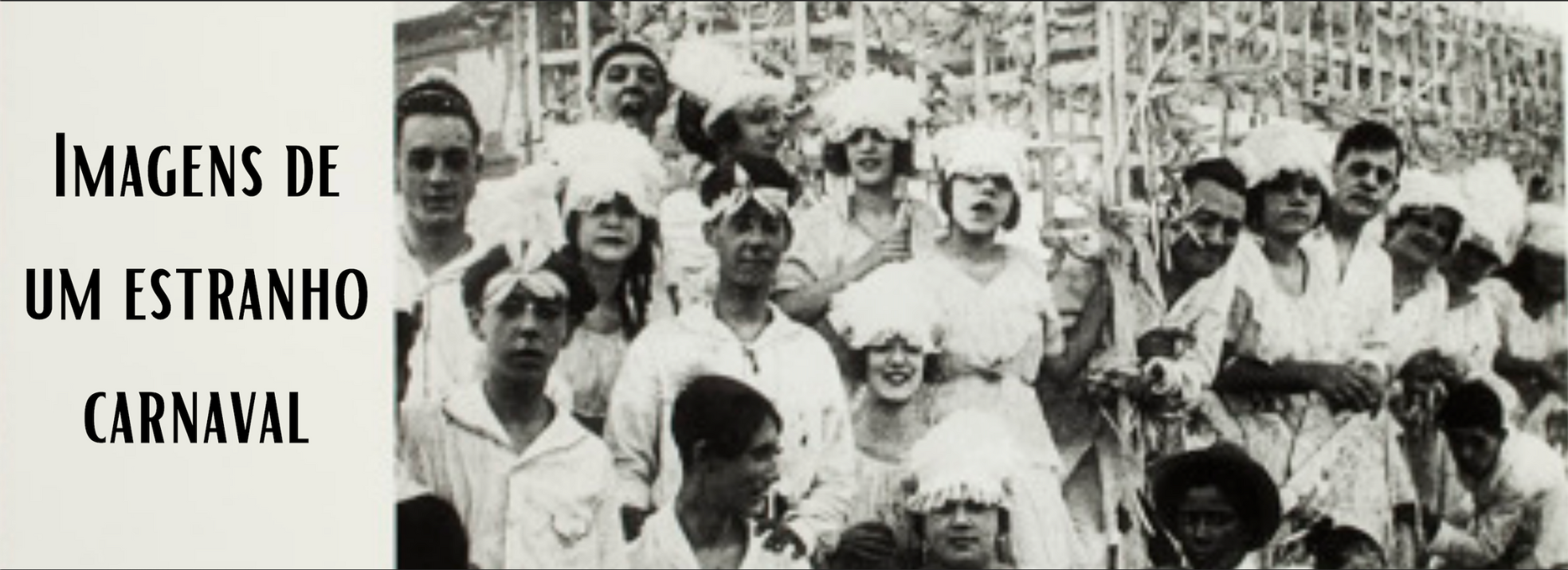
When watching O que foi o Carnaval de 1920, a silent documentary shot by Alberto Botelho in Rio de Janeiro, our first reaction is puzzlement. The joy normally associated with people celebrating Carnaval in the streets seems strangely absent. The film consists of three parts. In the first, we see scenes of the corso parade with cars of wealthy cariocas,1 driven by uniformed drivers and occupied by costumed men who repeatedly face the camera and pose for it. The whiteness of the passengers and their air of superiority are striking. Next, several shots taken at a children's Carnaval ball show costumed children posing or dancing for the camera, some quite serious and others with frightened faces on the verge of crying. The children all seem very uncomfortable, obeying the orders of the people behind the camera. The most uninhibited of the children, a girl named Hilda whom a title card describes as "little Feniana", appears in close-ups flanked by two small pierrots,2 and we learn that she has won a prize. In the third part of the film, a title card announces the parade of the Sociedades Carnavalescas [Carnival Societies] of the Tenentes [Lieutenants], Fenianos and Democráticos. Different floats and their occupants are filmed, first waiting to enter the parade, then advancing through the downtown streets.
Who are these elegant Cariocas who parade their floats in the corso? What are these huge floats? Why do the residents of Rio de Janeiro’s faces appear only at the edges of the pictures, given that they are the crowd who were mainly participating in the Carnaval? To answer these questions, we will look at some details about Botelho's work in the context of Brazilian cinema history and comment on the transformations that Rio's Carnaval has undergone since the creation of the Sociedades Carnavalescas in the 19th century.
Alberto Botelho was a prolific cameraman in the early decades of the 20th century, when he filmed several “singing films” for Francisco Serrador's company as well as countless documentary films produced in the “cavação” scheme. These were commissioned films that documented various political, cultural, or sporting activities of the elites and authorities. Botelho filmed a multitude of parties, car and motorcycle races, inaugurations, civic events, picturesque excursions, and soccer games. In 1911, he was hired by Serrador to record, in the meadows of Moóca, São Paulo, the flights of the aviator Ruggerone, fiancé of the daughter of textile entrepreneur Rodolfo Crespi, who commissioned the films. In 1914, he documented the arrival of Santos Dumont in Rio de Janeiro. Botelho filmed Pathé Journal's newsreels in Brazil for over a decade, and also participated in the making of fiction films. In 1912, he produced and filmed in Rio de Janeiro a re-enactment of the famous "400 contos crime", in 1918 he photographed two productions by Luiz de Barros, and in 1920 he did the photography for one of the many versions of O Guarani, this one directed by João de Deus.
Rio de Janeiro's 19th century Carnaval celebrations were diverse and uncontrolled events of multiple cultural origins in which the whole city participated. But since their founding in the 1860s, the Sociedades Carnavalescas joined those who had long been fighting for greater public control over Carnaval to eliminate the anarchy of the celebrations and the “dangers” of the more popular versions of the party, such as entrudo, zé-pereiras, cucumbis, cordões, and ranchos - all of which we will elaborate on later. The Sociedades Carnavalescas wanted to offer a version of the festivities that restored their European characteristics and Venetian origins, thus eliminating the wild confusion of drumbeats and mass gatherings. These societies instituted two types of floats for their parades, those of “critique” that criticized the socio-political situation of that period, and the floats of "allegories'' or "ideas," which were produced with the intention of reinforcing the impression of luxury and references to classical culture. The latter floats were made for the societies to differentiate themselves from the Carnaval of the lower classes. Botelho was often hired by these societies, and so the images he offered in his films were typically intended to highlight their cars and members. Therefore, what we see is not the party in its plurality, but only the organized revelry of Fenianos and Democráticos in their float parades, in their children's balls, and in the public ostentation of private cars, often rented, that paraded in the corso of Avenida Rio Branco. Advertisements in the press (see Figure 1) displayed costumes and party toys for the occasion. We see in these shots local people selling drinks to the occupants of the cars.

Botelho's work as a cinematographer on commissioned Carnaval films seems to have begun when he was hired by the Serrador Company to shoot O Carnaval do Rio in 1911. The film has since disappeared, but information in the film's file at the Cinemateca Brasileira3 indicates that the images featured costumed children and a Club dos Fenianos outing. In 1913 Botelho again filmed the corso on Avenida Rio Branco and some cars from the Clube dos Democráticos, and the following year he produced images of the corso on Avenida Paulista, where the São Paulo elite lived. There is, therefore, in the 1920 film, a repetition of the same subjects and financiers as in his earlier films about Carnaval.
It should be noted that these films were shown in the central region of Rio, which had been reformed in the first decade of the century by the mayor Pereira Passos to expel the old tenements and working-class housing and replace them with wide avenues where new cinemas were built, next to symbols of modernity such as the Municipal Theater and the National Library. A sanitized image of Carnaval was therefore demanded by the press, the elite, and the public authorities to be shown in these new elegant cinemas (Morettin, 2005: 136). According to Bruno Carvalho, with these urban changes the city's Carnaval “split along socio-geographical lines”. On one side there were the private corsos and masquerade balls, which took place in elegant, closed venues, and the parades of the Grandes Sociedades, which were shown in the movies. On the other side, there was the effervescence invisible to the cinema, the lively and anarchic parties of the lower classes, “spontaneous and authentic expressions of the African populations of Brazil” that were concentrated around Praça Onze (2019: 202). According to Carvalho, it won't be until 1932, after the ascension of President Getúlio Vargas and his defense of samba and miscegenation as one of the elements for the construction of a national identity that the era of the escolas de samba (parades of Carnaval associations from cordões and ranchos) would begin. The newly created newspaper O Mundo Sportivo, headed by journalist Mário Filho, created “the hitherto sporadic practice of treating Carnaval parades as competitions”. Pedro Ernesto, mayor of Rio de Janeiro appointed by Vargas in September 1931, supported the schools, making the parades official and giving them guaranteed financial aid (Carvalho, 2019: 211). Thus, it is important that we understand the forms of Carnaval that were intended to be left out of cinematic images in the 1920s.
As Maria Clementina Cunha explains in her detailed historical study of Rio de Janeiro's carnaval between 1880 and 1920 (2001), entrudo was, for the population of Rio de Janeiro in the 19th century, synonymous with carnaval, a practice that had come from Portugal that, over three days of revelry, featured games for everyone - young and old, slaves and masters, women and men:
(...) It was the custom of getting each other wet and dirty with lemons or wax oranges filled with scented water, using syringes, troughs, tubes and even bathtubs - any container that could hold water to be thrown. It also included, in certain situations, the use of powder, “vermelhão”,4 paints, flours, eggs and even mud, tar and fetid liquids, among them urine and "sewage" (Cunha, 2001: 54).
In the private space, the masters practiced a kind of domestic entrudo, and often the residents of houses on opposite sides of the street would shoot at each other, using smelly lemons that they would take from troughs held by slaves. In the street, these slaves participated more actively in the games. In the 1880s behaviors associated with entrudo began to be widely condemned by the Rio de Janeiro press, the police, and the Sociedades Carnavalescas, and the crudeness of entrudo was considered to be damaging to the reputation of Carnaval by the end of the century.
Rio de Janeiro's Carnaval also encompassed other popular practices. The cucumbis, for example, were parades of black people who, in the last years of the 19th century, dramatized in African languages the story of a black prince who dies after being attacked by a tribe dressed in feathers. At the end of the dramatization, the black prince is resurrected by a sorcerer and his return is celebrated. The Native Brazilian costumes of the parade had many feathers and necklaces of teeth, while the African court came with their drums and brought live or stuffed animals, such as snakes, turtles, lizards and others. Cunha explains that these parades, although criticized, were tolerated for their humble, primitive and even “picturesque” appearance. But after the abolition of slavery in 1888, these cucumbis began to be removed from what was considered the authentic Carnaval, a celebration without the portrayal of so much racial, social and cultural inequality. The cucumbis were labeled as “gangs of unruly blacks” disguised as Native Brazilians, and were literally banned from Carnaval celebrations.
Another form of popular practice during Carnaval were the noisy zé-pereiras, who invariably appeared and mingled with the larger crowds. These were parades created in the tenements, in which blacks, poor whites, prostitutes, manual laborers, and unemployed people paraded, ridiculing the upper classes by wearing ragged clothes inside out, beating tin drums, and displaying a banner made of cheap material. This modality was created in 1852 in Rio de Janeiro by a Portuguese shoemaker who felt nostalgia for the entrudo of his homeland (Cunha, 2001: 45-48).
Other important forms of popular Carnaval were cordões and ranchos, whose members came from the hills and distant neighborhoods. These celebrations were also considered crude and old-fashioned by the Sociedades Carnavalescas, but over the course of time they multiplied and managed to negotiate their survival in the face of the disciplinary project of Carnaval promoted by the Sociedades Carnavalescas and part of the press, which was losing strength in the early twentieth century. Many of these small popular Sociedades Carnavalescas requested public licenses to be able to go out during the Carnaval and visited the editorial offices of newspapers to acquire visibility.
There were important differences between cordões and ranchos. Cunha explains that while the cordões walked on foot, the ranchos rode allegorical floats on carts. The cordões' emphasis was on heavy percussion and singing in which “one or two dancers dressed as Indians sang the copla, and the choir repeated the chorus in unison”, sometimes accompanied only by cavaquinho and guitar. They sang a song with their strong drums and snares. The ranchos, on the other hand, sang in harmony with light percussion, strings, and wind instruments. The ranchos paraded with a predefined theme and had singing masters, who conducted a large presence of women, the pastoras. The larger societies were suspicious of these groups and did not differentiate between them, considering them all too numerous and threatening in their overt precariousness (2001: 152). However, in the first decade of the twentieth century a division was established: the ranchos began to be valued by the press for their poetic, musical, and organizational qualities, while the cordões received negative judgments that condemned their appearance of violence, miseducation, and marginality.
Returning to O que foi o Carnaval de 1920, we can now explore the origins of the Democráticos and Fenianos. Their members were immigrants and merchants who founded clubs to have familiar spaces to socialize and enjoy their Carnaval, and also, crucially, to be valued by the local elite. They housed reading rooms, lectures, games, and promoted balls and Carnaval parades, in addition to producing their own newspapers, which were distributed to the public during the parades. The Club dos Democráticos was created on August 16, 1866, when a group of bohemian merchants chose as their senior partner the Portuguese José Alves da Silva, who contributed most of the money to the club’s activities. This club accepted small employees and various bohemians. The Club dos Fenianos, founded in 1869, adopted its name from the Irish rebellion against the English Kingdom. Cunha explains that the founding of the club took place at a meeting on Rua da Assembleia, at the residence of Mr. Chuck, "a disgusted British subject of Irish nationality, who imported and sold costume jewelry, with an establishment in Rio de Janeiro”. His presence may explain the name adopted by the society, which included on its board many immigrants, mainly Italians and Spaniards (2001: 110-111).
There is a whole complex history of relationships between Carnaval associations and the press, seen as a source of legitimization and publicity at a time when radio did not yet exist in Brazil. Representatives of cordões and ranchos visited the editorial offices of newspapers bringing their banners and part of the bands to be featured and commented on in their articles about the Carnaval. Illustrated magazines would write about what was to come before each Carnaval. In the case of O que foi o Carnaval de 1920, the close relationship between the societies and the press can be seen in the issue of the Fon-Fon magazine of February 21, 1920, published soon after the festivities. There is a clear connection between the angles of the filming of each car of the Fenianos and Democráticos parades and the photos of that same parade published in the magazine. While the film has few intertitles and doesn't say much about each car that is shown, the magazine shows photos of almost all the cars, explaining in the captions the theme and meaning of each one (see Figures 2.,3., 4., and 5.), which helps us better understand Botelho’s shots.


It is likely that the available viewing copy of O que foi o Carnaval de 1920 has lost, in addition to some intertitles, some scenes as well. Although at one point an intertitle announces images of the "three beloved societies: Tenentes! Fenianos! And Democráticos!", you do not see any images of the Tenentes' parade. Another possibility is that the Tenentes were not part of those who commissioned the film.
With the help of Fon-Fon magazine we can better understand the allegorical and critique cars that are featured in the parade. In the promenade of the Fenianos the following appears in succession after the riders of the front committee: lead float Festa do Jubileu no Olimpo (winner of the Sudan cup that was awarded to the best float), float of criticism A mão, Beef float, Rapto de Psiché, float Pra cima de moá criticizing the price of coffee and with two men dramatizing a comic scene, float O obelisco de Luxor, Lohengrin float, Pela Moral float criticizing the "almofadinhas" and "melindrosas",5 showing white men dressed as women, float Cruzeiro do Sul, an unidentified float where some members appear in performance, and float A cadeirinha de 1820. The floats are filmed here at an angle very similar to the magazine's photos, parked before the parade begins. The Democráticos' cars are shown in the following shots, in which we see: the leading float Águia Excelsa, the float Regresso Primaveril, the float O Auri-Verde Pendão, the float Execução da Paz, the float Os Dois Pecegos: almofadinhas e melindrosas (repeating a subject of the Fenianos and which probably refers to a popular debate of the time), the Reino dos Ratos critique float (which won the Phenix Cup for best critique), the Fecho do Amor float, and lastly the critique car Por um óculo. Finally three Fenianos' floats that we have already seen parked reappear. They now enter Rio Branco Avenue, and there is noticeable effort by the cameraman to isolate these floats from the view of the public.
Even if they look precarious, films like O que foi o Carnaval de 1920 clearly reflect the spirit of their time. Within the classic description made by Paulo Emílio Salles Gomes about the "themes" of silent Brazilian documentaries, which he divided between "rituals of power" and "splendid cradle", it is possible to say that the images of this carnaval film are curiously close to the "rituals of power" films, which showed public events where the movement of elites and authorities is observed. The Carnaval appears here in a complicated manner because it displays images of an old and widespread celebration in the country, however only showing its most elitist aspects.

1. Cariocas are citizens of Rio de Janeiro
2. In a Carnaval context, a Peirrot is someone dressed as a clown.
3. Information provided by newspaper articles collected by Jean-Claude Bernardet in Filmografia do Cinema Brasileiro 1900-1935, Jornal O Estado de São Paulo, São Paulo, Comissão Estadual de Cinema, 1979.
4. Pulverized mercury sulfate
5. Pejorative terms to refer to young modern men and women of the time, their fashion and attitude.
REFERENCES
Bernardet, Jean-Claude (1979). Filmografia do Cinema Brasileiro 1900-1935, Jornal O Estado de São Paulo. São Paulo, Comissão Estadual de Cinema.
Carvalho, Bruno (2019). Cidade Porosa: dois séculos de história cultural do Rio de Janeiro. 1ª ed, Rio de Janeiro, Objetiva.
Cunha, Maria Clementina Pereira (2001). Ecos da folia: uma história social do Carnaval carioca entre 1880 e 1920. São Paulo, Companhia das Letras.
Gomes, Paulo Emílio Salles (1986). A expressão social dos filmes documentais no cinema mudo brasileiro (1898-1930). In: C.A. Calil e M.T. Machado (eds.), Paulo Emílio: um intelectual na linha de frente. São Paulo/Rio de Janeiro, Brasiliense/Embrafilme.
Morettin, Eduardo Victorio (2005). Dimensões históricas do documentário brasileiro no período silencioso. Revista Brasileira de História. São Paulo, vol.25, número 49, pp.125-152.


