

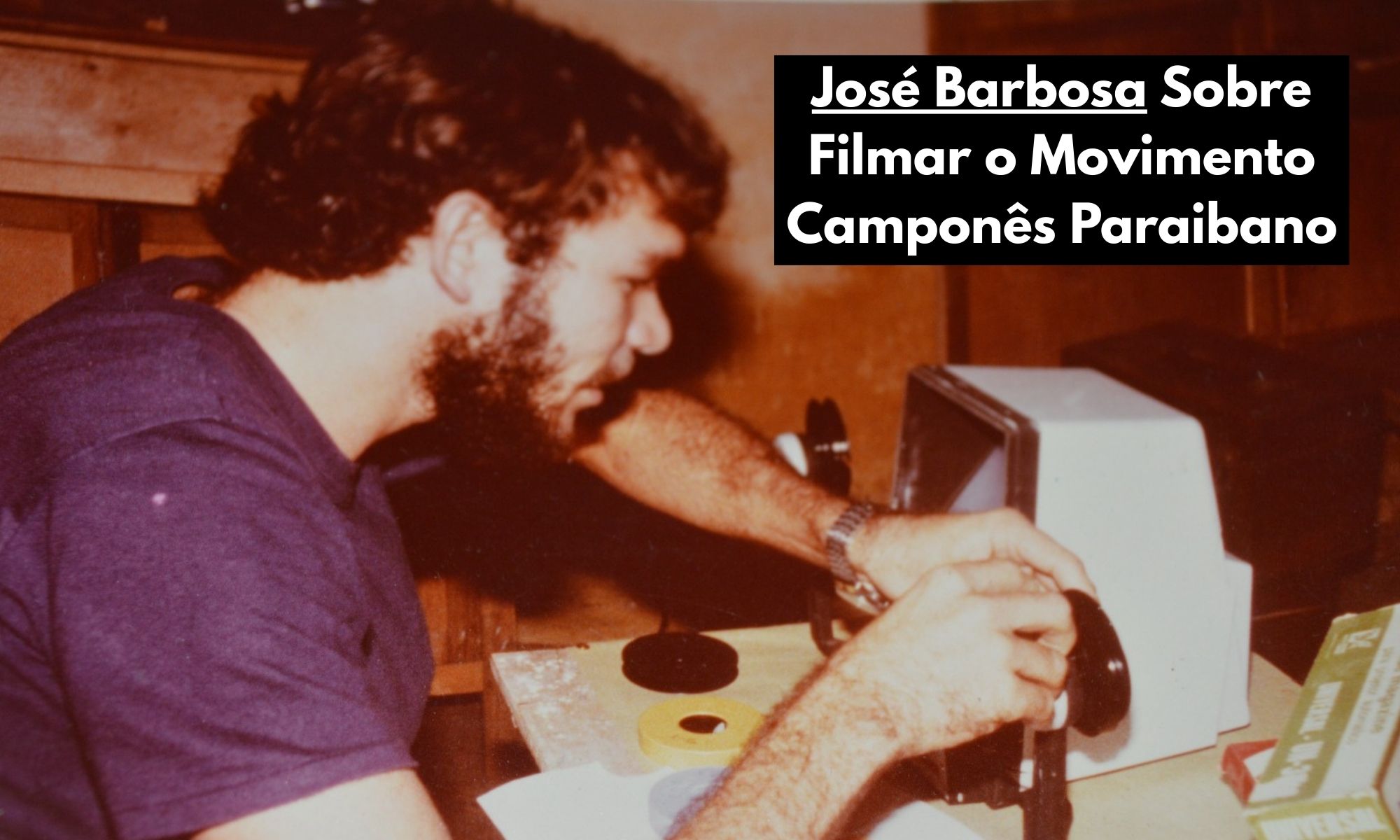
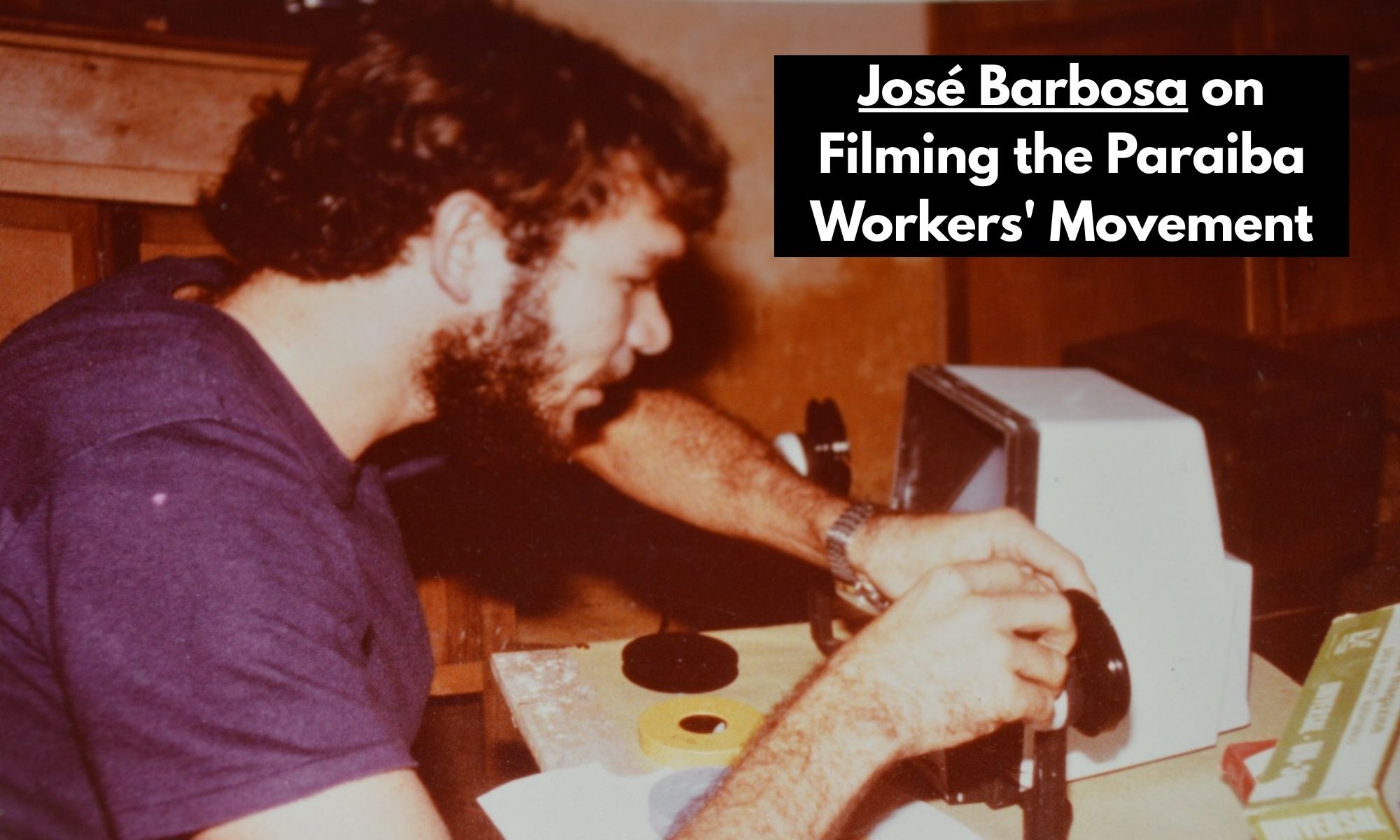
In 2022, we went to João Pessoa as part of the Traveling Digitization project. During our time in the city, we had the privilege of meeting documentarian José Barbosa and digitizing his super-8 films, two of which we are now presenting as part of the program "Long Live Margarida! Three films about the rural workers' struggle". The films portray the activities surrounding Worker’s Day festivities in the Paraiba Wetlands in the early 1980s: people taking to the streets, posters, leaflets, songs and speeches by union leaders, including historic footage of field work leader Margarida Maria Alves, who was murdered shortly afterwards and became a symbol of the struggle and resistance of rural women. We had the chance to talk to José Barbosa about how he arrived at these images; his work as a documentary maker for a Catholic institution committed to social justice; social communication; Margarida Maria Alves and the Paraíba rural movement.

Cinelimite: When we first met you in Paraíba, through João de Lima, there was some uncertainty about the content of the two films Primeira Semana Sindical no Brejo da Paraiba and 1º de Maio. Now that we have these beautiful new digital copies and understand that films have great historical importance, can you reflect on the experience of seeing them again after so long? After re-watching them, what are your thoughts on the works?
José Barbosa: Regarding the experience of having my films digitized, I thought it was very good to be able to show the film to people connected to the families of these rural workers. I was first able to get access to these workers thanks to SEDUP, an institution located in Guarabira - PB.
Seeing these materials after so long has given me a sense of the fact that time never stops. It all seems so far removed from today's reality, but it is part of the history of Paraíba, of field workers who fought to live off the land or with the land. And for those who were sugarcane workers, to see their labor rights respected by the region's mill owners.
I have missed some of the things that made up the reality of that time. But I enjoy revisiting these images.

CL: You made two films about the workers' movement in Paraíba. Why did this subject interest you?
JB: I was working as a documentarian for a Catholic Church social service organization called SEDUP (Serviço de Educação Popular). My job at the time was to record the events of the popular movement in the Brejo Paraibano region. This brought me into contact with the New Trade Union Movement that was emerging in the region, which organized commemorations on the 1st of May, with all the popular movements from the 22 municipalities of Brejo Paraibano, an occasion in which people from these movements expressed their demands.
CL: What was the production of these films like? You filmed, recorded the sound and finished the editing yourself, right? And the equipment came from NUDOC?
JB: For the film 1º de Maio, the camera I used was owned by SEDUP. There was a Super-8 camera at their HQ. So I learned how to operate and edit it in a course offered by NUDOC. I recorded and edited all the material. I did the editing at SEDUP itself.
But the film Abrindo Brechas was made with material from NUDOC. I did all the directing, shooting and editing myself.
CL: Have you had any formal training in filmmaking?
JB: All the formal training I've had I got on a NUDOC course. Other than that, I've been doing it independently and I know I still have a lot to learn.
CL: What inspired you to pick up the camera to record the movements of these workers? Perhaps, subconsciously, you realized that there was a historical relevance to these moments and that they needed to be captured? Or perhaps you felt that cinema could be a tool to help publicize the movements and inspire others to take part?
JB: The recordings I made at SEDUP were shown in rural areas to the rural workers of the time. It was a big party for them to see themselves on the screen. There was no electricity, so we used a portable generator. It was a movie night in the countryside. And they themselves were the artists. It was a great experience. If what I filmed is the story, it was because there was no pre-set script. I filmed what was there. Without really any outside references, I edited these films. And this is type of thing that makes cinema eternal.

CL: Were you a university student at the time of your productions? What was the dialog like between the student and rural workers' movements at the time?
JB: I had just studied Social Communication at UFPB. My first job was at SEDUP, as a journalist hired by an institution that asked me to produce materials for people who couldn't read. Audiovisual production was essential at the time. There were written productions, with few words. I learned a lot about being a communicator for social education. In fact, I was a recent graduate in Social Communication.
CL: In the film 1º de Maio, there were two performances/plays that seemed to be aimed at illustrating and explaining the situation of the workers and calling on them to join the union. How were these seen by the workers in the audience? Were they effective?
JB: They put on the plays themselves. I can't say how they were run. I came across them on May 1st. They talked about the situations experienced by the field workers. I think they understood the theater language, it had to do with their struggles, led by the new union, called Novo Sindicalismo, a movement in which Margarida Maria Alves took part.
CL: In your two films, we see union leader Margarida Maria Alves giving a speech. Knowing what happened to this important figure, her brutal political assassination, how does it feel to revisit these images? Do you remember what your impression of Margarida was at the time of these recordings? After her murder, how did this affect the rural labor movement in Paraiba?
JB: A large part of Margarida Maria Alves' eternalized speeches were recorded in Super-8. The phrase "It's better to die in the struggle than to die of hunger" was filmed by me. Today, this phrase has pretty much become a reference to Margarida Maria Alves' struggle and dedication, in her fight for respect for the labor rights of sugarcane workers, the base of the rural workers' union of which she was the president.
CL: Did you have the opportunity to meet and talk to Margarida Maria Alves? If so, can you describe these experiences for us?
JB: Yes. I wasn't much of a talker. I was a good listener. But once she said to me: "You're just a child". I was already 22. But in that fight she knew more than I did. I was the just the cameraman.

CL: Another important Brazilian figure we see in the movie 1º de Maio is the writer, nun and political activist Maria Valéria Rezende, acting, it seems, as a journalist. You know Maria Valéria, don't you? Can you tell us a bit about her and her interest in fighting for the labor cause?
JB: Valéria Rezende was the coordinator of SEDUP. I learned a lot from her about the pedagogical approach to working with the grassroots movements. Part of our job was to ask questions, to allow people to express themselves. Allowing people to speak. Through words, sought out and refined, with plausible arguments, people could self-educate. I learned a lot from her. And my own work, even if it wasn't one hundred percent, she didn't criticize, she just told me to listen to other people's opinions about what I had done. The people educated me on how to improve, more and more. I did radio shows, but always with my listeners as the judges. That's pedagogy. Valéria Rezende is the greatest pedagogue I know.
Also, in terms of people's struggles, including struggles for labor rights, she was linked to Liberation Theology, which was also the basis for Paulo Freire's political education, who knew how to combine faith and political struggle, as an expression of the synthesis of a historical-political time.

CL: In the film Primeira Semana Sindical no Brejo, you arrive early at the workers' meeting. We see people taking to the streets. This is an impressive part of the film, because we see trucks full and cars full, a wave of people arriving at the square in unison, which serves in the film as an initial sign of solidarity between the workers.
JB: I almost lived for my work. If a meeting was going to start at 8am, I would arrive 45 minutes earlier. I learned to be almost British, arriving a little earlier for scheduled appointments. I felt solidarity with the workers. I have to enjoy what I do. Being supportive is part of the job.
CL: What is the screening history of these films? Have you had the opportunity to screen them in labor unions or in a movie theater?
JB: Never at the movie theaters. But I projected the films in several small farms, in various towns in Brejo Paraibano. When I showed up, people would say: it's the “film guy”, or even the “poster guy”... I also made posters, etc.
CL: Both films are set in the Brejo region of Paraíba. Why was this region so essential to the workers' movements?
JB: The existence of an institution that takes care of the communication of any movement, giving them advice in this area, makes a big difference. Communication, as well as an awareness of what lines of thought were developing there, and the help of other institutions and intellectuals in solidarity with the working class, made Brejo an important region for organizing popular movements.
CL: In the film Primeira Semana Sindical no Brejo, one of the speakers on the podium says: "Today, the one thing we can be certain of is violence!", when talking about the "rural man". He says that these people are marginalized because they fight for their rights. It's a bit frightening to hear this and see that Margarida speaks right after him, because we know that she will be a victim of this violence.
So it's very obvious that this was a very important issue at the time. Can you give us an idea or explain more about this idea of violence against activists in the rural workers' movement?
JB: There were henchmen in the countryside who watched over private areas. The police were also used for this purpose. Judges and landowners are friends. The deputy goes along. The world at that time was made for the wealthy, not for salaried workers or small landowners (family farming), it was the world of the big landowners. A Brazilian tradition. In the countryside, police and goons were hired to evict residents from areas they had lived in for years. It was a policeman who killed Margarida. A crime that was never tried. The henchmen didn't allow outside agents to be present or acting in those lands. Hence the importance of the radio, and even the cinema, played in the home of a resident, who invited everyone else to watch a movie. A movie that was watched and debated. The film was a pedagogical trick of people's organization.
CL: At the beginning of the film 1º de Maio, you film the workers making flyers for the May Day meeting. And in the next scene, you cut to the workers handing out these leaflets to people. It's a small gesture, but these moments show us how the May 1st event depends on the work (perhaps voluntary) of ordinary people. It also shows us a special kind of unity between the members of the unions – they are making this movement together.
Could you talk about this part of your film? Just like in Primeira Semana Sindical no Brejo da Paraíba, with the moment at the beginning when the cars enter the square, here you film these small moments that seem to speak of something much bigger.
JB: 1º de Maio, at that moment, crowned a week of intensive work that was taking place all over Brejo. A week of mobilization, leaflet deliveries, radio shows and meetings with workers in the unions. As the "journalist" of these moments, I made sure I didn't miss anything that I thought was important. The big drama was how to tell the story in short pieces that would make sense to those watching, remembering that these materials were the basis for conversations after they were shown, in meetings that had a prologue, the video as text, in a context that needed to be understood. These meetings included local leaders, who led the conversation. I, as a producer, also asked questions. As the backstage of a movement, I was part of it. We even created the Women's Movement of Brejo Paraibano, with me at the base, producing audiovisual media.


