

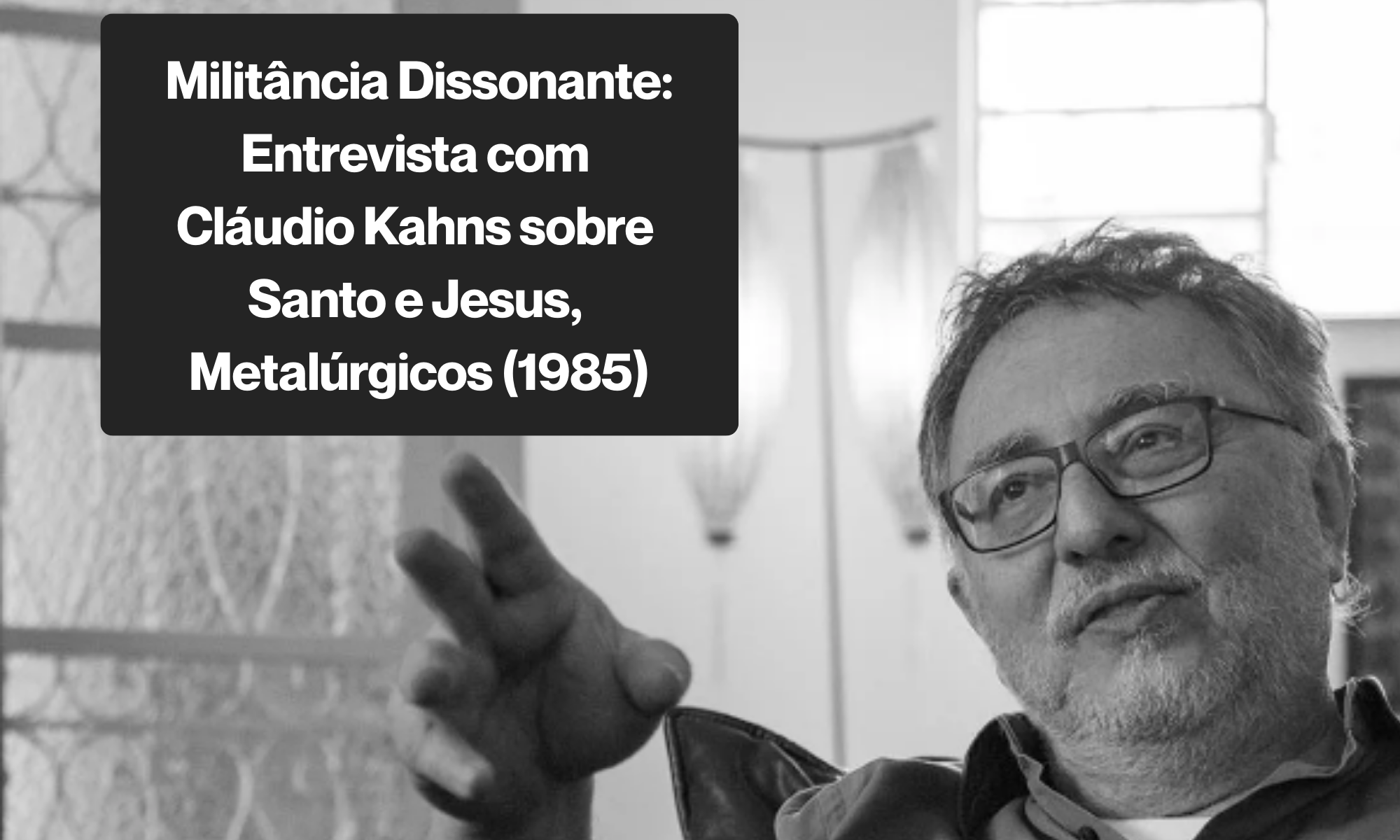
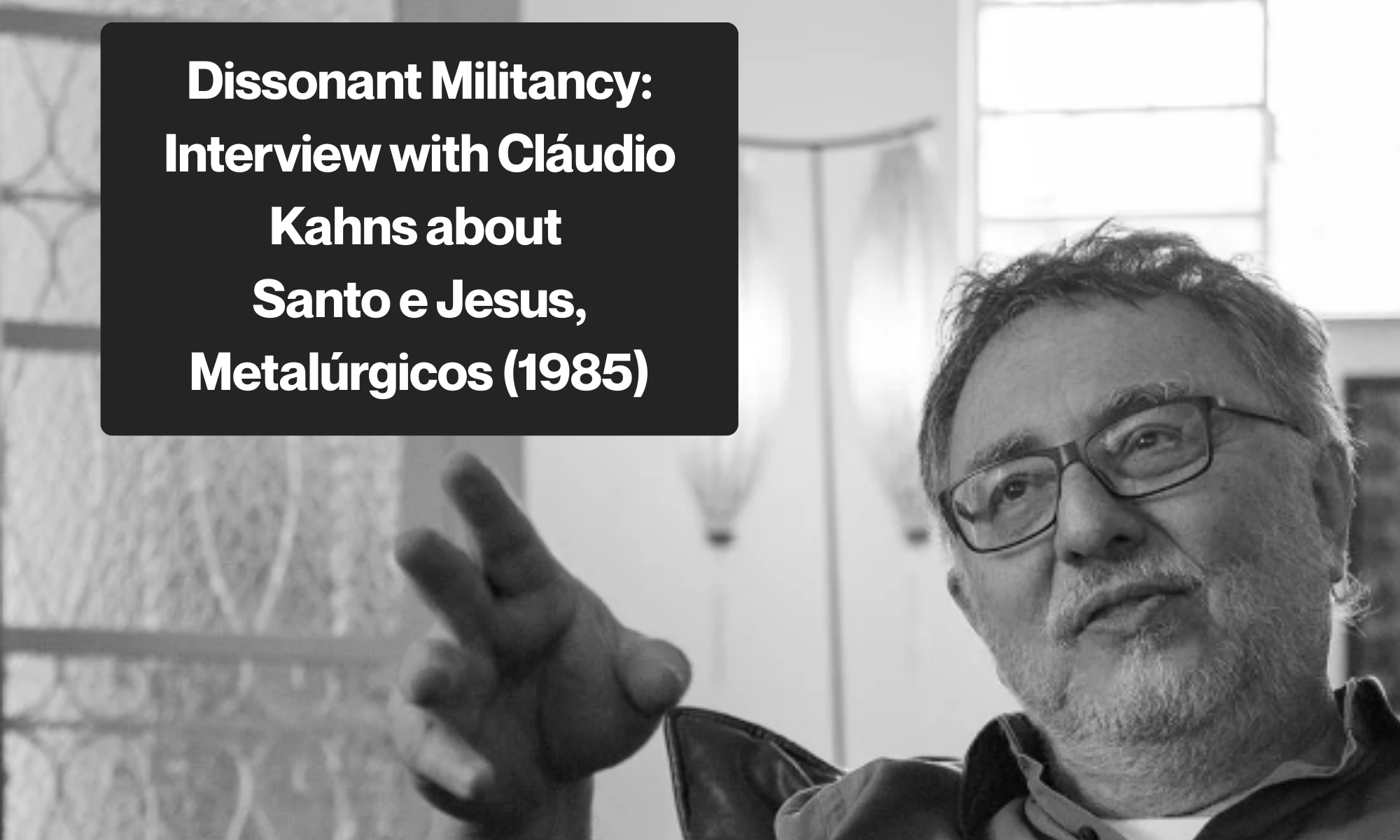
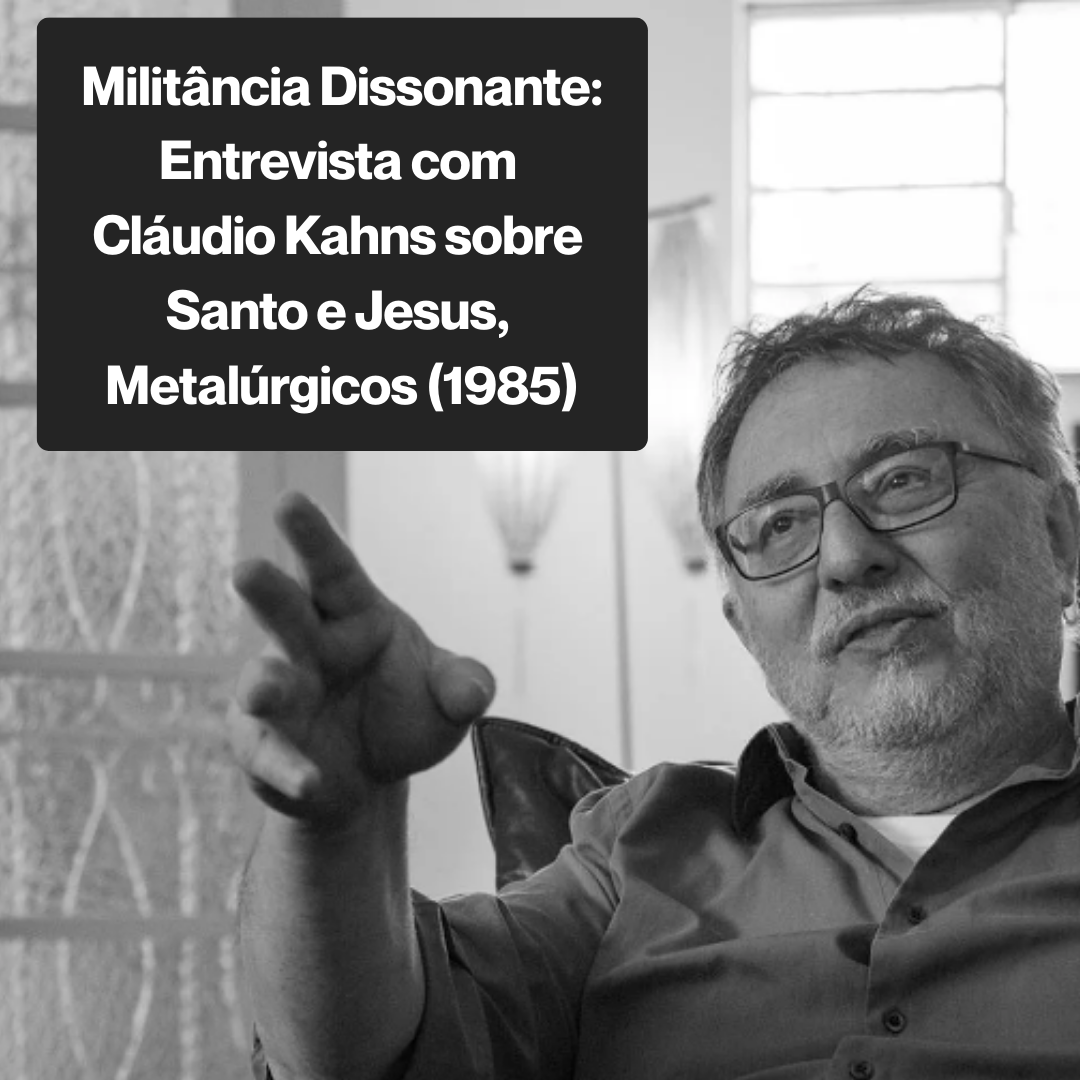
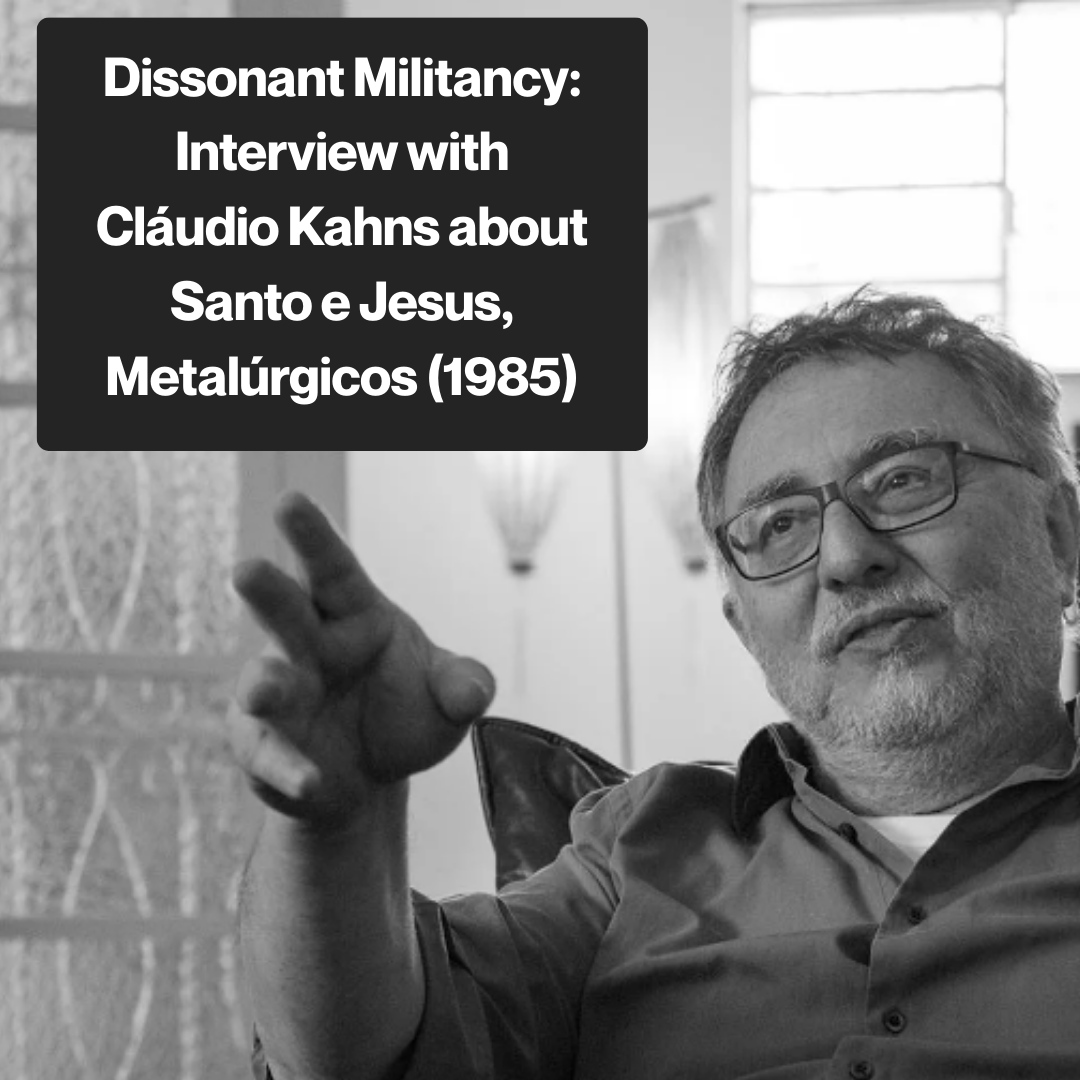
Victor Guimarães: Can you tell us a little about the genesis of the film? How did it begin? What was the starting point?
Cláudio Kahns: The film began with a phone call from Antônio Paulo Ferraz, from Rio de Janeiro, whom I had met through a common friend, Silvio Tendler, and with whom we had collaborated on the film Os Anos JK (1980). Antônio mentioned his idea of filming a "fait divers" with an anthropological view on the death of a worker murdered by the partner and lawyer of a metallurgical company in the Brás neighborhood in São Paulo. The worker had been murdered for claiming he had worked overtime. In a few days, I organized a team and we began our investigation, filming the murdered worker's colleagues, Nelson de Jesus, the bar they frequented in front of the factory, the boarding house where he lived, and the metalworkers' union. The idea was to film everything around this true event. In 1978, during the dictatorship, working conditions in the factory were terrible, as can be seen in several sequences in the film. Not only by the images of the work, but also by the statements of the workers themselves. Besides the repression, any attempt to strike was immediately denounced to the DOPS (Department of Political and Social Order), an instrument of the dictatorship to silence by force any attempt of alleged "subversion". The struggle for minimum rights for workers spread, with great difficulty, half clandestinely, and there was a demand for the creation of internal factory committees; it was the workers' movements and the unions trying to organize in the factories, with different political approaches.

VG: Right in the opening credits, the film announces that it was shot between October 1978 and September 1983. This is a very different time of production from many of the films made in parallel to the great strikes that took place in the ABC region, many of them made on the spur of the moment and finished in a few months, to follow and interfere in the ongoing struggles. You yourself would participate, in 1979, in the making of Que ninguém, nunca mais, ouse duvidar da luta dos trabalhadores (also known as Greve de Março). In Santo e Jesus, Metalúrgicos however, following the unfolding of the murders of Nelson de Jesus and then Santo Dias seems to push the film to another, more distended time. Can you talk a bit about this more elongated process of filmmaking? What differences do you see in relation to these other, more urgent films?
CL: In 1979, in addition to this film that you mentioned, it was, in fact, the year in which the great strikes of the metalworkers in the ABC region sprang up, where Lula emerged as a leader. I was part of Leon Hirszman's team, my first great professional work as production director (and a little as executive producer) together with an already established director, where we filmed all the developments of this strike that resulted in the film ABC da Greve (1990), finalized ten years later. The initial proposal was to shoot a short film, but with the extension and continuity of the strike, we ended up shooting about 100 cans of 16mm negative during one month, almost one thousand minutes of material. For a totally independent production, with few resources, this was an achievement. Nobody in Brazil had filmed so many cans of a strike film! In fact, both Santo e Jesus and ABC da Greve were films that took a long time to be finished. In the opening credits we put the shooting dates from 1978 to 1983, but Santo e Jesus was only finished in 1985; we had many breaks between one shoot and the next and we also wanted to follow all the developments of the case. So, our urgency was to try to make a film that would be as comprehensive as possible and show the almost inhuman working conditions in this factory, which certainly reflected what was happening in many other factories, all over Brazil. And all this during the military dictatorship, which created a climate of suffocation and salary slashing, preventing strikes, etc. I had also participated in filming with Adrian Cooper in 1978, in a hat factory in Campinas, which resulted in the beautiful and important short film Chapeleiros. By the way, Cinelimite attention, this is another film to be digitized! There we have an impressive view of what would have been a factory at the end of the 19th century, beginning of the 20th century. It was a suffocating, almost medieval environment. All these films were not of immediate intervention, or they ended up not intervening, because in the three cases it took a long time to finish them, mainly due to the lack of resources. ABC da Greve was only finished 10 years later, with Embrafilme's support and without the presence of Leon, who had passed away. The same with Chapeleiros, and also in the case of Santo and Jesus, which was largely financed by Antônio Paulo's brother, Hélio Ferraz, who had already produced other films. All of them were independent productions, independent initiatives, not commissions from a political group or syndicate. So, there was no finishing date, no release date, in general. It was made as and when it was possible! Everything was shot in negative 16mm, a can cost at the time something like 100 dollars, today it would be equivalent to 450/500 dollars! Just for a can of negative! Not including equipment, crew, sound, developing and copying the negatives, etc. This was a lot of money in Brazil at that time, especially without any kind of support or official financing. In fact, quite the opposite!
VG: Still about the filmmaking process, as a viewer, I have the impression that the film starts to be shot as a response to Nelson's murder, and in the middle of production, the death of Santo Dias happens, and the film needs to react to this. Was this the case?
CK: Yes, exactly that. The film began with an anthropological investigation into the death of the metalworker Nelson de Jesus. But during the making of the film, something shocking happened to Nelson's fellow metalworker, Santo Dias, whom we had chosen to be the narrator of the film! We had decided to give voice to a worker to be the narrator, we didn't want an external subject, an actor or an announcer to narrate what happened. What today is called a "lugar de fala"!1 We had soon realized that Santo Dias stood out among his colleagues for his perception of what happened, his vision of the working conditions inside the factory, and the articulation of his discourse. We didn't know exactly his importance as a political leader, but we did know that he had an organizing role and that he was part of the union opposition, a movement that contested Joaquinzão, the eternal president of the Metalworkers Union of São Paulo, considered a "fighter" by the movements further to the left. So we decided to film Santo Dias in his working place, his base outside the factory, near Capela do Socorro, in Santo Amaro. A few months after this filming, I heard on the radio that a worker had been assassinated by a military policeman during a strike of metalworkers in São Paulo. Since we were, because of the film, covering everything related to the metalworkers in SP, I immediately went to the funeral of the dead worker to find out what had happened. What a shock to me when I saw the church full of people and the body of Santo Dias lying on a sort of bench! I was stunned! And as I had no filming equipment, but there were TV crews on the scene, I knew that we would have access to these images later. Still shocked and saddened, I immediately thought that our film would become a film about a double murder, that of Nelson de Jesus and that of Santo Dias!

VG: For those watching the film, although we already know this from the beginning, it is very impressive to see that Santo Dias was a protagonist in the testimonies about the death of Nelson de Jesus, and in the course of the film he will also be murdered. There is an extremely tragic layer that the film has to deal with. What was it like dealing with this during the making of the film? I imagine it was a huge challenge from an ethical point of view, right?
CK: Victor, there wasn't much to reflect on. I reacted immediately! I called Antônio to tell him what had happened. Our dear and esteemed friend Santo had been murdered just for being involved in a strike! It was urgent to denounce yet another murder, one more of the thousands of arbitrary actions in those hard times of dictatorship. A few days later, a huge demonstration against his murder took place in São Paulo and we were there filming. And from then on, we followed all the repercussions of his assassination.
VG: A striking feature of the film are the various sequences in which you film the backstage of the press coverage. The editing even highlights these sequences with a dose of irony, as in the use of the Globo Network's "plim plim" as a sound refrain. Do you see the film as an effort of counter-information? Of resistance to the official coverage of the murders?
CK: Without a doubt, a subtle irony about how the press covered this kind of event, especially Globo, a completely dominant information vehicle at the time. In fact, there was not much interest in covering these facts, the press in general was muzzled, there was a lot of censorship. Our mission was to show how the facts happened from the point of view of those involved. In this sense, it was totally a counter-information film. I don't remember if these manifestations were disseminated at the time, but this was how the mainstream press, in general, worked at the time, with some exceptions in the print media, such as Folha de São Paulo, which gave ample coverage, even with censorship. I remember a curious fact: we had lost the footage of one of the assemblies in São Bernardo, at the time of the filming of ABC da Greve. At Leon's request, I went to Globo a week later, looking for images of that assembly. What was my amazement when the archivist told me that they had erased the images from the tapes for reuse a week after the most important demonstrations in Brazil during the dictatorship! The Globo TV archive had erased those images, but those of the Brazilian soccer championship games, also from a week before, had been preserved!

VG: The editing of the film seems to me to be of an absolutely remarkable intelligence and astuteness. The film deals with very diverse material, from newspaper clippings to statements, from images of the strikes to the daily life in the factories. And it doesn't do this in a didactic way, always betting on the spectator's ability to formulate his or her own conclusions. There is no use of an explanatory voice over, for example. Can you tell us a little about the editing decisions? How did you see this work at the time and how do you see it today when you review the film years later?
CK: For me the most important thing was to make a film different from what was common at the time: a film with images of the facts and almost always with an actor or speaker, denoting a certain paternalism. The decision not to have an external narrator had to do with the so-called "place of speech"; we wanted to give voice to the workers themselves through one of their own, since they would be the most suitable ones to talk about their living conditions, their work, their leisure, their problems. We deal with the life of workers, but with a less traditional vision, in relation to other militant films. The idea was exactly this, not to be didactic, to let people get into those environments, into those situations, to provide some involvement. Today I am very happy to see that the film, more than 40 years after it began, still arouses the interest of younger people. This is fantastic for me!
VG: Another thing that strikes me is the role of the music in the film. Sometimes it makes the images more dynamic, at other times there is a touch of irony, and at other times there is a certain dissonance between the soundtrack and the images. How do you perceive this work with music and its role in the construction of the film?
CK: This was a brilliant work by Willy Corrêa de Oliveira, to whom I am eternally grateful. He was extremely generous in also bringing his touch of modernity to the sound construction. Without a doubt, his soundtrack comments on passages in the film, with different musical approaches. He was part of an avant-garde generation in electronic music. His collaboration was very important.
VG: Since I first saw the film, I believe about ten years ago, I was very struck by the religious resonance of the names of the workers - Jesus and Santo - and the way the film deals poetically with this Christian repertoire, exploring this somewhat miraculous coincidence. The final image, with the camera moving from the plaque in honor of Santo Dias to the white sky, has always moved me a lot. How was for you this relationship between a poetic desire and a militant commitment? Was it a productive tension? Were you more concerned at the time with the political task - of mourning and memory - that the film should fulfill? Or were you also concerned with the poetry it could produce?
CK: There was indeed an idea for us to make a freer film, more open to interpretation. Without ceasing to be a political film, of course, but with a less rigid approach, this was totally intentional, even the music punctuates some humorous moments, highlighting the ridiculousness of some statements or commenting with a certain drama. I was trying, as was Antônio, to make a political film, but without being boring. On the contrary, I tried to interest the people who were watching those facts, those events and, at the same time, to interest the workers themselves. In short, an approach that was a little different from the militant cinema of the time.

VG: Those black and white images at the beginning of the film are quotes from Braços Cruzados, Máquinas Paradas (Roberto Gervitz, Sérgio Toledo, 1978), right? I notice an alignment of political stance between the films, because both narrate from the point of view of the union opposition. Can you reconstitute a little how this scenario of unionism was at the time? I am curious to know how these films were received by the workers. Were there many who were still sympathetic to the management of figures like Joaquinzão? Were there debates between different gangs, so to speak?
CK: Yes, we were also more aligned with the union opposition, of which Santo Dias was part. And that led to the creation of the PT. Joaquinzão's management was that of a political sector that was more conformist with the situation, that made alliances with the big industrialists; the opposition was more combative, it really tried to make a more radical change in the situation. Joaquinzão had a less aggressive base that allowed him to renew his mandate for several administrations of the Syndicate in SP. But he faced an increasingly fierce opposition from the sectors that were not aligned with reformism, with small conquests for the workers.
VG: In closing, I wanted to know how the screenings of the film went at the time. How was the distribution scheme? In which contexts was it shown and how was the reception at the time? Do you remember any outstanding discussions during the screenings?
CK: In 1981 I was part of a group of filmmakers who decided to create a film distribution company for unions, film clubs, schools, universities and other institutions, called CDI (Independent Cinema Distribution). We spent a year discussing the creation of this distribution company and came to the conclusion that it would be economically unviable! Even so, we opened CDI out of sheer stubbornness, and it played an important role in the diffusion of political films in the 1980s until the mid-1990s. So, not only was Santo and Jesus disseminated through the CDI, but we did some film screenings, and dozens of other films, political and/or less militant, were also distributed and shown throughout Brazil. Santo and Jesus was very widespread at the time with many copies of the film in 16mm and especially with the advent of VHS. I don't have the numbers, but it was extremely well attended in the outskirts, not only in São Paulo but all over Brazil, with the support of unions and universities, and it ended up winning the best feature film award at the XII Jornada de Curta Metragem, in Bahia, the most important documentary festival of those times, organized by Guido Araújo. Unfortunately I couldn't follow the film's exhibition trajectory, I was at that time involved with other productions at Tatu Filmes and had no condition to follow the screenings or the debates. In 1985, when Santo and Jesus was ready, I was launching A Marvada Carne, which had also been selected for the Critics' Week in Cannes. And starting, as executive producer, the film Vera. So it was simply impossible to follow Santo and Jesus.

1. "Lugar de fala" is a concept that has become wildly popularized in Brazil, especially in leftist spheres. Scholar Djamila Ribeiro defines it as "the place we socially occupy which makes us have diverse experiences and perspectives".


