

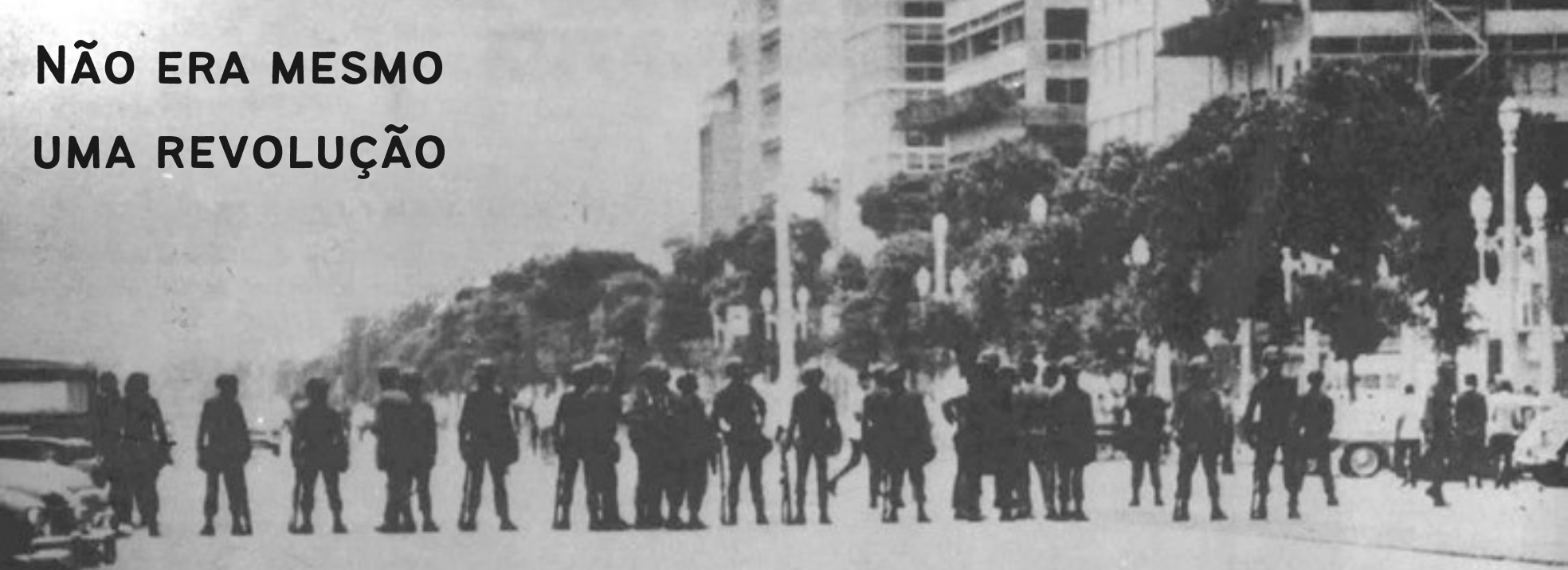


“It was in August 1968... It was in Rio de Janeiro in August 1968, a hell of a commotion, students in the streets, workers too; there were workers occupying factories in Minas Gerais, workers occupying factories in São Paulo, and students stirring things up. It was the dictatorship of Costa e Silva, who had been the second dictator, after Castelo Branco, and had overthrown President Jango, who was making the revolution in 1964; it wasn’t Marshal Castelo Branco, no, because he was a reactionary marshal... So there was a terrible wave going on, students in the streets, the leader was Vladimir Palmeira; there was Marcos Medeiros, Elinor Brito, the psychoanalyst Hélio Pellegrino, Franklin Martins, the whole tough crowd.
But it wasn’t really a revolution, I mean, it was unrest, it was... there was the French May too, there was one hell of a wave going on. People would say the following: that it was revolution, but it was the radical middle class, the reformist liberal bourgeoisie in the streets. And the workers... There were many peasants starving to death in the Northeast. Which, by the way, continues to be the case today, they have been dying of hunger for more than 400 years. And the intellectuals were there, at the Museum of Modern Art, that night. Exactly, discussing art, revolutionary art, because Tropicalism was beginning, one hell of a wave.
Then I called Saldanha, Luiz Carlos Saldanha, who had arrived from Italy; he had an Arriflex. Luiz Carlos Saldanha did the cinematography and camera, and the direct sound was done by José Ventura. Now, Hugo Carvana, Antônio Pitanga, who is from Bahia, and Odete Lara played the main roles; beyond them, there was Rogério Duarte, who is also from Bahia, Zé Medeiros, Hélio Oiticica, who is a painter, and the gang, Biju, Tineca, some people from Mangueira, and also Zelito, meaning not Doctor Zelito from the film, but Doctor Zelito from Mapa Filmes, and Chiquinho, who was in the Kombi.
And then time went by, because the film was left unfinished... Later I arrived in Havana, and did the sound at ICAIC... The synchronization was done by Raul Garcia, and I edited it with Tineca and Mireta. It was a co-production, and then Barceloni came in from Italy, and it ended up with the title Câncer. Rio de Janeiro. Shot there in Rio de Janeiro, in the favela, in the South Zone, in the North Zone, about those marginal figures of Rio de Janeiro, a shoot that took four days to film and four years to edit and synchronize... It was finished in May 1972; from August 1968 to May 1972, Câncer.”
It is with this monologue, intoned in his own voice, that Glauber Rocha opens his feature film Câncer. In the images, we see precisely what is described at one point in the speech: Luiz Carlos Saldanha’s camera glides along a long table of intellectuals, gathered at Rio de Janeiro’s MAM before a large audience. In the juxtaposition created by the filmmaker, a viewer unfamiliar with his voice may momentarily come away with the impression that the monologue is being delivered by the speaker currently at the table, who happens to be the poet Ferreira Gullar. He speaks inaudibly while being observed by his peers, who lean over the tabletop. Before long, however, it becomes clear that image and voice are not synchronized, that they are not saying the same thing. This contrast permeates the entire feature, and is the result of its mode of production and completion.
Already in these opening minutes, Glauber Rocha throws the audience headfirst into the world of Câncer, one of his most distinctive films, one that differs from everything the director had made up to that point and, even while clearly marking its place within the “evolutionary line” of Glauber’s filmography, from what would come afterward as well. In a long monologue, a variety of functions are synthesized. The film has no title card or cast and crew credits at the beginning or end, but the monologue fulfills that function, something Glauber would later repeat, in a different way, in Jorjamado no Cinema, from 1979. Likewise, the speech that opens the feature also provides the historical context of its filming, which ultimately also serves to justify the inflamed filmic discourse that would become evident in the very next moments, and describes the first shots to appear on screen at the exact moment they are visually present. It also lays out the difficult process of editing the material, which lasted four years and spanned one of Glauber’s periods of exile, having been completed in Cuba, and juxtaposes this with the dynamism of the shoot. Four days to film, four years to edit and synchronize.
There is conflicting information about the filming of Câncer. While Glauber himself states, in the aforementioned monologue and in later remarks, that it took place in August 1968, researchers such as Gonzalo Aguilar say that the film was in fact shot in May of that year. According to Aguilar, the feature was filmed “in May 1968, one year after the premiere of Terra em Transe and before the beginning of Antônio das Mortes. Glauber shot it during the month he had before beginning the new shoot” (Aguilar, 2016, p. 99).1 Aguilar’s claim is supported by newspaper items such as those published in Diário de Notícias in May and June 1968, which were already reporting on the shoot and still referring to the film by its provisional title, Num dia alucinante a paisagem era um câncer fascinante, citing “between July 8 and 10” of that year as the speculated period for the feature’s release. The researcher Frederico Coelho, who identifies August as the month of filming and is therefore in agreement with the Glauberian “official version,” points out that this window between the premiere of Terra em Transe and the beginning of filming on Antônio das Mortes would have been a “forced season” that Glauber spent in Rio, and notes the presence, in Câncer, of the actors Hugo Carvana and Odete Lara as evidence that this season was already being spent with the cast of Antônio das Mortes, before the trip to the backlands of Bahia for that film’s shoot.2
One can only speculate as to why the date changed from May to August in the feature’s opening monologue, whether it was the result of a lapse in Glauber’s own memory or a deliberate game. Perhaps “August” refers to the prologue recorded at MAM, which was in fact filmed after principal photography. The fact remains that the filming of Câncer in the famous May of ’68, mentioned, in fact, in Glauber’s own monologue, would have been perfectly in tune with the atmosphere then boiling over around the world, beginning in France, and starting to bear fruit in Brazil from a cinematic point of view. In that same month of May, Neville D’Almeida was shooting Jardim de Guerra, and in November of that year, at the Festival de Brasília, a definitive landmark of Brazilian cinema, Rogério Sganzerla’s O Bandido da Luz Vermelha, would be publicly screened for the first time.
It is no exaggeration to list 1968 as a watershed year for Brazilian cinema. It is the year in which, beginning with the premiere of Sganzerla’s film, what came to be called “Cinema de Invenção,” or “Cinema Marginal,” exploded onto the scene. The term alluded to Ozualdo Candeias’s A Margem, released the previous year, but also to a certain sense of artistic marginality, toward which converged, for example, musicians who carried out their work on the margins of Bossa Nova and musical Tropicalism; visual artists and poets who conceived and executed their ideas on the margins of the conservative parameters then in force, even among those who had sworn to break with aesthetic conservatism, as in the case of the Neoconcrete movement; and filmmakers who were creating a new kind of cinema, on the margins of the Cinema Novo movement. At that moment, Cinema Novo was beginning to see its “hard core” dismantled, with its leading figures focusing their efforts on the industrialization of Brazilian cinema through the creation of a state audiovisual production and distribution company, with mixed capital, designed to foster and provide an outlet for national film production. This would come to fruition the following year with the emergence of Embrafilme, in truth a late incarnation of a preexisting institution, the Instituto Nacional do Cinema Educativo, INCE.3
Editor Geraldo Veloso, one of the figures who experienced firsthand, in the heat of those events, the transformations Brazilian cinema was undergoing, defined the films shot or released in 1968 as exponents of “a cinema that necessarily brought with it a political reflection on a decisive moment in the contemporary history of the world (and especially of Brazil, which ended the year with the implementation of AI-5)” (Veloso 2012, p. 15).4 The filming of Câncer in May of that year would function as a seed for “the origin of what would become the udigrúdi of Brazilian cinema, in which Glauber would not participate, and with which he would even engage in harsh polemics, because he considered the experience of Câncer to be just as valid as that of Antônio das Mortes.” (Aguilar, op. cit.).
The term udigrúdi, a corruption of “underground,” is in fact used by Glauber himself to designate so-called Cinema Marginal, minimizing the efforts both of the “hard core” of the new movement and of those around it, and claiming that “the young filmmakers [Andrea] Tonacci, Sganzerla, [Julio] Bressane, Neville, and others of lesser talent rose up against Cinema Novo, announcing an old novelty: cheap cinema, handheld camera, and idea in the head.” According to the filmmaker, he himself was the true inventor of the Brazilian underground, precisely with Câncer.5
Se os "jovens cineastas" aderiram fervorosamente, entre o final da década de 1960 e meados dos anos 1970, às disputas sobre qual seria a verdadeira vanguarda cinematográfica brasileira, trocando farpas com o Cinema Novo capitaneado por Glauber, pelo menos em uma retrospectiva menos acalorada, em 1986, o papel de Câncer já era reconhecido por Jairo Ferreira, um dos principais teóricos do Cinema Marginal. Em "Cinema de Invenção", reunião de antigos e novos textos que serviu para solidificar o arcabouço teórico do movimento, há um breve capítulo dedicado a Glauber Rocha e seu Câncer. Se este não foge das polêmicas anteriores, e frisa que "o experimental nasceu mesmo foi na Boca do Lixo em 1967 com 'A Margem' de Ozualdo Candeias [...]" (Ferreira, 1986, p. 163), Ferreira, que publica seu livro já após o falecimento de Glauber, coloca o ponto final nessa disputa de modo mais ou menos conciliador, frisando a inventividade glauberiana na maneira como o cineasta opera nos planos-sequência de Câncer e propondo, a partir disso, que "os cinéfilos assistam 'Câncer' junto aos filmes de Hitch[cock] & Straub mais 'O Anjo Nasceu'/1969, de Julio Bressane" (ibid, p. 166).6
While the “young filmmakers” fervently joined, between the late 1960s and the mid-1970s, the disputes over who represented the true Brazilian cinematic avant-garde, trading barbs with Cinema Novo led by Glauber, at least in a less heated retrospective, in 1986, the role of Câncer was already recognized by Jairo Ferreira, one of the main theorists of Cinema Marginal. In Cinema de Invenção, a collection of old and new texts that helped solidify the movement’s theoretical framework, there is a brief chapter dedicated to Glauber Rocha and Câncer. While it does not avoid the earlier polemics, and stresses that “the experimental was truly born in Boca do Lixo in 1967 with Ozualdo Candeias’s A Margem [...],” (Ferreira, 1986, p. 163), Ferreira, publishing his book after Glauber’s death, brings this dispute to a more or less conciliatory close, emphasizing Glauber’s inventiveness in the way the filmmaker operates within the sequence shots of Câncer and proposing, on that basis, that “cinephiles watch Câncer alongside the films of Hitch[cock] & Straub, as well as Julio Bressane’s O Anjo Nasceu/1969.” (ibid, p. 166).6
Glauber’s view regarding a possible “authorship” of Brazilian underground cinema may seem mistaken, since Câncer only reached the public in 1972, by which point the Cinema de Invenção of Sganzerla, Bressane, and company had already been firmly established and had even released many of what would become its seminal films. However, it is difficult to say that Glauber would have seen his influence as completely retroactive, that is, as the influence of a film no one saw in 1968, released only in 1972, on the cinema made from 1968 onward, since, although the “founding fathers” of Cinema Marginal did not watch Câncer in 1968, the feature’s filming was openly publicized at the time, and some of the principles used by Glauber in the process did in fact become foundational principles of the movement responsible for films such as Cuidado, Madame (1970) and Copacabana Mon Amour (1970). Among these, one should emphasize a leaner production logic, less dependent on the structures of big-budget films, something that had been an initial precept of Cinema Novo, but which, by that point, had already been partially abandoned by it as the Cinema Novo filmmakers aligned themselves with the industrialization of Brazilian cinema in the lead-up to the founding of Embrafilme. One need only look at what the aforementioned Diário de Notícias was saying about Câncer as early as 1968.
“Odete Lara took part in Glauber Rocha’s experimental 16mm project, Num dia alucinante a paisagem era um câncer fascinante. Nelson Motta, always well informed and diligent, published an interview with Glauber: ‘I wanted to prove to myself that it is not necessary to shoot in 35mm, nor even to spend 100 million [cruzeiros], to make a good film’ [...]”
Influenced by Straub/Huillet and by the American underground, whose notable exponents include Jack Smith and Andy Warhol, Glauber made in Câncer something that can be summed up by what he said in an interview with Federico de Cárdenas and René Capriles: “the film has no story. It is three characters within a violent action. What I was seeking to do was a technical experiment, dealing with the problem of the endurance of the duration of the cinematic shot”.7 Without a script or pre-production, Câncer was shot almost entirely through improvisation, including improvised scenes: the actors, professional or not, improvised freely before Glauber’s camera.
What truly serves as the binding agent for shots that are distinct from one another and apparently unconnected at first is a central theme: violence, which the filmmaker dissects by placing it onscreen in various ways and from various angles.
There is, for example, social violence, manifested primarily in relation to Antônio Pitanga’s character, a poor Black man who, in search of work and a plate of food, ends up failing to achieve any effective results and moves toward total revolt and physical violence, which leads to tragic consequences.
One can also speak of the political violence employed by the ruling regime, when a character played by filmmaker Eduardo Coutinho is questioned about his supposed involvement with communism. And with Câncer having been shot on the eve of AI-5, it is well known that this kind of political inquisition by agents of the State was no small matter.
We can also cite gendered violence, when Hugo Carvana’s character says that Odete Lara’s character “deserves to be raped by four Black men in Flamengo jerseys on the Rio-Petrópolis highway,” in the midst of a conversation about fidelity and polygamy.
There is room, finally, but no less importantly, to speak of the violence of class struggle, which connects directly to the “social violence” mentioned earlier, when, beyond what Glauber himself already outlines in the opening monologue, Carvana says, in the aforementioned sequence with Odete Lara: “I am in favor of being brutally murdered by the masses, and of the masses eating all my entrails; of me, you, all of us being murdered and execrated. [...] We have nothing to do with the masses, we are two suckers, here, watching television at noon [...].” At this moment, Glauber, who considered himself “a sadist of the masses,”8 purges his own bourgeois guilt and makes a kind of inverse movement to what occurs in Black God, White Devil, when Antônio das Mortes, the character played by Maurício do Valle, massacres the followers of the popular religious leader inspired by Antônio Conselheiro of Canudos.
If Antônio das Mortes is representative of the typically Cinema Novo “contradictory character,” serving as an avatar for the dilemmas of the middle class even when present, filmically, in another context,9 as in Black God, White Devil itself, a cangaço film in which there is no middle class designated as such, in Câncer the conflict between classes unfolds in a significantly different way.
In the sequence in which Carvana and Odete Lara watch television, “the people” are cited as something distant, absent from the scene. Carvana sees the downfall of the bourgeoisie at the hands of the people as a way of rightly punishing the country’s more affluent classes for their own inertia and intellectual misery, expressed here through the act of idly watching television at noon, a time when the people are, for the most part, working. In other sequences, the people are physically represented by Pitanga’s character, as already discussed here, and he achieves his emancipation by murdering the character to whom he is subordinated at the end of the film, thereby completing the movement foreseen by Carvana’s character, even if it does not directly involve him or Odete Lara. Pitanga, despite the euphoria of the murder, does not have his problems solved here, remaining adrift despite his personal revenge.
One element that, while it may seem secondary to the viewer, was a fundamental factor in the filming process, must be taken into account when writing about Câncer, and may also serve as an object for reflections that go beyond these initial readings: the presence, in the film, of visual artist Hélio Oiticica.
Frederico Coelho proposes the thesis that Oiticica was responsible for bringing the most widely visible Brazilian art, which came largely from middle-class or upper-middle-class origins in the Rio-São Paulo axis, into contact with the reality of peripheral populations in the 1960s. Oiticica would have been the precursor of this movement when he began frequenting Morro da Mangueira, a favela in Rio de Janeiro, and became involved with the local population, finding affinity above all among the so-called malandragem and even among local petty criminals. The most notable example, amid Oiticica’s social relationships with peripheral criminality, is his friendship with the outlaw Cara de Cavalo, who, after being brutally murdered, was honored in two of the artist’s works, the best known of which is the flag Seja Marginal, Seja Herói.
Câncer was “partially filmed in the courtyard of Oiticica’s house,” in the Jardim Botânico neighborhood, in Rio de Janeiro’s South Zone, an affluent area of the city. By that point, the location “had already served as a clandestine meeting place where bohemians from the middle class mixed with residents of Mangueira.” Living with Oiticica at the time was the artist Rogério Duarte, who designed the poster for Black God, White Devil. Both appear in the film in brief roles, and Oiticica is responsible for bringing into the scene passistas from the samba school Estação Primeira de Mangueira, his friends, who also make appearances in the production. Samba, in fact, as an element of Câncer, and present in more than one sequence, is brought into the film as a whole through this connection made by Oiticica.
If, as Glauber aptly recalls in the monologue that opens Câncer, the film was “shot there in Rio de Janeiro, in the favela, in the South Zone, in the North Zone, about those marginal figures of Rio de Janeiro,” the Glauber-Oiticica partnership was fundamental in bringing another dimension to the production with regard to elements related to social marginality. It was this partnership that led Câncer up into Rio’s favelas and incorporated Mangueira and samba into its already vigorous discourse of denunciation and revolution, which pulses with surprising vitality amid a series of improvisations.
In the opening monologue, the director states that the changes that swept through 1968 were “not really a revolution,” but rather an “agitation” promoted by a “radical middle class,” a “reformist liberal bourgeoisie,” in the manner of the French Revolution. From this point of departure, one possible path for inserting the people as agents of change is offered through a film that departs greatly from the conventional, both in language and in discourse. Not without attending to the dangers of violence devoid of political meaning, Glauber delivers in Câncer one of his most complex and stimulating works, even if it remains among his least discussed.

1 Aguiar, Gonzalo. Hélio Oiticica, a asa branca do êxtase: arte brasileira 1968-1980. Tradução ao português: Gênese Andrade. Rio de Janeiro: Editora Anfiteatro, 2016.
2 See Coelho, Frederico. Eu, brasileiro, confesso minha culpa e meu pecado: cultura marginal no Brasil nas décadas de 1960 e 1970. Rio de Janeiro: Civilização Brasileira, 2010;
3 See the chapter “Roberto Farias e a Embrafilme” (p. 167-202), in Guedes, Wallace Andrioli. Política como produto: Pra Frente, Brasil, Roberto Farias e a ditadura militar. Curitiba: Appris, 2020.
4 Veloso, Geraldo. Jardim de Guerra (p. 15). In: Miranda, Danilo Santos (org). Neville D'Almeida Além Cinema: 17 de maio a 8 de julho de 2012. São Paulo: SESC, 2012.
5 Rocha, Glauber. Udigrudi: uma velha novidade. In: Arte em Revista, vol. 3, no. 5, p. 80-82, maio de 1981.
6 See the chapter “Glauber Rocha, plano sequência”, in Ferreira, Jairo. Cinema de Invenção. São Paulo: Max Limonad, 1986.
7 From the text “Glauber: el ‘transe’ da América Latina”. Originally published in Hablemos de Cine, Lima, nº 47, p. 34-38, maio-junho de 1969. In: Rocha, Glauber. Revolução do Cinema Novo. São Paulo: Cosac Naify, 2004.
8 In a letter to Carlos Diegues, cited by Aguilar, op. cit., p. 121-122.
9 See Bernardet, Jean-Claude. Brasil em tempo de cinema. São Paulo: Companhia das Letras, 2007.


