
PT/ENG
PT/ENG
13/3/2026
By/Por:
Laura Batitucci

“Nem os mortos estarão seguros se o inimigo vencer”

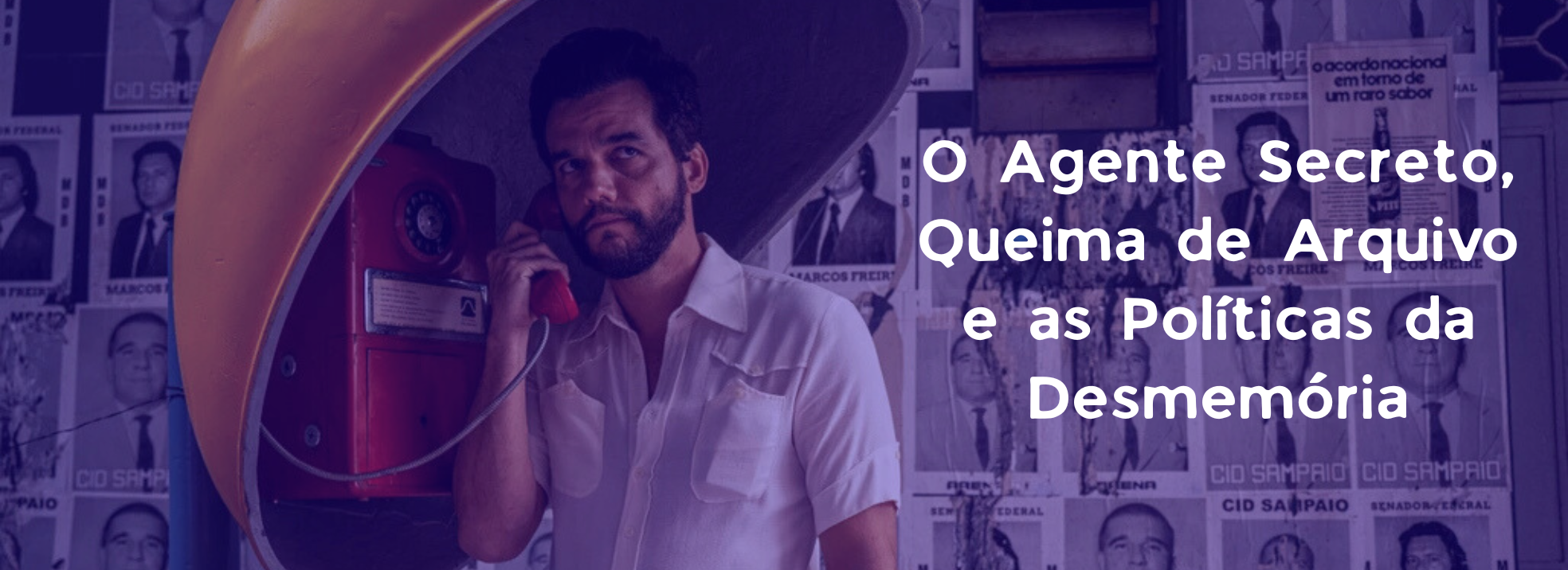
No pequeno cortejo que seria (será?) seu último Carnaval, “Marcelo”, ou Armando, protagonista de O Agente Secreto (Kleber Mendonça Filho, 2025), apenas passa. Saindo de um cinema em que havia entrado há muitas horas - onde nós, espectadores, estávamos também confinados em uma longa sequência de aproximadamente meia hora - o turbilhão de emoções que o dominara se vê materializado na rua em confusão e música. 

Em seu caminhar contemplativo e hesitante, projetamos medo, coragem, frustração; muitas coisas, mas não qualquer coisa. Fomos trazidos até aqui, até o interior da cabeça e do coração desse homem procurado, porque alguém, dentro de um cinema, nos contou uma história. Depois de mais de uma hora e meia de construção lenta, de cozinhar todos os elementos da narrativa em fogo baixo, a sequência da entrevista gravada que culmina nesse Carnaval metafórico pode finalmente nos dar o que queremos: uma história. Sentido, no caos. Como a mulher que sai da sessão de A Profecia (Richard Donner, 1976) possuída por um espírito (“é esse filme….” - diz Alexandre), ficamos ali possuídos pelo espírito da memória. Junto com um homem que nunca existiu (mas que existiu em muitos outros homens e muitas outras histórias), caminhamos por um Recife sombrio, momesco e pirracento rumo à segunda parte do filme - e sabemos o que esperar. 

Melhor engolir um poderoso psicotrópico, meu caro espectador: esse Carnaval vai ser de matar.

No seu ensaio Sobre o conceito da história (1940), diz Walter Benjamin: “Só terá o dom de atiçar no passado a centelha da esperança aquele historiador que tiver apreendido isto: nem os mortos estarão seguros se o inimigo vencer.”1 Se a História é uma batalha de narrativas, se a História é uma batalha de histórias, Kleber Mendonça Filho escolheu travar essa batalha dentro de um cinema. Dentro de um cinema - duplamente, na sequência mencionada acima - vemos desenrolar uma história de um Brasil que odeia o Brasil; uma história de um professor que se transforma, involuntariamente, em agente secreto da resistência; uma história de amor perdido e de trauma geracional.2 Mas, principalmente, uma história de arquivo. Da sua presença e simultaneamente da sua inexistência, das suas lacunas, gaguejos, engasgos. 

Uma impressão geral que tive das discussões online sobre o filme é que estas consideram paralela à narrativa central do filme, ou desconectada dela, a história de Flávia e Daniela em alguma universidade contemporânea ouvindo fitas magnéticas antigas. Estão errados. Nela está o coração, a chave de entendimento deste filme: a memória afetiva, traduzida em arquivo, por sua vez traduzido em cinema.

Kleber não foi o primeiro a duelar com o arquivo da ditadura brasileira dentro de uma tela de cinema, e ele sabe muito bem disso. Parte de uma longa tradição de filmes brasileiros que abordam o assunto, O Agente Secreto vai buscar inspiração clara (e assumida3) na obra-prima do maior documentarista brasileiro, o filme Cabra Marcado Para Morrer (Eduardo Coutinho, 1984). Fruto de um milagre da preservação cinematográfica, e ao mesmo tempo exemplo cabal de que os objetos valem menos do que as histórias que estão dentro das pessoas, o Cabra é a síntese da contradição brasileira na sua lida com a própria memória. 

Expondo o fazer cinematográfico na própria trama do filme, Coutinho costura dois tempos, refazendo aquilo que sobreviveu em fragmentos, em latas escondidas da sanha destruidora daqueles que não respeitam morto algum. Materializa em Elizabeth Teixeira a história que até então não tinha conseguido contar. 

Coutinho percebe, e Kleber também, algo de fundamental no trabalho com arquivos, algo que às vezes nem mesmo nós, trabalhadores de arquivo,4 percebemos assim tão facilmente. Não é assim tão estranho que não percebamos isso - afinal, podemos passar o dia com a cabeça enfiada em películas, medidores, fita adesiva, grão, planilhas, máquinas, latas, latas, latas. Na busca pela objetividade dos padrões técnicos e pelo respeito ao material, o que pode nos passar ao largo é que cada um dos objetos dos quais cuidamos com tanto afinco é, na verdade, uma prótese, um proxy, um pedaço incorpóreo da vida e da memória de uma pessoa (ou, mais frequentemente, de muitas pessoas, de uma comunidade). 

O arquivo “não será jamais a memória”5 e “tem lugar em lugar da falta originária e estrutural da chamada memória”, diz Jacques Derrida em sua leitura freudiana do “mal de arquivo” que nos assombra na contemporaneidade.

Ou, menos na perspectiva da psicanálise e mais na das historiografias, podemos também dizer que tais pedaços incorpóreos (“pernas cabeludas”?) seriam um lugar de memória: conceito do historiador francês Pierre Nora que pode ser aplicado não apenas a um lugar geográfico literal de memória, como um museu ou instituição de arquivo, mas também a objetos vestigiais, monumentos, documentos, registros.

O movimento que começou com a escrita termina na alta fidelidade e na fita magnética. Menos a memória é vivida do interior, mais ela tem necessidade de suportes exteriores e de referências tangíveis de uma existência que só vive através delas. Daí a obsessão pelo arquivo que marca o contemporâneo e que afeta, ao mesmo tempo, a preservação integral de todo o presente e a preservação integral de todo o passado.6

A fita magnética, objeto-fetiche que aparece em close-up diversas vezes no filme, é aqui ao mesmo tempo símbolo e materialidade do que não se pode acessar, não verdadeiramente: a memória. Se o cinema é o espaço da contenda das histórias, a fita é seu registro mambembe - com todas as suas pausas e defeitos, é quase impossível que alguém a decodifique. Que alguém a use para transformar de volta o arquivo em memória, que volte a fazer sentido do caos, que volte a imbuir afeto no objeto frio.7 Decifra-me ou te devoro, e as fitas devoraram Flávia e seu afã de reconstituir Armando. Como as fichas no Instituto de Identificação devoraram Armando e seu afã de reconstituir a mãe.

Outra acusação frequente nas discussões mencionadas é que O Agente Secreto é anticlimático. Nessa divisão que instituí, toda a segunda parte do filme (depois da entrevista gravada e do cortejo de Carnaval) cozinha igualmente em fogo baixo os elementos da morte de Armando sem nunca, de fato, matá-lo. Ou, podemos dizer assim, sem nos mostrar a cena da sua morte. Pessoalmente acho uma delícia: uma contravenção em forma de negação, uma tortura das expectativas do espectador, uma pequena rebeldia anti-Hollywoodiana num filme que exalta Hollywood em muitos outros sentidos. 

Mas, para além dos gostos pessoais e das piscadelas marotas do diretor, acredito que há aí uma mensagem importante. O que há de mais cruel e mais grotesco em regimes autoritários acontece fora das nossas vistas. Transforma-se rapidamente em página de jornal e chega às pessoas comuns com a maior distância possível, com a maior mediação possível. Um cadáver frio, como os objetos protéticos de um arquivo. Ainda mais frio se visto com a distância do tempo, pela tela de um computador.

Ao contrário da primeira parte do filme, que nos dá justamente dentro do cinema o que queremos e precisamos para seguir a história, a segunda parte não quer fechar ciclos ou atar nós de narrativa. A primeira parte acaba ali no cortejo como no cinema estadunidense clássico; a segunda parte é o caos, a violência e a criatividade que nos acompanha no Brasil desde sempre e que conhecemos tão bem. E, mais do que isso, é a queima de arquivo - procedimento a que nós, brasileiros, também já estamos mais do que acostumados. A expressão aparece até como legenda do jornal que Flávia lê sobre a morte de Armando (que é também quando o espectador recebe a notícia de que o personagem morreu).

Queima de arquivo: matar uma pessoa para que ela não conte um segredo ou comprometa alguém. Não há forma mais óbvia de constatar que pessoas são arquivos ambulantes: arquivos políticos, que guardam no próprio corpo as experiências e memórias que depois serão estudadas como História nos livros didáticos. Assassiná-las é deixar manca a história e a História, é abrir espaço para contar narrativas não-tão-verdadeiras sobre suas vidas, para o benefício de alguém, para o benefício de um regime. A ditadura empresarial-militar que dominou o Brasil por duas décadas se beneficiou diretamente de milhares de queimas de arquivo, literais e metafóricas - pequenos e grandes poderes que surgem e se mantém diretamente da morte de pessoas que carregavam segredos.

Talvez o insight mais bonito do trabalho em um arquivo é que pensamos estar lidando com o passado, mas, na verdade, estamos lidando com o futuro. O impulso de Flávia de copiar as gravações e entregar num pendrive8 a Fernando, filho de Armando, enquanto eles discutem sobre a memória que ele não tem do próprio pai, é um impulso grávido de futuro. Flávia quer perpetuar a história mambembe e fraturada de Armando, quer tentar transformá-la novamente no mais próximo possível de um diamante bruto da memória. A forma mais direta de o fazer (sem nunca o fazer de fato) é proteger o registro, copiá-lo, entregar aos seus descendentes. 

O inimigo a que Benjamin se referia em 1940 era o fascismo, e (surpresa!) aí está ele de novo à solta: o vemos por todos os lados e ainda assim é rarefeito como se não estivesse em parte alguma. Mas, antes de tudo, não podemos deixar que ele mexa à revelia com nossos mortos. Ao preservar nossos filmes e registros históricos, ao dar sentido às nossas memórias, e ao inventar daí novas histórias, talvez possamos personificar enfim o historiador de Benjamin e atiçar alguma fagulha de esperança.

1. BENJAMIN, Walter. O Anjo da História. Edição e tradução de João Barrento, Assírio & Alvim, 2013.

2. Roubo a expressão do próprio intérprete de Armando, Wagner Moura, que a incluiu em seu discurso ao receber o Globo de Ouro de Melhor Ator em 2026.

3. https://www.youtube.com/watch?v=_j6RLXJFe0U

4. Trabalho como técnica de restauro de filmes do Arquivo Nacional das Imagens em Movimento, da Cinemateca Portuguesa, em Lisboa, e também como diretora executiva da Cinelimite. Humildemente chamo o “local de fala” não para listar as minhas experiências profissionais, mas para me colocar como ponto de vista e de partida para esse texto, tão pessoal.

5. DERRIDA, Jacques. Mal de arquivo: uma impressão Freudiana. Rio de Janeiro: Relume Dumará, 2001. p.22

6. NORA, Pierre. Entre memória e história: A problemática dos lugares. Proj. História, São Paulo, 10, dez. 1993. Tradução de Yara Aun Khoury.

7. Uma conversa comum em conferências de arquivistas de filmes e preservação audiovisual é a noção de “ativação do arquivo”. Como estamos sempre soterrados até o pescoço naqueles objetos arquivísticos já mencionados, essa expressão é uma forma de nos lembrar que os filmes que preservamos precisam ser vistos, ou serão para sempre apenas objetos. Com o perdão da torção do conceito, se transformarão em “lugares sem memória”, desprovidos de humanidade que os ressignifique.

8. Digitalização e remasterização de fitas magnéticas de áudio é um procedimento rotineiro em um arquivo de filmes - e é curioso vê-lo tomar papel tão central num filme de ficção.

“Nem os mortos estarão seguros se o inimigo vencer”

No pequeno cortejo que seria (será?) seu último Carnaval, “Marcelo”, ou Armando, protagonista de O Agente Secreto (Kleber Mendonça Filho, 2025), apenas passa. Saindo de um cinema em que havia entrado há muitas horas - onde nós, espectadores, estávamos também confinados em uma longa sequência de aproximadamente meia hora - o turbilhão de emoções que o dominara se vê materializado na rua em confusão e música. 

Em seu caminhar contemplativo e hesitante, projetamos medo, coragem, frustração; muitas coisas, mas não qualquer coisa. Fomos trazidos até aqui, até o interior da cabeça e do coração desse homem procurado, porque alguém, dentro de um cinema, nos contou uma história. Depois de mais de uma hora e meia de construção lenta, de cozinhar todos os elementos da narrativa em fogo baixo, a sequência da entrevista gravada que culmina nesse Carnaval metafórico pode finalmente nos dar o que queremos: uma história. Sentido, no caos. Como a mulher que sai da sessão de A Profecia (Richard Donner, 1976) possuída por um espírito (“é esse filme….” - diz Alexandre), ficamos ali possuídos pelo espírito da memória. Junto com um homem que nunca existiu (mas que existiu em muitos outros homens e muitas outras histórias), caminhamos por um Recife sombrio, momesco e pirracento rumo à segunda parte do filme - e sabemos o que esperar. 

Melhor engolir um poderoso psicotrópico, meu caro espectador: esse Carnaval vai ser de matar.

No seu ensaio Sobre o conceito da história (1940), diz Walter Benjamin: “Só terá o dom de atiçar no passado a centelha da esperança aquele historiador que tiver apreendido isto: nem os mortos estarão seguros se o inimigo vencer.”1 Se a História é uma batalha de narrativas, se a História é uma batalha de histórias, Kleber Mendonça Filho escolheu travar essa batalha dentro de um cinema. Dentro de um cinema - duplamente, na sequência mencionada acima - vemos desenrolar uma história de um Brasil que odeia o Brasil; uma história de um professor que se transforma, involuntariamente, em agente secreto da resistência; uma história de amor perdido e de trauma geracional.2 Mas, principalmente, uma história de arquivo. Da sua presença e simultaneamente da sua inexistência, das suas lacunas, gaguejos, engasgos. 

Uma impressão geral que tive das discussões online sobre o filme é que estas consideram paralela à narrativa central do filme, ou desconectada dela, a história de Flávia e Daniela em alguma universidade contemporânea ouvindo fitas magnéticas antigas. Estão errados. Nela está o coração, a chave de entendimento deste filme: a memória afetiva, traduzida em arquivo, por sua vez traduzido em cinema.

Kleber não foi o primeiro a duelar com o arquivo da ditadura brasileira dentro de uma tela de cinema, e ele sabe muito bem disso. Parte de uma longa tradição de filmes brasileiros que abordam o assunto, O Agente Secreto vai buscar inspiração clara (e assumida3) na obra-prima do maior documentarista brasileiro, o filme Cabra Marcado Para Morrer (Eduardo Coutinho, 1984). Fruto de um milagre da preservação cinematográfica, e ao mesmo tempo exemplo cabal de que os objetos valem menos do que as histórias que estão dentro das pessoas, o Cabra é a síntese da contradição brasileira na sua lida com a própria memória. 

Expondo o fazer cinematográfico na própria trama do filme, Coutinho costura dois tempos, refazendo aquilo que sobreviveu em fragmentos, em latas escondidas da sanha destruidora daqueles que não respeitam morto algum. Materializa em Elizabeth Teixeira a história que até então não tinha conseguido contar. 

Coutinho percebe, e Kleber também, algo de fundamental no trabalho com arquivos, algo que às vezes nem mesmo nós, trabalhadores de arquivo,4 percebemos assim tão facilmente. Não é assim tão estranho que não percebamos isso - afinal, podemos passar o dia com a cabeça enfiada em películas, medidores, fita adesiva, grão, planilhas, máquinas, latas, latas, latas. Na busca pela objetividade dos padrões técnicos e pelo respeito ao material, o que pode nos passar ao largo é que cada um dos objetos dos quais cuidamos com tanto afinco é, na verdade, uma prótese, um proxy, um pedaço incorpóreo da vida e da memória de uma pessoa (ou, mais frequentemente, de muitas pessoas, de uma comunidade). 

O arquivo “não será jamais a memória”5 e “tem lugar em lugar da falta originária e estrutural da chamada memória”, diz Jacques Derrida em sua leitura freudiana do “mal de arquivo” que nos assombra na contemporaneidade.

Ou, menos na perspectiva da psicanálise e mais na das historiografias, podemos também dizer que tais pedaços incorpóreos (“pernas cabeludas”?) seriam um lugar de memória: conceito do historiador francês Pierre Nora que pode ser aplicado não apenas a um lugar geográfico literal de memória, como um museu ou instituição de arquivo, mas também a objetos vestigiais, monumentos, documentos, registros.

O movimento que começou com a escrita termina na alta fidelidade e na fita magnética. Menos a memória é vivida do interior, mais ela tem necessidade de suportes exteriores e de referências tangíveis de uma existência que só vive através delas. Daí a obsessão pelo arquivo que marca o contemporâneo e que afeta, ao mesmo tempo, a preservação integral de todo o presente e a preservação integral de todo o passado.6

A fita magnética, objeto-fetiche que aparece em close-up diversas vezes no filme, é aqui ao mesmo tempo símbolo e materialidade do que não se pode acessar, não verdadeiramente: a memória. Se o cinema é o espaço da contenda das histórias, a fita é seu registro mambembe - com todas as suas pausas e defeitos, é quase impossível que alguém a decodifique. Que alguém a use para transformar de volta o arquivo em memória, que volte a fazer sentido do caos, que volte a imbuir afeto no objeto frio.7 Decifra-me ou te devoro, e as fitas devoraram Flávia e seu afã de reconstituir Armando. Como as fichas no Instituto de Identificação devoraram Armando e seu afã de reconstituir a mãe.

Outra acusação frequente nas discussões mencionadas é que O Agente Secreto é anticlimático. Nessa divisão que instituí, toda a segunda parte do filme (depois da entrevista gravada e do cortejo de Carnaval) cozinha igualmente em fogo baixo os elementos da morte de Armando sem nunca, de fato, matá-lo. Ou, podemos dizer assim, sem nos mostrar a cena da sua morte. Pessoalmente acho uma delícia: uma contravenção em forma de negação, uma tortura das expectativas do espectador, uma pequena rebeldia anti-Hollywoodiana num filme que exalta Hollywood em muitos outros sentidos. 

Mas, para além dos gostos pessoais e das piscadelas marotas do diretor, acredito que há aí uma mensagem importante. O que há de mais cruel e mais grotesco em regimes autoritários acontece fora das nossas vistas. Transforma-se rapidamente em página de jornal e chega às pessoas comuns com a maior distância possível, com a maior mediação possível. Um cadáver frio, como os objetos protéticos de um arquivo. Ainda mais frio se visto com a distância do tempo, pela tela de um computador.

Ao contrário da primeira parte do filme, que nos dá justamente dentro do cinema o que queremos e precisamos para seguir a história, a segunda parte não quer fechar ciclos ou atar nós de narrativa. A primeira parte acaba ali no cortejo como no cinema estadunidense clássico; a segunda parte é o caos, a violência e a criatividade que nos acompanha no Brasil desde sempre e que conhecemos tão bem. E, mais do que isso, é a queima de arquivo - procedimento a que nós, brasileiros, também já estamos mais do que acostumados. A expressão aparece até como legenda do jornal que Flávia lê sobre a morte de Armando (que é também quando o espectador recebe a notícia de que o personagem morreu).

Queima de arquivo: matar uma pessoa para que ela não conte um segredo ou comprometa alguém. Não há forma mais óbvia de constatar que pessoas são arquivos ambulantes: arquivos políticos, que guardam no próprio corpo as experiências e memórias que depois serão estudadas como História nos livros didáticos. Assassiná-las é deixar manca a história e a História, é abrir espaço para contar narrativas não-tão-verdadeiras sobre suas vidas, para o benefício de alguém, para o benefício de um regime. A ditadura empresarial-militar que dominou o Brasil por duas décadas se beneficiou diretamente de milhares de queimas de arquivo, literais e metafóricas - pequenos e grandes poderes que surgem e se mantém diretamente da morte de pessoas que carregavam segredos.

Talvez o insight mais bonito do trabalho em um arquivo é que pensamos estar lidando com o passado, mas, na verdade, estamos lidando com o futuro. O impulso de Flávia de copiar as gravações e entregar num pendrive8 a Fernando, filho de Armando, enquanto eles discutem sobre a memória que ele não tem do próprio pai, é um impulso grávido de futuro. Flávia quer perpetuar a história mambembe e fraturada de Armando, quer tentar transformá-la novamente no mais próximo possível de um diamante bruto da memória. A forma mais direta de o fazer (sem nunca o fazer de fato) é proteger o registro, copiá-lo, entregar aos seus descendentes. 

O inimigo a que Benjamin se referia em 1940 era o fascismo, e (surpresa!) aí está ele de novo à solta: o vemos por todos os lados e ainda assim é rarefeito como se não estivesse em parte alguma. Mas, antes de tudo, não podemos deixar que ele mexa à revelia com nossos mortos. Ao preservar nossos filmes e registros históricos, ao dar sentido às nossas memórias, e ao inventar daí novas histórias, talvez possamos personificar enfim o historiador de Benjamin e atiçar alguma fagulha de esperança.

1. BENJAMIN, Walter. O Anjo da História. Edição e tradução de João Barrento, Assírio & Alvim, 2013.

2. Roubo a expressão do próprio intérprete de Armando, Wagner Moura, que a incluiu em seu discurso ao receber o Globo de Ouro de Melhor Ator em 2026.

3. https://www.youtube.com/watch?v=_j6RLXJFe0U

4. Trabalho como técnica de restauro de filmes do Arquivo Nacional das Imagens em Movimento, da Cinemateca Portuguesa, em Lisboa, e também como diretora executiva da Cinelimite. Humildemente chamo o “local de fala” não para listar as minhas experiências profissionais, mas para me colocar como ponto de vista e de partida para esse texto, tão pessoal.

5. DERRIDA, Jacques. Mal de arquivo: uma impressão Freudiana. Rio de Janeiro: Relume Dumará, 2001. p.22

6. NORA, Pierre. Entre memória e história: A problemática dos lugares. Proj. História, São Paulo, 10, dez. 1993. Tradução de Yara Aun Khoury.

7. Uma conversa comum em conferências de arquivistas de filmes e preservação audiovisual é a noção de “ativação do arquivo”. Como estamos sempre soterrados até o pescoço naqueles objetos arquivísticos já mencionados, essa expressão é uma forma de nos lembrar que os filmes que preservamos precisam ser vistos, ou serão para sempre apenas objetos. Com o perdão da torção do conceito, se transformarão em “lugares sem memória”, desprovidos de humanidade que os ressignifique.

8. Digitalização e remasterização de fitas magnéticas de áudio é um procedimento rotineiro em um arquivo de filmes - e é curioso vê-lo tomar papel tão central num filme de ficção.

“Not even the dead will be safe if the enemy wins”

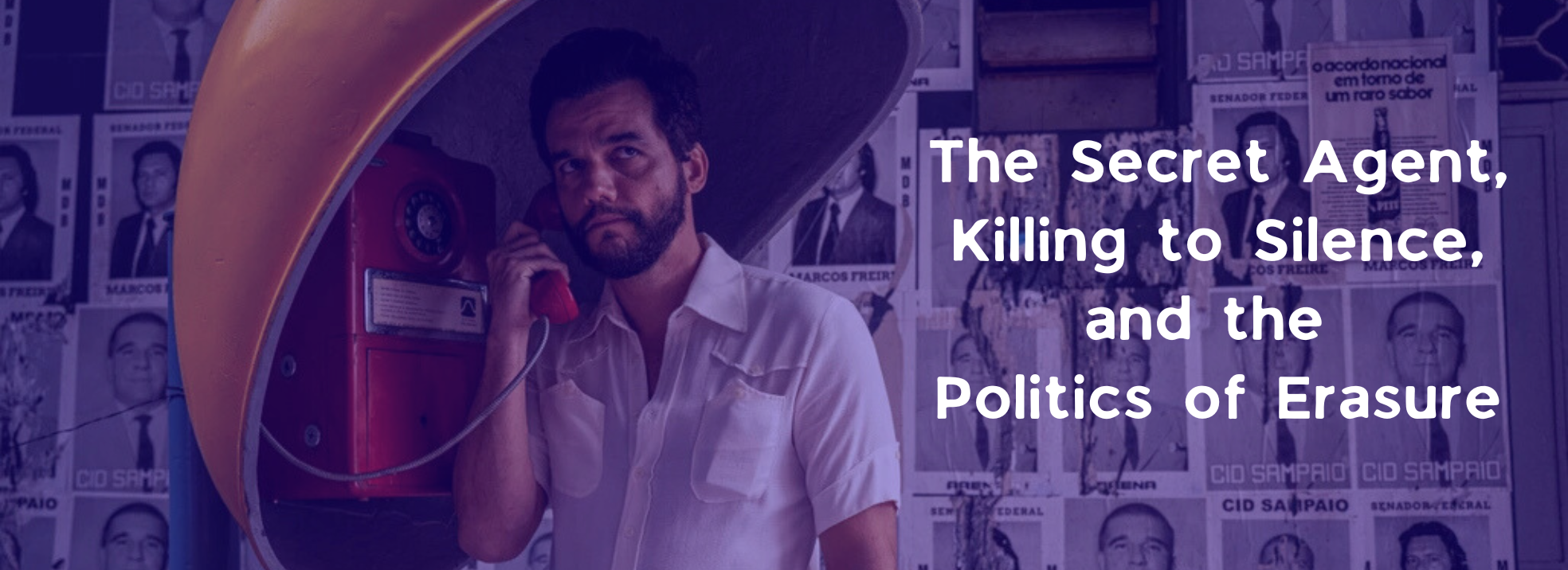
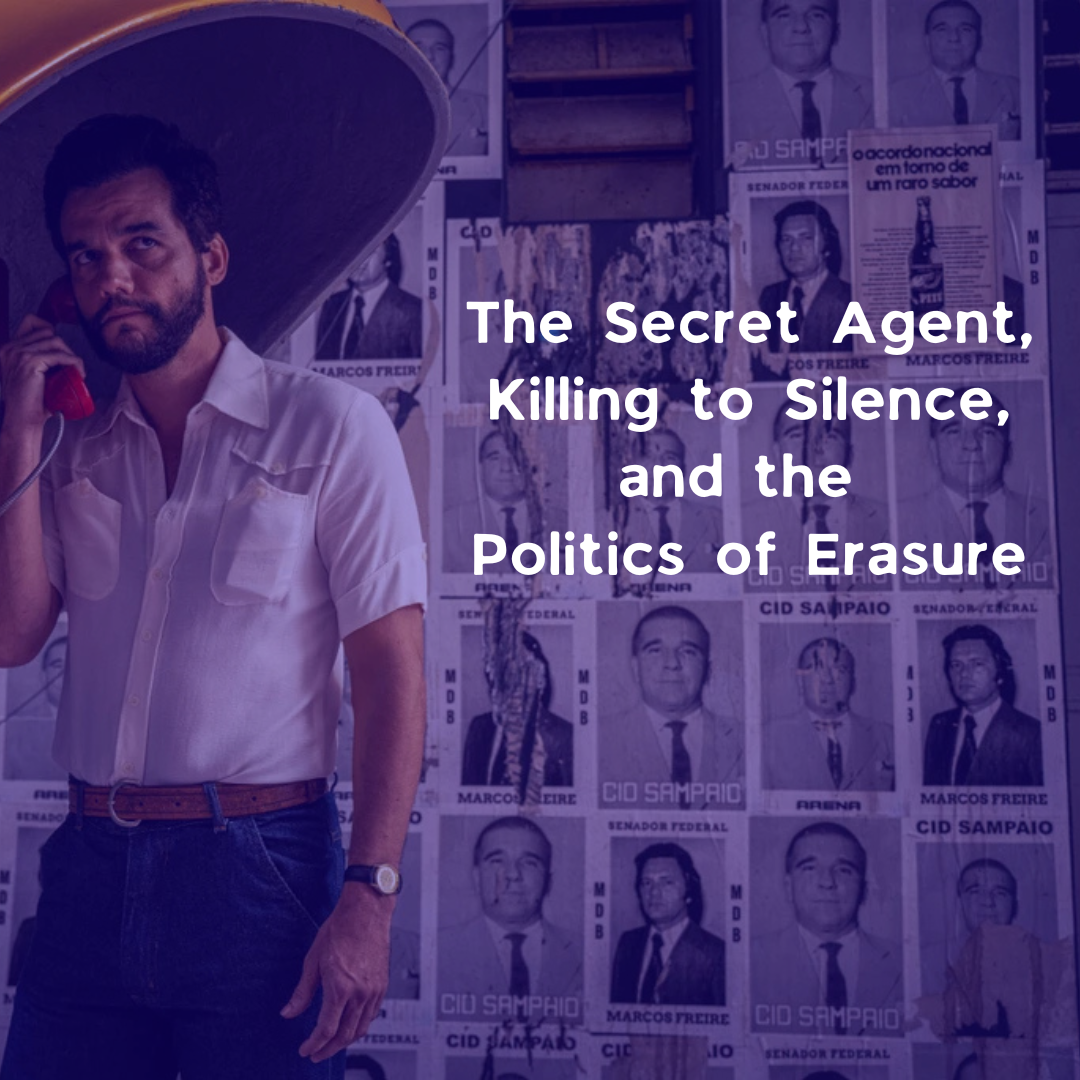
In the small procession that would be (will be?) his last Carnival, “Marcelo,” or Armando, the protagonist of The Secret Agent (Kleber Mendonça Filho, 2025), simply passes through. Emerging from a movie theater he had entered many hours earlier—where we, the spectators, had also been confined within a long sequence of nearly half an hour—the whirlwind of emotions that had overtaken him materializes in the street as confusion and music.

In his contemplative, hesitant walk, we project fear, courage, frustration—many things, but not just anything. We have been brought here, into the interior of this hunted man’s head and heart, because someone, inside a movie theater, has told us a story. 

After more than an hour and a half of slow construction, of simmering the elements of the narrative over a low flame, the recorded interview sequence that culminates in this metaphorical Carnival can finally give us what we want: a story. Meaning amid chaos.

Like the woman who leaves a screening of The Omen (Richard Donner, 1976) possessed by a spirit (“it’s this film...” says Alexandre), we remain there, possessed by the spirit of memory. Alongside a man who never existed, but who existed in many other men and many other stories, we walk through a dark, carnivalesque, mischievous Recife toward the film’s second half — and we know what to expect.

Better swallow a powerful psychotropic, my dear spectator: this Carnival is going to be deadly.

In his essay On the Concept of History (1940), Walter Benjamin writes: “Only that historian will have the gift of fanning the spark of hope in the past who has grasped this: not even the dead will be safe if the enemy is victorious.”1 If History is a battle of narratives, a battle of stories, Kleber Mendonça Filho chooses to wage that battle inside a movie theater.

Inside a movie theater, twice over, in the sequence mentioned above, we watch unfold a story of a Brazil that hates Brazil; a story of a teacher involuntarily transformed into a secret agent of the resistance; a story of lost love and generational trauma.2 But above all, it is a story of the archive: of its presence and, at the same time, its nonexistence; of its gaps, stammers, and hesitations.

A general impression I had reading online comments regard the story of Flávia and Daniela, at a contemporary university listening to old magnetic tapes, as parallel to the film’s central narrative, or even disconnected from it. They are mistaken. There lies the heart, the key to understanding this film: affective memory translated into archive, which in turn is translated into cinema.

Kleber was not the first to duel with the archive of the Brazilian dictatorship on a cinema screen, and he knows that very well. Part of a long tradition of Brazilian films that take up this subject, The Secret Agent draws clear and openly acknowledged3 inspiration from the masterpiece of Brazil’s greatest documentary filmmaker, Twenty Years Later (Cabra Marcado Para Morrer, Eduardo Coutinho, 1984).The product of a miracle of film preservation, and at the same time a perfect example of the fact that objects are worth less than the stories carried within people, Cabra encapsulates the Brazilian contradiction in dealing with its own memory.

By exposing the act of filmmaking within the very fabric of the film, Coutinho stitches together two temporalities, reconstructing what survived in fragments, in reels hidden away from the destructive fury of those who respect no dead at all. In Elizabeth Teixeira, he gives material form to the story he had until then been unable to tell.

Coutinho grasps, and Kleber does as well, something fundamental about working with archives, something that even we archival workers4 sometimes fail to perceive all that easily. It is not so strange that we fail to see it. After all, we may spend the day with our heads buried in film stock, gauges, adhesive tape, grain, spreadsheets, machines; cans, cans, cans.

In the search for the objectivity of technical standards and for respect toward the material itself, what may escape us is that each of the objects we care for so diligently is, in fact, a prosthesis, a proxy, an incorporeal fragment of a person’s life and memory — or, more often, of many people, of a community.

The archive “will never be either memory or anamnesis as spontaneous, alive and internal experience”5 and “takes place in the site of the original and structural failure of memory,” says Jacques Derrida in his Freudian reading of the “archive fever” that haunts us in contemporaneity.

Or, from a perspective less rooted in psychoanalysis and more in historiography, we might also say that such incorporeal fragments (“hairy legs”?) would constitute sites of memory: a concept coined by the French historian Pierre Nora that can be applied not only to literal geographic places of memory, such as museums or archival institutions, but also to vestigial objects, monuments, documents, and records.

The movement that began with writing ends with high fidelity and magnetic tape. The less memory is lived from within, the more it requires external supports and tangible references to an existence that lives only through them. Hence the obsession with the archive that marks the contemporary world and that affects, at one and the same time, the total preservation of the entire present and the total preservation of the entire past.6

Magnetic tape, a fetish object that appears in close-up several times throughout the film, is here both the symbol and the material form of what cannot truly be accessed: memory. If cinema is the space in which stories contend, the tape is their makeshift record. With all its pauses and defects, it is almost impossible for anyone to decode it—for anyone to use it to transform the archive back into memory, to make sense of chaos once again, to reinvest the cold object with affect.7

Decipher me or I devour you: the tapes devoured Flávia and her desire to piece Armando back together, just as the index cards at the Identification Institute devoured Armando and his desire to piece his mother back together.

Another frequent accusation in the online discussions mentioned above is that The Secret Agent is anticlimactic. Within the division I have proposed, the entire second half of the film, after the recorded interview and the Carnival procession, likewise simmers the elements of Armando’s death over low heat without ever, in fact, killing him. Or rather, without showing us the scene of his death.

Personally, I find it delightful: a transgression in the form of negation, a tormenting of the viewer’s expectations, a small anti-Hollywood act of rebellion in a film that celebrates Hollywood in so many other respects. But beyond personal taste and the director’s sly winks, I believe there is an important message here.

What is cruelest and most grotesque in authoritarian regimes takes place outside our field of vision. It is quickly transformed into a newspaper page and reaches ordinary people at the greatest possible remove, through the greatest possible mediation. A cold corpse, like the prosthetic objects of an archive. Colder still when seen across the distance of time, on a computer screen.

Unlike the film’s first half, which gives us precisely what we want and need to follow the story within the movie theater itself, the second half has no desire to close cycles or tie up narrative knots. The first half ends there, at the procession, as in classical American cinema. The second half is the chaos, the violence, and the creativity that have always accompanied us in Brazil and that we know so well.

More than that, it is killing to silence, a procedure to which we Brazilians have long been more than accustomed. The expression even appears as the newspaper headline Flávia reads about Armando’s death, which is also the moment when the spectator learns that the character has died.

Killing to silence: killing someone so that they cannot reveal a secret or implicate another person. There is no clearer way of recognizing that people are walking archives: political archives, carrying within their own bodies the experiences and memories that will later be studied as History in school textbooks.

To murder them is to cripple story and History alike, opening space for less than truthful narratives about their lives, for the benefit of someone, for the benefit of a regime. The corporate-military dictatorship that ruled Brazil for two decades benefited directly from thousands of acts of killing to silence, both literal and metaphorical, carried out by small and large powers that arise and sustain themselves through the deaths of people who carried secrets.

Perhaps the most beautiful insight of working in an archive is that we think we are dealing with the past when, in fact, we are dealing with the future. Flávia’s impulse to copy the recordings and hand them to Fernando, Armando’s son, on a flash drive,8 while they discuss the memory he does not have of his own father, is an impulse pregnant with futurity.

Flávia wants to perpetuate Armando’s makeshift and fractured story, to try once again to transform it into something as close as possible to the rough diamond of memory. The most direct way of doing so, without ever truly doing so, is to protect the record, copy it, and place it in the hands of his descendants.

The enemy Benjamin referred to in 1940 was fascism, and — surprise! — there it is again, on the loose: we see it everywhere, and yet it is so diffuse that it seems to be nowhere at all. But, before anything else, we cannot allow it to meddle with our dead at will.

By preserving our films and historical records, by giving meaning to our memories, and by inventing new stories from them, perhaps we may finally embody Benjamin’s historian and fan some spark of hope.

1. Walter Benjamin, O Anjo da História [The Angel of History], ed. and trans. João Barrento (Lisbon: Assírio & Alvim, 2013).

2. I borrow the expression from Armando’s own interpreter, Wagner Moura, who included it in his speech upon receiving the Golden Globe for Best Actor in 2026.

3. https://www.youtube.com/watch?v=_j6RLXJFe0U

4. I work as a film restoration technician at the Arquivo Nacional das Imagens em Movimento of the Cinemateca Portuguesa, in Lisbon, and also as executive director of Cinelimite. I invoke the notion of a “place of speech” here not to list my professional experience, but to position myself as the point of view and point of departure for this text, which is a deeply personal one.

5. Jacques Derrida, Mal de arquivo: uma impressão Freudiana (Rio de Janeiro: Relume Dumará, 2001), 22.

6. Pierre Nora, “Entre memória e história: A problemática dos lugares,” Projeto História 10 (São Paulo, December 1993), trans. Yara Aun Khoury.

7. A common topic of conversation at conferences of film archivists and audiovisual preservation professionals is the notion of “activating the archive.” Because we are always buried up to our necks in the archival objects already mentioned, the expression serves as a reminder that the films we preserve must also be seen, or else they will remain forever mere objects. With apologies for stretching the concept, they would become “sites without memory,” devoid of the humanity that might resignify them.

8. The digitization and remastering of magnetic audio tapes is a routine procedure in a film archive, and it is striking to see it assume such a central role in a fiction film.

“Not even the dead will be safe if the enemy wins”

In the small procession that would be (will be?) his last Carnival, “Marcelo,” or Armando, the protagonist of The Secret Agent (Kleber Mendonça Filho, 2025), simply passes through. Emerging from a movie theater he had entered many hours earlier—where we, the spectators, had also been confined within a long sequence of nearly half an hour—the whirlwind of emotions that had overtaken him materializes in the street as confusion and music.

In his contemplative, hesitant walk, we project fear, courage, frustration—many things, but not just anything. We have been brought here, into the interior of this hunted man’s head and heart, because someone, inside a movie theater, has told us a story. 

After more than an hour and a half of slow construction, of simmering the elements of the narrative over a low flame, the recorded interview sequence that culminates in this metaphorical Carnival can finally give us what we want: a story. Meaning amid chaos.

Like the woman who leaves a screening of The Omen (Richard Donner, 1976) possessed by a spirit (“it’s this film...” says Alexandre), we remain there, possessed by the spirit of memory. Alongside a man who never existed, but who existed in many other men and many other stories, we walk through a dark, carnivalesque, mischievous Recife toward the film’s second half — and we know what to expect.

Better swallow a powerful psychotropic, my dear spectator: this Carnival is going to be deadly.

In his essay On the Concept of History (1940), Walter Benjamin writes: “Only that historian will have the gift of fanning the spark of hope in the past who has grasped this: not even the dead will be safe if the enemy is victorious.”1 If History is a battle of narratives, a battle of stories, Kleber Mendonça Filho chooses to wage that battle inside a movie theater.

Inside a movie theater, twice over, in the sequence mentioned above, we watch unfold a story of a Brazil that hates Brazil; a story of a teacher involuntarily transformed into a secret agent of the resistance; a story of lost love and generational trauma.2 But above all, it is a story of the archive: of its presence and, at the same time, its nonexistence; of its gaps, stammers, and hesitations.

A general impression I had reading online comments regard the story of Flávia and Daniela, at a contemporary university listening to old magnetic tapes, as parallel to the film’s central narrative, or even disconnected from it. They are mistaken. There lies the heart, the key to understanding this film: affective memory translated into archive, which in turn is translated into cinema.

Kleber was not the first to duel with the archive of the Brazilian dictatorship on a cinema screen, and he knows that very well. Part of a long tradition of Brazilian films that take up this subject, The Secret Agent draws clear and openly acknowledged3 inspiration from the masterpiece of Brazil’s greatest documentary filmmaker, Twenty Years Later (Cabra Marcado Para Morrer, Eduardo Coutinho, 1984).The product of a miracle of film preservation, and at the same time a perfect example of the fact that objects are worth less than the stories carried within people, Cabra encapsulates the Brazilian contradiction in dealing with its own memory.

By exposing the act of filmmaking within the very fabric of the film, Coutinho stitches together two temporalities, reconstructing what survived in fragments, in reels hidden away from the destructive fury of those who respect no dead at all. In Elizabeth Teixeira, he gives material form to the story he had until then been unable to tell.

Coutinho grasps, and Kleber does as well, something fundamental about working with archives, something that even we archival workers4 sometimes fail to perceive all that easily. It is not so strange that we fail to see it. After all, we may spend the day with our heads buried in film stock, gauges, adhesive tape, grain, spreadsheets, machines; cans, cans, cans.

In the search for the objectivity of technical standards and for respect toward the material itself, what may escape us is that each of the objects we care for so diligently is, in fact, a prosthesis, a proxy, an incorporeal fragment of a person’s life and memory — or, more often, of many people, of a community.

The archive “will never be either memory or anamnesis as spontaneous, alive and internal experience”5 and “takes place in the site of the original and structural failure of memory,” says Jacques Derrida in his Freudian reading of the “archive fever” that haunts us in contemporaneity.

Or, from a perspective less rooted in psychoanalysis and more in historiography, we might also say that such incorporeal fragments (“hairy legs”?) would constitute sites of memory: a concept coined by the French historian Pierre Nora that can be applied not only to literal geographic places of memory, such as museums or archival institutions, but also to vestigial objects, monuments, documents, and records.

The movement that began with writing ends with high fidelity and magnetic tape. The less memory is lived from within, the more it requires external supports and tangible references to an existence that lives only through them. Hence the obsession with the archive that marks the contemporary world and that affects, at one and the same time, the total preservation of the entire present and the total preservation of the entire past.6

Magnetic tape, a fetish object that appears in close-up several times throughout the film, is here both the symbol and the material form of what cannot truly be accessed: memory. If cinema is the space in which stories contend, the tape is their makeshift record. With all its pauses and defects, it is almost impossible for anyone to decode it—for anyone to use it to transform the archive back into memory, to make sense of chaos once again, to reinvest the cold object with affect.7

Decipher me or I devour you: the tapes devoured Flávia and her desire to piece Armando back together, just as the index cards at the Identification Institute devoured Armando and his desire to piece his mother back together.

Another frequent accusation in the online discussions mentioned above is that The Secret Agent is anticlimactic. Within the division I have proposed, the entire second half of the film, after the recorded interview and the Carnival procession, likewise simmers the elements of Armando’s death over low heat without ever, in fact, killing him. Or rather, without showing us the scene of his death.

Personally, I find it delightful: a transgression in the form of negation, a tormenting of the viewer’s expectations, a small anti-Hollywood act of rebellion in a film that celebrates Hollywood in so many other respects. But beyond personal taste and the director’s sly winks, I believe there is an important message here.

What is cruelest and most grotesque in authoritarian regimes takes place outside our field of vision. It is quickly transformed into a newspaper page and reaches ordinary people at the greatest possible remove, through the greatest possible mediation. A cold corpse, like the prosthetic objects of an archive. Colder still when seen across the distance of time, on a computer screen.

Unlike the film’s first half, which gives us precisely what we want and need to follow the story within the movie theater itself, the second half has no desire to close cycles or tie up narrative knots. The first half ends there, at the procession, as in classical American cinema. The second half is the chaos, the violence, and the creativity that have always accompanied us in Brazil and that we know so well.

More than that, it is killing to silence, a procedure to which we Brazilians have long been more than accustomed. The expression even appears as the newspaper headline Flávia reads about Armando’s death, which is also the moment when the spectator learns that the character has died.

Killing to silence: killing someone so that they cannot reveal a secret or implicate another person. There is no clearer way of recognizing that people are walking archives: political archives, carrying within their own bodies the experiences and memories that will later be studied as History in school textbooks.

To murder them is to cripple story and History alike, opening space for less than truthful narratives about their lives, for the benefit of someone, for the benefit of a regime. The corporate-military dictatorship that ruled Brazil for two decades benefited directly from thousands of acts of killing to silence, both literal and metaphorical, carried out by small and large powers that arise and sustain themselves through the deaths of people who carried secrets.

Perhaps the most beautiful insight of working in an archive is that we think we are dealing with the past when, in fact, we are dealing with the future. Flávia’s impulse to copy the recordings and hand them to Fernando, Armando’s son, on a flash drive,8 while they discuss the memory he does not have of his own father, is an impulse pregnant with futurity.

Flávia wants to perpetuate Armando’s makeshift and fractured story, to try once again to transform it into something as close as possible to the rough diamond of memory. The most direct way of doing so, without ever truly doing so, is to protect the record, copy it, and place it in the hands of his descendants.

The enemy Benjamin referred to in 1940 was fascism, and — surprise! — there it is again, on the loose: we see it everywhere, and yet it is so diffuse that it seems to be nowhere at all. But, before anything else, we cannot allow it to meddle with our dead at will.

By preserving our films and historical records, by giving meaning to our memories, and by inventing new stories from them, perhaps we may finally embody Benjamin’s historian and fan some spark of hope.

1. Walter Benjamin, O Anjo da História [The Angel of History], ed. and trans. João Barrento (Lisbon: Assírio & Alvim, 2013).

2. I borrow the expression from Armando’s own interpreter, Wagner Moura, who included it in his speech upon receiving the Golden Globe for Best Actor in 2026.

3. https://www.youtube.com/watch?v=_j6RLXJFe0U

4. I work as a film restoration technician at the Arquivo Nacional das Imagens em Movimento of the Cinemateca Portuguesa, in Lisbon, and also as executive director of Cinelimite. I invoke the notion of a “place of speech” here not to list my professional experience, but to position myself as the point of view and point of departure for this text, which is a deeply personal one.

5. Jacques Derrida, Mal de arquivo: uma impressão Freudiana (Rio de Janeiro: Relume Dumará, 2001), 22.

6. Pierre Nora, “Entre memória e história: A problemática dos lugares,” Projeto História 10 (São Paulo, December 1993), trans. Yara Aun Khoury.

7. A common topic of conversation at conferences of film archivists and audiovisual preservation professionals is the notion of “activating the archive.” Because we are always buried up to our necks in the archival objects already mentioned, the expression serves as a reminder that the films we preserve must also be seen, or else they will remain forever mere objects. With apologies for stretching the concept, they would become “sites without memory,” devoid of the humanity that might resignify them.

8. The digitization and remastering of magnetic audio tapes is a routine procedure in a film archive, and it is striking to see it assume such a central role in a fiction film.

PT/ENG
PT/ENG
13/3/2026
By/Por:
Laura Batitucci

“Nem os mortos estarão seguros se o inimigo vencer”

No pequeno cortejo que seria (será?) seu último Carnaval, “Marcelo”, ou Armando, protagonista de O Agente Secreto (Kleber Mendonça Filho, 2025), apenas passa. Saindo de um cinema em que havia entrado há muitas horas - onde nós, espectadores, estávamos também confinados em uma longa sequência de aproximadamente meia hora - o turbilhão de emoções que o dominara se vê materializado na rua em confusão e música. 

Em seu caminhar contemplativo e hesitante, projetamos medo, coragem, frustração; muitas coisas, mas não qualquer coisa. Fomos trazidos até aqui, até o interior da cabeça e do coração desse homem procurado, porque alguém, dentro de um cinema, nos contou uma história. Depois de mais de uma hora e meia de construção lenta, de cozinhar todos os elementos da narrativa em fogo baixo, a sequência da entrevista gravada que culmina nesse Carnaval metafórico pode finalmente nos dar o que queremos: uma história. Sentido, no caos. Como a mulher que sai da sessão de A Profecia (Richard Donner, 1976) possuída por um espírito (“é esse filme….” - diz Alexandre), ficamos ali possuídos pelo espírito da memória. Junto com um homem que nunca existiu (mas que existiu em muitos outros homens e muitas outras histórias), caminhamos por um Recife sombrio, momesco e pirracento rumo à segunda parte do filme - e sabemos o que esperar. 

Melhor engolir um poderoso psicotrópico, meu caro espectador: esse Carnaval vai ser de matar.

No seu ensaio Sobre o conceito da história (1940), diz Walter Benjamin: “Só terá o dom de atiçar no passado a centelha da esperança aquele historiador que tiver apreendido isto: nem os mortos estarão seguros se o inimigo vencer.”1 Se a História é uma batalha de narrativas, se a História é uma batalha de histórias, Kleber Mendonça Filho escolheu travar essa batalha dentro de um cinema. Dentro de um cinema - duplamente, na sequência mencionada acima - vemos desenrolar uma história de um Brasil que odeia o Brasil; uma história de um professor que se transforma, involuntariamente, em agente secreto da resistência; uma história de amor perdido e de trauma geracional.2 Mas, principalmente, uma história de arquivo. Da sua presença e simultaneamente da sua inexistência, das suas lacunas, gaguejos, engasgos. 

Uma impressão geral que tive das discussões online sobre o filme é que estas consideram paralela à narrativa central do filme, ou desconectada dela, a história de Flávia e Daniela em alguma universidade contemporânea ouvindo fitas magnéticas antigas. Estão errados. Nela está o coração, a chave de entendimento deste filme: a memória afetiva, traduzida em arquivo, por sua vez traduzido em cinema.

Kleber não foi o primeiro a duelar com o arquivo da ditadura brasileira dentro de uma tela de cinema, e ele sabe muito bem disso. Parte de uma longa tradição de filmes brasileiros que abordam o assunto, O Agente Secreto vai buscar inspiração clara (e assumida3) na obra-prima do maior documentarista brasileiro, o filme Cabra Marcado Para Morrer (Eduardo Coutinho, 1984). Fruto de um milagre da preservação cinematográfica, e ao mesmo tempo exemplo cabal de que os objetos valem menos do que as histórias que estão dentro das pessoas, o Cabra é a síntese da contradição brasileira na sua lida com a própria memória. 

Expondo o fazer cinematográfico na própria trama do filme, Coutinho costura dois tempos, refazendo aquilo que sobreviveu em fragmentos, em latas escondidas da sanha destruidora daqueles que não respeitam morto algum. Materializa em Elizabeth Teixeira a história que até então não tinha conseguido contar. 

Coutinho percebe, e Kleber também, algo de fundamental no trabalho com arquivos, algo que às vezes nem mesmo nós, trabalhadores de arquivo,4 percebemos assim tão facilmente. Não é assim tão estranho que não percebamos isso - afinal, podemos passar o dia com a cabeça enfiada em películas, medidores, fita adesiva, grão, planilhas, máquinas, latas, latas, latas. Na busca pela objetividade dos padrões técnicos e pelo respeito ao material, o que pode nos passar ao largo é que cada um dos objetos dos quais cuidamos com tanto afinco é, na verdade, uma prótese, um proxy, um pedaço incorpóreo da vida e da memória de uma pessoa (ou, mais frequentemente, de muitas pessoas, de uma comunidade). 

O arquivo “não será jamais a memória”5 e “tem lugar em lugar da falta originária e estrutural da chamada memória”, diz Jacques Derrida em sua leitura freudiana do “mal de arquivo” que nos assombra na contemporaneidade.

Ou, menos na perspectiva da psicanálise e mais na das historiografias, podemos também dizer que tais pedaços incorpóreos (“pernas cabeludas”?) seriam um lugar de memória: conceito do historiador francês Pierre Nora que pode ser aplicado não apenas a um lugar geográfico literal de memória, como um museu ou instituição de arquivo, mas também a objetos vestigiais, monumentos, documentos, registros.

O movimento que começou com a escrita termina na alta fidelidade e na fita magnética. Menos a memória é vivida do interior, mais ela tem necessidade de suportes exteriores e de referências tangíveis de uma existência que só vive através delas. Daí a obsessão pelo arquivo que marca o contemporâneo e que afeta, ao mesmo tempo, a preservação integral de todo o presente e a preservação integral de todo o passado.6

A fita magnética, objeto-fetiche que aparece em close-up diversas vezes no filme, é aqui ao mesmo tempo símbolo e materialidade do que não se pode acessar, não verdadeiramente: a memória. Se o cinema é o espaço da contenda das histórias, a fita é seu registro mambembe - com todas as suas pausas e defeitos, é quase impossível que alguém a decodifique. Que alguém a use para transformar de volta o arquivo em memória, que volte a fazer sentido do caos, que volte a imbuir afeto no objeto frio.7 Decifra-me ou te devoro, e as fitas devoraram Flávia e seu afã de reconstituir Armando. Como as fichas no Instituto de Identificação devoraram Armando e seu afã de reconstituir a mãe.

Outra acusação frequente nas discussões mencionadas é que O Agente Secreto é anticlimático. Nessa divisão que instituí, toda a segunda parte do filme (depois da entrevista gravada e do cortejo de Carnaval) cozinha igualmente em fogo baixo os elementos da morte de Armando sem nunca, de fato, matá-lo. Ou, podemos dizer assim, sem nos mostrar a cena da sua morte. Pessoalmente acho uma delícia: uma contravenção em forma de negação, uma tortura das expectativas do espectador, uma pequena rebeldia anti-Hollywoodiana num filme que exalta Hollywood em muitos outros sentidos. 

Mas, para além dos gostos pessoais e das piscadelas marotas do diretor, acredito que há aí uma mensagem importante. O que há de mais cruel e mais grotesco em regimes autoritários acontece fora das nossas vistas. Transforma-se rapidamente em página de jornal e chega às pessoas comuns com a maior distância possível, com a maior mediação possível. Um cadáver frio, como os objetos protéticos de um arquivo. Ainda mais frio se visto com a distância do tempo, pela tela de um computador.

Ao contrário da primeira parte do filme, que nos dá justamente dentro do cinema o que queremos e precisamos para seguir a história, a segunda parte não quer fechar ciclos ou atar nós de narrativa. A primeira parte acaba ali no cortejo como no cinema estadunidense clássico; a segunda parte é o caos, a violência e a criatividade que nos acompanha no Brasil desde sempre e que conhecemos tão bem. E, mais do que isso, é a queima de arquivo - procedimento a que nós, brasileiros, também já estamos mais do que acostumados. A expressão aparece até como legenda do jornal que Flávia lê sobre a morte de Armando (que é também quando o espectador recebe a notícia de que o personagem morreu).

Queima de arquivo: matar uma pessoa para que ela não conte um segredo ou comprometa alguém. Não há forma mais óbvia de constatar que pessoas são arquivos ambulantes: arquivos políticos, que guardam no próprio corpo as experiências e memórias que depois serão estudadas como História nos livros didáticos. Assassiná-las é deixar manca a história e a História, é abrir espaço para contar narrativas não-tão-verdadeiras sobre suas vidas, para o benefício de alguém, para o benefício de um regime. A ditadura empresarial-militar que dominou o Brasil por duas décadas se beneficiou diretamente de milhares de queimas de arquivo, literais e metafóricas - pequenos e grandes poderes que surgem e se mantém diretamente da morte de pessoas que carregavam segredos.

Talvez o insight mais bonito do trabalho em um arquivo é que pensamos estar lidando com o passado, mas, na verdade, estamos lidando com o futuro. O impulso de Flávia de copiar as gravações e entregar num pendrive8 a Fernando, filho de Armando, enquanto eles discutem sobre a memória que ele não tem do próprio pai, é um impulso grávido de futuro. Flávia quer perpetuar a história mambembe e fraturada de Armando, quer tentar transformá-la novamente no mais próximo possível de um diamante bruto da memória. A forma mais direta de o fazer (sem nunca o fazer de fato) é proteger o registro, copiá-lo, entregar aos seus descendentes. 

O inimigo a que Benjamin se referia em 1940 era o fascismo, e (surpresa!) aí está ele de novo à solta: o vemos por todos os lados e ainda assim é rarefeito como se não estivesse em parte alguma. Mas, antes de tudo, não podemos deixar que ele mexa à revelia com nossos mortos. Ao preservar nossos filmes e registros históricos, ao dar sentido às nossas memórias, e ao inventar daí novas histórias, talvez possamos personificar enfim o historiador de Benjamin e atiçar alguma fagulha de esperança.

1. BENJAMIN, Walter. O Anjo da História. Edição e tradução de João Barrento, Assírio & Alvim, 2013.

2. Roubo a expressão do próprio intérprete de Armando, Wagner Moura, que a incluiu em seu discurso ao receber o Globo de Ouro de Melhor Ator em 2026.

3. https://www.youtube.com/watch?v=_j6RLXJFe0U

4. Trabalho como técnica de restauro de filmes do Arquivo Nacional das Imagens em Movimento, da Cinemateca Portuguesa, em Lisboa, e também como diretora executiva da Cinelimite. Humildemente chamo o “local de fala” não para listar as minhas experiências profissionais, mas para me colocar como ponto de vista e de partida para esse texto, tão pessoal.

5. DERRIDA, Jacques. Mal de arquivo: uma impressão Freudiana. Rio de Janeiro: Relume Dumará, 2001. p.22

6. NORA, Pierre. Entre memória e história: A problemática dos lugares. Proj. História, São Paulo, 10, dez. 1993. Tradução de Yara Aun Khoury.

7. Uma conversa comum em conferências de arquivistas de filmes e preservação audiovisual é a noção de “ativação do arquivo”. Como estamos sempre soterrados até o pescoço naqueles objetos arquivísticos já mencionados, essa expressão é uma forma de nos lembrar que os filmes que preservamos precisam ser vistos, ou serão para sempre apenas objetos. Com o perdão da torção do conceito, se transformarão em “lugares sem memória”, desprovidos de humanidade que os ressignifique.

8. Digitalização e remasterização de fitas magnéticas de áudio é um procedimento rotineiro em um arquivo de filmes - e é curioso vê-lo tomar papel tão central num filme de ficção.

“Nem os mortos estarão seguros se o inimigo vencer”

No pequeno cortejo que seria (será?) seu último Carnaval, “Marcelo”, ou Armando, protagonista de O Agente Secreto (Kleber Mendonça Filho, 2025), apenas passa. Saindo de um cinema em que havia entrado há muitas horas - onde nós, espectadores, estávamos também confinados em uma longa sequência de aproximadamente meia hora - o turbilhão de emoções que o dominara se vê materializado na rua em confusão e música. 

Em seu caminhar contemplativo e hesitante, projetamos medo, coragem, frustração; muitas coisas, mas não qualquer coisa. Fomos trazidos até aqui, até o interior da cabeça e do coração desse homem procurado, porque alguém, dentro de um cinema, nos contou uma história. Depois de mais de uma hora e meia de construção lenta, de cozinhar todos os elementos da narrativa em fogo baixo, a sequência da entrevista gravada que culmina nesse Carnaval metafórico pode finalmente nos dar o que queremos: uma história. Sentido, no caos. Como a mulher que sai da sessão de A Profecia (Richard Donner, 1976) possuída por um espírito (“é esse filme….” - diz Alexandre), ficamos ali possuídos pelo espírito da memória. Junto com um homem que nunca existiu (mas que existiu em muitos outros homens e muitas outras histórias), caminhamos por um Recife sombrio, momesco e pirracento rumo à segunda parte do filme - e sabemos o que esperar. 

Melhor engolir um poderoso psicotrópico, meu caro espectador: esse Carnaval vai ser de matar.

No seu ensaio Sobre o conceito da história (1940), diz Walter Benjamin: “Só terá o dom de atiçar no passado a centelha da esperança aquele historiador que tiver apreendido isto: nem os mortos estarão seguros se o inimigo vencer.”1 Se a História é uma batalha de narrativas, se a História é uma batalha de histórias, Kleber Mendonça Filho escolheu travar essa batalha dentro de um cinema. Dentro de um cinema - duplamente, na sequência mencionada acima - vemos desenrolar uma história de um Brasil que odeia o Brasil; uma história de um professor que se transforma, involuntariamente, em agente secreto da resistência; uma história de amor perdido e de trauma geracional.2 Mas, principalmente, uma história de arquivo. Da sua presença e simultaneamente da sua inexistência, das suas lacunas, gaguejos, engasgos. 

Uma impressão geral que tive das discussões online sobre o filme é que estas consideram paralela à narrativa central do filme, ou desconectada dela, a história de Flávia e Daniela em alguma universidade contemporânea ouvindo fitas magnéticas antigas. Estão errados. Nela está o coração, a chave de entendimento deste filme: a memória afetiva, traduzida em arquivo, por sua vez traduzido em cinema.

Kleber não foi o primeiro a duelar com o arquivo da ditadura brasileira dentro de uma tela de cinema, e ele sabe muito bem disso. Parte de uma longa tradição de filmes brasileiros que abordam o assunto, O Agente Secreto vai buscar inspiração clara (e assumida3) na obra-prima do maior documentarista brasileiro, o filme Cabra Marcado Para Morrer (Eduardo Coutinho, 1984). Fruto de um milagre da preservação cinematográfica, e ao mesmo tempo exemplo cabal de que os objetos valem menos do que as histórias que estão dentro das pessoas, o Cabra é a síntese da contradição brasileira na sua lida com a própria memória. 

Expondo o fazer cinematográfico na própria trama do filme, Coutinho costura dois tempos, refazendo aquilo que sobreviveu em fragmentos, em latas escondidas da sanha destruidora daqueles que não respeitam morto algum. Materializa em Elizabeth Teixeira a história que até então não tinha conseguido contar. 

Coutinho percebe, e Kleber também, algo de fundamental no trabalho com arquivos, algo que às vezes nem mesmo nós, trabalhadores de arquivo,4 percebemos assim tão facilmente. Não é assim tão estranho que não percebamos isso - afinal, podemos passar o dia com a cabeça enfiada em películas, medidores, fita adesiva, grão, planilhas, máquinas, latas, latas, latas. Na busca pela objetividade dos padrões técnicos e pelo respeito ao material, o que pode nos passar ao largo é que cada um dos objetos dos quais cuidamos com tanto afinco é, na verdade, uma prótese, um proxy, um pedaço incorpóreo da vida e da memória de uma pessoa (ou, mais frequentemente, de muitas pessoas, de uma comunidade). 

O arquivo “não será jamais a memória”5 e “tem lugar em lugar da falta originária e estrutural da chamada memória”, diz Jacques Derrida em sua leitura freudiana do “mal de arquivo” que nos assombra na contemporaneidade.

Ou, menos na perspectiva da psicanálise e mais na das historiografias, podemos também dizer que tais pedaços incorpóreos (“pernas cabeludas”?) seriam um lugar de memória: conceito do historiador francês Pierre Nora que pode ser aplicado não apenas a um lugar geográfico literal de memória, como um museu ou instituição de arquivo, mas também a objetos vestigiais, monumentos, documentos, registros.

O movimento que começou com a escrita termina na alta fidelidade e na fita magnética. Menos a memória é vivida do interior, mais ela tem necessidade de suportes exteriores e de referências tangíveis de uma existência que só vive através delas. Daí a obsessão pelo arquivo que marca o contemporâneo e que afeta, ao mesmo tempo, a preservação integral de todo o presente e a preservação integral de todo o passado.6

A fita magnética, objeto-fetiche que aparece em close-up diversas vezes no filme, é aqui ao mesmo tempo símbolo e materialidade do que não se pode acessar, não verdadeiramente: a memória. Se o cinema é o espaço da contenda das histórias, a fita é seu registro mambembe - com todas as suas pausas e defeitos, é quase impossível que alguém a decodifique. Que alguém a use para transformar de volta o arquivo em memória, que volte a fazer sentido do caos, que volte a imbuir afeto no objeto frio.7 Decifra-me ou te devoro, e as fitas devoraram Flávia e seu afã de reconstituir Armando. Como as fichas no Instituto de Identificação devoraram Armando e seu afã de reconstituir a mãe.

Outra acusação frequente nas discussões mencionadas é que O Agente Secreto é anticlimático. Nessa divisão que instituí, toda a segunda parte do filme (depois da entrevista gravada e do cortejo de Carnaval) cozinha igualmente em fogo baixo os elementos da morte de Armando sem nunca, de fato, matá-lo. Ou, podemos dizer assim, sem nos mostrar a cena da sua morte. Pessoalmente acho uma delícia: uma contravenção em forma de negação, uma tortura das expectativas do espectador, uma pequena rebeldia anti-Hollywoodiana num filme que exalta Hollywood em muitos outros sentidos. 

Mas, para além dos gostos pessoais e das piscadelas marotas do diretor, acredito que há aí uma mensagem importante. O que há de mais cruel e mais grotesco em regimes autoritários acontece fora das nossas vistas. Transforma-se rapidamente em página de jornal e chega às pessoas comuns com a maior distância possível, com a maior mediação possível. Um cadáver frio, como os objetos protéticos de um arquivo. Ainda mais frio se visto com a distância do tempo, pela tela de um computador.

Ao contrário da primeira parte do filme, que nos dá justamente dentro do cinema o que queremos e precisamos para seguir a história, a segunda parte não quer fechar ciclos ou atar nós de narrativa. A primeira parte acaba ali no cortejo como no cinema estadunidense clássico; a segunda parte é o caos, a violência e a criatividade que nos acompanha no Brasil desde sempre e que conhecemos tão bem. E, mais do que isso, é a queima de arquivo - procedimento a que nós, brasileiros, também já estamos mais do que acostumados. A expressão aparece até como legenda do jornal que Flávia lê sobre a morte de Armando (que é também quando o espectador recebe a notícia de que o personagem morreu).

Queima de arquivo: matar uma pessoa para que ela não conte um segredo ou comprometa alguém. Não há forma mais óbvia de constatar que pessoas são arquivos ambulantes: arquivos políticos, que guardam no próprio corpo as experiências e memórias que depois serão estudadas como História nos livros didáticos. Assassiná-las é deixar manca a história e a História, é abrir espaço para contar narrativas não-tão-verdadeiras sobre suas vidas, para o benefício de alguém, para o benefício de um regime. A ditadura empresarial-militar que dominou o Brasil por duas décadas se beneficiou diretamente de milhares de queimas de arquivo, literais e metafóricas - pequenos e grandes poderes que surgem e se mantém diretamente da morte de pessoas que carregavam segredos.

Talvez o insight mais bonito do trabalho em um arquivo é que pensamos estar lidando com o passado, mas, na verdade, estamos lidando com o futuro. O impulso de Flávia de copiar as gravações e entregar num pendrive8 a Fernando, filho de Armando, enquanto eles discutem sobre a memória que ele não tem do próprio pai, é um impulso grávido de futuro. Flávia quer perpetuar a história mambembe e fraturada de Armando, quer tentar transformá-la novamente no mais próximo possível de um diamante bruto da memória. A forma mais direta de o fazer (sem nunca o fazer de fato) é proteger o registro, copiá-lo, entregar aos seus descendentes. 

O inimigo a que Benjamin se referia em 1940 era o fascismo, e (surpresa!) aí está ele de novo à solta: o vemos por todos os lados e ainda assim é rarefeito como se não estivesse em parte alguma. Mas, antes de tudo, não podemos deixar que ele mexa à revelia com nossos mortos. Ao preservar nossos filmes e registros históricos, ao dar sentido às nossas memórias, e ao inventar daí novas histórias, talvez possamos personificar enfim o historiador de Benjamin e atiçar alguma fagulha de esperança.

1. BENJAMIN, Walter. O Anjo da História. Edição e tradução de João Barrento, Assírio & Alvim, 2013.

2. Roubo a expressão do próprio intérprete de Armando, Wagner Moura, que a incluiu em seu discurso ao receber o Globo de Ouro de Melhor Ator em 2026.

3. https://www.youtube.com/watch?v=_j6RLXJFe0U

4. Trabalho como técnica de restauro de filmes do Arquivo Nacional das Imagens em Movimento, da Cinemateca Portuguesa, em Lisboa, e também como diretora executiva da Cinelimite. Humildemente chamo o “local de fala” não para listar as minhas experiências profissionais, mas para me colocar como ponto de vista e de partida para esse texto, tão pessoal.

5. DERRIDA, Jacques. Mal de arquivo: uma impressão Freudiana. Rio de Janeiro: Relume Dumará, 2001. p.22

6. NORA, Pierre. Entre memória e história: A problemática dos lugares. Proj. História, São Paulo, 10, dez. 1993. Tradução de Yara Aun Khoury.

7. Uma conversa comum em conferências de arquivistas de filmes e preservação audiovisual é a noção de “ativação do arquivo”. Como estamos sempre soterrados até o pescoço naqueles objetos arquivísticos já mencionados, essa expressão é uma forma de nos lembrar que os filmes que preservamos precisam ser vistos, ou serão para sempre apenas objetos. Com o perdão da torção do conceito, se transformarão em “lugares sem memória”, desprovidos de humanidade que os ressignifique.

8. Digitalização e remasterização de fitas magnéticas de áudio é um procedimento rotineiro em um arquivo de filmes - e é curioso vê-lo tomar papel tão central num filme de ficção.

“Not even the dead will be safe if the enemy wins”

In the small procession that would be (will be?) his last Carnival, “Marcelo,” or Armando, the protagonist of The Secret Agent (Kleber Mendonça Filho, 2025), simply passes through. Emerging from a movie theater he had entered many hours earlier—where we, the spectators, had also been confined within a long sequence of nearly half an hour—the whirlwind of emotions that had overtaken him materializes in the street as confusion and music.

In his contemplative, hesitant walk, we project fear, courage, frustration—many things, but not just anything. We have been brought here, into the interior of this hunted man’s head and heart, because someone, inside a movie theater, has told us a story. 

After more than an hour and a half of slow construction, of simmering the elements of the narrative over a low flame, the recorded interview sequence that culminates in this metaphorical Carnival can finally give us what we want: a story. Meaning amid chaos.

Like the woman who leaves a screening of The Omen (Richard Donner, 1976) possessed by a spirit (“it’s this film...” says Alexandre), we remain there, possessed by the spirit of memory. Alongside a man who never existed, but who existed in many other men and many other stories, we walk through a dark, carnivalesque, mischievous Recife toward the film’s second half — and we know what to expect.

Better swallow a powerful psychotropic, my dear spectator: this Carnival is going to be deadly.

In his essay On the Concept of History (1940), Walter Benjamin writes: “Only that historian will have the gift of fanning the spark of hope in the past who has grasped this: not even the dead will be safe if the enemy is victorious.”1 If History is a battle of narratives, a battle of stories, Kleber Mendonça Filho chooses to wage that battle inside a movie theater.

Inside a movie theater, twice over, in the sequence mentioned above, we watch unfold a story of a Brazil that hates Brazil; a story of a teacher involuntarily transformed into a secret agent of the resistance; a story of lost love and generational trauma.2 But above all, it is a story of the archive: of its presence and, at the same time, its nonexistence; of its gaps, stammers, and hesitations.

A general impression I had reading online comments regard the story of Flávia and Daniela, at a contemporary university listening to old magnetic tapes, as parallel to the film’s central narrative, or even disconnected from it. They are mistaken. There lies the heart, the key to understanding this film: affective memory translated into archive, which in turn is translated into cinema.

Kleber was not the first to duel with the archive of the Brazilian dictatorship on a cinema screen, and he knows that very well. Part of a long tradition of Brazilian films that take up this subject, The Secret Agent draws clear and openly acknowledged3 inspiration from the masterpiece of Brazil’s greatest documentary filmmaker, Twenty Years Later (Cabra Marcado Para Morrer, Eduardo Coutinho, 1984).The product of a miracle of film preservation, and at the same time a perfect example of the fact that objects are worth less than the stories carried within people, Cabra encapsulates the Brazilian contradiction in dealing with its own memory.

By exposing the act of filmmaking within the very fabric of the film, Coutinho stitches together two temporalities, reconstructing what survived in fragments, in reels hidden away from the destructive fury of those who respect no dead at all. In Elizabeth Teixeira, he gives material form to the story he had until then been unable to tell.

Coutinho grasps, and Kleber does as well, something fundamental about working with archives, something that even we archival workers4 sometimes fail to perceive all that easily. It is not so strange that we fail to see it. After all, we may spend the day with our heads buried in film stock, gauges, adhesive tape, grain, spreadsheets, machines; cans, cans, cans.

In the search for the objectivity of technical standards and for respect toward the material itself, what may escape us is that each of the objects we care for so diligently is, in fact, a prosthesis, a proxy, an incorporeal fragment of a person’s life and memory — or, more often, of many people, of a community.

The archive “will never be either memory or anamnesis as spontaneous, alive and internal experience”5 and “takes place in the site of the original and structural failure of memory,” says Jacques Derrida in his Freudian reading of the “archive fever” that haunts us in contemporaneity.

Or, from a perspective less rooted in psychoanalysis and more in historiography, we might also say that such incorporeal fragments (“hairy legs”?) would constitute sites of memory: a concept coined by the French historian Pierre Nora that can be applied not only to literal geographic places of memory, such as museums or archival institutions, but also to vestigial objects, monuments, documents, and records.

The movement that began with writing ends with high fidelity and magnetic tape. The less memory is lived from within, the more it requires external supports and tangible references to an existence that lives only through them. Hence the obsession with the archive that marks the contemporary world and that affects, at one and the same time, the total preservation of the entire present and the total preservation of the entire past.6

Magnetic tape, a fetish object that appears in close-up several times throughout the film, is here both the symbol and the material form of what cannot truly be accessed: memory. If cinema is the space in which stories contend, the tape is their makeshift record. With all its pauses and defects, it is almost impossible for anyone to decode it—for anyone to use it to transform the archive back into memory, to make sense of chaos once again, to reinvest the cold object with affect.7

Decipher me or I devour you: the tapes devoured Flávia and her desire to piece Armando back together, just as the index cards at the Identification Institute devoured Armando and his desire to piece his mother back together.

Another frequent accusation in the online discussions mentioned above is that The Secret Agent is anticlimactic. Within the division I have proposed, the entire second half of the film, after the recorded interview and the Carnival procession, likewise simmers the elements of Armando’s death over low heat without ever, in fact, killing him. Or rather, without showing us the scene of his death.

Personally, I find it delightful: a transgression in the form of negation, a tormenting of the viewer’s expectations, a small anti-Hollywood act of rebellion in a film that celebrates Hollywood in so many other respects. But beyond personal taste and the director’s sly winks, I believe there is an important message here.

What is cruelest and most grotesque in authoritarian regimes takes place outside our field of vision. It is quickly transformed into a newspaper page and reaches ordinary people at the greatest possible remove, through the greatest possible mediation. A cold corpse, like the prosthetic objects of an archive. Colder still when seen across the distance of time, on a computer screen.

Unlike the film’s first half, which gives us precisely what we want and need to follow the story within the movie theater itself, the second half has no desire to close cycles or tie up narrative knots. The first half ends there, at the procession, as in classical American cinema. The second half is the chaos, the violence, and the creativity that have always accompanied us in Brazil and that we know so well.

More than that, it is killing to silence, a procedure to which we Brazilians have long been more than accustomed. The expression even appears as the newspaper headline Flávia reads about Armando’s death, which is also the moment when the spectator learns that the character has died.

Killing to silence: killing someone so that they cannot reveal a secret or implicate another person. There is no clearer way of recognizing that people are walking archives: political archives, carrying within their own bodies the experiences and memories that will later be studied as History in school textbooks.

To murder them is to cripple story and History alike, opening space for less than truthful narratives about their lives, for the benefit of someone, for the benefit of a regime. The corporate-military dictatorship that ruled Brazil for two decades benefited directly from thousands of acts of killing to silence, both literal and metaphorical, carried out by small and large powers that arise and sustain themselves through the deaths of people who carried secrets.

Perhaps the most beautiful insight of working in an archive is that we think we are dealing with the past when, in fact, we are dealing with the future. Flávia’s impulse to copy the recordings and hand them to Fernando, Armando’s son, on a flash drive,8 while they discuss the memory he does not have of his own father, is an impulse pregnant with futurity.

Flávia wants to perpetuate Armando’s makeshift and fractured story, to try once again to transform it into something as close as possible to the rough diamond of memory. The most direct way of doing so, without ever truly doing so, is to protect the record, copy it, and place it in the hands of his descendants.

The enemy Benjamin referred to in 1940 was fascism, and — surprise! — there it is again, on the loose: we see it everywhere, and yet it is so diffuse that it seems to be nowhere at all. But, before anything else, we cannot allow it to meddle with our dead at will.

By preserving our films and historical records, by giving meaning to our memories, and by inventing new stories from them, perhaps we may finally embody Benjamin’s historian and fan some spark of hope.

1. Walter Benjamin, O Anjo da História [The Angel of History], ed. and trans. João Barrento (Lisbon: Assírio & Alvim, 2013).

2. I borrow the expression from Armando’s own interpreter, Wagner Moura, who included it in his speech upon receiving the Golden Globe for Best Actor in 2026.

3. https://www.youtube.com/watch?v=_j6RLXJFe0U

4. I work as a film restoration technician at the Arquivo Nacional das Imagens em Movimento of the Cinemateca Portuguesa, in Lisbon, and also as executive director of Cinelimite. I invoke the notion of a “place of speech” here not to list my professional experience, but to position myself as the point of view and point of departure for this text, which is a deeply personal one.

5. Jacques Derrida, Mal de arquivo: uma impressão Freudiana (Rio de Janeiro: Relume Dumará, 2001), 22.

6. Pierre Nora, “Entre memória e história: A problemática dos lugares,” Projeto História 10 (São Paulo, December 1993), trans. Yara Aun Khoury.

7. A common topic of conversation at conferences of film archivists and audiovisual preservation professionals is the notion of “activating the archive.” Because we are always buried up to our necks in the archival objects already mentioned, the expression serves as a reminder that the films we preserve must also be seen, or else they will remain forever mere objects. With apologies for stretching the concept, they would become “sites without memory,” devoid of the humanity that might resignify them.

8. The digitization and remastering of magnetic audio tapes is a routine procedure in a film archive, and it is striking to see it assume such a central role in a fiction film.

“Not even the dead will be safe if the enemy wins”

In the small procession that would be (will be?) his last Carnival, “Marcelo,” or Armando, the protagonist of The Secret Agent (Kleber Mendonça Filho, 2025), simply passes through. Emerging from a movie theater he had entered many hours earlier—where we, the spectators, had also been confined within a long sequence of nearly half an hour—the whirlwind of emotions that had overtaken him materializes in the street as confusion and music.

In his contemplative, hesitant walk, we project fear, courage, frustration—many things, but not just anything. We have been brought here, into the interior of this hunted man’s head and heart, because someone, inside a movie theater, has told us a story. 

After more than an hour and a half of slow construction, of simmering the elements of the narrative over a low flame, the recorded interview sequence that culminates in this metaphorical Carnival can finally give us what we want: a story. Meaning amid chaos.

Like the woman who leaves a screening of The Omen (Richard Donner, 1976) possessed by a spirit (“it’s this film...” says Alexandre), we remain there, possessed by the spirit of memory. Alongside a man who never existed, but who existed in many other men and many other stories, we walk through a dark, carnivalesque, mischievous Recife toward the film’s second half — and we know what to expect.

Better swallow a powerful psychotropic, my dear spectator: this Carnival is going to be deadly.

In his essay On the Concept of History (1940), Walter Benjamin writes: “Only that historian will have the gift of fanning the spark of hope in the past who has grasped this: not even the dead will be safe if the enemy is victorious.”1 If History is a battle of narratives, a battle of stories, Kleber Mendonça Filho chooses to wage that battle inside a movie theater.

Inside a movie theater, twice over, in the sequence mentioned above, we watch unfold a story of a Brazil that hates Brazil; a story of a teacher involuntarily transformed into a secret agent of the resistance; a story of lost love and generational trauma.2 But above all, it is a story of the archive: of its presence and, at the same time, its nonexistence; of its gaps, stammers, and hesitations.

A general impression I had reading online comments regard the story of Flávia and Daniela, at a contemporary university listening to old magnetic tapes, as parallel to the film’s central narrative, or even disconnected from it. They are mistaken. There lies the heart, the key to understanding this film: affective memory translated into archive, which in turn is translated into cinema.

Kleber was not the first to duel with the archive of the Brazilian dictatorship on a cinema screen, and he knows that very well. Part of a long tradition of Brazilian films that take up this subject, The Secret Agent draws clear and openly acknowledged3 inspiration from the masterpiece of Brazil’s greatest documentary filmmaker, Twenty Years Later (Cabra Marcado Para Morrer, Eduardo Coutinho, 1984).The product of a miracle of film preservation, and at the same time a perfect example of the fact that objects are worth less than the stories carried within people, Cabra encapsulates the Brazilian contradiction in dealing with its own memory.

By exposing the act of filmmaking within the very fabric of the film, Coutinho stitches together two temporalities, reconstructing what survived in fragments, in reels hidden away from the destructive fury of those who respect no dead at all. In Elizabeth Teixeira, he gives material form to the story he had until then been unable to tell.

Coutinho grasps, and Kleber does as well, something fundamental about working with archives, something that even we archival workers4 sometimes fail to perceive all that easily. It is not so strange that we fail to see it. After all, we may spend the day with our heads buried in film stock, gauges, adhesive tape, grain, spreadsheets, machines; cans, cans, cans.

In the search for the objectivity of technical standards and for respect toward the material itself, what may escape us is that each of the objects we care for so diligently is, in fact, a prosthesis, a proxy, an incorporeal fragment of a person’s life and memory — or, more often, of many people, of a community.

The archive “will never be either memory or anamnesis as spontaneous, alive and internal experience”5 and “takes place in the site of the original and structural failure of memory,” says Jacques Derrida in his Freudian reading of the “archive fever” that haunts us in contemporaneity.

Or, from a perspective less rooted in psychoanalysis and more in historiography, we might also say that such incorporeal fragments (“hairy legs”?) would constitute sites of memory: a concept coined by the French historian Pierre Nora that can be applied not only to literal geographic places of memory, such as museums or archival institutions, but also to vestigial objects, monuments, documents, and records.

The movement that began with writing ends with high fidelity and magnetic tape. The less memory is lived from within, the more it requires external supports and tangible references to an existence that lives only through them. Hence the obsession with the archive that marks the contemporary world and that affects, at one and the same time, the total preservation of the entire present and the total preservation of the entire past.6

Magnetic tape, a fetish object that appears in close-up several times throughout the film, is here both the symbol and the material form of what cannot truly be accessed: memory. If cinema is the space in which stories contend, the tape is their makeshift record. With all its pauses and defects, it is almost impossible for anyone to decode it—for anyone to use it to transform the archive back into memory, to make sense of chaos once again, to reinvest the cold object with affect.7

Decipher me or I devour you: the tapes devoured Flávia and her desire to piece Armando back together, just as the index cards at the Identification Institute devoured Armando and his desire to piece his mother back together.

Another frequent accusation in the online discussions mentioned above is that The Secret Agent is anticlimactic. Within the division I have proposed, the entire second half of the film, after the recorded interview and the Carnival procession, likewise simmers the elements of Armando’s death over low heat without ever, in fact, killing him. Or rather, without showing us the scene of his death.

Personally, I find it delightful: a transgression in the form of negation, a tormenting of the viewer’s expectations, a small anti-Hollywood act of rebellion in a film that celebrates Hollywood in so many other respects. But beyond personal taste and the director’s sly winks, I believe there is an important message here.

What is cruelest and most grotesque in authoritarian regimes takes place outside our field of vision. It is quickly transformed into a newspaper page and reaches ordinary people at the greatest possible remove, through the greatest possible mediation. A cold corpse, like the prosthetic objects of an archive. Colder still when seen across the distance of time, on a computer screen.

Unlike the film’s first half, which gives us precisely what we want and need to follow the story within the movie theater itself, the second half has no desire to close cycles or tie up narrative knots. The first half ends there, at the procession, as in classical American cinema. The second half is the chaos, the violence, and the creativity that have always accompanied us in Brazil and that we know so well.

More than that, it is killing to silence, a procedure to which we Brazilians have long been more than accustomed. The expression even appears as the newspaper headline Flávia reads about Armando’s death, which is also the moment when the spectator learns that the character has died.

Killing to silence: killing someone so that they cannot reveal a secret or implicate another person. There is no clearer way of recognizing that people are walking archives: political archives, carrying within their own bodies the experiences and memories that will later be studied as History in school textbooks.

To murder them is to cripple story and History alike, opening space for less than truthful narratives about their lives, for the benefit of someone, for the benefit of a regime. The corporate-military dictatorship that ruled Brazil for two decades benefited directly from thousands of acts of killing to silence, both literal and metaphorical, carried out by small and large powers that arise and sustain themselves through the deaths of people who carried secrets.

Perhaps the most beautiful insight of working in an archive is that we think we are dealing with the past when, in fact, we are dealing with the future. Flávia’s impulse to copy the recordings and hand them to Fernando, Armando’s son, on a flash drive,8 while they discuss the memory he does not have of his own father, is an impulse pregnant with futurity.

Flávia wants to perpetuate Armando’s makeshift and fractured story, to try once again to transform it into something as close as possible to the rough diamond of memory. The most direct way of doing so, without ever truly doing so, is to protect the record, copy it, and place it in the hands of his descendants.

The enemy Benjamin referred to in 1940 was fascism, and — surprise! — there it is again, on the loose: we see it everywhere, and yet it is so diffuse that it seems to be nowhere at all. But, before anything else, we cannot allow it to meddle with our dead at will.

By preserving our films and historical records, by giving meaning to our memories, and by inventing new stories from them, perhaps we may finally embody Benjamin’s historian and fan some spark of hope.

1. Walter Benjamin, O Anjo da História [The Angel of History], ed. and trans. João Barrento (Lisbon: Assírio & Alvim, 2013).

2. I borrow the expression from Armando’s own interpreter, Wagner Moura, who included it in his speech upon receiving the Golden Globe for Best Actor in 2026.

3. https://www.youtube.com/watch?v=_j6RLXJFe0U

4. I work as a film restoration technician at the Arquivo Nacional das Imagens em Movimento of the Cinemateca Portuguesa, in Lisbon, and also as executive director of Cinelimite. I invoke the notion of a “place of speech” here not to list my professional experience, but to position myself as the point of view and point of departure for this text, which is a deeply personal one.

5. Jacques Derrida, Mal de arquivo: uma impressão Freudiana (Rio de Janeiro: Relume Dumará, 2001), 22.

6. Pierre Nora, “Entre memória e história: A problemática dos lugares,” Projeto História 10 (São Paulo, December 1993), trans. Yara Aun Khoury.

7. A common topic of conversation at conferences of film archivists and audiovisual preservation professionals is the notion of “activating the archive.” Because we are always buried up to our necks in the archival objects already mentioned, the expression serves as a reminder that the films we preserve must also be seen, or else they will remain forever mere objects. With apologies for stretching the concept, they would become “sites without memory,” devoid of the humanity that might resignify them.

8. The digitization and remastering of magnetic audio tapes is a routine procedure in a film archive, and it is striking to see it assume such a central role in a fiction film.

PT/ENG
PT/ENG
13/3/2026
By/Por:
Laura Batitucci

“Nem os mortos estarão seguros se o inimigo vencer”

No pequeno cortejo que seria (será?) seu último Carnaval, “Marcelo”, ou Armando, protagonista de O Agente Secreto (Kleber Mendonça Filho, 2025), apenas passa. Saindo de um cinema em que havia entrado há muitas horas - onde nós, espectadores, estávamos também confinados em uma longa sequência de aproximadamente meia hora - o turbilhão de emoções que o dominara se vê materializado na rua em confusão e música. 

Em seu caminhar contemplativo e hesitante, projetamos medo, coragem, frustração; muitas coisas, mas não qualquer coisa. Fomos trazidos até aqui, até o interior da cabeça e do coração desse homem procurado, porque alguém, dentro de um cinema, nos contou uma história. Depois de mais de uma hora e meia de construção lenta, de cozinhar todos os elementos da narrativa em fogo baixo, a sequência da entrevista gravada que culmina nesse Carnaval metafórico pode finalmente nos dar o que queremos: uma história. Sentido, no caos. Como a mulher que sai da sessão de A Profecia (Richard Donner, 1976) possuída por um espírito (“é esse filme….” - diz Alexandre), ficamos ali possuídos pelo espírito da memória. Junto com um homem que nunca existiu (mas que existiu em muitos outros homens e muitas outras histórias), caminhamos por um Recife sombrio, momesco e pirracento rumo à segunda parte do filme - e sabemos o que esperar. 

Melhor engolir um poderoso psicotrópico, meu caro espectador: esse Carnaval vai ser de matar.

No seu ensaio Sobre o conceito da história (1940), diz Walter Benjamin: “Só terá o dom de atiçar no passado a centelha da esperança aquele historiador que tiver apreendido isto: nem os mortos estarão seguros se o inimigo vencer.”1 Se a História é uma batalha de narrativas, se a História é uma batalha de histórias, Kleber Mendonça Filho escolheu travar essa batalha dentro de um cinema. Dentro de um cinema - duplamente, na sequência mencionada acima - vemos desenrolar uma história de um Brasil que odeia o Brasil; uma história de um professor que se transforma, involuntariamente, em agente secreto da resistência; uma história de amor perdido e de trauma geracional.2 Mas, principalmente, uma história de arquivo. Da sua presença e simultaneamente da sua inexistência, das suas lacunas, gaguejos, engasgos. 

Uma impressão geral que tive das discussões online sobre o filme é que estas consideram paralela à narrativa central do filme, ou desconectada dela, a história de Flávia e Daniela em alguma universidade contemporânea ouvindo fitas magnéticas antigas. Estão errados. Nela está o coração, a chave de entendimento deste filme: a memória afetiva, traduzida em arquivo, por sua vez traduzido em cinema.

Kleber não foi o primeiro a duelar com o arquivo da ditadura brasileira dentro de uma tela de cinema, e ele sabe muito bem disso. Parte de uma longa tradição de filmes brasileiros que abordam o assunto, O Agente Secreto vai buscar inspiração clara (e assumida3) na obra-prima do maior documentarista brasileiro, o filme Cabra Marcado Para Morrer (Eduardo Coutinho, 1984). Fruto de um milagre da preservação cinematográfica, e ao mesmo tempo exemplo cabal de que os objetos valem menos do que as histórias que estão dentro das pessoas, o Cabra é a síntese da contradição brasileira na sua lida com a própria memória. 

Expondo o fazer cinematográfico na própria trama do filme, Coutinho costura dois tempos, refazendo aquilo que sobreviveu em fragmentos, em latas escondidas da sanha destruidora daqueles que não respeitam morto algum. Materializa em Elizabeth Teixeira a história que até então não tinha conseguido contar. 

Coutinho percebe, e Kleber também, algo de fundamental no trabalho com arquivos, algo que às vezes nem mesmo nós, trabalhadores de arquivo,4 percebemos assim tão facilmente. Não é assim tão estranho que não percebamos isso - afinal, podemos passar o dia com a cabeça enfiada em películas, medidores, fita adesiva, grão, planilhas, máquinas, latas, latas, latas. Na busca pela objetividade dos padrões técnicos e pelo respeito ao material, o que pode nos passar ao largo é que cada um dos objetos dos quais cuidamos com tanto afinco é, na verdade, uma prótese, um proxy, um pedaço incorpóreo da vida e da memória de uma pessoa (ou, mais frequentemente, de muitas pessoas, de uma comunidade). 

O arquivo “não será jamais a memória”5 e “tem lugar em lugar da falta originária e estrutural da chamada memória”, diz Jacques Derrida em sua leitura freudiana do “mal de arquivo” que nos assombra na contemporaneidade.

Ou, menos na perspectiva da psicanálise e mais na das historiografias, podemos também dizer que tais pedaços incorpóreos (“pernas cabeludas”?) seriam um lugar de memória: conceito do historiador francês Pierre Nora que pode ser aplicado não apenas a um lugar geográfico literal de memória, como um museu ou instituição de arquivo, mas também a objetos vestigiais, monumentos, documentos, registros.

O movimento que começou com a escrita termina na alta fidelidade e na fita magnética. Menos a memória é vivida do interior, mais ela tem necessidade de suportes exteriores e de referências tangíveis de uma existência que só vive através delas. Daí a obsessão pelo arquivo que marca o contemporâneo e que afeta, ao mesmo tempo, a preservação integral de todo o presente e a preservação integral de todo o passado.6

A fita magnética, objeto-fetiche que aparece em close-up diversas vezes no filme, é aqui ao mesmo tempo símbolo e materialidade do que não se pode acessar, não verdadeiramente: a memória. Se o cinema é o espaço da contenda das histórias, a fita é seu registro mambembe - com todas as suas pausas e defeitos, é quase impossível que alguém a decodifique. Que alguém a use para transformar de volta o arquivo em memória, que volte a fazer sentido do caos, que volte a imbuir afeto no objeto frio.7 Decifra-me ou te devoro, e as fitas devoraram Flávia e seu afã de reconstituir Armando. Como as fichas no Instituto de Identificação devoraram Armando e seu afã de reconstituir a mãe.

Outra acusação frequente nas discussões mencionadas é que O Agente Secreto é anticlimático. Nessa divisão que instituí, toda a segunda parte do filme (depois da entrevista gravada e do cortejo de Carnaval) cozinha igualmente em fogo baixo os elementos da morte de Armando sem nunca, de fato, matá-lo. Ou, podemos dizer assim, sem nos mostrar a cena da sua morte. Pessoalmente acho uma delícia: uma contravenção em forma de negação, uma tortura das expectativas do espectador, uma pequena rebeldia anti-Hollywoodiana num filme que exalta Hollywood em muitos outros sentidos. 

Mas, para além dos gostos pessoais e das piscadelas marotas do diretor, acredito que há aí uma mensagem importante. O que há de mais cruel e mais grotesco em regimes autoritários acontece fora das nossas vistas. Transforma-se rapidamente em página de jornal e chega às pessoas comuns com a maior distância possível, com a maior mediação possível. Um cadáver frio, como os objetos protéticos de um arquivo. Ainda mais frio se visto com a distância do tempo, pela tela de um computador.

Ao contrário da primeira parte do filme, que nos dá justamente dentro do cinema o que queremos e precisamos para seguir a história, a segunda parte não quer fechar ciclos ou atar nós de narrativa. A primeira parte acaba ali no cortejo como no cinema estadunidense clássico; a segunda parte é o caos, a violência e a criatividade que nos acompanha no Brasil desde sempre e que conhecemos tão bem. E, mais do que isso, é a queima de arquivo - procedimento a que nós, brasileiros, também já estamos mais do que acostumados. A expressão aparece até como legenda do jornal que Flávia lê sobre a morte de Armando (que é também quando o espectador recebe a notícia de que o personagem morreu).

Queima de arquivo: matar uma pessoa para que ela não conte um segredo ou comprometa alguém. Não há forma mais óbvia de constatar que pessoas são arquivos ambulantes: arquivos políticos, que guardam no próprio corpo as experiências e memórias que depois serão estudadas como História nos livros didáticos. Assassiná-las é deixar manca a história e a História, é abrir espaço para contar narrativas não-tão-verdadeiras sobre suas vidas, para o benefício de alguém, para o benefício de um regime. A ditadura empresarial-militar que dominou o Brasil por duas décadas se beneficiou diretamente de milhares de queimas de arquivo, literais e metafóricas - pequenos e grandes poderes que surgem e se mantém diretamente da morte de pessoas que carregavam segredos.

Talvez o insight mais bonito do trabalho em um arquivo é que pensamos estar lidando com o passado, mas, na verdade, estamos lidando com o futuro. O impulso de Flávia de copiar as gravações e entregar num pendrive8 a Fernando, filho de Armando, enquanto eles discutem sobre a memória que ele não tem do próprio pai, é um impulso grávido de futuro. Flávia quer perpetuar a história mambembe e fraturada de Armando, quer tentar transformá-la novamente no mais próximo possível de um diamante bruto da memória. A forma mais direta de o fazer (sem nunca o fazer de fato) é proteger o registro, copiá-lo, entregar aos seus descendentes. 

O inimigo a que Benjamin se referia em 1940 era o fascismo, e (surpresa!) aí está ele de novo à solta: o vemos por todos os lados e ainda assim é rarefeito como se não estivesse em parte alguma. Mas, antes de tudo, não podemos deixar que ele mexa à revelia com nossos mortos. Ao preservar nossos filmes e registros históricos, ao dar sentido às nossas memórias, e ao inventar daí novas histórias, talvez possamos personificar enfim o historiador de Benjamin e atiçar alguma fagulha de esperança.

1. BENJAMIN, Walter. O Anjo da História. Edição e tradução de João Barrento, Assírio & Alvim, 2013.

2. Roubo a expressão do próprio intérprete de Armando, Wagner Moura, que a incluiu em seu discurso ao receber o Globo de Ouro de Melhor Ator em 2026.

3. https://www.youtube.com/watch?v=_j6RLXJFe0U

4. Trabalho como técnica de restauro de filmes do Arquivo Nacional das Imagens em Movimento, da Cinemateca Portuguesa, em Lisboa, e também como diretora executiva da Cinelimite. Humildemente chamo o “local de fala” não para listar as minhas experiências profissionais, mas para me colocar como ponto de vista e de partida para esse texto, tão pessoal.

5. DERRIDA, Jacques. Mal de arquivo: uma impressão Freudiana. Rio de Janeiro: Relume Dumará, 2001. p.22

6. NORA, Pierre. Entre memória e história: A problemática dos lugares. Proj. História, São Paulo, 10, dez. 1993. Tradução de Yara Aun Khoury.

7. Uma conversa comum em conferências de arquivistas de filmes e preservação audiovisual é a noção de “ativação do arquivo”. Como estamos sempre soterrados até o pescoço naqueles objetos arquivísticos já mencionados, essa expressão é uma forma de nos lembrar que os filmes que preservamos precisam ser vistos, ou serão para sempre apenas objetos. Com o perdão da torção do conceito, se transformarão em “lugares sem memória”, desprovidos de humanidade que os ressignifique.

8. Digitalização e remasterização de fitas magnéticas de áudio é um procedimento rotineiro em um arquivo de filmes - e é curioso vê-lo tomar papel tão central num filme de ficção.

“Nem os mortos estarão seguros se o inimigo vencer”

No pequeno cortejo que seria (será?) seu último Carnaval, “Marcelo”, ou Armando, protagonista de O Agente Secreto (Kleber Mendonça Filho, 2025), apenas passa. Saindo de um cinema em que havia entrado há muitas horas - onde nós, espectadores, estávamos também confinados em uma longa sequência de aproximadamente meia hora - o turbilhão de emoções que o dominara se vê materializado na rua em confusão e música. 

Em seu caminhar contemplativo e hesitante, projetamos medo, coragem, frustração; muitas coisas, mas não qualquer coisa. Fomos trazidos até aqui, até o interior da cabeça e do coração desse homem procurado, porque alguém, dentro de um cinema, nos contou uma história. Depois de mais de uma hora e meia de construção lenta, de cozinhar todos os elementos da narrativa em fogo baixo, a sequência da entrevista gravada que culmina nesse Carnaval metafórico pode finalmente nos dar o que queremos: uma história. Sentido, no caos. Como a mulher que sai da sessão de A Profecia (Richard Donner, 1976) possuída por um espírito (“é esse filme….” - diz Alexandre), ficamos ali possuídos pelo espírito da memória. Junto com um homem que nunca existiu (mas que existiu em muitos outros homens e muitas outras histórias), caminhamos por um Recife sombrio, momesco e pirracento rumo à segunda parte do filme - e sabemos o que esperar. 

Melhor engolir um poderoso psicotrópico, meu caro espectador: esse Carnaval vai ser de matar.

No seu ensaio Sobre o conceito da história (1940), diz Walter Benjamin: “Só terá o dom de atiçar no passado a centelha da esperança aquele historiador que tiver apreendido isto: nem os mortos estarão seguros se o inimigo vencer.”1 Se a História é uma batalha de narrativas, se a História é uma batalha de histórias, Kleber Mendonça Filho escolheu travar essa batalha dentro de um cinema. Dentro de um cinema - duplamente, na sequência mencionada acima - vemos desenrolar uma história de um Brasil que odeia o Brasil; uma história de um professor que se transforma, involuntariamente, em agente secreto da resistência; uma história de amor perdido e de trauma geracional.2 Mas, principalmente, uma história de arquivo. Da sua presença e simultaneamente da sua inexistência, das suas lacunas, gaguejos, engasgos. 

Uma impressão geral que tive das discussões online sobre o filme é que estas consideram paralela à narrativa central do filme, ou desconectada dela, a história de Flávia e Daniela em alguma universidade contemporânea ouvindo fitas magnéticas antigas. Estão errados. Nela está o coração, a chave de entendimento deste filme: a memória afetiva, traduzida em arquivo, por sua vez traduzido em cinema.

Kleber não foi o primeiro a duelar com o arquivo da ditadura brasileira dentro de uma tela de cinema, e ele sabe muito bem disso. Parte de uma longa tradição de filmes brasileiros que abordam o assunto, O Agente Secreto vai buscar inspiração clara (e assumida3) na obra-prima do maior documentarista brasileiro, o filme Cabra Marcado Para Morrer (Eduardo Coutinho, 1984). Fruto de um milagre da preservação cinematográfica, e ao mesmo tempo exemplo cabal de que os objetos valem menos do que as histórias que estão dentro das pessoas, o Cabra é a síntese da contradição brasileira na sua lida com a própria memória. 

Expondo o fazer cinematográfico na própria trama do filme, Coutinho costura dois tempos, refazendo aquilo que sobreviveu em fragmentos, em latas escondidas da sanha destruidora daqueles que não respeitam morto algum. Materializa em Elizabeth Teixeira a história que até então não tinha conseguido contar. 

Coutinho percebe, e Kleber também, algo de fundamental no trabalho com arquivos, algo que às vezes nem mesmo nós, trabalhadores de arquivo,4 percebemos assim tão facilmente. Não é assim tão estranho que não percebamos isso - afinal, podemos passar o dia com a cabeça enfiada em películas, medidores, fita adesiva, grão, planilhas, máquinas, latas, latas, latas. Na busca pela objetividade dos padrões técnicos e pelo respeito ao material, o que pode nos passar ao largo é que cada um dos objetos dos quais cuidamos com tanto afinco é, na verdade, uma prótese, um proxy, um pedaço incorpóreo da vida e da memória de uma pessoa (ou, mais frequentemente, de muitas pessoas, de uma comunidade). 

O arquivo “não será jamais a memória”5 e “tem lugar em lugar da falta originária e estrutural da chamada memória”, diz Jacques Derrida em sua leitura freudiana do “mal de arquivo” que nos assombra na contemporaneidade.

Ou, menos na perspectiva da psicanálise e mais na das historiografias, podemos também dizer que tais pedaços incorpóreos (“pernas cabeludas”?) seriam um lugar de memória: conceito do historiador francês Pierre Nora que pode ser aplicado não apenas a um lugar geográfico literal de memória, como um museu ou instituição de arquivo, mas também a objetos vestigiais, monumentos, documentos, registros.

O movimento que começou com a escrita termina na alta fidelidade e na fita magnética. Menos a memória é vivida do interior, mais ela tem necessidade de suportes exteriores e de referências tangíveis de uma existência que só vive através delas. Daí a obsessão pelo arquivo que marca o contemporâneo e que afeta, ao mesmo tempo, a preservação integral de todo o presente e a preservação integral de todo o passado.6

A fita magnética, objeto-fetiche que aparece em close-up diversas vezes no filme, é aqui ao mesmo tempo símbolo e materialidade do que não se pode acessar, não verdadeiramente: a memória. Se o cinema é o espaço da contenda das histórias, a fita é seu registro mambembe - com todas as suas pausas e defeitos, é quase impossível que alguém a decodifique. Que alguém a use para transformar de volta o arquivo em memória, que volte a fazer sentido do caos, que volte a imbuir afeto no objeto frio.7 Decifra-me ou te devoro, e as fitas devoraram Flávia e seu afã de reconstituir Armando. Como as fichas no Instituto de Identificação devoraram Armando e seu afã de reconstituir a mãe.

Outra acusação frequente nas discussões mencionadas é que O Agente Secreto é anticlimático. Nessa divisão que instituí, toda a segunda parte do filme (depois da entrevista gravada e do cortejo de Carnaval) cozinha igualmente em fogo baixo os elementos da morte de Armando sem nunca, de fato, matá-lo. Ou, podemos dizer assim, sem nos mostrar a cena da sua morte. Pessoalmente acho uma delícia: uma contravenção em forma de negação, uma tortura das expectativas do espectador, uma pequena rebeldia anti-Hollywoodiana num filme que exalta Hollywood em muitos outros sentidos. 

Mas, para além dos gostos pessoais e das piscadelas marotas do diretor, acredito que há aí uma mensagem importante. O que há de mais cruel e mais grotesco em regimes autoritários acontece fora das nossas vistas. Transforma-se rapidamente em página de jornal e chega às pessoas comuns com a maior distância possível, com a maior mediação possível. Um cadáver frio, como os objetos protéticos de um arquivo. Ainda mais frio se visto com a distância do tempo, pela tela de um computador.

Ao contrário da primeira parte do filme, que nos dá justamente dentro do cinema o que queremos e precisamos para seguir a história, a segunda parte não quer fechar ciclos ou atar nós de narrativa. A primeira parte acaba ali no cortejo como no cinema estadunidense clássico; a segunda parte é o caos, a violência e a criatividade que nos acompanha no Brasil desde sempre e que conhecemos tão bem. E, mais do que isso, é a queima de arquivo - procedimento a que nós, brasileiros, também já estamos mais do que acostumados. A expressão aparece até como legenda do jornal que Flávia lê sobre a morte de Armando (que é também quando o espectador recebe a notícia de que o personagem morreu).

Queima de arquivo: matar uma pessoa para que ela não conte um segredo ou comprometa alguém. Não há forma mais óbvia de constatar que pessoas são arquivos ambulantes: arquivos políticos, que guardam no próprio corpo as experiências e memórias que depois serão estudadas como História nos livros didáticos. Assassiná-las é deixar manca a história e a História, é abrir espaço para contar narrativas não-tão-verdadeiras sobre suas vidas, para o benefício de alguém, para o benefício de um regime. A ditadura empresarial-militar que dominou o Brasil por duas décadas se beneficiou diretamente de milhares de queimas de arquivo, literais e metafóricas - pequenos e grandes poderes que surgem e se mantém diretamente da morte de pessoas que carregavam segredos.

Talvez o insight mais bonito do trabalho em um arquivo é que pensamos estar lidando com o passado, mas, na verdade, estamos lidando com o futuro. O impulso de Flávia de copiar as gravações e entregar num pendrive8 a Fernando, filho de Armando, enquanto eles discutem sobre a memória que ele não tem do próprio pai, é um impulso grávido de futuro. Flávia quer perpetuar a história mambembe e fraturada de Armando, quer tentar transformá-la novamente no mais próximo possível de um diamante bruto da memória. A forma mais direta de o fazer (sem nunca o fazer de fato) é proteger o registro, copiá-lo, entregar aos seus descendentes. 

O inimigo a que Benjamin se referia em 1940 era o fascismo, e (surpresa!) aí está ele de novo à solta: o vemos por todos os lados e ainda assim é rarefeito como se não estivesse em parte alguma. Mas, antes de tudo, não podemos deixar que ele mexa à revelia com nossos mortos. Ao preservar nossos filmes e registros históricos, ao dar sentido às nossas memórias, e ao inventar daí novas histórias, talvez possamos personificar enfim o historiador de Benjamin e atiçar alguma fagulha de esperança.

1. BENJAMIN, Walter. O Anjo da História. Edição e tradução de João Barrento, Assírio & Alvim, 2013.

2. Roubo a expressão do próprio intérprete de Armando, Wagner Moura, que a incluiu em seu discurso ao receber o Globo de Ouro de Melhor Ator em 2026.

3. https://www.youtube.com/watch?v=_j6RLXJFe0U

4. Trabalho como técnica de restauro de filmes do Arquivo Nacional das Imagens em Movimento, da Cinemateca Portuguesa, em Lisboa, e também como diretora executiva da Cinelimite. Humildemente chamo o “local de fala” não para listar as minhas experiências profissionais, mas para me colocar como ponto de vista e de partida para esse texto, tão pessoal.

5. DERRIDA, Jacques. Mal de arquivo: uma impressão Freudiana. Rio de Janeiro: Relume Dumará, 2001. p.22

6. NORA, Pierre. Entre memória e história: A problemática dos lugares. Proj. História, São Paulo, 10, dez. 1993. Tradução de Yara Aun Khoury.

7. Uma conversa comum em conferências de arquivistas de filmes e preservação audiovisual é a noção de “ativação do arquivo”. Como estamos sempre soterrados até o pescoço naqueles objetos arquivísticos já mencionados, essa expressão é uma forma de nos lembrar que os filmes que preservamos precisam ser vistos, ou serão para sempre apenas objetos. Com o perdão da torção do conceito, se transformarão em “lugares sem memória”, desprovidos de humanidade que os ressignifique.

8. Digitalização e remasterização de fitas magnéticas de áudio é um procedimento rotineiro em um arquivo de filmes - e é curioso vê-lo tomar papel tão central num filme de ficção.

“Not even the dead will be safe if the enemy wins”

In the small procession that would be (will be?) his last Carnival, “Marcelo,” or Armando, the protagonist of The Secret Agent (Kleber Mendonça Filho, 2025), simply passes through. Emerging from a movie theater he had entered many hours earlier—where we, the spectators, had also been confined within a long sequence of nearly half an hour—the whirlwind of emotions that had overtaken him materializes in the street as confusion and music.

In his contemplative, hesitant walk, we project fear, courage, frustration—many things, but not just anything. We have been brought here, into the interior of this hunted man’s head and heart, because someone, inside a movie theater, has told us a story. 

After more than an hour and a half of slow construction, of simmering the elements of the narrative over a low flame, the recorded interview sequence that culminates in this metaphorical Carnival can finally give us what we want: a story. Meaning amid chaos.

Like the woman who leaves a screening of The Omen (Richard Donner, 1976) possessed by a spirit (“it’s this film...” says Alexandre), we remain there, possessed by the spirit of memory. Alongside a man who never existed, but who existed in many other men and many other stories, we walk through a dark, carnivalesque, mischievous Recife toward the film’s second half — and we know what to expect.

Better swallow a powerful psychotropic, my dear spectator: this Carnival is going to be deadly.

In his essay On the Concept of History (1940), Walter Benjamin writes: “Only that historian will have the gift of fanning the spark of hope in the past who has grasped this: not even the dead will be safe if the enemy is victorious.”1 If History is a battle of narratives, a battle of stories, Kleber Mendonça Filho chooses to wage that battle inside a movie theater.

Inside a movie theater, twice over, in the sequence mentioned above, we watch unfold a story of a Brazil that hates Brazil; a story of a teacher involuntarily transformed into a secret agent of the resistance; a story of lost love and generational trauma.2 But above all, it is a story of the archive: of its presence and, at the same time, its nonexistence; of its gaps, stammers, and hesitations.

A general impression I had reading online comments regard the story of Flávia and Daniela, at a contemporary university listening to old magnetic tapes, as parallel to the film’s central narrative, or even disconnected from it. They are mistaken. There lies the heart, the key to understanding this film: affective memory translated into archive, which in turn is translated into cinema.

Kleber was not the first to duel with the archive of the Brazilian dictatorship on a cinema screen, and he knows that very well. Part of a long tradition of Brazilian films that take up this subject, The Secret Agent draws clear and openly acknowledged3 inspiration from the masterpiece of Brazil’s greatest documentary filmmaker, Twenty Years Later (Cabra Marcado Para Morrer, Eduardo Coutinho, 1984).The product of a miracle of film preservation, and at the same time a perfect example of the fact that objects are worth less than the stories carried within people, Cabra encapsulates the Brazilian contradiction in dealing with its own memory.

By exposing the act of filmmaking within the very fabric of the film, Coutinho stitches together two temporalities, reconstructing what survived in fragments, in reels hidden away from the destructive fury of those who respect no dead at all. In Elizabeth Teixeira, he gives material form to the story he had until then been unable to tell.

Coutinho grasps, and Kleber does as well, something fundamental about working with archives, something that even we archival workers4 sometimes fail to perceive all that easily. It is not so strange that we fail to see it. After all, we may spend the day with our heads buried in film stock, gauges, adhesive tape, grain, spreadsheets, machines; cans, cans, cans.

In the search for the objectivity of technical standards and for respect toward the material itself, what may escape us is that each of the objects we care for so diligently is, in fact, a prosthesis, a proxy, an incorporeal fragment of a person’s life and memory — or, more often, of many people, of a community.

The archive “will never be either memory or anamnesis as spontaneous, alive and internal experience”5 and “takes place in the site of the original and structural failure of memory,” says Jacques Derrida in his Freudian reading of the “archive fever” that haunts us in contemporaneity.

Or, from a perspective less rooted in psychoanalysis and more in historiography, we might also say that such incorporeal fragments (“hairy legs”?) would constitute sites of memory: a concept coined by the French historian Pierre Nora that can be applied not only to literal geographic places of memory, such as museums or archival institutions, but also to vestigial objects, monuments, documents, and records.

The movement that began with writing ends with high fidelity and magnetic tape. The less memory is lived from within, the more it requires external supports and tangible references to an existence that lives only through them. Hence the obsession with the archive that marks the contemporary world and that affects, at one and the same time, the total preservation of the entire present and the total preservation of the entire past.6

Magnetic tape, a fetish object that appears in close-up several times throughout the film, is here both the symbol and the material form of what cannot truly be accessed: memory. If cinema is the space in which stories contend, the tape is their makeshift record. With all its pauses and defects, it is almost impossible for anyone to decode it—for anyone to use it to transform the archive back into memory, to make sense of chaos once again, to reinvest the cold object with affect.7

Decipher me or I devour you: the tapes devoured Flávia and her desire to piece Armando back together, just as the index cards at the Identification Institute devoured Armando and his desire to piece his mother back together.

Another frequent accusation in the online discussions mentioned above is that The Secret Agent is anticlimactic. Within the division I have proposed, the entire second half of the film, after the recorded interview and the Carnival procession, likewise simmers the elements of Armando’s death over low heat without ever, in fact, killing him. Or rather, without showing us the scene of his death.

Personally, I find it delightful: a transgression in the form of negation, a tormenting of the viewer’s expectations, a small anti-Hollywood act of rebellion in a film that celebrates Hollywood in so many other respects. But beyond personal taste and the director’s sly winks, I believe there is an important message here.

What is cruelest and most grotesque in authoritarian regimes takes place outside our field of vision. It is quickly transformed into a newspaper page and reaches ordinary people at the greatest possible remove, through the greatest possible mediation. A cold corpse, like the prosthetic objects of an archive. Colder still when seen across the distance of time, on a computer screen.

Unlike the film’s first half, which gives us precisely what we want and need to follow the story within the movie theater itself, the second half has no desire to close cycles or tie up narrative knots. The first half ends there, at the procession, as in classical American cinema. The second half is the chaos, the violence, and the creativity that have always accompanied us in Brazil and that we know so well.

More than that, it is killing to silence, a procedure to which we Brazilians have long been more than accustomed. The expression even appears as the newspaper headline Flávia reads about Armando’s death, which is also the moment when the spectator learns that the character has died.

Killing to silence: killing someone so that they cannot reveal a secret or implicate another person. There is no clearer way of recognizing that people are walking archives: political archives, carrying within their own bodies the experiences and memories that will later be studied as History in school textbooks.

To murder them is to cripple story and History alike, opening space for less than truthful narratives about their lives, for the benefit of someone, for the benefit of a regime. The corporate-military dictatorship that ruled Brazil for two decades benefited directly from thousands of acts of killing to silence, both literal and metaphorical, carried out by small and large powers that arise and sustain themselves through the deaths of people who carried secrets.

Perhaps the most beautiful insight of working in an archive is that we think we are dealing with the past when, in fact, we are dealing with the future. Flávia’s impulse to copy the recordings and hand them to Fernando, Armando’s son, on a flash drive,8 while they discuss the memory he does not have of his own father, is an impulse pregnant with futurity.

Flávia wants to perpetuate Armando’s makeshift and fractured story, to try once again to transform it into something as close as possible to the rough diamond of memory. The most direct way of doing so, without ever truly doing so, is to protect the record, copy it, and place it in the hands of his descendants.

The enemy Benjamin referred to in 1940 was fascism, and — surprise! — there it is again, on the loose: we see it everywhere, and yet it is so diffuse that it seems to be nowhere at all. But, before anything else, we cannot allow it to meddle with our dead at will.

By preserving our films and historical records, by giving meaning to our memories, and by inventing new stories from them, perhaps we may finally embody Benjamin’s historian and fan some spark of hope.

1. Walter Benjamin, O Anjo da História [The Angel of History], ed. and trans. João Barrento (Lisbon: Assírio & Alvim, 2013).

2. I borrow the expression from Armando’s own interpreter, Wagner Moura, who included it in his speech upon receiving the Golden Globe for Best Actor in 2026.

3. https://www.youtube.com/watch?v=_j6RLXJFe0U

4. I work as a film restoration technician at the Arquivo Nacional das Imagens em Movimento of the Cinemateca Portuguesa, in Lisbon, and also as executive director of Cinelimite. I invoke the notion of a “place of speech” here not to list my professional experience, but to position myself as the point of view and point of departure for this text, which is a deeply personal one.

5. Jacques Derrida, Mal de arquivo: uma impressão Freudiana (Rio de Janeiro: Relume Dumará, 2001), 22.

6. Pierre Nora, “Entre memória e história: A problemática dos lugares,” Projeto História 10 (São Paulo, December 1993), trans. Yara Aun Khoury.

7. A common topic of conversation at conferences of film archivists and audiovisual preservation professionals is the notion of “activating the archive.” Because we are always buried up to our necks in the archival objects already mentioned, the expression serves as a reminder that the films we preserve must also be seen, or else they will remain forever mere objects. With apologies for stretching the concept, they would become “sites without memory,” devoid of the humanity that might resignify them.

8. The digitization and remastering of magnetic audio tapes is a routine procedure in a film archive, and it is striking to see it assume such a central role in a fiction film.

“Not even the dead will be safe if the enemy wins”

In the small procession that would be (will be?) his last Carnival, “Marcelo,” or Armando, the protagonist of The Secret Agent (Kleber Mendonça Filho, 2025), simply passes through. Emerging from a movie theater he had entered many hours earlier—where we, the spectators, had also been confined within a long sequence of nearly half an hour—the whirlwind of emotions that had overtaken him materializes in the street as confusion and music.

In his contemplative, hesitant walk, we project fear, courage, frustration—many things, but not just anything. We have been brought here, into the interior of this hunted man’s head and heart, because someone, inside a movie theater, has told us a story. 

After more than an hour and a half of slow construction, of simmering the elements of the narrative over a low flame, the recorded interview sequence that culminates in this metaphorical Carnival can finally give us what we want: a story. Meaning amid chaos.

Like the woman who leaves a screening of The Omen (Richard Donner, 1976) possessed by a spirit (“it’s this film...” says Alexandre), we remain there, possessed by the spirit of memory. Alongside a man who never existed, but who existed in many other men and many other stories, we walk through a dark, carnivalesque, mischievous Recife toward the film’s second half — and we know what to expect.

Better swallow a powerful psychotropic, my dear spectator: this Carnival is going to be deadly.

In his essay On the Concept of History (1940), Walter Benjamin writes: “Only that historian will have the gift of fanning the spark of hope in the past who has grasped this: not even the dead will be safe if the enemy is victorious.”1 If History is a battle of narratives, a battle of stories, Kleber Mendonça Filho chooses to wage that battle inside a movie theater.

Inside a movie theater, twice over, in the sequence mentioned above, we watch unfold a story of a Brazil that hates Brazil; a story of a teacher involuntarily transformed into a secret agent of the resistance; a story of lost love and generational trauma.2 But above all, it is a story of the archive: of its presence and, at the same time, its nonexistence; of its gaps, stammers, and hesitations.

A general impression I had reading online comments regard the story of Flávia and Daniela, at a contemporary university listening to old magnetic tapes, as parallel to the film’s central narrative, or even disconnected from it. They are mistaken. There lies the heart, the key to understanding this film: affective memory translated into archive, which in turn is translated into cinema.

Kleber was not the first to duel with the archive of the Brazilian dictatorship on a cinema screen, and he knows that very well. Part of a long tradition of Brazilian films that take up this subject, The Secret Agent draws clear and openly acknowledged3 inspiration from the masterpiece of Brazil’s greatest documentary filmmaker, Twenty Years Later (Cabra Marcado Para Morrer, Eduardo Coutinho, 1984).The product of a miracle of film preservation, and at the same time a perfect example of the fact that objects are worth less than the stories carried within people, Cabra encapsulates the Brazilian contradiction in dealing with its own memory.

By exposing the act of filmmaking within the very fabric of the film, Coutinho stitches together two temporalities, reconstructing what survived in fragments, in reels hidden away from the destructive fury of those who respect no dead at all. In Elizabeth Teixeira, he gives material form to the story he had until then been unable to tell.

Coutinho grasps, and Kleber does as well, something fundamental about working with archives, something that even we archival workers4 sometimes fail to perceive all that easily. It is not so strange that we fail to see it. After all, we may spend the day with our heads buried in film stock, gauges, adhesive tape, grain, spreadsheets, machines; cans, cans, cans.

In the search for the objectivity of technical standards and for respect toward the material itself, what may escape us is that each of the objects we care for so diligently is, in fact, a prosthesis, a proxy, an incorporeal fragment of a person’s life and memory — or, more often, of many people, of a community.

The archive “will never be either memory or anamnesis as spontaneous, alive and internal experience”5 and “takes place in the site of the original and structural failure of memory,” says Jacques Derrida in his Freudian reading of the “archive fever” that haunts us in contemporaneity.

Or, from a perspective less rooted in psychoanalysis and more in historiography, we might also say that such incorporeal fragments (“hairy legs”?) would constitute sites of memory: a concept coined by the French historian Pierre Nora that can be applied not only to literal geographic places of memory, such as museums or archival institutions, but also to vestigial objects, monuments, documents, and records.

The movement that began with writing ends with high fidelity and magnetic tape. The less memory is lived from within, the more it requires external supports and tangible references to an existence that lives only through them. Hence the obsession with the archive that marks the contemporary world and that affects, at one and the same time, the total preservation of the entire present and the total preservation of the entire past.6

Magnetic tape, a fetish object that appears in close-up several times throughout the film, is here both the symbol and the material form of what cannot truly be accessed: memory. If cinema is the space in which stories contend, the tape is their makeshift record. With all its pauses and defects, it is almost impossible for anyone to decode it—for anyone to use it to transform the archive back into memory, to make sense of chaos once again, to reinvest the cold object with affect.7

Decipher me or I devour you: the tapes devoured Flávia and her desire to piece Armando back together, just as the index cards at the Identification Institute devoured Armando and his desire to piece his mother back together.

Another frequent accusation in the online discussions mentioned above is that The Secret Agent is anticlimactic. Within the division I have proposed, the entire second half of the film, after the recorded interview and the Carnival procession, likewise simmers the elements of Armando’s death over low heat without ever, in fact, killing him. Or rather, without showing us the scene of his death.

Personally, I find it delightful: a transgression in the form of negation, a tormenting of the viewer’s expectations, a small anti-Hollywood act of rebellion in a film that celebrates Hollywood in so many other respects. But beyond personal taste and the director’s sly winks, I believe there is an important message here.

What is cruelest and most grotesque in authoritarian regimes takes place outside our field of vision. It is quickly transformed into a newspaper page and reaches ordinary people at the greatest possible remove, through the greatest possible mediation. A cold corpse, like the prosthetic objects of an archive. Colder still when seen across the distance of time, on a computer screen.

Unlike the film’s first half, which gives us precisely what we want and need to follow the story within the movie theater itself, the second half has no desire to close cycles or tie up narrative knots. The first half ends there, at the procession, as in classical American cinema. The second half is the chaos, the violence, and the creativity that have always accompanied us in Brazil and that we know so well.

More than that, it is killing to silence, a procedure to which we Brazilians have long been more than accustomed. The expression even appears as the newspaper headline Flávia reads about Armando’s death, which is also the moment when the spectator learns that the character has died.

Killing to silence: killing someone so that they cannot reveal a secret or implicate another person. There is no clearer way of recognizing that people are walking archives: political archives, carrying within their own bodies the experiences and memories that will later be studied as History in school textbooks.

To murder them is to cripple story and History alike, opening space for less than truthful narratives about their lives, for the benefit of someone, for the benefit of a regime. The corporate-military dictatorship that ruled Brazil for two decades benefited directly from thousands of acts of killing to silence, both literal and metaphorical, carried out by small and large powers that arise and sustain themselves through the deaths of people who carried secrets.

Perhaps the most beautiful insight of working in an archive is that we think we are dealing with the past when, in fact, we are dealing with the future. Flávia’s impulse to copy the recordings and hand them to Fernando, Armando’s son, on a flash drive,8 while they discuss the memory he does not have of his own father, is an impulse pregnant with futurity.

Flávia wants to perpetuate Armando’s makeshift and fractured story, to try once again to transform it into something as close as possible to the rough diamond of memory. The most direct way of doing so, without ever truly doing so, is to protect the record, copy it, and place it in the hands of his descendants.

The enemy Benjamin referred to in 1940 was fascism, and — surprise! — there it is again, on the loose: we see it everywhere, and yet it is so diffuse that it seems to be nowhere at all. But, before anything else, we cannot allow it to meddle with our dead at will.

By preserving our films and historical records, by giving meaning to our memories, and by inventing new stories from them, perhaps we may finally embody Benjamin’s historian and fan some spark of hope.

1. Walter Benjamin, O Anjo da História [The Angel of History], ed. and trans. João Barrento (Lisbon: Assírio & Alvim, 2013).

2. I borrow the expression from Armando’s own interpreter, Wagner Moura, who included it in his speech upon receiving the Golden Globe for Best Actor in 2026.

3. https://www.youtube.com/watch?v=_j6RLXJFe0U

4. I work as a film restoration technician at the Arquivo Nacional das Imagens em Movimento of the Cinemateca Portuguesa, in Lisbon, and also as executive director of Cinelimite. I invoke the notion of a “place of speech” here not to list my professional experience, but to position myself as the point of view and point of departure for this text, which is a deeply personal one.

5. Jacques Derrida, Mal de arquivo: uma impressão Freudiana (Rio de Janeiro: Relume Dumará, 2001), 22.

6. Pierre Nora, “Entre memória e história: A problemática dos lugares,” Projeto História 10 (São Paulo, December 1993), trans. Yara Aun Khoury.

7. A common topic of conversation at conferences of film archivists and audiovisual preservation professionals is the notion of “activating the archive.” Because we are always buried up to our necks in the archival objects already mentioned, the expression serves as a reminder that the films we preserve must also be seen, or else they will remain forever mere objects. With apologies for stretching the concept, they would become “sites without memory,” devoid of the humanity that might resignify them.

8. The digitization and remastering of magnetic audio tapes is a routine procedure in a film archive, and it is striking to see it assume such a central role in a fiction film.

PT/ENG
PT/ENG
13/3/2026
By/Por:
Laura Batitucci

“Nem os mortos estarão seguros se o inimigo vencer”

No pequeno cortejo que seria (será?) seu último Carnaval, “Marcelo”, ou Armando, protagonista de O Agente Secreto (Kleber Mendonça Filho, 2025), apenas passa. Saindo de um cinema em que havia entrado há muitas horas - onde nós, espectadores, estávamos também confinados em uma longa sequência de aproximadamente meia hora - o turbilhão de emoções que o dominara se vê materializado na rua em confusão e música. 

Em seu caminhar contemplativo e hesitante, projetamos medo, coragem, frustração; muitas coisas, mas não qualquer coisa. Fomos trazidos até aqui, até o interior da cabeça e do coração desse homem procurado, porque alguém, dentro de um cinema, nos contou uma história. Depois de mais de uma hora e meia de construção lenta, de cozinhar todos os elementos da narrativa em fogo baixo, a sequência da entrevista gravada que culmina nesse Carnaval metafórico pode finalmente nos dar o que queremos: uma história. Sentido, no caos. Como a mulher que sai da sessão de A Profecia (Richard Donner, 1976) possuída por um espírito (“é esse filme….” - diz Alexandre), ficamos ali possuídos pelo espírito da memória. Junto com um homem que nunca existiu (mas que existiu em muitos outros homens e muitas outras histórias), caminhamos por um Recife sombrio, momesco e pirracento rumo à segunda parte do filme - e sabemos o que esperar. 

Melhor engolir um poderoso psicotrópico, meu caro espectador: esse Carnaval vai ser de matar.

No seu ensaio Sobre o conceito da história (1940), diz Walter Benjamin: “Só terá o dom de atiçar no passado a centelha da esperança aquele historiador que tiver apreendido isto: nem os mortos estarão seguros se o inimigo vencer.”1 Se a História é uma batalha de narrativas, se a História é uma batalha de histórias, Kleber Mendonça Filho escolheu travar essa batalha dentro de um cinema. Dentro de um cinema - duplamente, na sequência mencionada acima - vemos desenrolar uma história de um Brasil que odeia o Brasil; uma história de um professor que se transforma, involuntariamente, em agente secreto da resistência; uma história de amor perdido e de trauma geracional.2 Mas, principalmente, uma história de arquivo. Da sua presença e simultaneamente da sua inexistência, das suas lacunas, gaguejos, engasgos. 

Uma impressão geral que tive das discussões online sobre o filme é que estas consideram paralela à narrativa central do filme, ou desconectada dela, a história de Flávia e Daniela em alguma universidade contemporânea ouvindo fitas magnéticas antigas. Estão errados. Nela está o coração, a chave de entendimento deste filme: a memória afetiva, traduzida em arquivo, por sua vez traduzido em cinema.

Kleber não foi o primeiro a duelar com o arquivo da ditadura brasileira dentro de uma tela de cinema, e ele sabe muito bem disso. Parte de uma longa tradição de filmes brasileiros que abordam o assunto, O Agente Secreto vai buscar inspiração clara (e assumida3) na obra-prima do maior documentarista brasileiro, o filme Cabra Marcado Para Morrer (Eduardo Coutinho, 1984). Fruto de um milagre da preservação cinematográfica, e ao mesmo tempo exemplo cabal de que os objetos valem menos do que as histórias que estão dentro das pessoas, o Cabra é a síntese da contradição brasileira na sua lida com a própria memória. 

Expondo o fazer cinematográfico na própria trama do filme, Coutinho costura dois tempos, refazendo aquilo que sobreviveu em fragmentos, em latas escondidas da sanha destruidora daqueles que não respeitam morto algum. Materializa em Elizabeth Teixeira a história que até então não tinha conseguido contar. 

Coutinho percebe, e Kleber também, algo de fundamental no trabalho com arquivos, algo que às vezes nem mesmo nós, trabalhadores de arquivo,4 percebemos assim tão facilmente. Não é assim tão estranho que não percebamos isso - afinal, podemos passar o dia com a cabeça enfiada em películas, medidores, fita adesiva, grão, planilhas, máquinas, latas, latas, latas. Na busca pela objetividade dos padrões técnicos e pelo respeito ao material, o que pode nos passar ao largo é que cada um dos objetos dos quais cuidamos com tanto afinco é, na verdade, uma prótese, um proxy, um pedaço incorpóreo da vida e da memória de uma pessoa (ou, mais frequentemente, de muitas pessoas, de uma comunidade). 

O arquivo “não será jamais a memória”5 e “tem lugar em lugar da falta originária e estrutural da chamada memória”, diz Jacques Derrida em sua leitura freudiana do “mal de arquivo” que nos assombra na contemporaneidade.

Ou, menos na perspectiva da psicanálise e mais na das historiografias, podemos também dizer que tais pedaços incorpóreos (“pernas cabeludas”?) seriam um lugar de memória: conceito do historiador francês Pierre Nora que pode ser aplicado não apenas a um lugar geográfico literal de memória, como um museu ou instituição de arquivo, mas também a objetos vestigiais, monumentos, documentos, registros.

O movimento que começou com a escrita termina na alta fidelidade e na fita magnética. Menos a memória é vivida do interior, mais ela tem necessidade de suportes exteriores e de referências tangíveis de uma existência que só vive através delas. Daí a obsessão pelo arquivo que marca o contemporâneo e que afeta, ao mesmo tempo, a preservação integral de todo o presente e a preservação integral de todo o passado.6

A fita magnética, objeto-fetiche que aparece em close-up diversas vezes no filme, é aqui ao mesmo tempo símbolo e materialidade do que não se pode acessar, não verdadeiramente: a memória. Se o cinema é o espaço da contenda das histórias, a fita é seu registro mambembe - com todas as suas pausas e defeitos, é quase impossível que alguém a decodifique. Que alguém a use para transformar de volta o arquivo em memória, que volte a fazer sentido do caos, que volte a imbuir afeto no objeto frio.7 Decifra-me ou te devoro, e as fitas devoraram Flávia e seu afã de reconstituir Armando. Como as fichas no Instituto de Identificação devoraram Armando e seu afã de reconstituir a mãe.

Outra acusação frequente nas discussões mencionadas é que O Agente Secreto é anticlimático. Nessa divisão que instituí, toda a segunda parte do filme (depois da entrevista gravada e do cortejo de Carnaval) cozinha igualmente em fogo baixo os elementos da morte de Armando sem nunca, de fato, matá-lo. Ou, podemos dizer assim, sem nos mostrar a cena da sua morte. Pessoalmente acho uma delícia: uma contravenção em forma de negação, uma tortura das expectativas do espectador, uma pequena rebeldia anti-Hollywoodiana num filme que exalta Hollywood em muitos outros sentidos. 

Mas, para além dos gostos pessoais e das piscadelas marotas do diretor, acredito que há aí uma mensagem importante. O que há de mais cruel e mais grotesco em regimes autoritários acontece fora das nossas vistas. Transforma-se rapidamente em página de jornal e chega às pessoas comuns com a maior distância possível, com a maior mediação possível. Um cadáver frio, como os objetos protéticos de um arquivo. Ainda mais frio se visto com a distância do tempo, pela tela de um computador.

Ao contrário da primeira parte do filme, que nos dá justamente dentro do cinema o que queremos e precisamos para seguir a história, a segunda parte não quer fechar ciclos ou atar nós de narrativa. A primeira parte acaba ali no cortejo como no cinema estadunidense clássico; a segunda parte é o caos, a violência e a criatividade que nos acompanha no Brasil desde sempre e que conhecemos tão bem. E, mais do que isso, é a queima de arquivo - procedimento a que nós, brasileiros, também já estamos mais do que acostumados. A expressão aparece até como legenda do jornal que Flávia lê sobre a morte de Armando (que é também quando o espectador recebe a notícia de que o personagem morreu).

Queima de arquivo: matar uma pessoa para que ela não conte um segredo ou comprometa alguém. Não há forma mais óbvia de constatar que pessoas são arquivos ambulantes: arquivos políticos, que guardam no próprio corpo as experiências e memórias que depois serão estudadas como História nos livros didáticos. Assassiná-las é deixar manca a história e a História, é abrir espaço para contar narrativas não-tão-verdadeiras sobre suas vidas, para o benefício de alguém, para o benefício de um regime. A ditadura empresarial-militar que dominou o Brasil por duas décadas se beneficiou diretamente de milhares de queimas de arquivo, literais e metafóricas - pequenos e grandes poderes que surgem e se mantém diretamente da morte de pessoas que carregavam segredos.

Talvez o insight mais bonito do trabalho em um arquivo é que pensamos estar lidando com o passado, mas, na verdade, estamos lidando com o futuro. O impulso de Flávia de copiar as gravações e entregar num pendrive8 a Fernando, filho de Armando, enquanto eles discutem sobre a memória que ele não tem do próprio pai, é um impulso grávido de futuro. Flávia quer perpetuar a história mambembe e fraturada de Armando, quer tentar transformá-la novamente no mais próximo possível de um diamante bruto da memória. A forma mais direta de o fazer (sem nunca o fazer de fato) é proteger o registro, copiá-lo, entregar aos seus descendentes. 

O inimigo a que Benjamin se referia em 1940 era o fascismo, e (surpresa!) aí está ele de novo à solta: o vemos por todos os lados e ainda assim é rarefeito como se não estivesse em parte alguma. Mas, antes de tudo, não podemos deixar que ele mexa à revelia com nossos mortos. Ao preservar nossos filmes e registros históricos, ao dar sentido às nossas memórias, e ao inventar daí novas histórias, talvez possamos personificar enfim o historiador de Benjamin e atiçar alguma fagulha de esperança.

1. BENJAMIN, Walter. O Anjo da História. Edição e tradução de João Barrento, Assírio & Alvim, 2013.

2. Roubo a expressão do próprio intérprete de Armando, Wagner Moura, que a incluiu em seu discurso ao receber o Globo de Ouro de Melhor Ator em 2026.

3. https://www.youtube.com/watch?v=_j6RLXJFe0U

4. Trabalho como técnica de restauro de filmes do Arquivo Nacional das Imagens em Movimento, da Cinemateca Portuguesa, em Lisboa, e também como diretora executiva da Cinelimite. Humildemente chamo o “local de fala” não para listar as minhas experiências profissionais, mas para me colocar como ponto de vista e de partida para esse texto, tão pessoal.

5. DERRIDA, Jacques. Mal de arquivo: uma impressão Freudiana. Rio de Janeiro: Relume Dumará, 2001. p.22

6. NORA, Pierre. Entre memória e história: A problemática dos lugares. Proj. História, São Paulo, 10, dez. 1993. Tradução de Yara Aun Khoury.

7. Uma conversa comum em conferências de arquivistas de filmes e preservação audiovisual é a noção de “ativação do arquivo”. Como estamos sempre soterrados até o pescoço naqueles objetos arquivísticos já mencionados, essa expressão é uma forma de nos lembrar que os filmes que preservamos precisam ser vistos, ou serão para sempre apenas objetos. Com o perdão da torção do conceito, se transformarão em “lugares sem memória”, desprovidos de humanidade que os ressignifique.

8. Digitalização e remasterização de fitas magnéticas de áudio é um procedimento rotineiro em um arquivo de filmes - e é curioso vê-lo tomar papel tão central num filme de ficção.

“Nem os mortos estarão seguros se o inimigo vencer”

No pequeno cortejo que seria (será?) seu último Carnaval, “Marcelo”, ou Armando, protagonista de O Agente Secreto (Kleber Mendonça Filho, 2025), apenas passa. Saindo de um cinema em que havia entrado há muitas horas - onde nós, espectadores, estávamos também confinados em uma longa sequência de aproximadamente meia hora - o turbilhão de emoções que o dominara se vê materializado na rua em confusão e música. 

Em seu caminhar contemplativo e hesitante, projetamos medo, coragem, frustração; muitas coisas, mas não qualquer coisa. Fomos trazidos até aqui, até o interior da cabeça e do coração desse homem procurado, porque alguém, dentro de um cinema, nos contou uma história. Depois de mais de uma hora e meia de construção lenta, de cozinhar todos os elementos da narrativa em fogo baixo, a sequência da entrevista gravada que culmina nesse Carnaval metafórico pode finalmente nos dar o que queremos: uma história. Sentido, no caos. Como a mulher que sai da sessão de A Profecia (Richard Donner, 1976) possuída por um espírito (“é esse filme….” - diz Alexandre), ficamos ali possuídos pelo espírito da memória. Junto com um homem que nunca existiu (mas que existiu em muitos outros homens e muitas outras histórias), caminhamos por um Recife sombrio, momesco e pirracento rumo à segunda parte do filme - e sabemos o que esperar. 

Melhor engolir um poderoso psicotrópico, meu caro espectador: esse Carnaval vai ser de matar.

No seu ensaio Sobre o conceito da história (1940), diz Walter Benjamin: “Só terá o dom de atiçar no passado a centelha da esperança aquele historiador que tiver apreendido isto: nem os mortos estarão seguros se o inimigo vencer.”1 Se a História é uma batalha de narrativas, se a História é uma batalha de histórias, Kleber Mendonça Filho escolheu travar essa batalha dentro de um cinema. Dentro de um cinema - duplamente, na sequência mencionada acima - vemos desenrolar uma história de um Brasil que odeia o Brasil; uma história de um professor que se transforma, involuntariamente, em agente secreto da resistência; uma história de amor perdido e de trauma geracional.2 Mas, principalmente, uma história de arquivo. Da sua presença e simultaneamente da sua inexistência, das suas lacunas, gaguejos, engasgos. 

Uma impressão geral que tive das discussões online sobre o filme é que estas consideram paralela à narrativa central do filme, ou desconectada dela, a história de Flávia e Daniela em alguma universidade contemporânea ouvindo fitas magnéticas antigas. Estão errados. Nela está o coração, a chave de entendimento deste filme: a memória afetiva, traduzida em arquivo, por sua vez traduzido em cinema.

Kleber não foi o primeiro a duelar com o arquivo da ditadura brasileira dentro de uma tela de cinema, e ele sabe muito bem disso. Parte de uma longa tradição de filmes brasileiros que abordam o assunto, O Agente Secreto vai buscar inspiração clara (e assumida3) na obra-prima do maior documentarista brasileiro, o filme Cabra Marcado Para Morrer (Eduardo Coutinho, 1984). Fruto de um milagre da preservação cinematográfica, e ao mesmo tempo exemplo cabal de que os objetos valem menos do que as histórias que estão dentro das pessoas, o Cabra é a síntese da contradição brasileira na sua lida com a própria memória. 

Expondo o fazer cinematográfico na própria trama do filme, Coutinho costura dois tempos, refazendo aquilo que sobreviveu em fragmentos, em latas escondidas da sanha destruidora daqueles que não respeitam morto algum. Materializa em Elizabeth Teixeira a história que até então não tinha conseguido contar. 

Coutinho percebe, e Kleber também, algo de fundamental no trabalho com arquivos, algo que às vezes nem mesmo nós, trabalhadores de arquivo,4 percebemos assim tão facilmente. Não é assim tão estranho que não percebamos isso - afinal, podemos passar o dia com a cabeça enfiada em películas, medidores, fita adesiva, grão, planilhas, máquinas, latas, latas, latas. Na busca pela objetividade dos padrões técnicos e pelo respeito ao material, o que pode nos passar ao largo é que cada um dos objetos dos quais cuidamos com tanto afinco é, na verdade, uma prótese, um proxy, um pedaço incorpóreo da vida e da memória de uma pessoa (ou, mais frequentemente, de muitas pessoas, de uma comunidade). 

O arquivo “não será jamais a memória”5 e “tem lugar em lugar da falta originária e estrutural da chamada memória”, diz Jacques Derrida em sua leitura freudiana do “mal de arquivo” que nos assombra na contemporaneidade.

Ou, menos na perspectiva da psicanálise e mais na das historiografias, podemos também dizer que tais pedaços incorpóreos (“pernas cabeludas”?) seriam um lugar de memória: conceito do historiador francês Pierre Nora que pode ser aplicado não apenas a um lugar geográfico literal de memória, como um museu ou instituição de arquivo, mas também a objetos vestigiais, monumentos, documentos, registros.

O movimento que começou com a escrita termina na alta fidelidade e na fita magnética. Menos a memória é vivida do interior, mais ela tem necessidade de suportes exteriores e de referências tangíveis de uma existência que só vive através delas. Daí a obsessão pelo arquivo que marca o contemporâneo e que afeta, ao mesmo tempo, a preservação integral de todo o presente e a preservação integral de todo o passado.6

A fita magnética, objeto-fetiche que aparece em close-up diversas vezes no filme, é aqui ao mesmo tempo símbolo e materialidade do que não se pode acessar, não verdadeiramente: a memória. Se o cinema é o espaço da contenda das histórias, a fita é seu registro mambembe - com todas as suas pausas e defeitos, é quase impossível que alguém a decodifique. Que alguém a use para transformar de volta o arquivo em memória, que volte a fazer sentido do caos, que volte a imbuir afeto no objeto frio.7 Decifra-me ou te devoro, e as fitas devoraram Flávia e seu afã de reconstituir Armando. Como as fichas no Instituto de Identificação devoraram Armando e seu afã de reconstituir a mãe.

Outra acusação frequente nas discussões mencionadas é que O Agente Secreto é anticlimático. Nessa divisão que instituí, toda a segunda parte do filme (depois da entrevista gravada e do cortejo de Carnaval) cozinha igualmente em fogo baixo os elementos da morte de Armando sem nunca, de fato, matá-lo. Ou, podemos dizer assim, sem nos mostrar a cena da sua morte. Pessoalmente acho uma delícia: uma contravenção em forma de negação, uma tortura das expectativas do espectador, uma pequena rebeldia anti-Hollywoodiana num filme que exalta Hollywood em muitos outros sentidos. 

Mas, para além dos gostos pessoais e das piscadelas marotas do diretor, acredito que há aí uma mensagem importante. O que há de mais cruel e mais grotesco em regimes autoritários acontece fora das nossas vistas. Transforma-se rapidamente em página de jornal e chega às pessoas comuns com a maior distância possível, com a maior mediação possível. Um cadáver frio, como os objetos protéticos de um arquivo. Ainda mais frio se visto com a distância do tempo, pela tela de um computador.

Ao contrário da primeira parte do filme, que nos dá justamente dentro do cinema o que queremos e precisamos para seguir a história, a segunda parte não quer fechar ciclos ou atar nós de narrativa. A primeira parte acaba ali no cortejo como no cinema estadunidense clássico; a segunda parte é o caos, a violência e a criatividade que nos acompanha no Brasil desde sempre e que conhecemos tão bem. E, mais do que isso, é a queima de arquivo - procedimento a que nós, brasileiros, também já estamos mais do que acostumados. A expressão aparece até como legenda do jornal que Flávia lê sobre a morte de Armando (que é também quando o espectador recebe a notícia de que o personagem morreu).

Queima de arquivo: matar uma pessoa para que ela não conte um segredo ou comprometa alguém. Não há forma mais óbvia de constatar que pessoas são arquivos ambulantes: arquivos políticos, que guardam no próprio corpo as experiências e memórias que depois serão estudadas como História nos livros didáticos. Assassiná-las é deixar manca a história e a História, é abrir espaço para contar narrativas não-tão-verdadeiras sobre suas vidas, para o benefício de alguém, para o benefício de um regime. A ditadura empresarial-militar que dominou o Brasil por duas décadas se beneficiou diretamente de milhares de queimas de arquivo, literais e metafóricas - pequenos e grandes poderes que surgem e se mantém diretamente da morte de pessoas que carregavam segredos.

Talvez o insight mais bonito do trabalho em um arquivo é que pensamos estar lidando com o passado, mas, na verdade, estamos lidando com o futuro. O impulso de Flávia de copiar as gravações e entregar num pendrive8 a Fernando, filho de Armando, enquanto eles discutem sobre a memória que ele não tem do próprio pai, é um impulso grávido de futuro. Flávia quer perpetuar a história mambembe e fraturada de Armando, quer tentar transformá-la novamente no mais próximo possível de um diamante bruto da memória. A forma mais direta de o fazer (sem nunca o fazer de fato) é proteger o registro, copiá-lo, entregar aos seus descendentes. 

O inimigo a que Benjamin se referia em 1940 era o fascismo, e (surpresa!) aí está ele de novo à solta: o vemos por todos os lados e ainda assim é rarefeito como se não estivesse em parte alguma. Mas, antes de tudo, não podemos deixar que ele mexa à revelia com nossos mortos. Ao preservar nossos filmes e registros históricos, ao dar sentido às nossas memórias, e ao inventar daí novas histórias, talvez possamos personificar enfim o historiador de Benjamin e atiçar alguma fagulha de esperança.

1. BENJAMIN, Walter. O Anjo da História. Edição e tradução de João Barrento, Assírio & Alvim, 2013.

2. Roubo a expressão do próprio intérprete de Armando, Wagner Moura, que a incluiu em seu discurso ao receber o Globo de Ouro de Melhor Ator em 2026.

3. https://www.youtube.com/watch?v=_j6RLXJFe0U

4. Trabalho como técnica de restauro de filmes do Arquivo Nacional das Imagens em Movimento, da Cinemateca Portuguesa, em Lisboa, e também como diretora executiva da Cinelimite. Humildemente chamo o “local de fala” não para listar as minhas experiências profissionais, mas para me colocar como ponto de vista e de partida para esse texto, tão pessoal.

5. DERRIDA, Jacques. Mal de arquivo: uma impressão Freudiana. Rio de Janeiro: Relume Dumará, 2001. p.22

6. NORA, Pierre. Entre memória e história: A problemática dos lugares. Proj. História, São Paulo, 10, dez. 1993. Tradução de Yara Aun Khoury.

7. Uma conversa comum em conferências de arquivistas de filmes e preservação audiovisual é a noção de “ativação do arquivo”. Como estamos sempre soterrados até o pescoço naqueles objetos arquivísticos já mencionados, essa expressão é uma forma de nos lembrar que os filmes que preservamos precisam ser vistos, ou serão para sempre apenas objetos. Com o perdão da torção do conceito, se transformarão em “lugares sem memória”, desprovidos de humanidade que os ressignifique.

8. Digitalização e remasterização de fitas magnéticas de áudio é um procedimento rotineiro em um arquivo de filmes - e é curioso vê-lo tomar papel tão central num filme de ficção.

“Not even the dead will be safe if the enemy wins”

In the small procession that would be (will be?) his last Carnival, “Marcelo,” or Armando, the protagonist of The Secret Agent (Kleber Mendonça Filho, 2025), simply passes through. Emerging from a movie theater he had entered many hours earlier—where we, the spectators, had also been confined within a long sequence of nearly half an hour—the whirlwind of emotions that had overtaken him materializes in the street as confusion and music.

In his contemplative, hesitant walk, we project fear, courage, frustration—many things, but not just anything. We have been brought here, into the interior of this hunted man’s head and heart, because someone, inside a movie theater, has told us a story. 

After more than an hour and a half of slow construction, of simmering the elements of the narrative over a low flame, the recorded interview sequence that culminates in this metaphorical Carnival can finally give us what we want: a story. Meaning amid chaos.

Like the woman who leaves a screening of The Omen (Richard Donner, 1976) possessed by a spirit (“it’s this film...” says Alexandre), we remain there, possessed by the spirit of memory. Alongside a man who never existed, but who existed in many other men and many other stories, we walk through a dark, carnivalesque, mischievous Recife toward the film’s second half — and we know what to expect.

Better swallow a powerful psychotropic, my dear spectator: this Carnival is going to be deadly.

In his essay On the Concept of History (1940), Walter Benjamin writes: “Only that historian will have the gift of fanning the spark of hope in the past who has grasped this: not even the dead will be safe if the enemy is victorious.”1 If History is a battle of narratives, a battle of stories, Kleber Mendonça Filho chooses to wage that battle inside a movie theater.

Inside a movie theater, twice over, in the sequence mentioned above, we watch unfold a story of a Brazil that hates Brazil; a story of a teacher involuntarily transformed into a secret agent of the resistance; a story of lost love and generational trauma.2 But above all, it is a story of the archive: of its presence and, at the same time, its nonexistence; of its gaps, stammers, and hesitations.

A general impression I had reading online comments regard the story of Flávia and Daniela, at a contemporary university listening to old magnetic tapes, as parallel to the film’s central narrative, or even disconnected from it. They are mistaken. There lies the heart, the key to understanding this film: affective memory translated into archive, which in turn is translated into cinema.

Kleber was not the first to duel with the archive of the Brazilian dictatorship on a cinema screen, and he knows that very well. Part of a long tradition of Brazilian films that take up this subject, The Secret Agent draws clear and openly acknowledged3 inspiration from the masterpiece of Brazil’s greatest documentary filmmaker, Twenty Years Later (Cabra Marcado Para Morrer, Eduardo Coutinho, 1984).The product of a miracle of film preservation, and at the same time a perfect example of the fact that objects are worth less than the stories carried within people, Cabra encapsulates the Brazilian contradiction in dealing with its own memory.

By exposing the act of filmmaking within the very fabric of the film, Coutinho stitches together two temporalities, reconstructing what survived in fragments, in reels hidden away from the destructive fury of those who respect no dead at all. In Elizabeth Teixeira, he gives material form to the story he had until then been unable to tell.

Coutinho grasps, and Kleber does as well, something fundamental about working with archives, something that even we archival workers4 sometimes fail to perceive all that easily. It is not so strange that we fail to see it. After all, we may spend the day with our heads buried in film stock, gauges, adhesive tape, grain, spreadsheets, machines; cans, cans, cans.

In the search for the objectivity of technical standards and for respect toward the material itself, what may escape us is that each of the objects we care for so diligently is, in fact, a prosthesis, a proxy, an incorporeal fragment of a person’s life and memory — or, more often, of many people, of a community.

The archive “will never be either memory or anamnesis as spontaneous, alive and internal experience”5 and “takes place in the site of the original and structural failure of memory,” says Jacques Derrida in his Freudian reading of the “archive fever” that haunts us in contemporaneity.

Or, from a perspective less rooted in psychoanalysis and more in historiography, we might also say that such incorporeal fragments (“hairy legs”?) would constitute sites of memory: a concept coined by the French historian Pierre Nora that can be applied not only to literal geographic places of memory, such as museums or archival institutions, but also to vestigial objects, monuments, documents, and records.

The movement that began with writing ends with high fidelity and magnetic tape. The less memory is lived from within, the more it requires external supports and tangible references to an existence that lives only through them. Hence the obsession with the archive that marks the contemporary world and that affects, at one and the same time, the total preservation of the entire present and the total preservation of the entire past.6

Magnetic tape, a fetish object that appears in close-up several times throughout the film, is here both the symbol and the material form of what cannot truly be accessed: memory. If cinema is the space in which stories contend, the tape is their makeshift record. With all its pauses and defects, it is almost impossible for anyone to decode it—for anyone to use it to transform the archive back into memory, to make sense of chaos once again, to reinvest the cold object with affect.7

Decipher me or I devour you: the tapes devoured Flávia and her desire to piece Armando back together, just as the index cards at the Identification Institute devoured Armando and his desire to piece his mother back together.

Another frequent accusation in the online discussions mentioned above is that The Secret Agent is anticlimactic. Within the division I have proposed, the entire second half of the film, after the recorded interview and the Carnival procession, likewise simmers the elements of Armando’s death over low heat without ever, in fact, killing him. Or rather, without showing us the scene of his death.

Personally, I find it delightful: a transgression in the form of negation, a tormenting of the viewer’s expectations, a small anti-Hollywood act of rebellion in a film that celebrates Hollywood in so many other respects. But beyond personal taste and the director’s sly winks, I believe there is an important message here.

What is cruelest and most grotesque in authoritarian regimes takes place outside our field of vision. It is quickly transformed into a newspaper page and reaches ordinary people at the greatest possible remove, through the greatest possible mediation. A cold corpse, like the prosthetic objects of an archive. Colder still when seen across the distance of time, on a computer screen.

Unlike the film’s first half, which gives us precisely what we want and need to follow the story within the movie theater itself, the second half has no desire to close cycles or tie up narrative knots. The first half ends there, at the procession, as in classical American cinema. The second half is the chaos, the violence, and the creativity that have always accompanied us in Brazil and that we know so well.

More than that, it is killing to silence, a procedure to which we Brazilians have long been more than accustomed. The expression even appears as the newspaper headline Flávia reads about Armando’s death, which is also the moment when the spectator learns that the character has died.

Killing to silence: killing someone so that they cannot reveal a secret or implicate another person. There is no clearer way of recognizing that people are walking archives: political archives, carrying within their own bodies the experiences and memories that will later be studied as History in school textbooks.

To murder them is to cripple story and History alike, opening space for less than truthful narratives about their lives, for the benefit of someone, for the benefit of a regime. The corporate-military dictatorship that ruled Brazil for two decades benefited directly from thousands of acts of killing to silence, both literal and metaphorical, carried out by small and large powers that arise and sustain themselves through the deaths of people who carried secrets.

Perhaps the most beautiful insight of working in an archive is that we think we are dealing with the past when, in fact, we are dealing with the future. Flávia’s impulse to copy the recordings and hand them to Fernando, Armando’s son, on a flash drive,8 while they discuss the memory he does not have of his own father, is an impulse pregnant with futurity.

Flávia wants to perpetuate Armando’s makeshift and fractured story, to try once again to transform it into something as close as possible to the rough diamond of memory. The most direct way of doing so, without ever truly doing so, is to protect the record, copy it, and place it in the hands of his descendants.

The enemy Benjamin referred to in 1940 was fascism, and — surprise! — there it is again, on the loose: we see it everywhere, and yet it is so diffuse that it seems to be nowhere at all. But, before anything else, we cannot allow it to meddle with our dead at will.

By preserving our films and historical records, by giving meaning to our memories, and by inventing new stories from them, perhaps we may finally embody Benjamin’s historian and fan some spark of hope.

1. Walter Benjamin, O Anjo da História [The Angel of History], ed. and trans. João Barrento (Lisbon: Assírio & Alvim, 2013).

2. I borrow the expression from Armando’s own interpreter, Wagner Moura, who included it in his speech upon receiving the Golden Globe for Best Actor in 2026.

3. https://www.youtube.com/watch?v=_j6RLXJFe0U

4. I work as a film restoration technician at the Arquivo Nacional das Imagens em Movimento of the Cinemateca Portuguesa, in Lisbon, and also as executive director of Cinelimite. I invoke the notion of a “place of speech” here not to list my professional experience, but to position myself as the point of view and point of departure for this text, which is a deeply personal one.

5. Jacques Derrida, Mal de arquivo: uma impressão Freudiana (Rio de Janeiro: Relume Dumará, 2001), 22.

6. Pierre Nora, “Entre memória e história: A problemática dos lugares,” Projeto História 10 (São Paulo, December 1993), trans. Yara Aun Khoury.

7. A common topic of conversation at conferences of film archivists and audiovisual preservation professionals is the notion of “activating the archive.” Because we are always buried up to our necks in the archival objects already mentioned, the expression serves as a reminder that the films we preserve must also be seen, or else they will remain forever mere objects. With apologies for stretching the concept, they would become “sites without memory,” devoid of the humanity that might resignify them.

8. The digitization and remastering of magnetic audio tapes is a routine procedure in a film archive, and it is striking to see it assume such a central role in a fiction film.

“Not even the dead will be safe if the enemy wins”

In the small procession that would be (will be?) his last Carnival, “Marcelo,” or Armando, the protagonist of The Secret Agent (Kleber Mendonça Filho, 2025), simply passes through. Emerging from a movie theater he had entered many hours earlier—where we, the spectators, had also been confined within a long sequence of nearly half an hour—the whirlwind of emotions that had overtaken him materializes in the street as confusion and music.

In his contemplative, hesitant walk, we project fear, courage, frustration—many things, but not just anything. We have been brought here, into the interior of this hunted man’s head and heart, because someone, inside a movie theater, has told us a story. 

After more than an hour and a half of slow construction, of simmering the elements of the narrative over a low flame, the recorded interview sequence that culminates in this metaphorical Carnival can finally give us what we want: a story. Meaning amid chaos.

Like the woman who leaves a screening of The Omen (Richard Donner, 1976) possessed by a spirit (“it’s this film...” says Alexandre), we remain there, possessed by the spirit of memory. Alongside a man who never existed, but who existed in many other men and many other stories, we walk through a dark, carnivalesque, mischievous Recife toward the film’s second half — and we know what to expect.

Better swallow a powerful psychotropic, my dear spectator: this Carnival is going to be deadly.

In his essay On the Concept of History (1940), Walter Benjamin writes: “Only that historian will have the gift of fanning the spark of hope in the past who has grasped this: not even the dead will be safe if the enemy is victorious.”1 If History is a battle of narratives, a battle of stories, Kleber Mendonça Filho chooses to wage that battle inside a movie theater.

Inside a movie theater, twice over, in the sequence mentioned above, we watch unfold a story of a Brazil that hates Brazil; a story of a teacher involuntarily transformed into a secret agent of the resistance; a story of lost love and generational trauma.2 But above all, it is a story of the archive: of its presence and, at the same time, its nonexistence; of its gaps, stammers, and hesitations.

A general impression I had reading online comments regard the story of Flávia and Daniela, at a contemporary university listening to old magnetic tapes, as parallel to the film’s central narrative, or even disconnected from it. They are mistaken. There lies the heart, the key to understanding this film: affective memory translated into archive, which in turn is translated into cinema.

Kleber was not the first to duel with the archive of the Brazilian dictatorship on a cinema screen, and he knows that very well. Part of a long tradition of Brazilian films that take up this subject, The Secret Agent draws clear and openly acknowledged3 inspiration from the masterpiece of Brazil’s greatest documentary filmmaker, Twenty Years Later (Cabra Marcado Para Morrer, Eduardo Coutinho, 1984).The product of a miracle of film preservation, and at the same time a perfect example of the fact that objects are worth less than the stories carried within people, Cabra encapsulates the Brazilian contradiction in dealing with its own memory.

By exposing the act of filmmaking within the very fabric of the film, Coutinho stitches together two temporalities, reconstructing what survived in fragments, in reels hidden away from the destructive fury of those who respect no dead at all. In Elizabeth Teixeira, he gives material form to the story he had until then been unable to tell.

Coutinho grasps, and Kleber does as well, something fundamental about working with archives, something that even we archival workers4 sometimes fail to perceive all that easily. It is not so strange that we fail to see it. After all, we may spend the day with our heads buried in film stock, gauges, adhesive tape, grain, spreadsheets, machines; cans, cans, cans.

In the search for the objectivity of technical standards and for respect toward the material itself, what may escape us is that each of the objects we care for so diligently is, in fact, a prosthesis, a proxy, an incorporeal fragment of a person’s life and memory — or, more often, of many people, of a community.

The archive “will never be either memory or anamnesis as spontaneous, alive and internal experience”5 and “takes place in the site of the original and structural failure of memory,” says Jacques Derrida in his Freudian reading of the “archive fever” that haunts us in contemporaneity.

Or, from a perspective less rooted in psychoanalysis and more in historiography, we might also say that such incorporeal fragments (“hairy legs”?) would constitute sites of memory: a concept coined by the French historian Pierre Nora that can be applied not only to literal geographic places of memory, such as museums or archival institutions, but also to vestigial objects, monuments, documents, and records.

The movement that began with writing ends with high fidelity and magnetic tape. The less memory is lived from within, the more it requires external supports and tangible references to an existence that lives only through them. Hence the obsession with the archive that marks the contemporary world and that affects, at one and the same time, the total preservation of the entire present and the total preservation of the entire past.6

Magnetic tape, a fetish object that appears in close-up several times throughout the film, is here both the symbol and the material form of what cannot truly be accessed: memory. If cinema is the space in which stories contend, the tape is their makeshift record. With all its pauses and defects, it is almost impossible for anyone to decode it—for anyone to use it to transform the archive back into memory, to make sense of chaos once again, to reinvest the cold object with affect.7

Decipher me or I devour you: the tapes devoured Flávia and her desire to piece Armando back together, just as the index cards at the Identification Institute devoured Armando and his desire to piece his mother back together.

Another frequent accusation in the online discussions mentioned above is that The Secret Agent is anticlimactic. Within the division I have proposed, the entire second half of the film, after the recorded interview and the Carnival procession, likewise simmers the elements of Armando’s death over low heat without ever, in fact, killing him. Or rather, without showing us the scene of his death.

Personally, I find it delightful: a transgression in the form of negation, a tormenting of the viewer’s expectations, a small anti-Hollywood act of rebellion in a film that celebrates Hollywood in so many other respects. But beyond personal taste and the director’s sly winks, I believe there is an important message here.

What is cruelest and most grotesque in authoritarian regimes takes place outside our field of vision. It is quickly transformed into a newspaper page and reaches ordinary people at the greatest possible remove, through the greatest possible mediation. A cold corpse, like the prosthetic objects of an archive. Colder still when seen across the distance of time, on a computer screen.

Unlike the film’s first half, which gives us precisely what we want and need to follow the story within the movie theater itself, the second half has no desire to close cycles or tie up narrative knots. The first half ends there, at the procession, as in classical American cinema. The second half is the chaos, the violence, and the creativity that have always accompanied us in Brazil and that we know so well.

More than that, it is killing to silence, a procedure to which we Brazilians have long been more than accustomed. The expression even appears as the newspaper headline Flávia reads about Armando’s death, which is also the moment when the spectator learns that the character has died.

Killing to silence: killing someone so that they cannot reveal a secret or implicate another person. There is no clearer way of recognizing that people are walking archives: political archives, carrying within their own bodies the experiences and memories that will later be studied as History in school textbooks.

To murder them is to cripple story and History alike, opening space for less than truthful narratives about their lives, for the benefit of someone, for the benefit of a regime. The corporate-military dictatorship that ruled Brazil for two decades benefited directly from thousands of acts of killing to silence, both literal and metaphorical, carried out by small and large powers that arise and sustain themselves through the deaths of people who carried secrets.

Perhaps the most beautiful insight of working in an archive is that we think we are dealing with the past when, in fact, we are dealing with the future. Flávia’s impulse to copy the recordings and hand them to Fernando, Armando’s son, on a flash drive,8 while they discuss the memory he does not have of his own father, is an impulse pregnant with futurity.

Flávia wants to perpetuate Armando’s makeshift and fractured story, to try once again to transform it into something as close as possible to the rough diamond of memory. The most direct way of doing so, without ever truly doing so, is to protect the record, copy it, and place it in the hands of his descendants.

The enemy Benjamin referred to in 1940 was fascism, and — surprise! — there it is again, on the loose: we see it everywhere, and yet it is so diffuse that it seems to be nowhere at all. But, before anything else, we cannot allow it to meddle with our dead at will.

By preserving our films and historical records, by giving meaning to our memories, and by inventing new stories from them, perhaps we may finally embody Benjamin’s historian and fan some spark of hope.

1. Walter Benjamin, O Anjo da História [The Angel of History], ed. and trans. João Barrento (Lisbon: Assírio & Alvim, 2013).

2. I borrow the expression from Armando’s own interpreter, Wagner Moura, who included it in his speech upon receiving the Golden Globe for Best Actor in 2026.

3. https://www.youtube.com/watch?v=_j6RLXJFe0U

4. I work as a film restoration technician at the Arquivo Nacional das Imagens em Movimento of the Cinemateca Portuguesa, in Lisbon, and also as executive director of Cinelimite. I invoke the notion of a “place of speech” here not to list my professional experience, but to position myself as the point of view and point of departure for this text, which is a deeply personal one.

5. Jacques Derrida, Mal de arquivo: uma impressão Freudiana (Rio de Janeiro: Relume Dumará, 2001), 22.

6. Pierre Nora, “Entre memória e história: A problemática dos lugares,” Projeto História 10 (São Paulo, December 1993), trans. Yara Aun Khoury.

7. A common topic of conversation at conferences of film archivists and audiovisual preservation professionals is the notion of “activating the archive.” Because we are always buried up to our necks in the archival objects already mentioned, the expression serves as a reminder that the films we preserve must also be seen, or else they will remain forever mere objects. With apologies for stretching the concept, they would become “sites without memory,” devoid of the humanity that might resignify them.

8. The digitization and remastering of magnetic audio tapes is a routine procedure in a film archive, and it is striking to see it assume such a central role in a fiction film.