

PT/ENG
PT/ENG
27/10/2020
By/Por:
William Plotnick

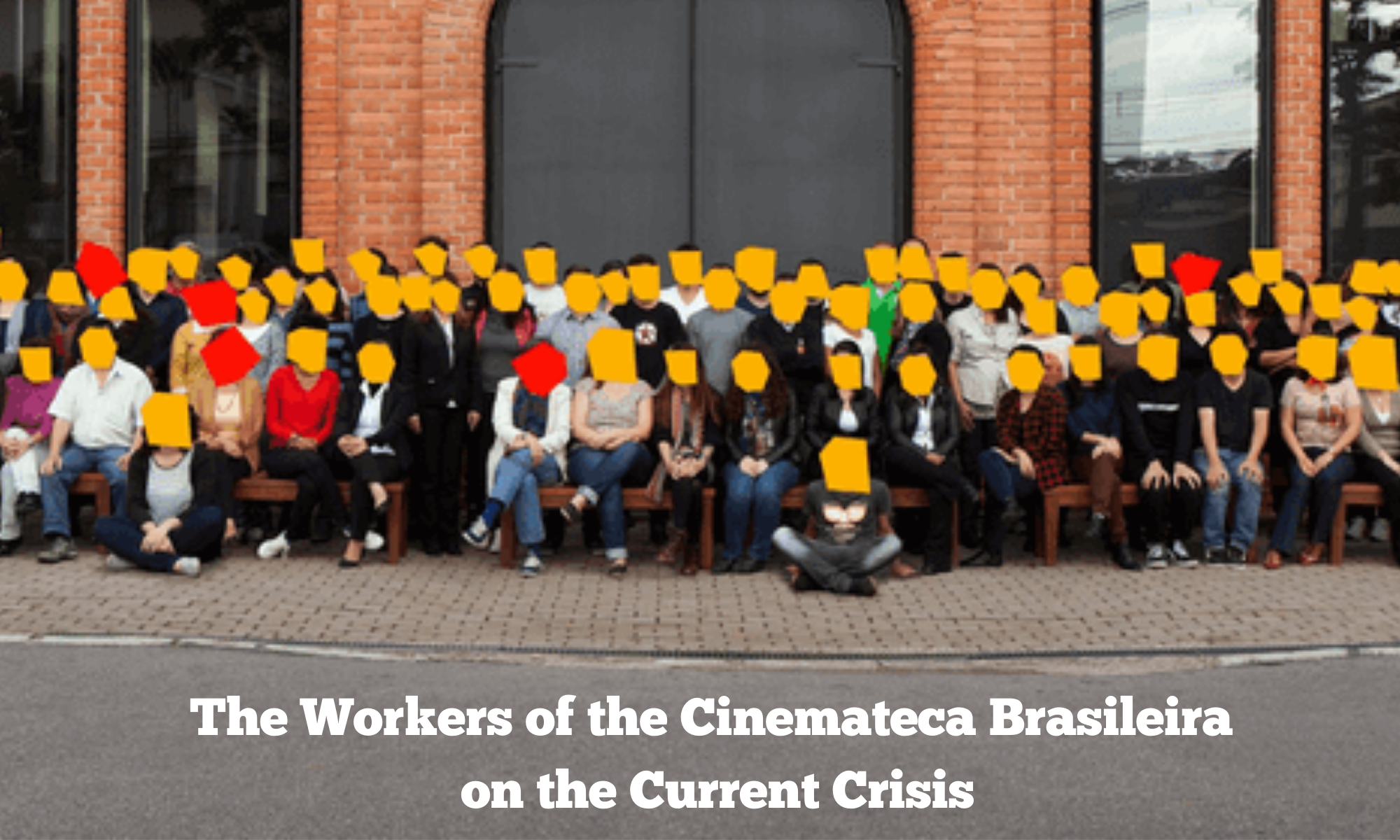
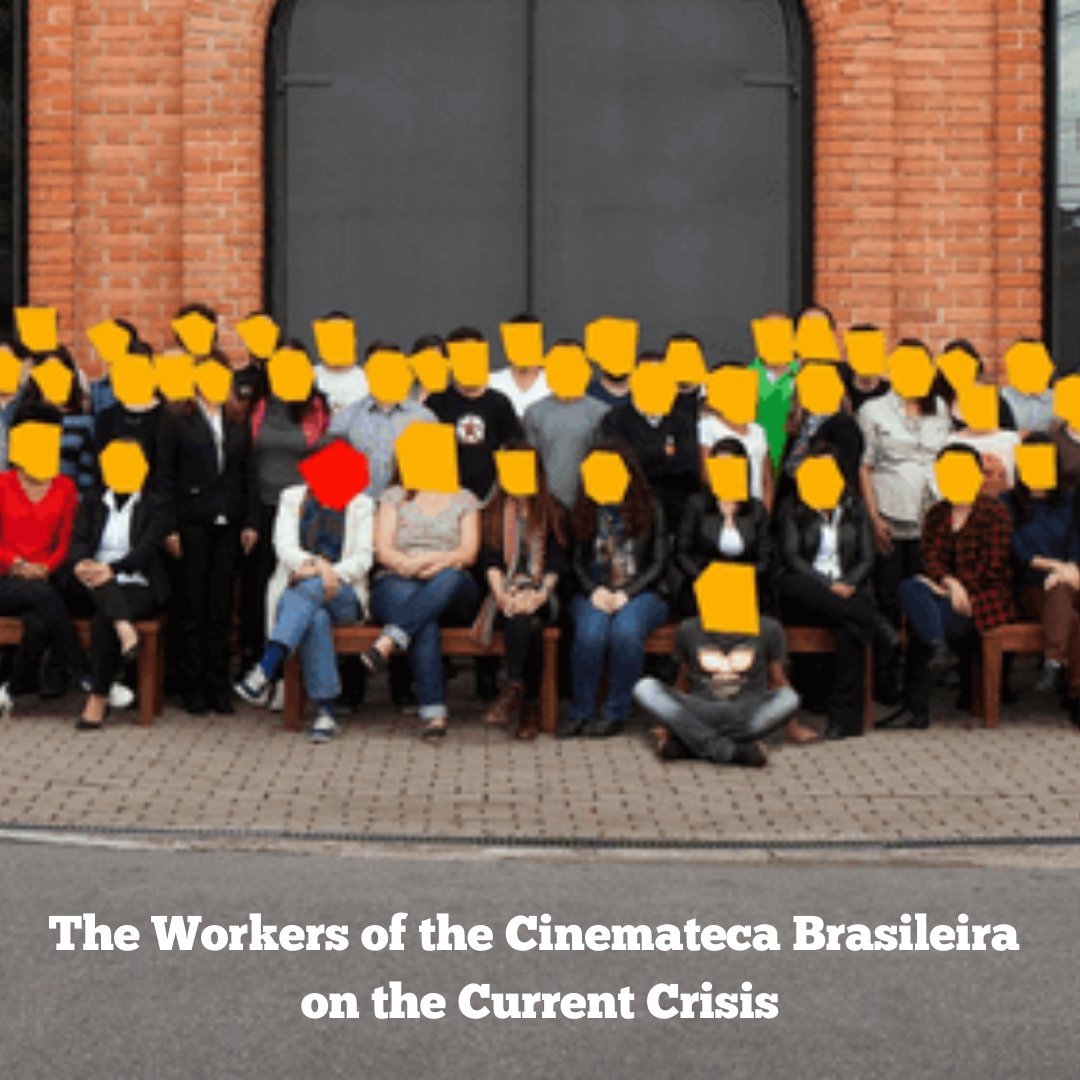
Em setembro, a equipe da Cinelimite teve a oportunidade de entrevistar os Trabalhadores da Cinemateca Brasileira, o coletivo que representa a equipe do maior acervo cinematográfico do Brasil, que está lutando há quase um ano inteiro pela sobrevivência desta instituição vital. Com essa entrevista, pudemos nos inteirar, pelos próprios funcionários, dos vários problemas que a Cinemateca e os profissionais da preservação audiovisual enfrentam no Brasil.

Em homenagem ao Dia Internacional do Patrimônio Audiovisual, apresentamos esta entrevista com alguns dos mais bravos arquivistas do mundo atualmente.

Cinelimite: Qual tem sido a reação da comunidade cinematográfica internacional à crise da Cinemateca Brasileira? E o que podemos fazer para nos mantermos em dia sobre a situação?

Trabalhadores da Cinemateca Brasileira: Primeiramente, um agradecimento a todos que contribuíram com a campanha de arrecadação online e que vêm repercutindo a causa da Cinemateca Brasileira. Esse retorno da sociedade motivou, e vem motivando, o coletivo de trabalhadores da Cinemateca a relatar essa situação nas redes sociais. Mesmo com um corpo técnico com opiniões e vínculos diversos - além dos 41 celetistas que formalmente estiveram em greve, existem também os 11 prestadores de serviços - o retorno que tivemos foi importante, pois elevou a questão não só dos salários atrasados, mas do valor dos trabalhos técnicos realizados na instituição. Trabalhos que, aliás, advêm de investimentos públicos, e por isso compõem um dos patrimônios da própria Cinemateca Brasileira a serem preservados em qualquer solução de continuidade. Neste momento, a cobrança tem que ser feita junto à Secretaria Especial da Cultura e à Secretaria Nacional do Audiovisual para que eles encaminhem uma solução para a Cinemateca Brasileira. E que esta solução não seja meramente formal: que considere a atual equipe técnica e profissionais terceirizados e a sua ampliação.Na ótica do governo, eles teriam feito a saída emergencial ao contratarem os serviços de segurança e brigadista.

No entanto, não existe equipe técnica na instituição e boa parte dos profissionais terceirizados que trabalhavam lá também não foram chamados para esses novos contratos. A situação é bem preocupante porque sabemos dos problemas de queda de energia na região,1 e da necessidade de monitoramento dos acervos. Sem equipe técnica suficiente para realizar essas funções, o acervo encontra-se vulnerável. Afora a ausência de uma transição da atual equipe para uma próxima.

CL: A Cinemateca Brasileira já passou por várias crises no passado. Vocês diriam que a crise atual é a mais significativa da história da instituição?

TCB: Sim. Pela primeira vez, em sua septuagenária história, não há equipe técnica trabalhando no local, não há qualquer garantia decontinuidade. O que fica cada vez mais patente é o descaso do poder público e afalta de atitude para solucionar os problemas enfrentados pela instituição.

CL: A crise na Cinemateca Brasileira não aconteceu da noite pro dia. Houve várias e lentas mudanças que foram comprometendo a instituição ao longo dos últimos anos. De que forma as condições de trabalho mudaram desde o início do governo Bolsonaro?

TCB: De maneira geral, as condições de trabalho na Cinemateca Brasileira seguiram o padrão do tratamento geral do governo em relação ao setor cultural. O início do governo marcou a extinção do Ministério da Cultura, ao qual a Cinemateca estava diretamente subordinada desde sua incorporação ao governo federal.2 As atividades anteriormente vinculadas ao Ministério da Cultura foram transferidas, através de uma Secretaria Especial de Cultura, para o Ministério da Cidadania.

Em novembro de 2019, após a queda do terceiro nome a comandar a secretaria, foi determinada sua transferência para o Ministério do Turismo. Essa transferência só foi concluída em junho de 2020. Entre os nomes que comandaram a pasta tivemos o diretor de teatro Ricardo Alvim, afastado após reproduzir um discurso do político nazista Joseph Goebbels, e a atriz Regina Duarte, que, ao ser desligada, publicou um vídeo no qual informava que assumiria a Cinemateca Brasileira, o que não se concretizou. Esse panorama sobre a Secretaria de Cultura demonstra o clima de indefinição que norteia as políticas culturais do país, o que, obviamente, também afetou a Cinemateca.

Há nas estruturas do governo federal vieses ideológicos, como o representado pelo já demitido ex-ministro da educação Abraham Weintraub. Partiu dele, a rescisão unilateral com a Organização Social que geria a Cinemateca Brasileira, Acerp, ainda no ano de 2019, deixando definitivamente os funcionários em condição de incerteza acerca da manutenção dos trabalhos da instituição.

Somente em junho de 2020, após dois meses sem salários, o início das movimentações dos trabalhadores e da auto-indicação da atriz Regina Duarte para "fazer Cinemateca", o governo começou a apontar providências para a gestão da instituição. Ou seja: entre janeiro (quando o contrato com a Organização Social já havia sido rompido) e junho, o governo não realizou nenhum movimento, seja institucional, seja financeiro, visando a gestão da Cinemateca.

CL: Há alguma expectativa entre vocês de que em breve haja progresso por parte do governo na solução dessa crise?

TCB: Em fevereiro de 2020, uma enchente prejudicou parte do acervo de uma das sedes da Cinemateca Brasileira. O trabalho de recuperação dos danos desse patrimônio foi feito pelos funcionários contratados pela organização social. O governo federal não realizou qualquer intervenção ou aporte financeiro. Sem a presença da Acerp e principalmente dos funcionários, que continuaram executando suas tarefas na Cinemateca durante o ano de 2020, esse patrimônio continuaria, literalmente, na lama.

A falta de apoio do governo, a falta de pagamentos, as demissões e a necessidade de pensar em nossa sobrevivência durante a pandemia, tudo isso acaba nos desmotivando. Mas tentamos continuar batalhando para que a crise se resolva, porque a Cinemateca Brasileira é um patrimônio inestimável para o povo brasileiro; não pode se perder como o Museu Nacional, perda que inclusive deveria servir de alerta ao governo.

A situação política não está favorável, mas há parlamentares preocupados com a causa. Talvez seja possível uma solução de transição diante da compreensão maior por parte do governo federal em relação às necessidades da Cinemateca Brasileira, após a visita técnica durante todo o dia 07 de agosto, quando as chaves lhe foram entregues. Por isso, esperamos poder ajudar na transição dos novos funcionários da instituição (caso novos funcionários sejam contratados). Há muitos bons motivos para recontratar os funcionários demitidos. A Cinemateca Brasileira não poderá cumprir sua missão de guardiã do patrimônio nacional sem a equipe especializada cujo conhecimento técnico foi desenvolvido trabalhando lá. Como esses trabalhadores passaram tantos anos desenvolvendo esses conhecimentos, eles se tornaram fundamentais para o funcionamento da instituição.  Para que o acervo não sofra impactos mais desastrosos do que os já ocorridos neste ano de 2020, é essencial que o governo abra espaço para uma solução de transição que leve em conta essa equipe, para que ela passe os encaminhamentos para a nova gestão, o que não foi possível com o caos político e administrativo que se instalou em todos esses meses.

CL: Antes da interrupção dos trabalhos, quais eram algumas dos próximos projetos e atividades que estavam programados na Cinemateca?

TCB: Uma parte da equipe estava envolvida em projetos que eram a continuidade do ano anterior. Os números podem ser vistos no relatório de gestão da Acerp 2019. Esse trabalho foi interrompido por causa da pandemia, assim como o trabalho de recuperação do acervo inundado na enchente de fevereiro de 2020. Contando com uma equipe técnica extremamente reduzida, realizar os trabalhos recorrentes já era um grande desafio. Análise técnica de materiais fílmicos, movimentação de acervo, incorporação e análise de materiais de depósito legal, duplicações emergenciais, higienização de materiais, entre outros, tudo isso também foi interrompido, além das diversas solicitações de terceiros para acesso aos materiais, que também não foram realizadas, travando diversos projetos.

A pandemia alterou os planos para este ano e, ainda que a crise financeira não estivesse relacionada a ela, fez a questão se intensificar, uma vez que não era possível continuar trabalhando sem recebimento de salário e sem haver uma perspectiva para tal recebimento. Alguns poucos funcionários continuaram com trabalhos mínimos de monitoramento e manutenção mesmo durante a greve. Após o governo federal tomar as chaves da Cinemateca Brasileira no dia 07 de agosto de 2020, os últimos funcionários da instituição saíram, os vinculados à Acerp e a equipe de limpeza. Os funcionários da Cinemateca ligados à Acerp foram demitidos, impossibilitando definitivamente até a continuação dos trabalhos mínimos de monitoramento e manutenção.

CL: Os trabalhadores da Cinemateca Brasileira organizaram vários protestos públicos, fizeram uma campanha de financiamento coletivo, colocaram faixas pela cidade de São Paulo e arregimentaram importante apoio online. Apesar de todas essas conquistas, quais foram seus maiores desafios ao longo dos últimos meses? Que ideias ou crenças mantêm os trabalhadores unidos e fortes durante este período difícil?

TCB: Além da questão do não pagamento dos nossos salários e da insegurança em relação ao futuro, outro grande desafio foi a falta de transparência em relação à comunicação conosco, pois foi através da imprensa que acompanhamos as decisões e movimentações políticas da Acerp e do governo federal. Nos mantivemos unidos até aqui procurando minorar as situações individuais de cada um e tentando resolver a situação o mais rapidamente possível, com cada pessoa contribuindo da maneira que podia, fosse movimentando as ações virtuais, fosse presente nos atos ou nos dois.

CL: De que forma a comunidade cinematográfica brasileira ajudou na pressão por mudanças? E por que é importante que todos os cineastas brasileiros se preocupem com a atual crise na Cinemateca Brasileira?

TCB: Instituições e associações ligadas ao audiovisual e movimentos formados em torno da causa como o SOS Cinemateca e o Cinemateca Acesa estão sendo importantes para a divulgação da situação de emergência vivenciada pela Cinemateca Brasileira e pelos trabalhadores, são pessoas que além de divulgar procuram acessar a esferas políticas que podem ajudar na resolução dessa crise. É importante que os cineastas estejam acompanhando e dando apoio, porque é a Cinemateca que tem a infraestrutura e equipe técnica que não só assegura a preservação das matrizes das obras audiovisuais produzidas por eles, como também garante a preservação e difusão de toda a produção audiovisual brasileira dos últimos 120 anos, proporcionando assim meios de acesso e referências para novas produções.

CL: Podem discorrer sobre a importância de instituições como a Cinemateca na redescoberta e reavaliação do passado? Consideram que proporcionar acesso à história do Brasil é importante no momento atual?

TCB: As instituições de memória tem o papel de salvaguardar e difundir seu acervo para que nós possamos acessá-lo e produzir novas leituras de mundo, e para que a continuidade desse processo seja legada às próximas gerações. Esse movimento é, por si, um dos traços definidores de uma nação. A produção audiovisual é parte desse movimento, e diz muito sobre o período em que é produzida: a técnica utilizada, a linguagem, o que é mostrado e até o que não é. Estes são elementos que nos dão contextos históricos e nos permitem, neste século XXI, fazer questionamentos a partir da bagagem que adquirimos ao longo dos mais de 120 anos da nossa produção audiovisual. Por exemplo, compreender as permanências e mudanças, no que a nossa sociedade entende em termos comportamentais e conquistas de direitos.

O Brasil se interessa pouco por seu passado porque as políticas públicas para com o patrimônio histórico material e imaterial, quando existem, estão muito suscetíveis aos interesses do governo da vez. Nesse caso, a Cinemateca Brasileira é vítima de descontinuidades que não vêm de agora, mas que agora, mais do que nunca, expõe a ausência de uma política pública para a Preservação Audiovisual. É importante que a população esteja municiada com uma educação pública de qualidade, acesso à informação e às manifestações culturais produzidas por todo país, pois são direitos fundamentais para que a sociedade brasileira se desenvolva. Isso não pode, e nem deveria, ser visto como algo ameaçador a qualquer tipo de governo em uma democracia.

CL: O movimento dos trabalhadores da Cinemateca Brasileira deixou claro que a preservação de filmes não se dá pelo trabalho isolado de alguns indivíduos, mas é necessário toda uma gama de trabalhadores de diferentes áreas para salvaguardar adequadamente a história do audiovisual brasileiro. De que forma a negligência do governo em relação à Cinemateca Brasileira afeta esses grupos de colaboradores que, em última instância, possibilitam a preservação dos filmes?

TCB: A negligência afeta os trabalhadores em muitos aspectos. Do ponto de vista individual, a equipe ficou sem salários por meses e muitos encontram-se desempregados, mesmo entre as equipes terceirizadas, pois elas também tiveram muitas demissões. Do ponto de vista do trabalho coletivo, primeiro a pandemia afetou os trabalhos, exigindo a interrupção de muitos serviços presenciais e redução das equipes; depois, as equipes terceirizadas foram se retirando por causa da falta de pagamentos para as empresas e sobrecarregando poucos trabalhadores que continuavam indo na instituição mesmo sem receber os salários.

Muitos colaboradores estão na instituição há muitos anos. Afastá-los de seus trabalhos é uma perda para a sociedade que investiu em suas formações. Como já mencionamos anteriormente, esse tipo de conhecimento e técnica só são possíveis de obter na prática e com os anos, perder esses colaboradores é trabalho e investimento jogados fora, teria que se recomeçar do zero. E isso significaria danos irreversíveis ao patrimônio audiovisual, à nossa produção intelectual e científica, à nossa história e ao nosso papel enquanto nação perante o mundo.

CL: Preservar filmes é combater o processo natural de decadência da película. Para preservar os mais de 250.000 rolos de filmes que a Cinemateca Brasileira possui é necessária uma grande equipe profissional. Como o descaso do governo em pagar seus salários e manter a Cinemateca Brasileira colocou em risco todo o acervo? E quais são os riscos que este acervo corre no momento?

TCB: Dá um trabalho tremendo combater a degradação físico-química da película cinematográfica, e o trabalho de preservação audiovisual tem caráter preventivo e contínuo. Desde as formas de atrasar os efeitos dessa degradação, passando pela análise e separação dos materiais com degradação mais evidente (e que colocam outros materiais em risco) até a criação de novas matrizes para evitar a perda de materiais em vias de desaparecimento o trabalho de um acervo audiovisual é contínuo e bastante qualificado. Esse trabalho depende também de condições climáticas favoráveis a preservação destes e de diversos outros suportes que compõem o acervo da Cinemateca, condições estas obtidas com o auxílio de aparelhos de ar condicionado e desumidificadores, por exemplo, devidamente controlados para a especificidade de cada material. Por fim, ainda que todo o trabalho vise evitar qualquer tipo de acidente a presença de bombeiros é fundamental, dada a característica inflamável de parte do material e como forma de evitar que qualquer evento de autocombustão se torne um incêndio generalizado.

A ausência de mão de obra qualificada e das condições materiais para execução do trabalho deixam o acervo sob os efeitos dessa degradação natural. É importante salientar que o governo federal não fez aportes financeiros para a Cinemateca por, pelo menos, todo o primeiro semestre de 2020. Com isso, os técnicos, os bombeiros, a manutenção dos equipamentos climatizadores e a aquisição de material do trabalho diário ficam prejudicados. Também fica prejudicado o trabalho estratégico dos coordenadores e diretores da Cinemateca, responsáveis por instituir e executar as políticas de preservação e difusão da instituição. Da mesma forma, também ficam sem recursos os serviços de limpeza, segurança e todos aqueles relacionados com o funcionamento da instituição que também mantém uma biblioteca, acervo documental, um banco de dados sobre a Filmografia Brasileira com acesso online aberto, três espaços de exibição, entre outros serviços, além de também trabalhar com material digital e diversos formatos de vídeo, que também têm suas especificidades de preservação.

Iniciativas da equipe da Cinemateca, da sociedade civil e de entes estatais em nível municipal e estadual tentaram minorar os efeitos da ausência do governo federal, mantendo equipamentos de climatização em funcionamento, fornecendo segurança e realizando ações pontuais de cuidado com o acervo. Como fica evidente, essas iniciativas são limitadas pela falta de condições financeiras.

Não é exagero, portanto, apontar que o material está em risco, tanto em um sentido mais urgente, já que parte do acervo corre mesmo riscos de incêndio, quanto em um sentido mais sutil, mas não menos profundo: o risco de apagamento da memória audiovisual brasileira, que tem lugar nesse material que sofre sua degradação natural sem o acompanhamento e as atitudes preventivas que eram realizadas pela mão de obra qualificada. Trabalhos totalmente interrompidos com a retirada da Acerp e a consequente demissão de todos os funcionários.

1. A Cinemateca Brasileira fica na Vila Clementino, em São Paulo.

2. Em 1984, a instituição fazia parte do Ministério da Educação e Cultura (MEC) e, desde 1985, do Ministério da Cultura (MinC).

Em setembro, a equipe da Cinelimite teve a oportunidade de entrevistar os Trabalhadores da Cinemateca Brasileira, o coletivo que representa a equipe do maior acervo cinematográfico do Brasil, que está lutando há quase um ano inteiro pela sobrevivência desta instituição vital. Com essa entrevista, pudemos nos inteirar, pelos próprios funcionários, dos vários problemas que a Cinemateca e os profissionais da preservação audiovisual enfrentam no Brasil.

Em homenagem ao Dia Internacional do Patrimônio Audiovisual, apresentamos esta entrevista com alguns dos mais bravos arquivistas do mundo atualmente.

Cinelimite: Qual tem sido a reação da comunidade cinematográfica internacional à crise da Cinemateca Brasileira? E o que podemos fazer para nos mantermos em dia sobre a situação?

Trabalhadores da Cinemateca Brasileira: Primeiramente, um agradecimento a todos que contribuíram com a campanha de arrecadação online e que vêm repercutindo a causa da Cinemateca Brasileira. Esse retorno da sociedade motivou, e vem motivando, o coletivo de trabalhadores da Cinemateca a relatar essa situação nas redes sociais. Mesmo com um corpo técnico com opiniões e vínculos diversos - além dos 41 celetistas que formalmente estiveram em greve, existem também os 11 prestadores de serviços - o retorno que tivemos foi importante, pois elevou a questão não só dos salários atrasados, mas do valor dos trabalhos técnicos realizados na instituição. Trabalhos que, aliás, advêm de investimentos públicos, e por isso compõem um dos patrimônios da própria Cinemateca Brasileira a serem preservados em qualquer solução de continuidade. Neste momento, a cobrança tem que ser feita junto à Secretaria Especial da Cultura e à Secretaria Nacional do Audiovisual para que eles encaminhem uma solução para a Cinemateca Brasileira. E que esta solução não seja meramente formal: que considere a atual equipe técnica e profissionais terceirizados e a sua ampliação.Na ótica do governo, eles teriam feito a saída emergencial ao contratarem os serviços de segurança e brigadista.

No entanto, não existe equipe técnica na instituição e boa parte dos profissionais terceirizados que trabalhavam lá também não foram chamados para esses novos contratos. A situação é bem preocupante porque sabemos dos problemas de queda de energia na região,1 e da necessidade de monitoramento dos acervos. Sem equipe técnica suficiente para realizar essas funções, o acervo encontra-se vulnerável. Afora a ausência de uma transição da atual equipe para uma próxima.

CL: A Cinemateca Brasileira já passou por várias crises no passado. Vocês diriam que a crise atual é a mais significativa da história da instituição?

TCB: Sim. Pela primeira vez, em sua septuagenária história, não há equipe técnica trabalhando no local, não há qualquer garantia decontinuidade. O que fica cada vez mais patente é o descaso do poder público e afalta de atitude para solucionar os problemas enfrentados pela instituição.

CL: A crise na Cinemateca Brasileira não aconteceu da noite pro dia. Houve várias e lentas mudanças que foram comprometendo a instituição ao longo dos últimos anos. De que forma as condições de trabalho mudaram desde o início do governo Bolsonaro?

TCB: De maneira geral, as condições de trabalho na Cinemateca Brasileira seguiram o padrão do tratamento geral do governo em relação ao setor cultural. O início do governo marcou a extinção do Ministério da Cultura, ao qual a Cinemateca estava diretamente subordinada desde sua incorporação ao governo federal.2 As atividades anteriormente vinculadas ao Ministério da Cultura foram transferidas, através de uma Secretaria Especial de Cultura, para o Ministério da Cidadania.

Em novembro de 2019, após a queda do terceiro nome a comandar a secretaria, foi determinada sua transferência para o Ministério do Turismo. Essa transferência só foi concluída em junho de 2020. Entre os nomes que comandaram a pasta tivemos o diretor de teatro Ricardo Alvim, afastado após reproduzir um discurso do político nazista Joseph Goebbels, e a atriz Regina Duarte, que, ao ser desligada, publicou um vídeo no qual informava que assumiria a Cinemateca Brasileira, o que não se concretizou. Esse panorama sobre a Secretaria de Cultura demonstra o clima de indefinição que norteia as políticas culturais do país, o que, obviamente, também afetou a Cinemateca.

Há nas estruturas do governo federal vieses ideológicos, como o representado pelo já demitido ex-ministro da educação Abraham Weintraub. Partiu dele, a rescisão unilateral com a Organização Social que geria a Cinemateca Brasileira, Acerp, ainda no ano de 2019, deixando definitivamente os funcionários em condição de incerteza acerca da manutenção dos trabalhos da instituição.

Somente em junho de 2020, após dois meses sem salários, o início das movimentações dos trabalhadores e da auto-indicação da atriz Regina Duarte para "fazer Cinemateca", o governo começou a apontar providências para a gestão da instituição. Ou seja: entre janeiro (quando o contrato com a Organização Social já havia sido rompido) e junho, o governo não realizou nenhum movimento, seja institucional, seja financeiro, visando a gestão da Cinemateca.

CL: Há alguma expectativa entre vocês de que em breve haja progresso por parte do governo na solução dessa crise?

TCB: Em fevereiro de 2020, uma enchente prejudicou parte do acervo de uma das sedes da Cinemateca Brasileira. O trabalho de recuperação dos danos desse patrimônio foi feito pelos funcionários contratados pela organização social. O governo federal não realizou qualquer intervenção ou aporte financeiro. Sem a presença da Acerp e principalmente dos funcionários, que continuaram executando suas tarefas na Cinemateca durante o ano de 2020, esse patrimônio continuaria, literalmente, na lama.

A falta de apoio do governo, a falta de pagamentos, as demissões e a necessidade de pensar em nossa sobrevivência durante a pandemia, tudo isso acaba nos desmotivando. Mas tentamos continuar batalhando para que a crise se resolva, porque a Cinemateca Brasileira é um patrimônio inestimável para o povo brasileiro; não pode se perder como o Museu Nacional, perda que inclusive deveria servir de alerta ao governo.

A situação política não está favorável, mas há parlamentares preocupados com a causa. Talvez seja possível uma solução de transição diante da compreensão maior por parte do governo federal em relação às necessidades da Cinemateca Brasileira, após a visita técnica durante todo o dia 07 de agosto, quando as chaves lhe foram entregues. Por isso, esperamos poder ajudar na transição dos novos funcionários da instituição (caso novos funcionários sejam contratados). Há muitos bons motivos para recontratar os funcionários demitidos. A Cinemateca Brasileira não poderá cumprir sua missão de guardiã do patrimônio nacional sem a equipe especializada cujo conhecimento técnico foi desenvolvido trabalhando lá. Como esses trabalhadores passaram tantos anos desenvolvendo esses conhecimentos, eles se tornaram fundamentais para o funcionamento da instituição.  Para que o acervo não sofra impactos mais desastrosos do que os já ocorridos neste ano de 2020, é essencial que o governo abra espaço para uma solução de transição que leve em conta essa equipe, para que ela passe os encaminhamentos para a nova gestão, o que não foi possível com o caos político e administrativo que se instalou em todos esses meses.

CL: Antes da interrupção dos trabalhos, quais eram algumas dos próximos projetos e atividades que estavam programados na Cinemateca?

TCB: Uma parte da equipe estava envolvida em projetos que eram a continuidade do ano anterior. Os números podem ser vistos no relatório de gestão da Acerp 2019. Esse trabalho foi interrompido por causa da pandemia, assim como o trabalho de recuperação do acervo inundado na enchente de fevereiro de 2020. Contando com uma equipe técnica extremamente reduzida, realizar os trabalhos recorrentes já era um grande desafio. Análise técnica de materiais fílmicos, movimentação de acervo, incorporação e análise de materiais de depósito legal, duplicações emergenciais, higienização de materiais, entre outros, tudo isso também foi interrompido, além das diversas solicitações de terceiros para acesso aos materiais, que também não foram realizadas, travando diversos projetos.

A pandemia alterou os planos para este ano e, ainda que a crise financeira não estivesse relacionada a ela, fez a questão se intensificar, uma vez que não era possível continuar trabalhando sem recebimento de salário e sem haver uma perspectiva para tal recebimento. Alguns poucos funcionários continuaram com trabalhos mínimos de monitoramento e manutenção mesmo durante a greve. Após o governo federal tomar as chaves da Cinemateca Brasileira no dia 07 de agosto de 2020, os últimos funcionários da instituição saíram, os vinculados à Acerp e a equipe de limpeza. Os funcionários da Cinemateca ligados à Acerp foram demitidos, impossibilitando definitivamente até a continuação dos trabalhos mínimos de monitoramento e manutenção.

CL: Os trabalhadores da Cinemateca Brasileira organizaram vários protestos públicos, fizeram uma campanha de financiamento coletivo, colocaram faixas pela cidade de São Paulo e arregimentaram importante apoio online. Apesar de todas essas conquistas, quais foram seus maiores desafios ao longo dos últimos meses? Que ideias ou crenças mantêm os trabalhadores unidos e fortes durante este período difícil?

TCB: Além da questão do não pagamento dos nossos salários e da insegurança em relação ao futuro, outro grande desafio foi a falta de transparência em relação à comunicação conosco, pois foi através da imprensa que acompanhamos as decisões e movimentações políticas da Acerp e do governo federal. Nos mantivemos unidos até aqui procurando minorar as situações individuais de cada um e tentando resolver a situação o mais rapidamente possível, com cada pessoa contribuindo da maneira que podia, fosse movimentando as ações virtuais, fosse presente nos atos ou nos dois.

CL: De que forma a comunidade cinematográfica brasileira ajudou na pressão por mudanças? E por que é importante que todos os cineastas brasileiros se preocupem com a atual crise na Cinemateca Brasileira?

TCB: Instituições e associações ligadas ao audiovisual e movimentos formados em torno da causa como o SOS Cinemateca e o Cinemateca Acesa estão sendo importantes para a divulgação da situação de emergência vivenciada pela Cinemateca Brasileira e pelos trabalhadores, são pessoas que além de divulgar procuram acessar a esferas políticas que podem ajudar na resolução dessa crise. É importante que os cineastas estejam acompanhando e dando apoio, porque é a Cinemateca que tem a infraestrutura e equipe técnica que não só assegura a preservação das matrizes das obras audiovisuais produzidas por eles, como também garante a preservação e difusão de toda a produção audiovisual brasileira dos últimos 120 anos, proporcionando assim meios de acesso e referências para novas produções.

CL: Podem discorrer sobre a importância de instituições como a Cinemateca na redescoberta e reavaliação do passado? Consideram que proporcionar acesso à história do Brasil é importante no momento atual?

TCB: As instituições de memória tem o papel de salvaguardar e difundir seu acervo para que nós possamos acessá-lo e produzir novas leituras de mundo, e para que a continuidade desse processo seja legada às próximas gerações. Esse movimento é, por si, um dos traços definidores de uma nação. A produção audiovisual é parte desse movimento, e diz muito sobre o período em que é produzida: a técnica utilizada, a linguagem, o que é mostrado e até o que não é. Estes são elementos que nos dão contextos históricos e nos permitem, neste século XXI, fazer questionamentos a partir da bagagem que adquirimos ao longo dos mais de 120 anos da nossa produção audiovisual. Por exemplo, compreender as permanências e mudanças, no que a nossa sociedade entende em termos comportamentais e conquistas de direitos.

O Brasil se interessa pouco por seu passado porque as políticas públicas para com o patrimônio histórico material e imaterial, quando existem, estão muito suscetíveis aos interesses do governo da vez. Nesse caso, a Cinemateca Brasileira é vítima de descontinuidades que não vêm de agora, mas que agora, mais do que nunca, expõe a ausência de uma política pública para a Preservação Audiovisual. É importante que a população esteja municiada com uma educação pública de qualidade, acesso à informação e às manifestações culturais produzidas por todo país, pois são direitos fundamentais para que a sociedade brasileira se desenvolva. Isso não pode, e nem deveria, ser visto como algo ameaçador a qualquer tipo de governo em uma democracia.

CL: O movimento dos trabalhadores da Cinemateca Brasileira deixou claro que a preservação de filmes não se dá pelo trabalho isolado de alguns indivíduos, mas é necessário toda uma gama de trabalhadores de diferentes áreas para salvaguardar adequadamente a história do audiovisual brasileiro. De que forma a negligência do governo em relação à Cinemateca Brasileira afeta esses grupos de colaboradores que, em última instância, possibilitam a preservação dos filmes?

TCB: A negligência afeta os trabalhadores em muitos aspectos. Do ponto de vista individual, a equipe ficou sem salários por meses e muitos encontram-se desempregados, mesmo entre as equipes terceirizadas, pois elas também tiveram muitas demissões. Do ponto de vista do trabalho coletivo, primeiro a pandemia afetou os trabalhos, exigindo a interrupção de muitos serviços presenciais e redução das equipes; depois, as equipes terceirizadas foram se retirando por causa da falta de pagamentos para as empresas e sobrecarregando poucos trabalhadores que continuavam indo na instituição mesmo sem receber os salários.

Muitos colaboradores estão na instituição há muitos anos. Afastá-los de seus trabalhos é uma perda para a sociedade que investiu em suas formações. Como já mencionamos anteriormente, esse tipo de conhecimento e técnica só são possíveis de obter na prática e com os anos, perder esses colaboradores é trabalho e investimento jogados fora, teria que se recomeçar do zero. E isso significaria danos irreversíveis ao patrimônio audiovisual, à nossa produção intelectual e científica, à nossa história e ao nosso papel enquanto nação perante o mundo.

CL: Preservar filmes é combater o processo natural de decadência da película. Para preservar os mais de 250.000 rolos de filmes que a Cinemateca Brasileira possui é necessária uma grande equipe profissional. Como o descaso do governo em pagar seus salários e manter a Cinemateca Brasileira colocou em risco todo o acervo? E quais são os riscos que este acervo corre no momento?

TCB: Dá um trabalho tremendo combater a degradação físico-química da película cinematográfica, e o trabalho de preservação audiovisual tem caráter preventivo e contínuo. Desde as formas de atrasar os efeitos dessa degradação, passando pela análise e separação dos materiais com degradação mais evidente (e que colocam outros materiais em risco) até a criação de novas matrizes para evitar a perda de materiais em vias de desaparecimento o trabalho de um acervo audiovisual é contínuo e bastante qualificado. Esse trabalho depende também de condições climáticas favoráveis a preservação destes e de diversos outros suportes que compõem o acervo da Cinemateca, condições estas obtidas com o auxílio de aparelhos de ar condicionado e desumidificadores, por exemplo, devidamente controlados para a especificidade de cada material. Por fim, ainda que todo o trabalho vise evitar qualquer tipo de acidente a presença de bombeiros é fundamental, dada a característica inflamável de parte do material e como forma de evitar que qualquer evento de autocombustão se torne um incêndio generalizado.

A ausência de mão de obra qualificada e das condições materiais para execução do trabalho deixam o acervo sob os efeitos dessa degradação natural. É importante salientar que o governo federal não fez aportes financeiros para a Cinemateca por, pelo menos, todo o primeiro semestre de 2020. Com isso, os técnicos, os bombeiros, a manutenção dos equipamentos climatizadores e a aquisição de material do trabalho diário ficam prejudicados. Também fica prejudicado o trabalho estratégico dos coordenadores e diretores da Cinemateca, responsáveis por instituir e executar as políticas de preservação e difusão da instituição. Da mesma forma, também ficam sem recursos os serviços de limpeza, segurança e todos aqueles relacionados com o funcionamento da instituição que também mantém uma biblioteca, acervo documental, um banco de dados sobre a Filmografia Brasileira com acesso online aberto, três espaços de exibição, entre outros serviços, além de também trabalhar com material digital e diversos formatos de vídeo, que também têm suas especificidades de preservação.

Iniciativas da equipe da Cinemateca, da sociedade civil e de entes estatais em nível municipal e estadual tentaram minorar os efeitos da ausência do governo federal, mantendo equipamentos de climatização em funcionamento, fornecendo segurança e realizando ações pontuais de cuidado com o acervo. Como fica evidente, essas iniciativas são limitadas pela falta de condições financeiras.

Não é exagero, portanto, apontar que o material está em risco, tanto em um sentido mais urgente, já que parte do acervo corre mesmo riscos de incêndio, quanto em um sentido mais sutil, mas não menos profundo: o risco de apagamento da memória audiovisual brasileira, que tem lugar nesse material que sofre sua degradação natural sem o acompanhamento e as atitudes preventivas que eram realizadas pela mão de obra qualificada. Trabalhos totalmente interrompidos com a retirada da Acerp e a consequente demissão de todos os funcionários.

1. A Cinemateca Brasileira fica na Vila Clementino, em São Paulo.

2. Em 1984, a instituição fazia parte do Ministério da Educação e Cultura (MEC) e, desde 1985, do Ministério da Cultura (MinC).

This past September, the staff of Cinelimite had the opportunity to conduct an interview with the Workers of the Cinemateca Brasileira (Trabalhadores da Cinemateca Brasileira) , the collective representing the archivists and staff of Brazil’s largest film archive, who have been fighting for nearly an entire year for the survival of this vital institution. Our goal with this interview was to hear about the numerous issues facing the Cinemateca Brasileira and the field of audiovisual preservation in Brazil directly from workers of the archive themselves. In honor of World Audiovisual Heritage Day, we present an interview with some of the bravest archive workers in the world today.

Cinelimite: How have you perceived the reaction to the crisis of the Cinemateca Brasileira from the international film community? What do we need to know right now to stay up to date with what is happening at the Cinemateca Brasileira?

Trabalhadores da Cinemateca Brasileira: Firstly, we want to thank everyone who contributed to our crowdfunding campaign and everyone who has been spreading the news about the crisis of the Cinemateca Brasileira. This response from global communities motivated the Cinemateca workers’ collective to write about what was happening at the CB on social media. The Cinemateca’s technical staff is a group of people with different opinions and different employment relationships — in addition to the forty-one workers who were formally on strike, there were eleven service providers — so the feedback we got was important as it emphasized the problem of unpaid wages and the value of the technical work that we provide for the institution. This work itself is a result of public investments, of years of development of methodologies and workflow, therefore it is also a valuable asset for the institution. Right now, our demands have to be made to the Special Secretariat of Culture and the National Audiovisual Secretariat so they can come up with a solution for the crisis the Cinemateca Brasileira faces. However, this solution must account for the current technical staff, the outsourced workers and present a plan as to how the institution can hire and train new workers.

The government’s emergency solution to the crisis was to hire security and firefighter staff. However, at the moment there are no technical staff at the institution, and most of the outsourced workers did not have their contracts renewed. This situation is worrisome. Power outages have happened in that region of the city,1 and the vaults need constant monitoring by technical staff to ensure that the collection is properly preserved. Without these necessary maintenance, the archive is vulnerable to numerous mishaps.

CL: The Cinemateca Brasileira has been through several crises in the past. Would you say that the current situation has been the most harmful to the institution in its history?

TCB: Yes. For the first time in its 70-year history, there are no technical staff working at the Cinemateca and there is no guarantee that the archive will continue its operations. What has never been more explicit is the negligence of public authorities, and their unwillingness to take action to solve the problems the institution is facing.

CL: The crisis at the Cinemateca Brasileira did not happen overnight, as there have been several slow changes that have begun to impact the institution in recent years. Can you discuss some of the ways that working conditions have changed since the beginning of the Bolsonaro administration?

TCB: Generally speaking, the working conditions at the Cinemateca Brasileira reflect the same mistreatment dispensed by the federal government towards every institution that operates within the cultural sector. At the very beginning of their term, the Bolsonaro administration extinguished the Ministry of Culture, under which the Cinemateca was directly subordinate since being incorporated into the federal government.2 All activities previously linked to the Ministry of Culture were transferred via the Special Secretariat of Culture to the Ministry of Citizenship.

In November 2019, after three consecutive secretaries of culture had vacated their position, the control over the Cinemateca was set to be transferred to the Ministry of Tourism, but this only ended up occurring in June 2020. Among past secretaries of culture, theater director Roberto Alvim was replaced after quoting a speech of Nazi politician Joseph Goebbels, while actress Regina Duarte posted a video on social media after leaving the position where she claimed she was going to be named the next head of the Cinemateca Brasileira, which did not happen. This panorama of the Secretariat of Culture illustrates the uncertainty with which cultural policies have been dealt with by the Bolsonaro administration, and as a result of these policies, the Cinemateca has obviously been negatively affected.

The federal government is made up of functionaries with numerous ideological biases, such as those clearly displayed by ex-minister of education Abraham Weintraub. Weintraub decided unilaterally, in 2019, not to renew the contract with the social organization that managed the Cinemateca Brasileira, Acerp, leaving its employees unsure if work at the institution would continue. It was only in June 2020, following two months without salary, once the workers began protesting, and after actress Regina Duarte appointed herself for “a gig at the Cinemateca”, that the government began to take action regarding the management of the institution. This means that from January (when the contract with Acerp had already been terminated) to June the federal government did nothing, either institutionally or financially, about the management of the Cinemateca.

CL: Are there any expectations among you that there will soon be action by the government towards resolving this crisis?

TCB: In February 2020, a flood damaged part of the archive in one of the Cinemateca Brasileira’s facilities. This damage was dealt with by the workers who were hired by Acerp and outsourced. The government didn’t take any action nor send financial support. Without Acerp and the workers who carried on with their functions at the Cinemateca in 2020, the archive would literally still be in the mud.

The lack of governmental support, the unpaid salaries, the lay-offs, and our need to find new means of survival during a pandemic has been very demotivating to us. But we are trying to continue fighting for a solution to the crisis because the Cinemateca Brasileira preserves the priceless heritage of the Brazilian people. It cannot be lost in the same manner that the Museu Nacional was.3 What happened to the Museu Nacional should serve as a warning to the government of what can occur if they neglect the maintenance of their archives.

While the political situation is unfavorable, there are politicians who care for our cause. The federal government has begun to show that they are trying to understand the needs of the Cinemateca Brasileira since we handed over the keys to them during their visit to the institution on August 7th. Because of that, we hope that we can help the institution transition to new workers (in the event that new workers are hired). There are many good reasons for those in charge to bring back all of the laid-off employees. The Cinemateca Brasileira will not be able to fulfill its mission as a safeguard of national heritage without the specialized staff whose technical knowledge was specifically developed while working there. It is because these workers have spent so many years developing this knowledge that they have become vital to the institution’s operations. In order to keep the archive safe from even further damage than what it already has endured this past year, the government must be open to a solution that takes the current staff into account so that we can instruct the incoming staff properly, which wasn’t possible due to the political and administrative chaos that had been taking place over the past months.

CL: Before the interruption of work at the Cinemateca Brasileira, what were some of the upcoming activities and projects that were slated to take place at the archive?

TCB: Part of the staff had been working on projects from the previous year. People can learn more about the projects we were working on prior to the work stoppage by checking out the official ACERP management report. When the pandemic arrived, it brought that as well as the work we were doing to recover archival materials from the February 2020 flood to a halt. With our technical staff cut short, everyday tasks quickly became challenging. As of today, all technical analysis of films, the management of the archives, the incorporation and analysis of legal deposit materials, the production of emergency duplicates, and the maintenance of materials hygiene has been halted. In addition, all of the requests to access our archives have been denied, which has led to the interruption of many important future projects.

The pandemic has changed our plans for this year. Even if it isn’t the direct cause of our financial crisis, it has made matters worse since it was and remains impossible to keep working without payment during this difficult time. During our strike, very few employees continued monitoring and maintaining the collections of the archive, and now even less are doing so. After the federal government took the keys of the Cinemateca Brasileira on August 7, 2020, the last employees of the institution left, as well as those linked to Acerp and the cleaning staff. The Acerp workers were fired, which made it impossible for even minimal monitoring and maintenance duties to be continued.

CL: The Cinemateca Brasileira workers organized several public protests, campaigned for collective funding, put up banners around the city of São Paulo, and built a strong social media presence to spread awareness of its cause. Despite all these achievements, what have been your biggest challenges over the last few months? What are the ideals or beliefs that have kept workers united during this difficult period?

TCB: In addition to our unpaid salaries and unsure futures, the lack of transparency or communication from the government has presented a huge challenge for our protest. During the period when our protests began, we were following the decisions and political moves of Acerp and the government the same way as everyone else: through the press. But we remained united in support of one another then, and we continue to strive towards the resolution of the situation at the Cinemateca Brasileira as quickly as possible. Today, we are all contributing in whatever way we can, either through taking action virtually, taking part in the protests in person, or both.

CL: How has the Brazilian film community stood up to the injustices the Cinemateca Brasileira and its workers have endured? And why should all filmmakers be concerned about the future of the Cinemateca Brasileira?

TCB: Audiovisual-related institutions, associations, and movements which support our cause, such as SOS Cinemateca and Cinemateca Acesa, are important as they have helped to spread the word about the emergency situation the Cinemateca and its workers face. Not only are these people helping to alert more people to the cause, but they are also contacting politicians who might help us find a solution to the crisis. It is important that filmmakers follow and support the Cinemateca, whose infrastructure and technical staff not only keep the matrix of their own works safe, but also preserves and exhibits the whole of Brazilian audiovisual productions of the last 120 years, thus providing access and reference for new productions.

CL: Can you talk about the importance of institutions like the Cinemateca in the rediscovery and reevaluation of Brazil’s history? And how do you see providing access to Brazilian history as playing an important role within the contemporary moment?

TCB: Institutions of cultural memory like the Cinemateca Brasileira have to keep up and exhibit their collections so that the public can access the institution’s historical materials. New generations build upon their worldviews by encountering these histories, and these new perspectives become the defining features of a nation. Audiovisual productions are a vital part of that process, and they say a lot about the period in which they were made. We can learn from the cinematic techniques being used, the way language is spoken, and develop new ideas about representation from what has or hasn’t been shown. These elements provide context to our history and allow us in the 21st century to ask questions and introduce new subjects from what we have acquired over our 120+ years of audiovisual production. We can, for instance, understand what has remained and what has changed in our society’s perception of human behavior and fundamental rights.

Brazil has little interest in its own past. We know this because public policies for material and immaterial historical heritage, when they exist, are always susceptible to the interests of the current government. The Cinemateca Brasileira is the victim of operational discontinuities which are not rare among government-funded Brazilian cultural institutions, but now more than ever these discontinuities reveal the lack of public policies for audiovisual preservation. It is important that the population has quality public education and access to information and cultural manifestations, as these are fundamental towards the development of Brazilian society. This cannot or should not be seen as threatening to any government in a democracy.

CL: The Cinemateca Brasileira workers’ movement has made it clear that the preservation of films does not come about through the isolated work of a few individuals, but rather that a whole range of specialized workers is needed to adequately safeguard Brazilian audiovisual history. How does the government’s neglect of the Cinemateca affect the teams of collaborators who ultimately make the preservation of films possible?

TCB: The governmental negligence has affected us in many ways. As previously mentioned, the staff has been without salary for months and all of us, even a lot of the outsourced workers, have been fired. First the pandemic affected many of our long-standing projects, as many on-site activities had to be halted; then the outsourced workers started to retreat due to the lack of payment from the companies that they work for, although some companies even kept working at the Cinemateca despite not getting paid.

Many of our staff have been part of the institution for many years, so when they are away from their work, the very society that invested in their technical skills loses out. As we mentioned before, one can only obtain this kind of knowledge and technique through years of practice, and to lose these workers means to waste years of work and public investment. If skilled workers are abruptly forced to leave the institution, everything has to start again from scratch. This means irreversible damage to the audiovisual heritage, damage to our intellectual and scientific production, damage to our history and damage to the role of our nation in the world.

CL: To preserve films is to combat the natural process of film decay. To preserve the more than 250,000 rolls of films that the Cinemateca Brasileira has, a great professional team is needed. How did the government's carelessness in paying worker’s salaries and maintaining the Cinemateca Brasileira put the entire collection at risk? And what are the specific risks that this collection runs during this moment?

TCB: It is a tremendous work to fight the physical and chemical degradation of film material, and audiovisual preservation is a preventive measure that must remain ongoing. From learning how to delay film degradation, analyzing and separating material in an advanced degradative state, to making new matrices in order to avoid the loss of highly-deteriorated material, the work at an audiovisual archive has to be done by highly qualified professionals. Another vital part of the preservation process is to maintain temperature conditions that are favorable to preservation of the various kinds of material contained in the Cinemateca Brasileira archive. Such conditions are achieved with air-conditioning and dehumidifying devices and these devices are controlled to match the specific conditions of each type of material. Lastly, since a portion of our content is highly flammable, the role of firefighters is fundamental to the Cinemateca Brasileira because they help us avoid the spread of a fire.  

The lack of qualified workers in the Cinemateca Brasileira leaves all of the archival materials subject to natural degradation. It is important to highlight that the federal government has not offered any financial support to the Cinemateca during the first six months of 2020. So, the technical staff, the firefighters, the workers who maintain the air-conditioning devices and those who deal with the acquisitions of new material have all been affected. In addition, the strategic work done by the coordinators and directors of the Cinemateca who are responsible for implementing and executing the institution’s preservation and diffusion policies has been affected as well. Not to mention the cleaning and security teams who serve important roles in helping the institution function, as well as those who work in the library, the document collection center, they maintain the online Brazilian film database, the three screening rooms, and digital and video materials, which also need to be preserved under specific conditions.

The Cinemateca staff, civil society, and municipal and state agencies have been working to minimize the impact of the lack of federal support, keeping the temperature devices working as well as providing security and other occasional needs of the archive. Obviously, such individual actions can only accomplish so much given the lack of financial support.

It is no exaggeration to say the collection is at risk. The risk, on one hand, is urgent, as the collection poses a real fire risk if it is not maintained, but on the other hand there is a long term risk in the fact that the audio-visual materials at the Cinemateca Brasileira will degrade naturally if they aren’t given due attention and care by qualified workers. All the work has been totally interrupted with Acerp stepping out and the dismissal of all the workers.

1. The Cinemateca Brasileira is located at Vila Clementino, São Paulo

2. The Cinemateca Brasileira was part of the Ministry of Education and Culture (MEC) in 1984, and since 1985 it has been part of the Ministry of Culture (MinC).

3. On September 2nd, 2018, there was a large fire at the National Museum of Brazil. It is believed that 92.5% of its archive of 20 million items were destroyed.

This past September, the staff of Cinelimite had the opportunity to conduct an interview with the Workers of the Cinemateca Brasileira (Trabalhadores da Cinemateca Brasileira) , the collective representing the archivists and staff of Brazil’s largest film archive, who have been fighting for nearly an entire year for the survival of this vital institution. Our goal with this interview was to hear about the numerous issues facing the Cinemateca Brasileira and the field of audiovisual preservation in Brazil directly from workers of the archive themselves. In honor of World Audiovisual Heritage Day, we present an interview with some of the bravest archive workers in the world today.

Cinelimite: How have you perceived the reaction to the crisis of the Cinemateca Brasileira from the international film community? What do we need to know right now to stay up to date with what is happening at the Cinemateca Brasileira?

Trabalhadores da Cinemateca Brasileira: Firstly, we want to thank everyone who contributed to our crowdfunding campaign and everyone who has been spreading the news about the crisis of the Cinemateca Brasileira. This response from global communities motivated the Cinemateca workers’ collective to write about what was happening at the CB on social media. The Cinemateca’s technical staff is a group of people with different opinions and different employment relationships — in addition to the forty-one workers who were formally on strike, there were eleven service providers — so the feedback we got was important as it emphasized the problem of unpaid wages and the value of the technical work that we provide for the institution. This work itself is a result of public investments, of years of development of methodologies and workflow, therefore it is also a valuable asset for the institution. Right now, our demands have to be made to the Special Secretariat of Culture and the National Audiovisual Secretariat so they can come up with a solution for the crisis the Cinemateca Brasileira faces. However, this solution must account for the current technical staff, the outsourced workers and present a plan as to how the institution can hire and train new workers.

The government’s emergency solution to the crisis was to hire security and firefighter staff. However, at the moment there are no technical staff at the institution, and most of the outsourced workers did not have their contracts renewed. This situation is worrisome. Power outages have happened in that region of the city,1 and the vaults need constant monitoring by technical staff to ensure that the collection is properly preserved. Without these necessary maintenance, the archive is vulnerable to numerous mishaps.

CL: The Cinemateca Brasileira has been through several crises in the past. Would you say that the current situation has been the most harmful to the institution in its history?

TCB: Yes. For the first time in its 70-year history, there are no technical staff working at the Cinemateca and there is no guarantee that the archive will continue its operations. What has never been more explicit is the negligence of public authorities, and their unwillingness to take action to solve the problems the institution is facing.

CL: The crisis at the Cinemateca Brasileira did not happen overnight, as there have been several slow changes that have begun to impact the institution in recent years. Can you discuss some of the ways that working conditions have changed since the beginning of the Bolsonaro administration?

TCB: Generally speaking, the working conditions at the Cinemateca Brasileira reflect the same mistreatment dispensed by the federal government towards every institution that operates within the cultural sector. At the very beginning of their term, the Bolsonaro administration extinguished the Ministry of Culture, under which the Cinemateca was directly subordinate since being incorporated into the federal government.2 All activities previously linked to the Ministry of Culture were transferred via the Special Secretariat of Culture to the Ministry of Citizenship.

In November 2019, after three consecutive secretaries of culture had vacated their position, the control over the Cinemateca was set to be transferred to the Ministry of Tourism, but this only ended up occurring in June 2020. Among past secretaries of culture, theater director Roberto Alvim was replaced after quoting a speech of Nazi politician Joseph Goebbels, while actress Regina Duarte posted a video on social media after leaving the position where she claimed she was going to be named the next head of the Cinemateca Brasileira, which did not happen. This panorama of the Secretariat of Culture illustrates the uncertainty with which cultural policies have been dealt with by the Bolsonaro administration, and as a result of these policies, the Cinemateca has obviously been negatively affected.

The federal government is made up of functionaries with numerous ideological biases, such as those clearly displayed by ex-minister of education Abraham Weintraub. Weintraub decided unilaterally, in 2019, not to renew the contract with the social organization that managed the Cinemateca Brasileira, Acerp, leaving its employees unsure if work at the institution would continue. It was only in June 2020, following two months without salary, once the workers began protesting, and after actress Regina Duarte appointed herself for “a gig at the Cinemateca”, that the government began to take action regarding the management of the institution. This means that from January (when the contract with Acerp had already been terminated) to June the federal government did nothing, either institutionally or financially, about the management of the Cinemateca.

CL: Are there any expectations among you that there will soon be action by the government towards resolving this crisis?

TCB: In February 2020, a flood damaged part of the archive in one of the Cinemateca Brasileira’s facilities. This damage was dealt with by the workers who were hired by Acerp and outsourced. The government didn’t take any action nor send financial support. Without Acerp and the workers who carried on with their functions at the Cinemateca in 2020, the archive would literally still be in the mud.

The lack of governmental support, the unpaid salaries, the lay-offs, and our need to find new means of survival during a pandemic has been very demotivating to us. But we are trying to continue fighting for a solution to the crisis because the Cinemateca Brasileira preserves the priceless heritage of the Brazilian people. It cannot be lost in the same manner that the Museu Nacional was.3 What happened to the Museu Nacional should serve as a warning to the government of what can occur if they neglect the maintenance of their archives.

While the political situation is unfavorable, there are politicians who care for our cause. The federal government has begun to show that they are trying to understand the needs of the Cinemateca Brasileira since we handed over the keys to them during their visit to the institution on August 7th. Because of that, we hope that we can help the institution transition to new workers (in the event that new workers are hired). There are many good reasons for those in charge to bring back all of the laid-off employees. The Cinemateca Brasileira will not be able to fulfill its mission as a safeguard of national heritage without the specialized staff whose technical knowledge was specifically developed while working there. It is because these workers have spent so many years developing this knowledge that they have become vital to the institution’s operations. In order to keep the archive safe from even further damage than what it already has endured this past year, the government must be open to a solution that takes the current staff into account so that we can instruct the incoming staff properly, which wasn’t possible due to the political and administrative chaos that had been taking place over the past months.

CL: Before the interruption of work at the Cinemateca Brasileira, what were some of the upcoming activities and projects that were slated to take place at the archive?

TCB: Part of the staff had been working on projects from the previous year. People can learn more about the projects we were working on prior to the work stoppage by checking out the official ACERP management report. When the pandemic arrived, it brought that as well as the work we were doing to recover archival materials from the February 2020 flood to a halt. With our technical staff cut short, everyday tasks quickly became challenging. As of today, all technical analysis of films, the management of the archives, the incorporation and analysis of legal deposit materials, the production of emergency duplicates, and the maintenance of materials hygiene has been halted. In addition, all of the requests to access our archives have been denied, which has led to the interruption of many important future projects.

The pandemic has changed our plans for this year. Even if it isn’t the direct cause of our financial crisis, it has made matters worse since it was and remains impossible to keep working without payment during this difficult time. During our strike, very few employees continued monitoring and maintaining the collections of the archive, and now even less are doing so. After the federal government took the keys of the Cinemateca Brasileira on August 7, 2020, the last employees of the institution left, as well as those linked to Acerp and the cleaning staff. The Acerp workers were fired, which made it impossible for even minimal monitoring and maintenance duties to be continued.

CL: The Cinemateca Brasileira workers organized several public protests, campaigned for collective funding, put up banners around the city of São Paulo, and built a strong social media presence to spread awareness of its cause. Despite all these achievements, what have been your biggest challenges over the last few months? What are the ideals or beliefs that have kept workers united during this difficult period?

TCB: In addition to our unpaid salaries and unsure futures, the lack of transparency or communication from the government has presented a huge challenge for our protest. During the period when our protests began, we were following the decisions and political moves of Acerp and the government the same way as everyone else: through the press. But we remained united in support of one another then, and we continue to strive towards the resolution of the situation at the Cinemateca Brasileira as quickly as possible. Today, we are all contributing in whatever way we can, either through taking action virtually, taking part in the protests in person, or both.

CL: How has the Brazilian film community stood up to the injustices the Cinemateca Brasileira and its workers have endured? And why should all filmmakers be concerned about the future of the Cinemateca Brasileira?

TCB: Audiovisual-related institutions, associations, and movements which support our cause, such as SOS Cinemateca and Cinemateca Acesa, are important as they have helped to spread the word about the emergency situation the Cinemateca and its workers face. Not only are these people helping to alert more people to the cause, but they are also contacting politicians who might help us find a solution to the crisis. It is important that filmmakers follow and support the Cinemateca, whose infrastructure and technical staff not only keep the matrix of their own works safe, but also preserves and exhibits the whole of Brazilian audiovisual productions of the last 120 years, thus providing access and reference for new productions.

CL: Can you talk about the importance of institutions like the Cinemateca in the rediscovery and reevaluation of Brazil’s history? And how do you see providing access to Brazilian history as playing an important role within the contemporary moment?

TCB: Institutions of cultural memory like the Cinemateca Brasileira have to keep up and exhibit their collections so that the public can access the institution’s historical materials. New generations build upon their worldviews by encountering these histories, and these new perspectives become the defining features of a nation. Audiovisual productions are a vital part of that process, and they say a lot about the period in which they were made. We can learn from the cinematic techniques being used, the way language is spoken, and develop new ideas about representation from what has or hasn’t been shown. These elements provide context to our history and allow us in the 21st century to ask questions and introduce new subjects from what we have acquired over our 120+ years of audiovisual production. We can, for instance, understand what has remained and what has changed in our society’s perception of human behavior and fundamental rights.

Brazil has little interest in its own past. We know this because public policies for material and immaterial historical heritage, when they exist, are always susceptible to the interests of the current government. The Cinemateca Brasileira is the victim of operational discontinuities which are not rare among government-funded Brazilian cultural institutions, but now more than ever these discontinuities reveal the lack of public policies for audiovisual preservation. It is important that the population has quality public education and access to information and cultural manifestations, as these are fundamental towards the development of Brazilian society. This cannot or should not be seen as threatening to any government in a democracy.

CL: The Cinemateca Brasileira workers’ movement has made it clear that the preservation of films does not come about through the isolated work of a few individuals, but rather that a whole range of specialized workers is needed to adequately safeguard Brazilian audiovisual history. How does the government’s neglect of the Cinemateca affect the teams of collaborators who ultimately make the preservation of films possible?

TCB: The governmental negligence has affected us in many ways. As previously mentioned, the staff has been without salary for months and all of us, even a lot of the outsourced workers, have been fired. First the pandemic affected many of our long-standing projects, as many on-site activities had to be halted; then the outsourced workers started to retreat due to the lack of payment from the companies that they work for, although some companies even kept working at the Cinemateca despite not getting paid.

Many of our staff have been part of the institution for many years, so when they are away from their work, the very society that invested in their technical skills loses out. As we mentioned before, one can only obtain this kind of knowledge and technique through years of practice, and to lose these workers means to waste years of work and public investment. If skilled workers are abruptly forced to leave the institution, everything has to start again from scratch. This means irreversible damage to the audiovisual heritage, damage to our intellectual and scientific production, damage to our history and damage to the role of our nation in the world.

CL: To preserve films is to combat the natural process of film decay. To preserve the more than 250,000 rolls of films that the Cinemateca Brasileira has, a great professional team is needed. How did the government's carelessness in paying worker’s salaries and maintaining the Cinemateca Brasileira put the entire collection at risk? And what are the specific risks that this collection runs during this moment?

TCB: It is a tremendous work to fight the physical and chemical degradation of film material, and audiovisual preservation is a preventive measure that must remain ongoing. From learning how to delay film degradation, analyzing and separating material in an advanced degradative state, to making new matrices in order to avoid the loss of highly-deteriorated material, the work at an audiovisual archive has to be done by highly qualified professionals. Another vital part of the preservation process is to maintain temperature conditions that are favorable to preservation of the various kinds of material contained in the Cinemateca Brasileira archive. Such conditions are achieved with air-conditioning and dehumidifying devices and these devices are controlled to match the specific conditions of each type of material. Lastly, since a portion of our content is highly flammable, the role of firefighters is fundamental to the Cinemateca Brasileira because they help us avoid the spread of a fire.  

The lack of qualified workers in the Cinemateca Brasileira leaves all of the archival materials subject to natural degradation. It is important to highlight that the federal government has not offered any financial support to the Cinemateca during the first six months of 2020. So, the technical staff, the firefighters, the workers who maintain the air-conditioning devices and those who deal with the acquisitions of new material have all been affected. In addition, the strategic work done by the coordinators and directors of the Cinemateca who are responsible for implementing and executing the institution’s preservation and diffusion policies has been affected as well. Not to mention the cleaning and security teams who serve important roles in helping the institution function, as well as those who work in the library, the document collection center, they maintain the online Brazilian film database, the three screening rooms, and digital and video materials, which also need to be preserved under specific conditions.

The Cinemateca staff, civil society, and municipal and state agencies have been working to minimize the impact of the lack of federal support, keeping the temperature devices working as well as providing security and other occasional needs of the archive. Obviously, such individual actions can only accomplish so much given the lack of financial support.

It is no exaggeration to say the collection is at risk. The risk, on one hand, is urgent, as the collection poses a real fire risk if it is not maintained, but on the other hand there is a long term risk in the fact that the audio-visual materials at the Cinemateca Brasileira will degrade naturally if they aren’t given due attention and care by qualified workers. All the work has been totally interrupted with Acerp stepping out and the dismissal of all the workers.

1. The Cinemateca Brasileira is located at Vila Clementino, São Paulo

2. The Cinemateca Brasileira was part of the Ministry of Education and Culture (MEC) in 1984, and since 1985 it has been part of the Ministry of Culture (MinC).

3. On September 2nd, 2018, there was a large fire at the National Museum of Brazil. It is believed that 92.5% of its archive of 20 million items were destroyed.

PT/ENG
PT/ENG
27/10/2020
By/Por:
William Plotnick

Em setembro, a equipe da Cinelimite teve a oportunidade de entrevistar os Trabalhadores da Cinemateca Brasileira, o coletivo que representa a equipe do maior acervo cinematográfico do Brasil, que está lutando há quase um ano inteiro pela sobrevivência desta instituição vital. Com essa entrevista, pudemos nos inteirar, pelos próprios funcionários, dos vários problemas que a Cinemateca e os profissionais da preservação audiovisual enfrentam no Brasil.

Em homenagem ao Dia Internacional do Patrimônio Audiovisual, apresentamos esta entrevista com alguns dos mais bravos arquivistas do mundo atualmente.

Cinelimite: Qual tem sido a reação da comunidade cinematográfica internacional à crise da Cinemateca Brasileira? E o que podemos fazer para nos mantermos em dia sobre a situação?

Trabalhadores da Cinemateca Brasileira: Primeiramente, um agradecimento a todos que contribuíram com a campanha de arrecadação online e que vêm repercutindo a causa da Cinemateca Brasileira. Esse retorno da sociedade motivou, e vem motivando, o coletivo de trabalhadores da Cinemateca a relatar essa situação nas redes sociais. Mesmo com um corpo técnico com opiniões e vínculos diversos - além dos 41 celetistas que formalmente estiveram em greve, existem também os 11 prestadores de serviços - o retorno que tivemos foi importante, pois elevou a questão não só dos salários atrasados, mas do valor dos trabalhos técnicos realizados na instituição. Trabalhos que, aliás, advêm de investimentos públicos, e por isso compõem um dos patrimônios da própria Cinemateca Brasileira a serem preservados em qualquer solução de continuidade. Neste momento, a cobrança tem que ser feita junto à Secretaria Especial da Cultura e à Secretaria Nacional do Audiovisual para que eles encaminhem uma solução para a Cinemateca Brasileira. E que esta solução não seja meramente formal: que considere a atual equipe técnica e profissionais terceirizados e a sua ampliação.Na ótica do governo, eles teriam feito a saída emergencial ao contratarem os serviços de segurança e brigadista.

No entanto, não existe equipe técnica na instituição e boa parte dos profissionais terceirizados que trabalhavam lá também não foram chamados para esses novos contratos. A situação é bem preocupante porque sabemos dos problemas de queda de energia na região,1 e da necessidade de monitoramento dos acervos. Sem equipe técnica suficiente para realizar essas funções, o acervo encontra-se vulnerável. Afora a ausência de uma transição da atual equipe para uma próxima.

CL: A Cinemateca Brasileira já passou por várias crises no passado. Vocês diriam que a crise atual é a mais significativa da história da instituição?

TCB: Sim. Pela primeira vez, em sua septuagenária história, não há equipe técnica trabalhando no local, não há qualquer garantia decontinuidade. O que fica cada vez mais patente é o descaso do poder público e afalta de atitude para solucionar os problemas enfrentados pela instituição.

CL: A crise na Cinemateca Brasileira não aconteceu da noite pro dia. Houve várias e lentas mudanças que foram comprometendo a instituição ao longo dos últimos anos. De que forma as condições de trabalho mudaram desde o início do governo Bolsonaro?

TCB: De maneira geral, as condições de trabalho na Cinemateca Brasileira seguiram o padrão do tratamento geral do governo em relação ao setor cultural. O início do governo marcou a extinção do Ministério da Cultura, ao qual a Cinemateca estava diretamente subordinada desde sua incorporação ao governo federal.2 As atividades anteriormente vinculadas ao Ministério da Cultura foram transferidas, através de uma Secretaria Especial de Cultura, para o Ministério da Cidadania.

Em novembro de 2019, após a queda do terceiro nome a comandar a secretaria, foi determinada sua transferência para o Ministério do Turismo. Essa transferência só foi concluída em junho de 2020. Entre os nomes que comandaram a pasta tivemos o diretor de teatro Ricardo Alvim, afastado após reproduzir um discurso do político nazista Joseph Goebbels, e a atriz Regina Duarte, que, ao ser desligada, publicou um vídeo no qual informava que assumiria a Cinemateca Brasileira, o que não se concretizou. Esse panorama sobre a Secretaria de Cultura demonstra o clima de indefinição que norteia as políticas culturais do país, o que, obviamente, também afetou a Cinemateca.

Há nas estruturas do governo federal vieses ideológicos, como o representado pelo já demitido ex-ministro da educação Abraham Weintraub. Partiu dele, a rescisão unilateral com a Organização Social que geria a Cinemateca Brasileira, Acerp, ainda no ano de 2019, deixando definitivamente os funcionários em condição de incerteza acerca da manutenção dos trabalhos da instituição.

Somente em junho de 2020, após dois meses sem salários, o início das movimentações dos trabalhadores e da auto-indicação da atriz Regina Duarte para "fazer Cinemateca", o governo começou a apontar providências para a gestão da instituição. Ou seja: entre janeiro (quando o contrato com a Organização Social já havia sido rompido) e junho, o governo não realizou nenhum movimento, seja institucional, seja financeiro, visando a gestão da Cinemateca.

CL: Há alguma expectativa entre vocês de que em breve haja progresso por parte do governo na solução dessa crise?

TCB: Em fevereiro de 2020, uma enchente prejudicou parte do acervo de uma das sedes da Cinemateca Brasileira. O trabalho de recuperação dos danos desse patrimônio foi feito pelos funcionários contratados pela organização social. O governo federal não realizou qualquer intervenção ou aporte financeiro. Sem a presença da Acerp e principalmente dos funcionários, que continuaram executando suas tarefas na Cinemateca durante o ano de 2020, esse patrimônio continuaria, literalmente, na lama.

A falta de apoio do governo, a falta de pagamentos, as demissões e a necessidade de pensar em nossa sobrevivência durante a pandemia, tudo isso acaba nos desmotivando. Mas tentamos continuar batalhando para que a crise se resolva, porque a Cinemateca Brasileira é um patrimônio inestimável para o povo brasileiro; não pode se perder como o Museu Nacional, perda que inclusive deveria servir de alerta ao governo.

A situação política não está favorável, mas há parlamentares preocupados com a causa. Talvez seja possível uma solução de transição diante da compreensão maior por parte do governo federal em relação às necessidades da Cinemateca Brasileira, após a visita técnica durante todo o dia 07 de agosto, quando as chaves lhe foram entregues. Por isso, esperamos poder ajudar na transição dos novos funcionários da instituição (caso novos funcionários sejam contratados). Há muitos bons motivos para recontratar os funcionários demitidos. A Cinemateca Brasileira não poderá cumprir sua missão de guardiã do patrimônio nacional sem a equipe especializada cujo conhecimento técnico foi desenvolvido trabalhando lá. Como esses trabalhadores passaram tantos anos desenvolvendo esses conhecimentos, eles se tornaram fundamentais para o funcionamento da instituição.  Para que o acervo não sofra impactos mais desastrosos do que os já ocorridos neste ano de 2020, é essencial que o governo abra espaço para uma solução de transição que leve em conta essa equipe, para que ela passe os encaminhamentos para a nova gestão, o que não foi possível com o caos político e administrativo que se instalou em todos esses meses.

CL: Antes da interrupção dos trabalhos, quais eram algumas dos próximos projetos e atividades que estavam programados na Cinemateca?

TCB: Uma parte da equipe estava envolvida em projetos que eram a continuidade do ano anterior. Os números podem ser vistos no relatório de gestão da Acerp 2019. Esse trabalho foi interrompido por causa da pandemia, assim como o trabalho de recuperação do acervo inundado na enchente de fevereiro de 2020. Contando com uma equipe técnica extremamente reduzida, realizar os trabalhos recorrentes já era um grande desafio. Análise técnica de materiais fílmicos, movimentação de acervo, incorporação e análise de materiais de depósito legal, duplicações emergenciais, higienização de materiais, entre outros, tudo isso também foi interrompido, além das diversas solicitações de terceiros para acesso aos materiais, que também não foram realizadas, travando diversos projetos.

A pandemia alterou os planos para este ano e, ainda que a crise financeira não estivesse relacionada a ela, fez a questão se intensificar, uma vez que não era possível continuar trabalhando sem recebimento de salário e sem haver uma perspectiva para tal recebimento. Alguns poucos funcionários continuaram com trabalhos mínimos de monitoramento e manutenção mesmo durante a greve. Após o governo federal tomar as chaves da Cinemateca Brasileira no dia 07 de agosto de 2020, os últimos funcionários da instituição saíram, os vinculados à Acerp e a equipe de limpeza. Os funcionários da Cinemateca ligados à Acerp foram demitidos, impossibilitando definitivamente até a continuação dos trabalhos mínimos de monitoramento e manutenção.

CL: Os trabalhadores da Cinemateca Brasileira organizaram vários protestos públicos, fizeram uma campanha de financiamento coletivo, colocaram faixas pela cidade de São Paulo e arregimentaram importante apoio online. Apesar de todas essas conquistas, quais foram seus maiores desafios ao longo dos últimos meses? Que ideias ou crenças mantêm os trabalhadores unidos e fortes durante este período difícil?

TCB: Além da questão do não pagamento dos nossos salários e da insegurança em relação ao futuro, outro grande desafio foi a falta de transparência em relação à comunicação conosco, pois foi através da imprensa que acompanhamos as decisões e movimentações políticas da Acerp e do governo federal. Nos mantivemos unidos até aqui procurando minorar as situações individuais de cada um e tentando resolver a situação o mais rapidamente possível, com cada pessoa contribuindo da maneira que podia, fosse movimentando as ações virtuais, fosse presente nos atos ou nos dois.

CL: De que forma a comunidade cinematográfica brasileira ajudou na pressão por mudanças? E por que é importante que todos os cineastas brasileiros se preocupem com a atual crise na Cinemateca Brasileira?

TCB: Instituições e associações ligadas ao audiovisual e movimentos formados em torno da causa como o SOS Cinemateca e o Cinemateca Acesa estão sendo importantes para a divulgação da situação de emergência vivenciada pela Cinemateca Brasileira e pelos trabalhadores, são pessoas que além de divulgar procuram acessar a esferas políticas que podem ajudar na resolução dessa crise. É importante que os cineastas estejam acompanhando e dando apoio, porque é a Cinemateca que tem a infraestrutura e equipe técnica que não só assegura a preservação das matrizes das obras audiovisuais produzidas por eles, como também garante a preservação e difusão de toda a produção audiovisual brasileira dos últimos 120 anos, proporcionando assim meios de acesso e referências para novas produções.

CL: Podem discorrer sobre a importância de instituições como a Cinemateca na redescoberta e reavaliação do passado? Consideram que proporcionar acesso à história do Brasil é importante no momento atual?

TCB: As instituições de memória tem o papel de salvaguardar e difundir seu acervo para que nós possamos acessá-lo e produzir novas leituras de mundo, e para que a continuidade desse processo seja legada às próximas gerações. Esse movimento é, por si, um dos traços definidores de uma nação. A produção audiovisual é parte desse movimento, e diz muito sobre o período em que é produzida: a técnica utilizada, a linguagem, o que é mostrado e até o que não é. Estes são elementos que nos dão contextos históricos e nos permitem, neste século XXI, fazer questionamentos a partir da bagagem que adquirimos ao longo dos mais de 120 anos da nossa produção audiovisual. Por exemplo, compreender as permanências e mudanças, no que a nossa sociedade entende em termos comportamentais e conquistas de direitos.

O Brasil se interessa pouco por seu passado porque as políticas públicas para com o patrimônio histórico material e imaterial, quando existem, estão muito suscetíveis aos interesses do governo da vez. Nesse caso, a Cinemateca Brasileira é vítima de descontinuidades que não vêm de agora, mas que agora, mais do que nunca, expõe a ausência de uma política pública para a Preservação Audiovisual. É importante que a população esteja municiada com uma educação pública de qualidade, acesso à informação e às manifestações culturais produzidas por todo país, pois são direitos fundamentais para que a sociedade brasileira se desenvolva. Isso não pode, e nem deveria, ser visto como algo ameaçador a qualquer tipo de governo em uma democracia.

CL: O movimento dos trabalhadores da Cinemateca Brasileira deixou claro que a preservação de filmes não se dá pelo trabalho isolado de alguns indivíduos, mas é necessário toda uma gama de trabalhadores de diferentes áreas para salvaguardar adequadamente a história do audiovisual brasileiro. De que forma a negligência do governo em relação à Cinemateca Brasileira afeta esses grupos de colaboradores que, em última instância, possibilitam a preservação dos filmes?

TCB: A negligência afeta os trabalhadores em muitos aspectos. Do ponto de vista individual, a equipe ficou sem salários por meses e muitos encontram-se desempregados, mesmo entre as equipes terceirizadas, pois elas também tiveram muitas demissões. Do ponto de vista do trabalho coletivo, primeiro a pandemia afetou os trabalhos, exigindo a interrupção de muitos serviços presenciais e redução das equipes; depois, as equipes terceirizadas foram se retirando por causa da falta de pagamentos para as empresas e sobrecarregando poucos trabalhadores que continuavam indo na instituição mesmo sem receber os salários.

Muitos colaboradores estão na instituição há muitos anos. Afastá-los de seus trabalhos é uma perda para a sociedade que investiu em suas formações. Como já mencionamos anteriormente, esse tipo de conhecimento e técnica só são possíveis de obter na prática e com os anos, perder esses colaboradores é trabalho e investimento jogados fora, teria que se recomeçar do zero. E isso significaria danos irreversíveis ao patrimônio audiovisual, à nossa produção intelectual e científica, à nossa história e ao nosso papel enquanto nação perante o mundo.

CL: Preservar filmes é combater o processo natural de decadência da película. Para preservar os mais de 250.000 rolos de filmes que a Cinemateca Brasileira possui é necessária uma grande equipe profissional. Como o descaso do governo em pagar seus salários e manter a Cinemateca Brasileira colocou em risco todo o acervo? E quais são os riscos que este acervo corre no momento?

TCB: Dá um trabalho tremendo combater a degradação físico-química da película cinematográfica, e o trabalho de preservação audiovisual tem caráter preventivo e contínuo. Desde as formas de atrasar os efeitos dessa degradação, passando pela análise e separação dos materiais com degradação mais evidente (e que colocam outros materiais em risco) até a criação de novas matrizes para evitar a perda de materiais em vias de desaparecimento o trabalho de um acervo audiovisual é contínuo e bastante qualificado. Esse trabalho depende também de condições climáticas favoráveis a preservação destes e de diversos outros suportes que compõem o acervo da Cinemateca, condições estas obtidas com o auxílio de aparelhos de ar condicionado e desumidificadores, por exemplo, devidamente controlados para a especificidade de cada material. Por fim, ainda que todo o trabalho vise evitar qualquer tipo de acidente a presença de bombeiros é fundamental, dada a característica inflamável de parte do material e como forma de evitar que qualquer evento de autocombustão se torne um incêndio generalizado.

A ausência de mão de obra qualificada e das condições materiais para execução do trabalho deixam o acervo sob os efeitos dessa degradação natural. É importante salientar que o governo federal não fez aportes financeiros para a Cinemateca por, pelo menos, todo o primeiro semestre de 2020. Com isso, os técnicos, os bombeiros, a manutenção dos equipamentos climatizadores e a aquisição de material do trabalho diário ficam prejudicados. Também fica prejudicado o trabalho estratégico dos coordenadores e diretores da Cinemateca, responsáveis por instituir e executar as políticas de preservação e difusão da instituição. Da mesma forma, também ficam sem recursos os serviços de limpeza, segurança e todos aqueles relacionados com o funcionamento da instituição que também mantém uma biblioteca, acervo documental, um banco de dados sobre a Filmografia Brasileira com acesso online aberto, três espaços de exibição, entre outros serviços, além de também trabalhar com material digital e diversos formatos de vídeo, que também têm suas especificidades de preservação.

Iniciativas da equipe da Cinemateca, da sociedade civil e de entes estatais em nível municipal e estadual tentaram minorar os efeitos da ausência do governo federal, mantendo equipamentos de climatização em funcionamento, fornecendo segurança e realizando ações pontuais de cuidado com o acervo. Como fica evidente, essas iniciativas são limitadas pela falta de condições financeiras.

Não é exagero, portanto, apontar que o material está em risco, tanto em um sentido mais urgente, já que parte do acervo corre mesmo riscos de incêndio, quanto em um sentido mais sutil, mas não menos profundo: o risco de apagamento da memória audiovisual brasileira, que tem lugar nesse material que sofre sua degradação natural sem o acompanhamento e as atitudes preventivas que eram realizadas pela mão de obra qualificada. Trabalhos totalmente interrompidos com a retirada da Acerp e a consequente demissão de todos os funcionários.

1. A Cinemateca Brasileira fica na Vila Clementino, em São Paulo.

2. Em 1984, a instituição fazia parte do Ministério da Educação e Cultura (MEC) e, desde 1985, do Ministério da Cultura (MinC).

Em setembro, a equipe da Cinelimite teve a oportunidade de entrevistar os Trabalhadores da Cinemateca Brasileira, o coletivo que representa a equipe do maior acervo cinematográfico do Brasil, que está lutando há quase um ano inteiro pela sobrevivência desta instituição vital. Com essa entrevista, pudemos nos inteirar, pelos próprios funcionários, dos vários problemas que a Cinemateca e os profissionais da preservação audiovisual enfrentam no Brasil.

Em homenagem ao Dia Internacional do Patrimônio Audiovisual, apresentamos esta entrevista com alguns dos mais bravos arquivistas do mundo atualmente.

Cinelimite: Qual tem sido a reação da comunidade cinematográfica internacional à crise da Cinemateca Brasileira? E o que podemos fazer para nos mantermos em dia sobre a situação?

Trabalhadores da Cinemateca Brasileira: Primeiramente, um agradecimento a todos que contribuíram com a campanha de arrecadação online e que vêm repercutindo a causa da Cinemateca Brasileira. Esse retorno da sociedade motivou, e vem motivando, o coletivo de trabalhadores da Cinemateca a relatar essa situação nas redes sociais. Mesmo com um corpo técnico com opiniões e vínculos diversos - além dos 41 celetistas que formalmente estiveram em greve, existem também os 11 prestadores de serviços - o retorno que tivemos foi importante, pois elevou a questão não só dos salários atrasados, mas do valor dos trabalhos técnicos realizados na instituição. Trabalhos que, aliás, advêm de investimentos públicos, e por isso compõem um dos patrimônios da própria Cinemateca Brasileira a serem preservados em qualquer solução de continuidade. Neste momento, a cobrança tem que ser feita junto à Secretaria Especial da Cultura e à Secretaria Nacional do Audiovisual para que eles encaminhem uma solução para a Cinemateca Brasileira. E que esta solução não seja meramente formal: que considere a atual equipe técnica e profissionais terceirizados e a sua ampliação.Na ótica do governo, eles teriam feito a saída emergencial ao contratarem os serviços de segurança e brigadista.

No entanto, não existe equipe técnica na instituição e boa parte dos profissionais terceirizados que trabalhavam lá também não foram chamados para esses novos contratos. A situação é bem preocupante porque sabemos dos problemas de queda de energia na região,1 e da necessidade de monitoramento dos acervos. Sem equipe técnica suficiente para realizar essas funções, o acervo encontra-se vulnerável. Afora a ausência de uma transição da atual equipe para uma próxima.

CL: A Cinemateca Brasileira já passou por várias crises no passado. Vocês diriam que a crise atual é a mais significativa da história da instituição?

TCB: Sim. Pela primeira vez, em sua septuagenária história, não há equipe técnica trabalhando no local, não há qualquer garantia decontinuidade. O que fica cada vez mais patente é o descaso do poder público e afalta de atitude para solucionar os problemas enfrentados pela instituição.

CL: A crise na Cinemateca Brasileira não aconteceu da noite pro dia. Houve várias e lentas mudanças que foram comprometendo a instituição ao longo dos últimos anos. De que forma as condições de trabalho mudaram desde o início do governo Bolsonaro?

TCB: De maneira geral, as condições de trabalho na Cinemateca Brasileira seguiram o padrão do tratamento geral do governo em relação ao setor cultural. O início do governo marcou a extinção do Ministério da Cultura, ao qual a Cinemateca estava diretamente subordinada desde sua incorporação ao governo federal.2 As atividades anteriormente vinculadas ao Ministério da Cultura foram transferidas, através de uma Secretaria Especial de Cultura, para o Ministério da Cidadania.

Em novembro de 2019, após a queda do terceiro nome a comandar a secretaria, foi determinada sua transferência para o Ministério do Turismo. Essa transferência só foi concluída em junho de 2020. Entre os nomes que comandaram a pasta tivemos o diretor de teatro Ricardo Alvim, afastado após reproduzir um discurso do político nazista Joseph Goebbels, e a atriz Regina Duarte, que, ao ser desligada, publicou um vídeo no qual informava que assumiria a Cinemateca Brasileira, o que não se concretizou. Esse panorama sobre a Secretaria de Cultura demonstra o clima de indefinição que norteia as políticas culturais do país, o que, obviamente, também afetou a Cinemateca.

Há nas estruturas do governo federal vieses ideológicos, como o representado pelo já demitido ex-ministro da educação Abraham Weintraub. Partiu dele, a rescisão unilateral com a Organização Social que geria a Cinemateca Brasileira, Acerp, ainda no ano de 2019, deixando definitivamente os funcionários em condição de incerteza acerca da manutenção dos trabalhos da instituição.

Somente em junho de 2020, após dois meses sem salários, o início das movimentações dos trabalhadores e da auto-indicação da atriz Regina Duarte para "fazer Cinemateca", o governo começou a apontar providências para a gestão da instituição. Ou seja: entre janeiro (quando o contrato com a Organização Social já havia sido rompido) e junho, o governo não realizou nenhum movimento, seja institucional, seja financeiro, visando a gestão da Cinemateca.

CL: Há alguma expectativa entre vocês de que em breve haja progresso por parte do governo na solução dessa crise?

TCB: Em fevereiro de 2020, uma enchente prejudicou parte do acervo de uma das sedes da Cinemateca Brasileira. O trabalho de recuperação dos danos desse patrimônio foi feito pelos funcionários contratados pela organização social. O governo federal não realizou qualquer intervenção ou aporte financeiro. Sem a presença da Acerp e principalmente dos funcionários, que continuaram executando suas tarefas na Cinemateca durante o ano de 2020, esse patrimônio continuaria, literalmente, na lama.

A falta de apoio do governo, a falta de pagamentos, as demissões e a necessidade de pensar em nossa sobrevivência durante a pandemia, tudo isso acaba nos desmotivando. Mas tentamos continuar batalhando para que a crise se resolva, porque a Cinemateca Brasileira é um patrimônio inestimável para o povo brasileiro; não pode se perder como o Museu Nacional, perda que inclusive deveria servir de alerta ao governo.

A situação política não está favorável, mas há parlamentares preocupados com a causa. Talvez seja possível uma solução de transição diante da compreensão maior por parte do governo federal em relação às necessidades da Cinemateca Brasileira, após a visita técnica durante todo o dia 07 de agosto, quando as chaves lhe foram entregues. Por isso, esperamos poder ajudar na transição dos novos funcionários da instituição (caso novos funcionários sejam contratados). Há muitos bons motivos para recontratar os funcionários demitidos. A Cinemateca Brasileira não poderá cumprir sua missão de guardiã do patrimônio nacional sem a equipe especializada cujo conhecimento técnico foi desenvolvido trabalhando lá. Como esses trabalhadores passaram tantos anos desenvolvendo esses conhecimentos, eles se tornaram fundamentais para o funcionamento da instituição.  Para que o acervo não sofra impactos mais desastrosos do que os já ocorridos neste ano de 2020, é essencial que o governo abra espaço para uma solução de transição que leve em conta essa equipe, para que ela passe os encaminhamentos para a nova gestão, o que não foi possível com o caos político e administrativo que se instalou em todos esses meses.

CL: Antes da interrupção dos trabalhos, quais eram algumas dos próximos projetos e atividades que estavam programados na Cinemateca?

TCB: Uma parte da equipe estava envolvida em projetos que eram a continuidade do ano anterior. Os números podem ser vistos no relatório de gestão da Acerp 2019. Esse trabalho foi interrompido por causa da pandemia, assim como o trabalho de recuperação do acervo inundado na enchente de fevereiro de 2020. Contando com uma equipe técnica extremamente reduzida, realizar os trabalhos recorrentes já era um grande desafio. Análise técnica de materiais fílmicos, movimentação de acervo, incorporação e análise de materiais de depósito legal, duplicações emergenciais, higienização de materiais, entre outros, tudo isso também foi interrompido, além das diversas solicitações de terceiros para acesso aos materiais, que também não foram realizadas, travando diversos projetos.

A pandemia alterou os planos para este ano e, ainda que a crise financeira não estivesse relacionada a ela, fez a questão se intensificar, uma vez que não era possível continuar trabalhando sem recebimento de salário e sem haver uma perspectiva para tal recebimento. Alguns poucos funcionários continuaram com trabalhos mínimos de monitoramento e manutenção mesmo durante a greve. Após o governo federal tomar as chaves da Cinemateca Brasileira no dia 07 de agosto de 2020, os últimos funcionários da instituição saíram, os vinculados à Acerp e a equipe de limpeza. Os funcionários da Cinemateca ligados à Acerp foram demitidos, impossibilitando definitivamente até a continuação dos trabalhos mínimos de monitoramento e manutenção.

CL: Os trabalhadores da Cinemateca Brasileira organizaram vários protestos públicos, fizeram uma campanha de financiamento coletivo, colocaram faixas pela cidade de São Paulo e arregimentaram importante apoio online. Apesar de todas essas conquistas, quais foram seus maiores desafios ao longo dos últimos meses? Que ideias ou crenças mantêm os trabalhadores unidos e fortes durante este período difícil?

TCB: Além da questão do não pagamento dos nossos salários e da insegurança em relação ao futuro, outro grande desafio foi a falta de transparência em relação à comunicação conosco, pois foi através da imprensa que acompanhamos as decisões e movimentações políticas da Acerp e do governo federal. Nos mantivemos unidos até aqui procurando minorar as situações individuais de cada um e tentando resolver a situação o mais rapidamente possível, com cada pessoa contribuindo da maneira que podia, fosse movimentando as ações virtuais, fosse presente nos atos ou nos dois.

CL: De que forma a comunidade cinematográfica brasileira ajudou na pressão por mudanças? E por que é importante que todos os cineastas brasileiros se preocupem com a atual crise na Cinemateca Brasileira?

TCB: Instituições e associações ligadas ao audiovisual e movimentos formados em torno da causa como o SOS Cinemateca e o Cinemateca Acesa estão sendo importantes para a divulgação da situação de emergência vivenciada pela Cinemateca Brasileira e pelos trabalhadores, são pessoas que além de divulgar procuram acessar a esferas políticas que podem ajudar na resolução dessa crise. É importante que os cineastas estejam acompanhando e dando apoio, porque é a Cinemateca que tem a infraestrutura e equipe técnica que não só assegura a preservação das matrizes das obras audiovisuais produzidas por eles, como também garante a preservação e difusão de toda a produção audiovisual brasileira dos últimos 120 anos, proporcionando assim meios de acesso e referências para novas produções.

CL: Podem discorrer sobre a importância de instituições como a Cinemateca na redescoberta e reavaliação do passado? Consideram que proporcionar acesso à história do Brasil é importante no momento atual?

TCB: As instituições de memória tem o papel de salvaguardar e difundir seu acervo para que nós possamos acessá-lo e produzir novas leituras de mundo, e para que a continuidade desse processo seja legada às próximas gerações. Esse movimento é, por si, um dos traços definidores de uma nação. A produção audiovisual é parte desse movimento, e diz muito sobre o período em que é produzida: a técnica utilizada, a linguagem, o que é mostrado e até o que não é. Estes são elementos que nos dão contextos históricos e nos permitem, neste século XXI, fazer questionamentos a partir da bagagem que adquirimos ao longo dos mais de 120 anos da nossa produção audiovisual. Por exemplo, compreender as permanências e mudanças, no que a nossa sociedade entende em termos comportamentais e conquistas de direitos.

O Brasil se interessa pouco por seu passado porque as políticas públicas para com o patrimônio histórico material e imaterial, quando existem, estão muito suscetíveis aos interesses do governo da vez. Nesse caso, a Cinemateca Brasileira é vítima de descontinuidades que não vêm de agora, mas que agora, mais do que nunca, expõe a ausência de uma política pública para a Preservação Audiovisual. É importante que a população esteja municiada com uma educação pública de qualidade, acesso à informação e às manifestações culturais produzidas por todo país, pois são direitos fundamentais para que a sociedade brasileira se desenvolva. Isso não pode, e nem deveria, ser visto como algo ameaçador a qualquer tipo de governo em uma democracia.

CL: O movimento dos trabalhadores da Cinemateca Brasileira deixou claro que a preservação de filmes não se dá pelo trabalho isolado de alguns indivíduos, mas é necessário toda uma gama de trabalhadores de diferentes áreas para salvaguardar adequadamente a história do audiovisual brasileiro. De que forma a negligência do governo em relação à Cinemateca Brasileira afeta esses grupos de colaboradores que, em última instância, possibilitam a preservação dos filmes?

TCB: A negligência afeta os trabalhadores em muitos aspectos. Do ponto de vista individual, a equipe ficou sem salários por meses e muitos encontram-se desempregados, mesmo entre as equipes terceirizadas, pois elas também tiveram muitas demissões. Do ponto de vista do trabalho coletivo, primeiro a pandemia afetou os trabalhos, exigindo a interrupção de muitos serviços presenciais e redução das equipes; depois, as equipes terceirizadas foram se retirando por causa da falta de pagamentos para as empresas e sobrecarregando poucos trabalhadores que continuavam indo na instituição mesmo sem receber os salários.

Muitos colaboradores estão na instituição há muitos anos. Afastá-los de seus trabalhos é uma perda para a sociedade que investiu em suas formações. Como já mencionamos anteriormente, esse tipo de conhecimento e técnica só são possíveis de obter na prática e com os anos, perder esses colaboradores é trabalho e investimento jogados fora, teria que se recomeçar do zero. E isso significaria danos irreversíveis ao patrimônio audiovisual, à nossa produção intelectual e científica, à nossa história e ao nosso papel enquanto nação perante o mundo.

CL: Preservar filmes é combater o processo natural de decadência da película. Para preservar os mais de 250.000 rolos de filmes que a Cinemateca Brasileira possui é necessária uma grande equipe profissional. Como o descaso do governo em pagar seus salários e manter a Cinemateca Brasileira colocou em risco todo o acervo? E quais são os riscos que este acervo corre no momento?

TCB: Dá um trabalho tremendo combater a degradação físico-química da película cinematográfica, e o trabalho de preservação audiovisual tem caráter preventivo e contínuo. Desde as formas de atrasar os efeitos dessa degradação, passando pela análise e separação dos materiais com degradação mais evidente (e que colocam outros materiais em risco) até a criação de novas matrizes para evitar a perda de materiais em vias de desaparecimento o trabalho de um acervo audiovisual é contínuo e bastante qualificado. Esse trabalho depende também de condições climáticas favoráveis a preservação destes e de diversos outros suportes que compõem o acervo da Cinemateca, condições estas obtidas com o auxílio de aparelhos de ar condicionado e desumidificadores, por exemplo, devidamente controlados para a especificidade de cada material. Por fim, ainda que todo o trabalho vise evitar qualquer tipo de acidente a presença de bombeiros é fundamental, dada a característica inflamável de parte do material e como forma de evitar que qualquer evento de autocombustão se torne um incêndio generalizado.

A ausência de mão de obra qualificada e das condições materiais para execução do trabalho deixam o acervo sob os efeitos dessa degradação natural. É importante salientar que o governo federal não fez aportes financeiros para a Cinemateca por, pelo menos, todo o primeiro semestre de 2020. Com isso, os técnicos, os bombeiros, a manutenção dos equipamentos climatizadores e a aquisição de material do trabalho diário ficam prejudicados. Também fica prejudicado o trabalho estratégico dos coordenadores e diretores da Cinemateca, responsáveis por instituir e executar as políticas de preservação e difusão da instituição. Da mesma forma, também ficam sem recursos os serviços de limpeza, segurança e todos aqueles relacionados com o funcionamento da instituição que também mantém uma biblioteca, acervo documental, um banco de dados sobre a Filmografia Brasileira com acesso online aberto, três espaços de exibição, entre outros serviços, além de também trabalhar com material digital e diversos formatos de vídeo, que também têm suas especificidades de preservação.

Iniciativas da equipe da Cinemateca, da sociedade civil e de entes estatais em nível municipal e estadual tentaram minorar os efeitos da ausência do governo federal, mantendo equipamentos de climatização em funcionamento, fornecendo segurança e realizando ações pontuais de cuidado com o acervo. Como fica evidente, essas iniciativas são limitadas pela falta de condições financeiras.

Não é exagero, portanto, apontar que o material está em risco, tanto em um sentido mais urgente, já que parte do acervo corre mesmo riscos de incêndio, quanto em um sentido mais sutil, mas não menos profundo: o risco de apagamento da memória audiovisual brasileira, que tem lugar nesse material que sofre sua degradação natural sem o acompanhamento e as atitudes preventivas que eram realizadas pela mão de obra qualificada. Trabalhos totalmente interrompidos com a retirada da Acerp e a consequente demissão de todos os funcionários.

1. A Cinemateca Brasileira fica na Vila Clementino, em São Paulo.

2. Em 1984, a instituição fazia parte do Ministério da Educação e Cultura (MEC) e, desde 1985, do Ministério da Cultura (MinC).

This past September, the staff of Cinelimite had the opportunity to conduct an interview with the Workers of the Cinemateca Brasileira (Trabalhadores da Cinemateca Brasileira) , the collective representing the archivists and staff of Brazil’s largest film archive, who have been fighting for nearly an entire year for the survival of this vital institution. Our goal with this interview was to hear about the numerous issues facing the Cinemateca Brasileira and the field of audiovisual preservation in Brazil directly from workers of the archive themselves. In honor of World Audiovisual Heritage Day, we present an interview with some of the bravest archive workers in the world today.

Cinelimite: How have you perceived the reaction to the crisis of the Cinemateca Brasileira from the international film community? What do we need to know right now to stay up to date with what is happening at the Cinemateca Brasileira?

Trabalhadores da Cinemateca Brasileira: Firstly, we want to thank everyone who contributed to our crowdfunding campaign and everyone who has been spreading the news about the crisis of the Cinemateca Brasileira. This response from global communities motivated the Cinemateca workers’ collective to write about what was happening at the CB on social media. The Cinemateca’s technical staff is a group of people with different opinions and different employment relationships — in addition to the forty-one workers who were formally on strike, there were eleven service providers — so the feedback we got was important as it emphasized the problem of unpaid wages and the value of the technical work that we provide for the institution. This work itself is a result of public investments, of years of development of methodologies and workflow, therefore it is also a valuable asset for the institution. Right now, our demands have to be made to the Special Secretariat of Culture and the National Audiovisual Secretariat so they can come up with a solution for the crisis the Cinemateca Brasileira faces. However, this solution must account for the current technical staff, the outsourced workers and present a plan as to how the institution can hire and train new workers.

The government’s emergency solution to the crisis was to hire security and firefighter staff. However, at the moment there are no technical staff at the institution, and most of the outsourced workers did not have their contracts renewed. This situation is worrisome. Power outages have happened in that region of the city,1 and the vaults need constant monitoring by technical staff to ensure that the collection is properly preserved. Without these necessary maintenance, the archive is vulnerable to numerous mishaps.

CL: The Cinemateca Brasileira has been through several crises in the past. Would you say that the current situation has been the most harmful to the institution in its history?

TCB: Yes. For the first time in its 70-year history, there are no technical staff working at the Cinemateca and there is no guarantee that the archive will continue its operations. What has never been more explicit is the negligence of public authorities, and their unwillingness to take action to solve the problems the institution is facing.

CL: The crisis at the Cinemateca Brasileira did not happen overnight, as there have been several slow changes that have begun to impact the institution in recent years. Can you discuss some of the ways that working conditions have changed since the beginning of the Bolsonaro administration?

TCB: Generally speaking, the working conditions at the Cinemateca Brasileira reflect the same mistreatment dispensed by the federal government towards every institution that operates within the cultural sector. At the very beginning of their term, the Bolsonaro administration extinguished the Ministry of Culture, under which the Cinemateca was directly subordinate since being incorporated into the federal government.2 All activities previously linked to the Ministry of Culture were transferred via the Special Secretariat of Culture to the Ministry of Citizenship.

In November 2019, after three consecutive secretaries of culture had vacated their position, the control over the Cinemateca was set to be transferred to the Ministry of Tourism, but this only ended up occurring in June 2020. Among past secretaries of culture, theater director Roberto Alvim was replaced after quoting a speech of Nazi politician Joseph Goebbels, while actress Regina Duarte posted a video on social media after leaving the position where she claimed she was going to be named the next head of the Cinemateca Brasileira, which did not happen. This panorama of the Secretariat of Culture illustrates the uncertainty with which cultural policies have been dealt with by the Bolsonaro administration, and as a result of these policies, the Cinemateca has obviously been negatively affected.

The federal government is made up of functionaries with numerous ideological biases, such as those clearly displayed by ex-minister of education Abraham Weintraub. Weintraub decided unilaterally, in 2019, not to renew the contract with the social organization that managed the Cinemateca Brasileira, Acerp, leaving its employees unsure if work at the institution would continue. It was only in June 2020, following two months without salary, once the workers began protesting, and after actress Regina Duarte appointed herself for “a gig at the Cinemateca”, that the government began to take action regarding the management of the institution. This means that from January (when the contract with Acerp had already been terminated) to June the federal government did nothing, either institutionally or financially, about the management of the Cinemateca.

CL: Are there any expectations among you that there will soon be action by the government towards resolving this crisis?

TCB: In February 2020, a flood damaged part of the archive in one of the Cinemateca Brasileira’s facilities. This damage was dealt with by the workers who were hired by Acerp and outsourced. The government didn’t take any action nor send financial support. Without Acerp and the workers who carried on with their functions at the Cinemateca in 2020, the archive would literally still be in the mud.

The lack of governmental support, the unpaid salaries, the lay-offs, and our need to find new means of survival during a pandemic has been very demotivating to us. But we are trying to continue fighting for a solution to the crisis because the Cinemateca Brasileira preserves the priceless heritage of the Brazilian people. It cannot be lost in the same manner that the Museu Nacional was.3 What happened to the Museu Nacional should serve as a warning to the government of what can occur if they neglect the maintenance of their archives.

While the political situation is unfavorable, there are politicians who care for our cause. The federal government has begun to show that they are trying to understand the needs of the Cinemateca Brasileira since we handed over the keys to them during their visit to the institution on August 7th. Because of that, we hope that we can help the institution transition to new workers (in the event that new workers are hired). There are many good reasons for those in charge to bring back all of the laid-off employees. The Cinemateca Brasileira will not be able to fulfill its mission as a safeguard of national heritage without the specialized staff whose technical knowledge was specifically developed while working there. It is because these workers have spent so many years developing this knowledge that they have become vital to the institution’s operations. In order to keep the archive safe from even further damage than what it already has endured this past year, the government must be open to a solution that takes the current staff into account so that we can instruct the incoming staff properly, which wasn’t possible due to the political and administrative chaos that had been taking place over the past months.

CL: Before the interruption of work at the Cinemateca Brasileira, what were some of the upcoming activities and projects that were slated to take place at the archive?

TCB: Part of the staff had been working on projects from the previous year. People can learn more about the projects we were working on prior to the work stoppage by checking out the official ACERP management report. When the pandemic arrived, it brought that as well as the work we were doing to recover archival materials from the February 2020 flood to a halt. With our technical staff cut short, everyday tasks quickly became challenging. As of today, all technical analysis of films, the management of the archives, the incorporation and analysis of legal deposit materials, the production of emergency duplicates, and the maintenance of materials hygiene has been halted. In addition, all of the requests to access our archives have been denied, which has led to the interruption of many important future projects.

The pandemic has changed our plans for this year. Even if it isn’t the direct cause of our financial crisis, it has made matters worse since it was and remains impossible to keep working without payment during this difficult time. During our strike, very few employees continued monitoring and maintaining the collections of the archive, and now even less are doing so. After the federal government took the keys of the Cinemateca Brasileira on August 7, 2020, the last employees of the institution left, as well as those linked to Acerp and the cleaning staff. The Acerp workers were fired, which made it impossible for even minimal monitoring and maintenance duties to be continued.

CL: The Cinemateca Brasileira workers organized several public protests, campaigned for collective funding, put up banners around the city of São Paulo, and built a strong social media presence to spread awareness of its cause. Despite all these achievements, what have been your biggest challenges over the last few months? What are the ideals or beliefs that have kept workers united during this difficult period?

TCB: In addition to our unpaid salaries and unsure futures, the lack of transparency or communication from the government has presented a huge challenge for our protest. During the period when our protests began, we were following the decisions and political moves of Acerp and the government the same way as everyone else: through the press. But we remained united in support of one another then, and we continue to strive towards the resolution of the situation at the Cinemateca Brasileira as quickly as possible. Today, we are all contributing in whatever way we can, either through taking action virtually, taking part in the protests in person, or both.

CL: How has the Brazilian film community stood up to the injustices the Cinemateca Brasileira and its workers have endured? And why should all filmmakers be concerned about the future of the Cinemateca Brasileira?

TCB: Audiovisual-related institutions, associations, and movements which support our cause, such as SOS Cinemateca and Cinemateca Acesa, are important as they have helped to spread the word about the emergency situation the Cinemateca and its workers face. Not only are these people helping to alert more people to the cause, but they are also contacting politicians who might help us find a solution to the crisis. It is important that filmmakers follow and support the Cinemateca, whose infrastructure and technical staff not only keep the matrix of their own works safe, but also preserves and exhibits the whole of Brazilian audiovisual productions of the last 120 years, thus providing access and reference for new productions.

CL: Can you talk about the importance of institutions like the Cinemateca in the rediscovery and reevaluation of Brazil’s history? And how do you see providing access to Brazilian history as playing an important role within the contemporary moment?

TCB: Institutions of cultural memory like the Cinemateca Brasileira have to keep up and exhibit their collections so that the public can access the institution’s historical materials. New generations build upon their worldviews by encountering these histories, and these new perspectives become the defining features of a nation. Audiovisual productions are a vital part of that process, and they say a lot about the period in which they were made. We can learn from the cinematic techniques being used, the way language is spoken, and develop new ideas about representation from what has or hasn’t been shown. These elements provide context to our history and allow us in the 21st century to ask questions and introduce new subjects from what we have acquired over our 120+ years of audiovisual production. We can, for instance, understand what has remained and what has changed in our society’s perception of human behavior and fundamental rights.

Brazil has little interest in its own past. We know this because public policies for material and immaterial historical heritage, when they exist, are always susceptible to the interests of the current government. The Cinemateca Brasileira is the victim of operational discontinuities which are not rare among government-funded Brazilian cultural institutions, but now more than ever these discontinuities reveal the lack of public policies for audiovisual preservation. It is important that the population has quality public education and access to information and cultural manifestations, as these are fundamental towards the development of Brazilian society. This cannot or should not be seen as threatening to any government in a democracy.

CL: The Cinemateca Brasileira workers’ movement has made it clear that the preservation of films does not come about through the isolated work of a few individuals, but rather that a whole range of specialized workers is needed to adequately safeguard Brazilian audiovisual history. How does the government’s neglect of the Cinemateca affect the teams of collaborators who ultimately make the preservation of films possible?

TCB: The governmental negligence has affected us in many ways. As previously mentioned, the staff has been without salary for months and all of us, even a lot of the outsourced workers, have been fired. First the pandemic affected many of our long-standing projects, as many on-site activities had to be halted; then the outsourced workers started to retreat due to the lack of payment from the companies that they work for, although some companies even kept working at the Cinemateca despite not getting paid.

Many of our staff have been part of the institution for many years, so when they are away from their work, the very society that invested in their technical skills loses out. As we mentioned before, one can only obtain this kind of knowledge and technique through years of practice, and to lose these workers means to waste years of work and public investment. If skilled workers are abruptly forced to leave the institution, everything has to start again from scratch. This means irreversible damage to the audiovisual heritage, damage to our intellectual and scientific production, damage to our history and damage to the role of our nation in the world.

CL: To preserve films is to combat the natural process of film decay. To preserve the more than 250,000 rolls of films that the Cinemateca Brasileira has, a great professional team is needed. How did the government's carelessness in paying worker’s salaries and maintaining the Cinemateca Brasileira put the entire collection at risk? And what are the specific risks that this collection runs during this moment?

TCB: It is a tremendous work to fight the physical and chemical degradation of film material, and audiovisual preservation is a preventive measure that must remain ongoing. From learning how to delay film degradation, analyzing and separating material in an advanced degradative state, to making new matrices in order to avoid the loss of highly-deteriorated material, the work at an audiovisual archive has to be done by highly qualified professionals. Another vital part of the preservation process is to maintain temperature conditions that are favorable to preservation of the various kinds of material contained in the Cinemateca Brasileira archive. Such conditions are achieved with air-conditioning and dehumidifying devices and these devices are controlled to match the specific conditions of each type of material. Lastly, since a portion of our content is highly flammable, the role of firefighters is fundamental to the Cinemateca Brasileira because they help us avoid the spread of a fire.  

The lack of qualified workers in the Cinemateca Brasileira leaves all of the archival materials subject to natural degradation. It is important to highlight that the federal government has not offered any financial support to the Cinemateca during the first six months of 2020. So, the technical staff, the firefighters, the workers who maintain the air-conditioning devices and those who deal with the acquisitions of new material have all been affected. In addition, the strategic work done by the coordinators and directors of the Cinemateca who are responsible for implementing and executing the institution’s preservation and diffusion policies has been affected as well. Not to mention the cleaning and security teams who serve important roles in helping the institution function, as well as those who work in the library, the document collection center, they maintain the online Brazilian film database, the three screening rooms, and digital and video materials, which also need to be preserved under specific conditions.

The Cinemateca staff, civil society, and municipal and state agencies have been working to minimize the impact of the lack of federal support, keeping the temperature devices working as well as providing security and other occasional needs of the archive. Obviously, such individual actions can only accomplish so much given the lack of financial support.

It is no exaggeration to say the collection is at risk. The risk, on one hand, is urgent, as the collection poses a real fire risk if it is not maintained, but on the other hand there is a long term risk in the fact that the audio-visual materials at the Cinemateca Brasileira will degrade naturally if they aren’t given due attention and care by qualified workers. All the work has been totally interrupted with Acerp stepping out and the dismissal of all the workers.

1. The Cinemateca Brasileira is located at Vila Clementino, São Paulo

2. The Cinemateca Brasileira was part of the Ministry of Education and Culture (MEC) in 1984, and since 1985 it has been part of the Ministry of Culture (MinC).

3. On September 2nd, 2018, there was a large fire at the National Museum of Brazil. It is believed that 92.5% of its archive of 20 million items were destroyed.

This past September, the staff of Cinelimite had the opportunity to conduct an interview with the Workers of the Cinemateca Brasileira (Trabalhadores da Cinemateca Brasileira) , the collective representing the archivists and staff of Brazil’s largest film archive, who have been fighting for nearly an entire year for the survival of this vital institution. Our goal with this interview was to hear about the numerous issues facing the Cinemateca Brasileira and the field of audiovisual preservation in Brazil directly from workers of the archive themselves. In honor of World Audiovisual Heritage Day, we present an interview with some of the bravest archive workers in the world today.

Cinelimite: How have you perceived the reaction to the crisis of the Cinemateca Brasileira from the international film community? What do we need to know right now to stay up to date with what is happening at the Cinemateca Brasileira?

Trabalhadores da Cinemateca Brasileira: Firstly, we want to thank everyone who contributed to our crowdfunding campaign and everyone who has been spreading the news about the crisis of the Cinemateca Brasileira. This response from global communities motivated the Cinemateca workers’ collective to write about what was happening at the CB on social media. The Cinemateca’s technical staff is a group of people with different opinions and different employment relationships — in addition to the forty-one workers who were formally on strike, there were eleven service providers — so the feedback we got was important as it emphasized the problem of unpaid wages and the value of the technical work that we provide for the institution. This work itself is a result of public investments, of years of development of methodologies and workflow, therefore it is also a valuable asset for the institution. Right now, our demands have to be made to the Special Secretariat of Culture and the National Audiovisual Secretariat so they can come up with a solution for the crisis the Cinemateca Brasileira faces. However, this solution must account for the current technical staff, the outsourced workers and present a plan as to how the institution can hire and train new workers.

The government’s emergency solution to the crisis was to hire security and firefighter staff. However, at the moment there are no technical staff at the institution, and most of the outsourced workers did not have their contracts renewed. This situation is worrisome. Power outages have happened in that region of the city,1 and the vaults need constant monitoring by technical staff to ensure that the collection is properly preserved. Without these necessary maintenance, the archive is vulnerable to numerous mishaps.

CL: The Cinemateca Brasileira has been through several crises in the past. Would you say that the current situation has been the most harmful to the institution in its history?

TCB: Yes. For the first time in its 70-year history, there are no technical staff working at the Cinemateca and there is no guarantee that the archive will continue its operations. What has never been more explicit is the negligence of public authorities, and their unwillingness to take action to solve the problems the institution is facing.

CL: The crisis at the Cinemateca Brasileira did not happen overnight, as there have been several slow changes that have begun to impact the institution in recent years. Can you discuss some of the ways that working conditions have changed since the beginning of the Bolsonaro administration?

TCB: Generally speaking, the working conditions at the Cinemateca Brasileira reflect the same mistreatment dispensed by the federal government towards every institution that operates within the cultural sector. At the very beginning of their term, the Bolsonaro administration extinguished the Ministry of Culture, under which the Cinemateca was directly subordinate since being incorporated into the federal government.2 All activities previously linked to the Ministry of Culture were transferred via the Special Secretariat of Culture to the Ministry of Citizenship.

In November 2019, after three consecutive secretaries of culture had vacated their position, the control over the Cinemateca was set to be transferred to the Ministry of Tourism, but this only ended up occurring in June 2020. Among past secretaries of culture, theater director Roberto Alvim was replaced after quoting a speech of Nazi politician Joseph Goebbels, while actress Regina Duarte posted a video on social media after leaving the position where she claimed she was going to be named the next head of the Cinemateca Brasileira, which did not happen. This panorama of the Secretariat of Culture illustrates the uncertainty with which cultural policies have been dealt with by the Bolsonaro administration, and as a result of these policies, the Cinemateca has obviously been negatively affected.

The federal government is made up of functionaries with numerous ideological biases, such as those clearly displayed by ex-minister of education Abraham Weintraub. Weintraub decided unilaterally, in 2019, not to renew the contract with the social organization that managed the Cinemateca Brasileira, Acerp, leaving its employees unsure if work at the institution would continue. It was only in June 2020, following two months without salary, once the workers began protesting, and after actress Regina Duarte appointed herself for “a gig at the Cinemateca”, that the government began to take action regarding the management of the institution. This means that from January (when the contract with Acerp had already been terminated) to June the federal government did nothing, either institutionally or financially, about the management of the Cinemateca.

CL: Are there any expectations among you that there will soon be action by the government towards resolving this crisis?

TCB: In February 2020, a flood damaged part of the archive in one of the Cinemateca Brasileira’s facilities. This damage was dealt with by the workers who were hired by Acerp and outsourced. The government didn’t take any action nor send financial support. Without Acerp and the workers who carried on with their functions at the Cinemateca in 2020, the archive would literally still be in the mud.

The lack of governmental support, the unpaid salaries, the lay-offs, and our need to find new means of survival during a pandemic has been very demotivating to us. But we are trying to continue fighting for a solution to the crisis because the Cinemateca Brasileira preserves the priceless heritage of the Brazilian people. It cannot be lost in the same manner that the Museu Nacional was.3 What happened to the Museu Nacional should serve as a warning to the government of what can occur if they neglect the maintenance of their archives.

While the political situation is unfavorable, there are politicians who care for our cause. The federal government has begun to show that they are trying to understand the needs of the Cinemateca Brasileira since we handed over the keys to them during their visit to the institution on August 7th. Because of that, we hope that we can help the institution transition to new workers (in the event that new workers are hired). There are many good reasons for those in charge to bring back all of the laid-off employees. The Cinemateca Brasileira will not be able to fulfill its mission as a safeguard of national heritage without the specialized staff whose technical knowledge was specifically developed while working there. It is because these workers have spent so many years developing this knowledge that they have become vital to the institution’s operations. In order to keep the archive safe from even further damage than what it already has endured this past year, the government must be open to a solution that takes the current staff into account so that we can instruct the incoming staff properly, which wasn’t possible due to the political and administrative chaos that had been taking place over the past months.

CL: Before the interruption of work at the Cinemateca Brasileira, what were some of the upcoming activities and projects that were slated to take place at the archive?

TCB: Part of the staff had been working on projects from the previous year. People can learn more about the projects we were working on prior to the work stoppage by checking out the official ACERP management report. When the pandemic arrived, it brought that as well as the work we were doing to recover archival materials from the February 2020 flood to a halt. With our technical staff cut short, everyday tasks quickly became challenging. As of today, all technical analysis of films, the management of the archives, the incorporation and analysis of legal deposit materials, the production of emergency duplicates, and the maintenance of materials hygiene has been halted. In addition, all of the requests to access our archives have been denied, which has led to the interruption of many important future projects.

The pandemic has changed our plans for this year. Even if it isn’t the direct cause of our financial crisis, it has made matters worse since it was and remains impossible to keep working without payment during this difficult time. During our strike, very few employees continued monitoring and maintaining the collections of the archive, and now even less are doing so. After the federal government took the keys of the Cinemateca Brasileira on August 7, 2020, the last employees of the institution left, as well as those linked to Acerp and the cleaning staff. The Acerp workers were fired, which made it impossible for even minimal monitoring and maintenance duties to be continued.

CL: The Cinemateca Brasileira workers organized several public protests, campaigned for collective funding, put up banners around the city of São Paulo, and built a strong social media presence to spread awareness of its cause. Despite all these achievements, what have been your biggest challenges over the last few months? What are the ideals or beliefs that have kept workers united during this difficult period?

TCB: In addition to our unpaid salaries and unsure futures, the lack of transparency or communication from the government has presented a huge challenge for our protest. During the period when our protests began, we were following the decisions and political moves of Acerp and the government the same way as everyone else: through the press. But we remained united in support of one another then, and we continue to strive towards the resolution of the situation at the Cinemateca Brasileira as quickly as possible. Today, we are all contributing in whatever way we can, either through taking action virtually, taking part in the protests in person, or both.

CL: How has the Brazilian film community stood up to the injustices the Cinemateca Brasileira and its workers have endured? And why should all filmmakers be concerned about the future of the Cinemateca Brasileira?

TCB: Audiovisual-related institutions, associations, and movements which support our cause, such as SOS Cinemateca and Cinemateca Acesa, are important as they have helped to spread the word about the emergency situation the Cinemateca and its workers face. Not only are these people helping to alert more people to the cause, but they are also contacting politicians who might help us find a solution to the crisis. It is important that filmmakers follow and support the Cinemateca, whose infrastructure and technical staff not only keep the matrix of their own works safe, but also preserves and exhibits the whole of Brazilian audiovisual productions of the last 120 years, thus providing access and reference for new productions.

CL: Can you talk about the importance of institutions like the Cinemateca in the rediscovery and reevaluation of Brazil’s history? And how do you see providing access to Brazilian history as playing an important role within the contemporary moment?

TCB: Institutions of cultural memory like the Cinemateca Brasileira have to keep up and exhibit their collections so that the public can access the institution’s historical materials. New generations build upon their worldviews by encountering these histories, and these new perspectives become the defining features of a nation. Audiovisual productions are a vital part of that process, and they say a lot about the period in which they were made. We can learn from the cinematic techniques being used, the way language is spoken, and develop new ideas about representation from what has or hasn’t been shown. These elements provide context to our history and allow us in the 21st century to ask questions and introduce new subjects from what we have acquired over our 120+ years of audiovisual production. We can, for instance, understand what has remained and what has changed in our society’s perception of human behavior and fundamental rights.

Brazil has little interest in its own past. We know this because public policies for material and immaterial historical heritage, when they exist, are always susceptible to the interests of the current government. The Cinemateca Brasileira is the victim of operational discontinuities which are not rare among government-funded Brazilian cultural institutions, but now more than ever these discontinuities reveal the lack of public policies for audiovisual preservation. It is important that the population has quality public education and access to information and cultural manifestations, as these are fundamental towards the development of Brazilian society. This cannot or should not be seen as threatening to any government in a democracy.

CL: The Cinemateca Brasileira workers’ movement has made it clear that the preservation of films does not come about through the isolated work of a few individuals, but rather that a whole range of specialized workers is needed to adequately safeguard Brazilian audiovisual history. How does the government’s neglect of the Cinemateca affect the teams of collaborators who ultimately make the preservation of films possible?

TCB: The governmental negligence has affected us in many ways. As previously mentioned, the staff has been without salary for months and all of us, even a lot of the outsourced workers, have been fired. First the pandemic affected many of our long-standing projects, as many on-site activities had to be halted; then the outsourced workers started to retreat due to the lack of payment from the companies that they work for, although some companies even kept working at the Cinemateca despite not getting paid.

Many of our staff have been part of the institution for many years, so when they are away from their work, the very society that invested in their technical skills loses out. As we mentioned before, one can only obtain this kind of knowledge and technique through years of practice, and to lose these workers means to waste years of work and public investment. If skilled workers are abruptly forced to leave the institution, everything has to start again from scratch. This means irreversible damage to the audiovisual heritage, damage to our intellectual and scientific production, damage to our history and damage to the role of our nation in the world.

CL: To preserve films is to combat the natural process of film decay. To preserve the more than 250,000 rolls of films that the Cinemateca Brasileira has, a great professional team is needed. How did the government's carelessness in paying worker’s salaries and maintaining the Cinemateca Brasileira put the entire collection at risk? And what are the specific risks that this collection runs during this moment?

TCB: It is a tremendous work to fight the physical and chemical degradation of film material, and audiovisual preservation is a preventive measure that must remain ongoing. From learning how to delay film degradation, analyzing and separating material in an advanced degradative state, to making new matrices in order to avoid the loss of highly-deteriorated material, the work at an audiovisual archive has to be done by highly qualified professionals. Another vital part of the preservation process is to maintain temperature conditions that are favorable to preservation of the various kinds of material contained in the Cinemateca Brasileira archive. Such conditions are achieved with air-conditioning and dehumidifying devices and these devices are controlled to match the specific conditions of each type of material. Lastly, since a portion of our content is highly flammable, the role of firefighters is fundamental to the Cinemateca Brasileira because they help us avoid the spread of a fire.  

The lack of qualified workers in the Cinemateca Brasileira leaves all of the archival materials subject to natural degradation. It is important to highlight that the federal government has not offered any financial support to the Cinemateca during the first six months of 2020. So, the technical staff, the firefighters, the workers who maintain the air-conditioning devices and those who deal with the acquisitions of new material have all been affected. In addition, the strategic work done by the coordinators and directors of the Cinemateca who are responsible for implementing and executing the institution’s preservation and diffusion policies has been affected as well. Not to mention the cleaning and security teams who serve important roles in helping the institution function, as well as those who work in the library, the document collection center, they maintain the online Brazilian film database, the three screening rooms, and digital and video materials, which also need to be preserved under specific conditions.

The Cinemateca staff, civil society, and municipal and state agencies have been working to minimize the impact of the lack of federal support, keeping the temperature devices working as well as providing security and other occasional needs of the archive. Obviously, such individual actions can only accomplish so much given the lack of financial support.

It is no exaggeration to say the collection is at risk. The risk, on one hand, is urgent, as the collection poses a real fire risk if it is not maintained, but on the other hand there is a long term risk in the fact that the audio-visual materials at the Cinemateca Brasileira will degrade naturally if they aren’t given due attention and care by qualified workers. All the work has been totally interrupted with Acerp stepping out and the dismissal of all the workers.

1. The Cinemateca Brasileira is located at Vila Clementino, São Paulo

2. The Cinemateca Brasileira was part of the Ministry of Education and Culture (MEC) in 1984, and since 1985 it has been part of the Ministry of Culture (MinC).

3. On September 2nd, 2018, there was a large fire at the National Museum of Brazil. It is believed that 92.5% of its archive of 20 million items were destroyed.

PT/ENG
PT/ENG
27/10/2020
By/Por:
William Plotnick

Em setembro, a equipe da Cinelimite teve a oportunidade de entrevistar os Trabalhadores da Cinemateca Brasileira, o coletivo que representa a equipe do maior acervo cinematográfico do Brasil, que está lutando há quase um ano inteiro pela sobrevivência desta instituição vital. Com essa entrevista, pudemos nos inteirar, pelos próprios funcionários, dos vários problemas que a Cinemateca e os profissionais da preservação audiovisual enfrentam no Brasil.

Em homenagem ao Dia Internacional do Patrimônio Audiovisual, apresentamos esta entrevista com alguns dos mais bravos arquivistas do mundo atualmente.

Cinelimite: Qual tem sido a reação da comunidade cinematográfica internacional à crise da Cinemateca Brasileira? E o que podemos fazer para nos mantermos em dia sobre a situação?

Trabalhadores da Cinemateca Brasileira: Primeiramente, um agradecimento a todos que contribuíram com a campanha de arrecadação online e que vêm repercutindo a causa da Cinemateca Brasileira. Esse retorno da sociedade motivou, e vem motivando, o coletivo de trabalhadores da Cinemateca a relatar essa situação nas redes sociais. Mesmo com um corpo técnico com opiniões e vínculos diversos - além dos 41 celetistas que formalmente estiveram em greve, existem também os 11 prestadores de serviços - o retorno que tivemos foi importante, pois elevou a questão não só dos salários atrasados, mas do valor dos trabalhos técnicos realizados na instituição. Trabalhos que, aliás, advêm de investimentos públicos, e por isso compõem um dos patrimônios da própria Cinemateca Brasileira a serem preservados em qualquer solução de continuidade. Neste momento, a cobrança tem que ser feita junto à Secretaria Especial da Cultura e à Secretaria Nacional do Audiovisual para que eles encaminhem uma solução para a Cinemateca Brasileira. E que esta solução não seja meramente formal: que considere a atual equipe técnica e profissionais terceirizados e a sua ampliação.Na ótica do governo, eles teriam feito a saída emergencial ao contratarem os serviços de segurança e brigadista.

No entanto, não existe equipe técnica na instituição e boa parte dos profissionais terceirizados que trabalhavam lá também não foram chamados para esses novos contratos. A situação é bem preocupante porque sabemos dos problemas de queda de energia na região,1 e da necessidade de monitoramento dos acervos. Sem equipe técnica suficiente para realizar essas funções, o acervo encontra-se vulnerável. Afora a ausência de uma transição da atual equipe para uma próxima.

CL: A Cinemateca Brasileira já passou por várias crises no passado. Vocês diriam que a crise atual é a mais significativa da história da instituição?

TCB: Sim. Pela primeira vez, em sua septuagenária história, não há equipe técnica trabalhando no local, não há qualquer garantia decontinuidade. O que fica cada vez mais patente é o descaso do poder público e afalta de atitude para solucionar os problemas enfrentados pela instituição.

CL: A crise na Cinemateca Brasileira não aconteceu da noite pro dia. Houve várias e lentas mudanças que foram comprometendo a instituição ao longo dos últimos anos. De que forma as condições de trabalho mudaram desde o início do governo Bolsonaro?

TCB: De maneira geral, as condições de trabalho na Cinemateca Brasileira seguiram o padrão do tratamento geral do governo em relação ao setor cultural. O início do governo marcou a extinção do Ministério da Cultura, ao qual a Cinemateca estava diretamente subordinada desde sua incorporação ao governo federal.2 As atividades anteriormente vinculadas ao Ministério da Cultura foram transferidas, através de uma Secretaria Especial de Cultura, para o Ministério da Cidadania.

Em novembro de 2019, após a queda do terceiro nome a comandar a secretaria, foi determinada sua transferência para o Ministério do Turismo. Essa transferência só foi concluída em junho de 2020. Entre os nomes que comandaram a pasta tivemos o diretor de teatro Ricardo Alvim, afastado após reproduzir um discurso do político nazista Joseph Goebbels, e a atriz Regina Duarte, que, ao ser desligada, publicou um vídeo no qual informava que assumiria a Cinemateca Brasileira, o que não se concretizou. Esse panorama sobre a Secretaria de Cultura demonstra o clima de indefinição que norteia as políticas culturais do país, o que, obviamente, também afetou a Cinemateca.

Há nas estruturas do governo federal vieses ideológicos, como o representado pelo já demitido ex-ministro da educação Abraham Weintraub. Partiu dele, a rescisão unilateral com a Organização Social que geria a Cinemateca Brasileira, Acerp, ainda no ano de 2019, deixando definitivamente os funcionários em condição de incerteza acerca da manutenção dos trabalhos da instituição.

Somente em junho de 2020, após dois meses sem salários, o início das movimentações dos trabalhadores e da auto-indicação da atriz Regina Duarte para "fazer Cinemateca", o governo começou a apontar providências para a gestão da instituição. Ou seja: entre janeiro (quando o contrato com a Organização Social já havia sido rompido) e junho, o governo não realizou nenhum movimento, seja institucional, seja financeiro, visando a gestão da Cinemateca.

CL: Há alguma expectativa entre vocês de que em breve haja progresso por parte do governo na solução dessa crise?

TCB: Em fevereiro de 2020, uma enchente prejudicou parte do acervo de uma das sedes da Cinemateca Brasileira. O trabalho de recuperação dos danos desse patrimônio foi feito pelos funcionários contratados pela organização social. O governo federal não realizou qualquer intervenção ou aporte financeiro. Sem a presença da Acerp e principalmente dos funcionários, que continuaram executando suas tarefas na Cinemateca durante o ano de 2020, esse patrimônio continuaria, literalmente, na lama.

A falta de apoio do governo, a falta de pagamentos, as demissões e a necessidade de pensar em nossa sobrevivência durante a pandemia, tudo isso acaba nos desmotivando. Mas tentamos continuar batalhando para que a crise se resolva, porque a Cinemateca Brasileira é um patrimônio inestimável para o povo brasileiro; não pode se perder como o Museu Nacional, perda que inclusive deveria servir de alerta ao governo.

A situação política não está favorável, mas há parlamentares preocupados com a causa. Talvez seja possível uma solução de transição diante da compreensão maior por parte do governo federal em relação às necessidades da Cinemateca Brasileira, após a visita técnica durante todo o dia 07 de agosto, quando as chaves lhe foram entregues. Por isso, esperamos poder ajudar na transição dos novos funcionários da instituição (caso novos funcionários sejam contratados). Há muitos bons motivos para recontratar os funcionários demitidos. A Cinemateca Brasileira não poderá cumprir sua missão de guardiã do patrimônio nacional sem a equipe especializada cujo conhecimento técnico foi desenvolvido trabalhando lá. Como esses trabalhadores passaram tantos anos desenvolvendo esses conhecimentos, eles se tornaram fundamentais para o funcionamento da instituição.  Para que o acervo não sofra impactos mais desastrosos do que os já ocorridos neste ano de 2020, é essencial que o governo abra espaço para uma solução de transição que leve em conta essa equipe, para que ela passe os encaminhamentos para a nova gestão, o que não foi possível com o caos político e administrativo que se instalou em todos esses meses.

CL: Antes da interrupção dos trabalhos, quais eram algumas dos próximos projetos e atividades que estavam programados na Cinemateca?

TCB: Uma parte da equipe estava envolvida em projetos que eram a continuidade do ano anterior. Os números podem ser vistos no relatório de gestão da Acerp 2019. Esse trabalho foi interrompido por causa da pandemia, assim como o trabalho de recuperação do acervo inundado na enchente de fevereiro de 2020. Contando com uma equipe técnica extremamente reduzida, realizar os trabalhos recorrentes já era um grande desafio. Análise técnica de materiais fílmicos, movimentação de acervo, incorporação e análise de materiais de depósito legal, duplicações emergenciais, higienização de materiais, entre outros, tudo isso também foi interrompido, além das diversas solicitações de terceiros para acesso aos materiais, que também não foram realizadas, travando diversos projetos.

A pandemia alterou os planos para este ano e, ainda que a crise financeira não estivesse relacionada a ela, fez a questão se intensificar, uma vez que não era possível continuar trabalhando sem recebimento de salário e sem haver uma perspectiva para tal recebimento. Alguns poucos funcionários continuaram com trabalhos mínimos de monitoramento e manutenção mesmo durante a greve. Após o governo federal tomar as chaves da Cinemateca Brasileira no dia 07 de agosto de 2020, os últimos funcionários da instituição saíram, os vinculados à Acerp e a equipe de limpeza. Os funcionários da Cinemateca ligados à Acerp foram demitidos, impossibilitando definitivamente até a continuação dos trabalhos mínimos de monitoramento e manutenção.

CL: Os trabalhadores da Cinemateca Brasileira organizaram vários protestos públicos, fizeram uma campanha de financiamento coletivo, colocaram faixas pela cidade de São Paulo e arregimentaram importante apoio online. Apesar de todas essas conquistas, quais foram seus maiores desafios ao longo dos últimos meses? Que ideias ou crenças mantêm os trabalhadores unidos e fortes durante este período difícil?

TCB: Além da questão do não pagamento dos nossos salários e da insegurança em relação ao futuro, outro grande desafio foi a falta de transparência em relação à comunicação conosco, pois foi através da imprensa que acompanhamos as decisões e movimentações políticas da Acerp e do governo federal. Nos mantivemos unidos até aqui procurando minorar as situações individuais de cada um e tentando resolver a situação o mais rapidamente possível, com cada pessoa contribuindo da maneira que podia, fosse movimentando as ações virtuais, fosse presente nos atos ou nos dois.

CL: De que forma a comunidade cinematográfica brasileira ajudou na pressão por mudanças? E por que é importante que todos os cineastas brasileiros se preocupem com a atual crise na Cinemateca Brasileira?

TCB: Instituições e associações ligadas ao audiovisual e movimentos formados em torno da causa como o SOS Cinemateca e o Cinemateca Acesa estão sendo importantes para a divulgação da situação de emergência vivenciada pela Cinemateca Brasileira e pelos trabalhadores, são pessoas que além de divulgar procuram acessar a esferas políticas que podem ajudar na resolução dessa crise. É importante que os cineastas estejam acompanhando e dando apoio, porque é a Cinemateca que tem a infraestrutura e equipe técnica que não só assegura a preservação das matrizes das obras audiovisuais produzidas por eles, como também garante a preservação e difusão de toda a produção audiovisual brasileira dos últimos 120 anos, proporcionando assim meios de acesso e referências para novas produções.

CL: Podem discorrer sobre a importância de instituições como a Cinemateca na redescoberta e reavaliação do passado? Consideram que proporcionar acesso à história do Brasil é importante no momento atual?

TCB: As instituições de memória tem o papel de salvaguardar e difundir seu acervo para que nós possamos acessá-lo e produzir novas leituras de mundo, e para que a continuidade desse processo seja legada às próximas gerações. Esse movimento é, por si, um dos traços definidores de uma nação. A produção audiovisual é parte desse movimento, e diz muito sobre o período em que é produzida: a técnica utilizada, a linguagem, o que é mostrado e até o que não é. Estes são elementos que nos dão contextos históricos e nos permitem, neste século XXI, fazer questionamentos a partir da bagagem que adquirimos ao longo dos mais de 120 anos da nossa produção audiovisual. Por exemplo, compreender as permanências e mudanças, no que a nossa sociedade entende em termos comportamentais e conquistas de direitos.

O Brasil se interessa pouco por seu passado porque as políticas públicas para com o patrimônio histórico material e imaterial, quando existem, estão muito suscetíveis aos interesses do governo da vez. Nesse caso, a Cinemateca Brasileira é vítima de descontinuidades que não vêm de agora, mas que agora, mais do que nunca, expõe a ausência de uma política pública para a Preservação Audiovisual. É importante que a população esteja municiada com uma educação pública de qualidade, acesso à informação e às manifestações culturais produzidas por todo país, pois são direitos fundamentais para que a sociedade brasileira se desenvolva. Isso não pode, e nem deveria, ser visto como algo ameaçador a qualquer tipo de governo em uma democracia.

CL: O movimento dos trabalhadores da Cinemateca Brasileira deixou claro que a preservação de filmes não se dá pelo trabalho isolado de alguns indivíduos, mas é necessário toda uma gama de trabalhadores de diferentes áreas para salvaguardar adequadamente a história do audiovisual brasileiro. De que forma a negligência do governo em relação à Cinemateca Brasileira afeta esses grupos de colaboradores que, em última instância, possibilitam a preservação dos filmes?

TCB: A negligência afeta os trabalhadores em muitos aspectos. Do ponto de vista individual, a equipe ficou sem salários por meses e muitos encontram-se desempregados, mesmo entre as equipes terceirizadas, pois elas também tiveram muitas demissões. Do ponto de vista do trabalho coletivo, primeiro a pandemia afetou os trabalhos, exigindo a interrupção de muitos serviços presenciais e redução das equipes; depois, as equipes terceirizadas foram se retirando por causa da falta de pagamentos para as empresas e sobrecarregando poucos trabalhadores que continuavam indo na instituição mesmo sem receber os salários.

Muitos colaboradores estão na instituição há muitos anos. Afastá-los de seus trabalhos é uma perda para a sociedade que investiu em suas formações. Como já mencionamos anteriormente, esse tipo de conhecimento e técnica só são possíveis de obter na prática e com os anos, perder esses colaboradores é trabalho e investimento jogados fora, teria que se recomeçar do zero. E isso significaria danos irreversíveis ao patrimônio audiovisual, à nossa produção intelectual e científica, à nossa história e ao nosso papel enquanto nação perante o mundo.

CL: Preservar filmes é combater o processo natural de decadência da película. Para preservar os mais de 250.000 rolos de filmes que a Cinemateca Brasileira possui é necessária uma grande equipe profissional. Como o descaso do governo em pagar seus salários e manter a Cinemateca Brasileira colocou em risco todo o acervo? E quais são os riscos que este acervo corre no momento?

TCB: Dá um trabalho tremendo combater a degradação físico-química da película cinematográfica, e o trabalho de preservação audiovisual tem caráter preventivo e contínuo. Desde as formas de atrasar os efeitos dessa degradação, passando pela análise e separação dos materiais com degradação mais evidente (e que colocam outros materiais em risco) até a criação de novas matrizes para evitar a perda de materiais em vias de desaparecimento o trabalho de um acervo audiovisual é contínuo e bastante qualificado. Esse trabalho depende também de condições climáticas favoráveis a preservação destes e de diversos outros suportes que compõem o acervo da Cinemateca, condições estas obtidas com o auxílio de aparelhos de ar condicionado e desumidificadores, por exemplo, devidamente controlados para a especificidade de cada material. Por fim, ainda que todo o trabalho vise evitar qualquer tipo de acidente a presença de bombeiros é fundamental, dada a característica inflamável de parte do material e como forma de evitar que qualquer evento de autocombustão se torne um incêndio generalizado.

A ausência de mão de obra qualificada e das condições materiais para execução do trabalho deixam o acervo sob os efeitos dessa degradação natural. É importante salientar que o governo federal não fez aportes financeiros para a Cinemateca por, pelo menos, todo o primeiro semestre de 2020. Com isso, os técnicos, os bombeiros, a manutenção dos equipamentos climatizadores e a aquisição de material do trabalho diário ficam prejudicados. Também fica prejudicado o trabalho estratégico dos coordenadores e diretores da Cinemateca, responsáveis por instituir e executar as políticas de preservação e difusão da instituição. Da mesma forma, também ficam sem recursos os serviços de limpeza, segurança e todos aqueles relacionados com o funcionamento da instituição que também mantém uma biblioteca, acervo documental, um banco de dados sobre a Filmografia Brasileira com acesso online aberto, três espaços de exibição, entre outros serviços, além de também trabalhar com material digital e diversos formatos de vídeo, que também têm suas especificidades de preservação.

Iniciativas da equipe da Cinemateca, da sociedade civil e de entes estatais em nível municipal e estadual tentaram minorar os efeitos da ausência do governo federal, mantendo equipamentos de climatização em funcionamento, fornecendo segurança e realizando ações pontuais de cuidado com o acervo. Como fica evidente, essas iniciativas são limitadas pela falta de condições financeiras.

Não é exagero, portanto, apontar que o material está em risco, tanto em um sentido mais urgente, já que parte do acervo corre mesmo riscos de incêndio, quanto em um sentido mais sutil, mas não menos profundo: o risco de apagamento da memória audiovisual brasileira, que tem lugar nesse material que sofre sua degradação natural sem o acompanhamento e as atitudes preventivas que eram realizadas pela mão de obra qualificada. Trabalhos totalmente interrompidos com a retirada da Acerp e a consequente demissão de todos os funcionários.

1. A Cinemateca Brasileira fica na Vila Clementino, em São Paulo.

2. Em 1984, a instituição fazia parte do Ministério da Educação e Cultura (MEC) e, desde 1985, do Ministério da Cultura (MinC).

Em setembro, a equipe da Cinelimite teve a oportunidade de entrevistar os Trabalhadores da Cinemateca Brasileira, o coletivo que representa a equipe do maior acervo cinematográfico do Brasil, que está lutando há quase um ano inteiro pela sobrevivência desta instituição vital. Com essa entrevista, pudemos nos inteirar, pelos próprios funcionários, dos vários problemas que a Cinemateca e os profissionais da preservação audiovisual enfrentam no Brasil.

Em homenagem ao Dia Internacional do Patrimônio Audiovisual, apresentamos esta entrevista com alguns dos mais bravos arquivistas do mundo atualmente.

Cinelimite: Qual tem sido a reação da comunidade cinematográfica internacional à crise da Cinemateca Brasileira? E o que podemos fazer para nos mantermos em dia sobre a situação?

Trabalhadores da Cinemateca Brasileira: Primeiramente, um agradecimento a todos que contribuíram com a campanha de arrecadação online e que vêm repercutindo a causa da Cinemateca Brasileira. Esse retorno da sociedade motivou, e vem motivando, o coletivo de trabalhadores da Cinemateca a relatar essa situação nas redes sociais. Mesmo com um corpo técnico com opiniões e vínculos diversos - além dos 41 celetistas que formalmente estiveram em greve, existem também os 11 prestadores de serviços - o retorno que tivemos foi importante, pois elevou a questão não só dos salários atrasados, mas do valor dos trabalhos técnicos realizados na instituição. Trabalhos que, aliás, advêm de investimentos públicos, e por isso compõem um dos patrimônios da própria Cinemateca Brasileira a serem preservados em qualquer solução de continuidade. Neste momento, a cobrança tem que ser feita junto à Secretaria Especial da Cultura e à Secretaria Nacional do Audiovisual para que eles encaminhem uma solução para a Cinemateca Brasileira. E que esta solução não seja meramente formal: que considere a atual equipe técnica e profissionais terceirizados e a sua ampliação.Na ótica do governo, eles teriam feito a saída emergencial ao contratarem os serviços de segurança e brigadista.

No entanto, não existe equipe técnica na instituição e boa parte dos profissionais terceirizados que trabalhavam lá também não foram chamados para esses novos contratos. A situação é bem preocupante porque sabemos dos problemas de queda de energia na região,1 e da necessidade de monitoramento dos acervos. Sem equipe técnica suficiente para realizar essas funções, o acervo encontra-se vulnerável. Afora a ausência de uma transição da atual equipe para uma próxima.

CL: A Cinemateca Brasileira já passou por várias crises no passado. Vocês diriam que a crise atual é a mais significativa da história da instituição?

TCB: Sim. Pela primeira vez, em sua septuagenária história, não há equipe técnica trabalhando no local, não há qualquer garantia decontinuidade. O que fica cada vez mais patente é o descaso do poder público e afalta de atitude para solucionar os problemas enfrentados pela instituição.

CL: A crise na Cinemateca Brasileira não aconteceu da noite pro dia. Houve várias e lentas mudanças que foram comprometendo a instituição ao longo dos últimos anos. De que forma as condições de trabalho mudaram desde o início do governo Bolsonaro?

TCB: De maneira geral, as condições de trabalho na Cinemateca Brasileira seguiram o padrão do tratamento geral do governo em relação ao setor cultural. O início do governo marcou a extinção do Ministério da Cultura, ao qual a Cinemateca estava diretamente subordinada desde sua incorporação ao governo federal.2 As atividades anteriormente vinculadas ao Ministério da Cultura foram transferidas, através de uma Secretaria Especial de Cultura, para o Ministério da Cidadania.

Em novembro de 2019, após a queda do terceiro nome a comandar a secretaria, foi determinada sua transferência para o Ministério do Turismo. Essa transferência só foi concluída em junho de 2020. Entre os nomes que comandaram a pasta tivemos o diretor de teatro Ricardo Alvim, afastado após reproduzir um discurso do político nazista Joseph Goebbels, e a atriz Regina Duarte, que, ao ser desligada, publicou um vídeo no qual informava que assumiria a Cinemateca Brasileira, o que não se concretizou. Esse panorama sobre a Secretaria de Cultura demonstra o clima de indefinição que norteia as políticas culturais do país, o que, obviamente, também afetou a Cinemateca.

Há nas estruturas do governo federal vieses ideológicos, como o representado pelo já demitido ex-ministro da educação Abraham Weintraub. Partiu dele, a rescisão unilateral com a Organização Social que geria a Cinemateca Brasileira, Acerp, ainda no ano de 2019, deixando definitivamente os funcionários em condição de incerteza acerca da manutenção dos trabalhos da instituição.

Somente em junho de 2020, após dois meses sem salários, o início das movimentações dos trabalhadores e da auto-indicação da atriz Regina Duarte para "fazer Cinemateca", o governo começou a apontar providências para a gestão da instituição. Ou seja: entre janeiro (quando o contrato com a Organização Social já havia sido rompido) e junho, o governo não realizou nenhum movimento, seja institucional, seja financeiro, visando a gestão da Cinemateca.

CL: Há alguma expectativa entre vocês de que em breve haja progresso por parte do governo na solução dessa crise?

TCB: Em fevereiro de 2020, uma enchente prejudicou parte do acervo de uma das sedes da Cinemateca Brasileira. O trabalho de recuperação dos danos desse patrimônio foi feito pelos funcionários contratados pela organização social. O governo federal não realizou qualquer intervenção ou aporte financeiro. Sem a presença da Acerp e principalmente dos funcionários, que continuaram executando suas tarefas na Cinemateca durante o ano de 2020, esse patrimônio continuaria, literalmente, na lama.

A falta de apoio do governo, a falta de pagamentos, as demissões e a necessidade de pensar em nossa sobrevivência durante a pandemia, tudo isso acaba nos desmotivando. Mas tentamos continuar batalhando para que a crise se resolva, porque a Cinemateca Brasileira é um patrimônio inestimável para o povo brasileiro; não pode se perder como o Museu Nacional, perda que inclusive deveria servir de alerta ao governo.

A situação política não está favorável, mas há parlamentares preocupados com a causa. Talvez seja possível uma solução de transição diante da compreensão maior por parte do governo federal em relação às necessidades da Cinemateca Brasileira, após a visita técnica durante todo o dia 07 de agosto, quando as chaves lhe foram entregues. Por isso, esperamos poder ajudar na transição dos novos funcionários da instituição (caso novos funcionários sejam contratados). Há muitos bons motivos para recontratar os funcionários demitidos. A Cinemateca Brasileira não poderá cumprir sua missão de guardiã do patrimônio nacional sem a equipe especializada cujo conhecimento técnico foi desenvolvido trabalhando lá. Como esses trabalhadores passaram tantos anos desenvolvendo esses conhecimentos, eles se tornaram fundamentais para o funcionamento da instituição.  Para que o acervo não sofra impactos mais desastrosos do que os já ocorridos neste ano de 2020, é essencial que o governo abra espaço para uma solução de transição que leve em conta essa equipe, para que ela passe os encaminhamentos para a nova gestão, o que não foi possível com o caos político e administrativo que se instalou em todos esses meses.

CL: Antes da interrupção dos trabalhos, quais eram algumas dos próximos projetos e atividades que estavam programados na Cinemateca?

TCB: Uma parte da equipe estava envolvida em projetos que eram a continuidade do ano anterior. Os números podem ser vistos no relatório de gestão da Acerp 2019. Esse trabalho foi interrompido por causa da pandemia, assim como o trabalho de recuperação do acervo inundado na enchente de fevereiro de 2020. Contando com uma equipe técnica extremamente reduzida, realizar os trabalhos recorrentes já era um grande desafio. Análise técnica de materiais fílmicos, movimentação de acervo, incorporação e análise de materiais de depósito legal, duplicações emergenciais, higienização de materiais, entre outros, tudo isso também foi interrompido, além das diversas solicitações de terceiros para acesso aos materiais, que também não foram realizadas, travando diversos projetos.

A pandemia alterou os planos para este ano e, ainda que a crise financeira não estivesse relacionada a ela, fez a questão se intensificar, uma vez que não era possível continuar trabalhando sem recebimento de salário e sem haver uma perspectiva para tal recebimento. Alguns poucos funcionários continuaram com trabalhos mínimos de monitoramento e manutenção mesmo durante a greve. Após o governo federal tomar as chaves da Cinemateca Brasileira no dia 07 de agosto de 2020, os últimos funcionários da instituição saíram, os vinculados à Acerp e a equipe de limpeza. Os funcionários da Cinemateca ligados à Acerp foram demitidos, impossibilitando definitivamente até a continuação dos trabalhos mínimos de monitoramento e manutenção.

CL: Os trabalhadores da Cinemateca Brasileira organizaram vários protestos públicos, fizeram uma campanha de financiamento coletivo, colocaram faixas pela cidade de São Paulo e arregimentaram importante apoio online. Apesar de todas essas conquistas, quais foram seus maiores desafios ao longo dos últimos meses? Que ideias ou crenças mantêm os trabalhadores unidos e fortes durante este período difícil?

TCB: Além da questão do não pagamento dos nossos salários e da insegurança em relação ao futuro, outro grande desafio foi a falta de transparência em relação à comunicação conosco, pois foi através da imprensa que acompanhamos as decisões e movimentações políticas da Acerp e do governo federal. Nos mantivemos unidos até aqui procurando minorar as situações individuais de cada um e tentando resolver a situação o mais rapidamente possível, com cada pessoa contribuindo da maneira que podia, fosse movimentando as ações virtuais, fosse presente nos atos ou nos dois.

CL: De que forma a comunidade cinematográfica brasileira ajudou na pressão por mudanças? E por que é importante que todos os cineastas brasileiros se preocupem com a atual crise na Cinemateca Brasileira?

TCB: Instituições e associações ligadas ao audiovisual e movimentos formados em torno da causa como o SOS Cinemateca e o Cinemateca Acesa estão sendo importantes para a divulgação da situação de emergência vivenciada pela Cinemateca Brasileira e pelos trabalhadores, são pessoas que além de divulgar procuram acessar a esferas políticas que podem ajudar na resolução dessa crise. É importante que os cineastas estejam acompanhando e dando apoio, porque é a Cinemateca que tem a infraestrutura e equipe técnica que não só assegura a preservação das matrizes das obras audiovisuais produzidas por eles, como também garante a preservação e difusão de toda a produção audiovisual brasileira dos últimos 120 anos, proporcionando assim meios de acesso e referências para novas produções.

CL: Podem discorrer sobre a importância de instituições como a Cinemateca na redescoberta e reavaliação do passado? Consideram que proporcionar acesso à história do Brasil é importante no momento atual?

TCB: As instituições de memória tem o papel de salvaguardar e difundir seu acervo para que nós possamos acessá-lo e produzir novas leituras de mundo, e para que a continuidade desse processo seja legada às próximas gerações. Esse movimento é, por si, um dos traços definidores de uma nação. A produção audiovisual é parte desse movimento, e diz muito sobre o período em que é produzida: a técnica utilizada, a linguagem, o que é mostrado e até o que não é. Estes são elementos que nos dão contextos históricos e nos permitem, neste século XXI, fazer questionamentos a partir da bagagem que adquirimos ao longo dos mais de 120 anos da nossa produção audiovisual. Por exemplo, compreender as permanências e mudanças, no que a nossa sociedade entende em termos comportamentais e conquistas de direitos.

O Brasil se interessa pouco por seu passado porque as políticas públicas para com o patrimônio histórico material e imaterial, quando existem, estão muito suscetíveis aos interesses do governo da vez. Nesse caso, a Cinemateca Brasileira é vítima de descontinuidades que não vêm de agora, mas que agora, mais do que nunca, expõe a ausência de uma política pública para a Preservação Audiovisual. É importante que a população esteja municiada com uma educação pública de qualidade, acesso à informação e às manifestações culturais produzidas por todo país, pois são direitos fundamentais para que a sociedade brasileira se desenvolva. Isso não pode, e nem deveria, ser visto como algo ameaçador a qualquer tipo de governo em uma democracia.

CL: O movimento dos trabalhadores da Cinemateca Brasileira deixou claro que a preservação de filmes não se dá pelo trabalho isolado de alguns indivíduos, mas é necessário toda uma gama de trabalhadores de diferentes áreas para salvaguardar adequadamente a história do audiovisual brasileiro. De que forma a negligência do governo em relação à Cinemateca Brasileira afeta esses grupos de colaboradores que, em última instância, possibilitam a preservação dos filmes?

TCB: A negligência afeta os trabalhadores em muitos aspectos. Do ponto de vista individual, a equipe ficou sem salários por meses e muitos encontram-se desempregados, mesmo entre as equipes terceirizadas, pois elas também tiveram muitas demissões. Do ponto de vista do trabalho coletivo, primeiro a pandemia afetou os trabalhos, exigindo a interrupção de muitos serviços presenciais e redução das equipes; depois, as equipes terceirizadas foram se retirando por causa da falta de pagamentos para as empresas e sobrecarregando poucos trabalhadores que continuavam indo na instituição mesmo sem receber os salários.

Muitos colaboradores estão na instituição há muitos anos. Afastá-los de seus trabalhos é uma perda para a sociedade que investiu em suas formações. Como já mencionamos anteriormente, esse tipo de conhecimento e técnica só são possíveis de obter na prática e com os anos, perder esses colaboradores é trabalho e investimento jogados fora, teria que se recomeçar do zero. E isso significaria danos irreversíveis ao patrimônio audiovisual, à nossa produção intelectual e científica, à nossa história e ao nosso papel enquanto nação perante o mundo.

CL: Preservar filmes é combater o processo natural de decadência da película. Para preservar os mais de 250.000 rolos de filmes que a Cinemateca Brasileira possui é necessária uma grande equipe profissional. Como o descaso do governo em pagar seus salários e manter a Cinemateca Brasileira colocou em risco todo o acervo? E quais são os riscos que este acervo corre no momento?

TCB: Dá um trabalho tremendo combater a degradação físico-química da película cinematográfica, e o trabalho de preservação audiovisual tem caráter preventivo e contínuo. Desde as formas de atrasar os efeitos dessa degradação, passando pela análise e separação dos materiais com degradação mais evidente (e que colocam outros materiais em risco) até a criação de novas matrizes para evitar a perda de materiais em vias de desaparecimento o trabalho de um acervo audiovisual é contínuo e bastante qualificado. Esse trabalho depende também de condições climáticas favoráveis a preservação destes e de diversos outros suportes que compõem o acervo da Cinemateca, condições estas obtidas com o auxílio de aparelhos de ar condicionado e desumidificadores, por exemplo, devidamente controlados para a especificidade de cada material. Por fim, ainda que todo o trabalho vise evitar qualquer tipo de acidente a presença de bombeiros é fundamental, dada a característica inflamável de parte do material e como forma de evitar que qualquer evento de autocombustão se torne um incêndio generalizado.

A ausência de mão de obra qualificada e das condições materiais para execução do trabalho deixam o acervo sob os efeitos dessa degradação natural. É importante salientar que o governo federal não fez aportes financeiros para a Cinemateca por, pelo menos, todo o primeiro semestre de 2020. Com isso, os técnicos, os bombeiros, a manutenção dos equipamentos climatizadores e a aquisição de material do trabalho diário ficam prejudicados. Também fica prejudicado o trabalho estratégico dos coordenadores e diretores da Cinemateca, responsáveis por instituir e executar as políticas de preservação e difusão da instituição. Da mesma forma, também ficam sem recursos os serviços de limpeza, segurança e todos aqueles relacionados com o funcionamento da instituição que também mantém uma biblioteca, acervo documental, um banco de dados sobre a Filmografia Brasileira com acesso online aberto, três espaços de exibição, entre outros serviços, além de também trabalhar com material digital e diversos formatos de vídeo, que também têm suas especificidades de preservação.

Iniciativas da equipe da Cinemateca, da sociedade civil e de entes estatais em nível municipal e estadual tentaram minorar os efeitos da ausência do governo federal, mantendo equipamentos de climatização em funcionamento, fornecendo segurança e realizando ações pontuais de cuidado com o acervo. Como fica evidente, essas iniciativas são limitadas pela falta de condições financeiras.

Não é exagero, portanto, apontar que o material está em risco, tanto em um sentido mais urgente, já que parte do acervo corre mesmo riscos de incêndio, quanto em um sentido mais sutil, mas não menos profundo: o risco de apagamento da memória audiovisual brasileira, que tem lugar nesse material que sofre sua degradação natural sem o acompanhamento e as atitudes preventivas que eram realizadas pela mão de obra qualificada. Trabalhos totalmente interrompidos com a retirada da Acerp e a consequente demissão de todos os funcionários.

1. A Cinemateca Brasileira fica na Vila Clementino, em São Paulo.

2. Em 1984, a instituição fazia parte do Ministério da Educação e Cultura (MEC) e, desde 1985, do Ministério da Cultura (MinC).

This past September, the staff of Cinelimite had the opportunity to conduct an interview with the Workers of the Cinemateca Brasileira (Trabalhadores da Cinemateca Brasileira) , the collective representing the archivists and staff of Brazil’s largest film archive, who have been fighting for nearly an entire year for the survival of this vital institution. Our goal with this interview was to hear about the numerous issues facing the Cinemateca Brasileira and the field of audiovisual preservation in Brazil directly from workers of the archive themselves. In honor of World Audiovisual Heritage Day, we present an interview with some of the bravest archive workers in the world today.

Cinelimite: How have you perceived the reaction to the crisis of the Cinemateca Brasileira from the international film community? What do we need to know right now to stay up to date with what is happening at the Cinemateca Brasileira?

Trabalhadores da Cinemateca Brasileira: Firstly, we want to thank everyone who contributed to our crowdfunding campaign and everyone who has been spreading the news about the crisis of the Cinemateca Brasileira. This response from global communities motivated the Cinemateca workers’ collective to write about what was happening at the CB on social media. The Cinemateca’s technical staff is a group of people with different opinions and different employment relationships — in addition to the forty-one workers who were formally on strike, there were eleven service providers — so the feedback we got was important as it emphasized the problem of unpaid wages and the value of the technical work that we provide for the institution. This work itself is a result of public investments, of years of development of methodologies and workflow, therefore it is also a valuable asset for the institution. Right now, our demands have to be made to the Special Secretariat of Culture and the National Audiovisual Secretariat so they can come up with a solution for the crisis the Cinemateca Brasileira faces. However, this solution must account for the current technical staff, the outsourced workers and present a plan as to how the institution can hire and train new workers.

The government’s emergency solution to the crisis was to hire security and firefighter staff. However, at the moment there are no technical staff at the institution, and most of the outsourced workers did not have their contracts renewed. This situation is worrisome. Power outages have happened in that region of the city,1 and the vaults need constant monitoring by technical staff to ensure that the collection is properly preserved. Without these necessary maintenance, the archive is vulnerable to numerous mishaps.

CL: The Cinemateca Brasileira has been through several crises in the past. Would you say that the current situation has been the most harmful to the institution in its history?

TCB: Yes. For the first time in its 70-year history, there are no technical staff working at the Cinemateca and there is no guarantee that the archive will continue its operations. What has never been more explicit is the negligence of public authorities, and their unwillingness to take action to solve the problems the institution is facing.

CL: The crisis at the Cinemateca Brasileira did not happen overnight, as there have been several slow changes that have begun to impact the institution in recent years. Can you discuss some of the ways that working conditions have changed since the beginning of the Bolsonaro administration?

TCB: Generally speaking, the working conditions at the Cinemateca Brasileira reflect the same mistreatment dispensed by the federal government towards every institution that operates within the cultural sector. At the very beginning of their term, the Bolsonaro administration extinguished the Ministry of Culture, under which the Cinemateca was directly subordinate since being incorporated into the federal government.2 All activities previously linked to the Ministry of Culture were transferred via the Special Secretariat of Culture to the Ministry of Citizenship.

In November 2019, after three consecutive secretaries of culture had vacated their position, the control over the Cinemateca was set to be transferred to the Ministry of Tourism, but this only ended up occurring in June 2020. Among past secretaries of culture, theater director Roberto Alvim was replaced after quoting a speech of Nazi politician Joseph Goebbels, while actress Regina Duarte posted a video on social media after leaving the position where she claimed she was going to be named the next head of the Cinemateca Brasileira, which did not happen. This panorama of the Secretariat of Culture illustrates the uncertainty with which cultural policies have been dealt with by the Bolsonaro administration, and as a result of these policies, the Cinemateca has obviously been negatively affected.

The federal government is made up of functionaries with numerous ideological biases, such as those clearly displayed by ex-minister of education Abraham Weintraub. Weintraub decided unilaterally, in 2019, not to renew the contract with the social organization that managed the Cinemateca Brasileira, Acerp, leaving its employees unsure if work at the institution would continue. It was only in June 2020, following two months without salary, once the workers began protesting, and after actress Regina Duarte appointed herself for “a gig at the Cinemateca”, that the government began to take action regarding the management of the institution. This means that from January (when the contract with Acerp had already been terminated) to June the federal government did nothing, either institutionally or financially, about the management of the Cinemateca.

CL: Are there any expectations among you that there will soon be action by the government towards resolving this crisis?

TCB: In February 2020, a flood damaged part of the archive in one of the Cinemateca Brasileira’s facilities. This damage was dealt with by the workers who were hired by Acerp and outsourced. The government didn’t take any action nor send financial support. Without Acerp and the workers who carried on with their functions at the Cinemateca in 2020, the archive would literally still be in the mud.

The lack of governmental support, the unpaid salaries, the lay-offs, and our need to find new means of survival during a pandemic has been very demotivating to us. But we are trying to continue fighting for a solution to the crisis because the Cinemateca Brasileira preserves the priceless heritage of the Brazilian people. It cannot be lost in the same manner that the Museu Nacional was.3 What happened to the Museu Nacional should serve as a warning to the government of what can occur if they neglect the maintenance of their archives.

While the political situation is unfavorable, there are politicians who care for our cause. The federal government has begun to show that they are trying to understand the needs of the Cinemateca Brasileira since we handed over the keys to them during their visit to the institution on August 7th. Because of that, we hope that we can help the institution transition to new workers (in the event that new workers are hired). There are many good reasons for those in charge to bring back all of the laid-off employees. The Cinemateca Brasileira will not be able to fulfill its mission as a safeguard of national heritage without the specialized staff whose technical knowledge was specifically developed while working there. It is because these workers have spent so many years developing this knowledge that they have become vital to the institution’s operations. In order to keep the archive safe from even further damage than what it already has endured this past year, the government must be open to a solution that takes the current staff into account so that we can instruct the incoming staff properly, which wasn’t possible due to the political and administrative chaos that had been taking place over the past months.

CL: Before the interruption of work at the Cinemateca Brasileira, what were some of the upcoming activities and projects that were slated to take place at the archive?

TCB: Part of the staff had been working on projects from the previous year. People can learn more about the projects we were working on prior to the work stoppage by checking out the official ACERP management report. When the pandemic arrived, it brought that as well as the work we were doing to recover archival materials from the February 2020 flood to a halt. With our technical staff cut short, everyday tasks quickly became challenging. As of today, all technical analysis of films, the management of the archives, the incorporation and analysis of legal deposit materials, the production of emergency duplicates, and the maintenance of materials hygiene has been halted. In addition, all of the requests to access our archives have been denied, which has led to the interruption of many important future projects.

The pandemic has changed our plans for this year. Even if it isn’t the direct cause of our financial crisis, it has made matters worse since it was and remains impossible to keep working without payment during this difficult time. During our strike, very few employees continued monitoring and maintaining the collections of the archive, and now even less are doing so. After the federal government took the keys of the Cinemateca Brasileira on August 7, 2020, the last employees of the institution left, as well as those linked to Acerp and the cleaning staff. The Acerp workers were fired, which made it impossible for even minimal monitoring and maintenance duties to be continued.

CL: The Cinemateca Brasileira workers organized several public protests, campaigned for collective funding, put up banners around the city of São Paulo, and built a strong social media presence to spread awareness of its cause. Despite all these achievements, what have been your biggest challenges over the last few months? What are the ideals or beliefs that have kept workers united during this difficult period?

TCB: In addition to our unpaid salaries and unsure futures, the lack of transparency or communication from the government has presented a huge challenge for our protest. During the period when our protests began, we were following the decisions and political moves of Acerp and the government the same way as everyone else: through the press. But we remained united in support of one another then, and we continue to strive towards the resolution of the situation at the Cinemateca Brasileira as quickly as possible. Today, we are all contributing in whatever way we can, either through taking action virtually, taking part in the protests in person, or both.

CL: How has the Brazilian film community stood up to the injustices the Cinemateca Brasileira and its workers have endured? And why should all filmmakers be concerned about the future of the Cinemateca Brasileira?

TCB: Audiovisual-related institutions, associations, and movements which support our cause, such as SOS Cinemateca and Cinemateca Acesa, are important as they have helped to spread the word about the emergency situation the Cinemateca and its workers face. Not only are these people helping to alert more people to the cause, but they are also contacting politicians who might help us find a solution to the crisis. It is important that filmmakers follow and support the Cinemateca, whose infrastructure and technical staff not only keep the matrix of their own works safe, but also preserves and exhibits the whole of Brazilian audiovisual productions of the last 120 years, thus providing access and reference for new productions.

CL: Can you talk about the importance of institutions like the Cinemateca in the rediscovery and reevaluation of Brazil’s history? And how do you see providing access to Brazilian history as playing an important role within the contemporary moment?

TCB: Institutions of cultural memory like the Cinemateca Brasileira have to keep up and exhibit their collections so that the public can access the institution’s historical materials. New generations build upon their worldviews by encountering these histories, and these new perspectives become the defining features of a nation. Audiovisual productions are a vital part of that process, and they say a lot about the period in which they were made. We can learn from the cinematic techniques being used, the way language is spoken, and develop new ideas about representation from what has or hasn’t been shown. These elements provide context to our history and allow us in the 21st century to ask questions and introduce new subjects from what we have acquired over our 120+ years of audiovisual production. We can, for instance, understand what has remained and what has changed in our society’s perception of human behavior and fundamental rights.

Brazil has little interest in its own past. We know this because public policies for material and immaterial historical heritage, when they exist, are always susceptible to the interests of the current government. The Cinemateca Brasileira is the victim of operational discontinuities which are not rare among government-funded Brazilian cultural institutions, but now more than ever these discontinuities reveal the lack of public policies for audiovisual preservation. It is important that the population has quality public education and access to information and cultural manifestations, as these are fundamental towards the development of Brazilian society. This cannot or should not be seen as threatening to any government in a democracy.

CL: The Cinemateca Brasileira workers’ movement has made it clear that the preservation of films does not come about through the isolated work of a few individuals, but rather that a whole range of specialized workers is needed to adequately safeguard Brazilian audiovisual history. How does the government’s neglect of the Cinemateca affect the teams of collaborators who ultimately make the preservation of films possible?

TCB: The governmental negligence has affected us in many ways. As previously mentioned, the staff has been without salary for months and all of us, even a lot of the outsourced workers, have been fired. First the pandemic affected many of our long-standing projects, as many on-site activities had to be halted; then the outsourced workers started to retreat due to the lack of payment from the companies that they work for, although some companies even kept working at the Cinemateca despite not getting paid.

Many of our staff have been part of the institution for many years, so when they are away from their work, the very society that invested in their technical skills loses out. As we mentioned before, one can only obtain this kind of knowledge and technique through years of practice, and to lose these workers means to waste years of work and public investment. If skilled workers are abruptly forced to leave the institution, everything has to start again from scratch. This means irreversible damage to the audiovisual heritage, damage to our intellectual and scientific production, damage to our history and damage to the role of our nation in the world.

CL: To preserve films is to combat the natural process of film decay. To preserve the more than 250,000 rolls of films that the Cinemateca Brasileira has, a great professional team is needed. How did the government's carelessness in paying worker’s salaries and maintaining the Cinemateca Brasileira put the entire collection at risk? And what are the specific risks that this collection runs during this moment?

TCB: It is a tremendous work to fight the physical and chemical degradation of film material, and audiovisual preservation is a preventive measure that must remain ongoing. From learning how to delay film degradation, analyzing and separating material in an advanced degradative state, to making new matrices in order to avoid the loss of highly-deteriorated material, the work at an audiovisual archive has to be done by highly qualified professionals. Another vital part of the preservation process is to maintain temperature conditions that are favorable to preservation of the various kinds of material contained in the Cinemateca Brasileira archive. Such conditions are achieved with air-conditioning and dehumidifying devices and these devices are controlled to match the specific conditions of each type of material. Lastly, since a portion of our content is highly flammable, the role of firefighters is fundamental to the Cinemateca Brasileira because they help us avoid the spread of a fire.  

The lack of qualified workers in the Cinemateca Brasileira leaves all of the archival materials subject to natural degradation. It is important to highlight that the federal government has not offered any financial support to the Cinemateca during the first six months of 2020. So, the technical staff, the firefighters, the workers who maintain the air-conditioning devices and those who deal with the acquisitions of new material have all been affected. In addition, the strategic work done by the coordinators and directors of the Cinemateca who are responsible for implementing and executing the institution’s preservation and diffusion policies has been affected as well. Not to mention the cleaning and security teams who serve important roles in helping the institution function, as well as those who work in the library, the document collection center, they maintain the online Brazilian film database, the three screening rooms, and digital and video materials, which also need to be preserved under specific conditions.

The Cinemateca staff, civil society, and municipal and state agencies have been working to minimize the impact of the lack of federal support, keeping the temperature devices working as well as providing security and other occasional needs of the archive. Obviously, such individual actions can only accomplish so much given the lack of financial support.

It is no exaggeration to say the collection is at risk. The risk, on one hand, is urgent, as the collection poses a real fire risk if it is not maintained, but on the other hand there is a long term risk in the fact that the audio-visual materials at the Cinemateca Brasileira will degrade naturally if they aren’t given due attention and care by qualified workers. All the work has been totally interrupted with Acerp stepping out and the dismissal of all the workers.

1. The Cinemateca Brasileira is located at Vila Clementino, São Paulo

2. The Cinemateca Brasileira was part of the Ministry of Education and Culture (MEC) in 1984, and since 1985 it has been part of the Ministry of Culture (MinC).

3. On September 2nd, 2018, there was a large fire at the National Museum of Brazil. It is believed that 92.5% of its archive of 20 million items were destroyed.

This past September, the staff of Cinelimite had the opportunity to conduct an interview with the Workers of the Cinemateca Brasileira (Trabalhadores da Cinemateca Brasileira) , the collective representing the archivists and staff of Brazil’s largest film archive, who have been fighting for nearly an entire year for the survival of this vital institution. Our goal with this interview was to hear about the numerous issues facing the Cinemateca Brasileira and the field of audiovisual preservation in Brazil directly from workers of the archive themselves. In honor of World Audiovisual Heritage Day, we present an interview with some of the bravest archive workers in the world today.

Cinelimite: How have you perceived the reaction to the crisis of the Cinemateca Brasileira from the international film community? What do we need to know right now to stay up to date with what is happening at the Cinemateca Brasileira?

Trabalhadores da Cinemateca Brasileira: Firstly, we want to thank everyone who contributed to our crowdfunding campaign and everyone who has been spreading the news about the crisis of the Cinemateca Brasileira. This response from global communities motivated the Cinemateca workers’ collective to write about what was happening at the CB on social media. The Cinemateca’s technical staff is a group of people with different opinions and different employment relationships — in addition to the forty-one workers who were formally on strike, there were eleven service providers — so the feedback we got was important as it emphasized the problem of unpaid wages and the value of the technical work that we provide for the institution. This work itself is a result of public investments, of years of development of methodologies and workflow, therefore it is also a valuable asset for the institution. Right now, our demands have to be made to the Special Secretariat of Culture and the National Audiovisual Secretariat so they can come up with a solution for the crisis the Cinemateca Brasileira faces. However, this solution must account for the current technical staff, the outsourced workers and present a plan as to how the institution can hire and train new workers.

The government’s emergency solution to the crisis was to hire security and firefighter staff. However, at the moment there are no technical staff at the institution, and most of the outsourced workers did not have their contracts renewed. This situation is worrisome. Power outages have happened in that region of the city,1 and the vaults need constant monitoring by technical staff to ensure that the collection is properly preserved. Without these necessary maintenance, the archive is vulnerable to numerous mishaps.

CL: The Cinemateca Brasileira has been through several crises in the past. Would you say that the current situation has been the most harmful to the institution in its history?

TCB: Yes. For the first time in its 70-year history, there are no technical staff working at the Cinemateca and there is no guarantee that the archive will continue its operations. What has never been more explicit is the negligence of public authorities, and their unwillingness to take action to solve the problems the institution is facing.

CL: The crisis at the Cinemateca Brasileira did not happen overnight, as there have been several slow changes that have begun to impact the institution in recent years. Can you discuss some of the ways that working conditions have changed since the beginning of the Bolsonaro administration?

TCB: Generally speaking, the working conditions at the Cinemateca Brasileira reflect the same mistreatment dispensed by the federal government towards every institution that operates within the cultural sector. At the very beginning of their term, the Bolsonaro administration extinguished the Ministry of Culture, under which the Cinemateca was directly subordinate since being incorporated into the federal government.2 All activities previously linked to the Ministry of Culture were transferred via the Special Secretariat of Culture to the Ministry of Citizenship.

In November 2019, after three consecutive secretaries of culture had vacated their position, the control over the Cinemateca was set to be transferred to the Ministry of Tourism, but this only ended up occurring in June 2020. Among past secretaries of culture, theater director Roberto Alvim was replaced after quoting a speech of Nazi politician Joseph Goebbels, while actress Regina Duarte posted a video on social media after leaving the position where she claimed she was going to be named the next head of the Cinemateca Brasileira, which did not happen. This panorama of the Secretariat of Culture illustrates the uncertainty with which cultural policies have been dealt with by the Bolsonaro administration, and as a result of these policies, the Cinemateca has obviously been negatively affected.

The federal government is made up of functionaries with numerous ideological biases, such as those clearly displayed by ex-minister of education Abraham Weintraub. Weintraub decided unilaterally, in 2019, not to renew the contract with the social organization that managed the Cinemateca Brasileira, Acerp, leaving its employees unsure if work at the institution would continue. It was only in June 2020, following two months without salary, once the workers began protesting, and after actress Regina Duarte appointed herself for “a gig at the Cinemateca”, that the government began to take action regarding the management of the institution. This means that from January (when the contract with Acerp had already been terminated) to June the federal government did nothing, either institutionally or financially, about the management of the Cinemateca.

CL: Are there any expectations among you that there will soon be action by the government towards resolving this crisis?

TCB: In February 2020, a flood damaged part of the archive in one of the Cinemateca Brasileira’s facilities. This damage was dealt with by the workers who were hired by Acerp and outsourced. The government didn’t take any action nor send financial support. Without Acerp and the workers who carried on with their functions at the Cinemateca in 2020, the archive would literally still be in the mud.

The lack of governmental support, the unpaid salaries, the lay-offs, and our need to find new means of survival during a pandemic has been very demotivating to us. But we are trying to continue fighting for a solution to the crisis because the Cinemateca Brasileira preserves the priceless heritage of the Brazilian people. It cannot be lost in the same manner that the Museu Nacional was.3 What happened to the Museu Nacional should serve as a warning to the government of what can occur if they neglect the maintenance of their archives.

While the political situation is unfavorable, there are politicians who care for our cause. The federal government has begun to show that they are trying to understand the needs of the Cinemateca Brasileira since we handed over the keys to them during their visit to the institution on August 7th. Because of that, we hope that we can help the institution transition to new workers (in the event that new workers are hired). There are many good reasons for those in charge to bring back all of the laid-off employees. The Cinemateca Brasileira will not be able to fulfill its mission as a safeguard of national heritage without the specialized staff whose technical knowledge was specifically developed while working there. It is because these workers have spent so many years developing this knowledge that they have become vital to the institution’s operations. In order to keep the archive safe from even further damage than what it already has endured this past year, the government must be open to a solution that takes the current staff into account so that we can instruct the incoming staff properly, which wasn’t possible due to the political and administrative chaos that had been taking place over the past months.

CL: Before the interruption of work at the Cinemateca Brasileira, what were some of the upcoming activities and projects that were slated to take place at the archive?

TCB: Part of the staff had been working on projects from the previous year. People can learn more about the projects we were working on prior to the work stoppage by checking out the official ACERP management report. When the pandemic arrived, it brought that as well as the work we were doing to recover archival materials from the February 2020 flood to a halt. With our technical staff cut short, everyday tasks quickly became challenging. As of today, all technical analysis of films, the management of the archives, the incorporation and analysis of legal deposit materials, the production of emergency duplicates, and the maintenance of materials hygiene has been halted. In addition, all of the requests to access our archives have been denied, which has led to the interruption of many important future projects.

The pandemic has changed our plans for this year. Even if it isn’t the direct cause of our financial crisis, it has made matters worse since it was and remains impossible to keep working without payment during this difficult time. During our strike, very few employees continued monitoring and maintaining the collections of the archive, and now even less are doing so. After the federal government took the keys of the Cinemateca Brasileira on August 7, 2020, the last employees of the institution left, as well as those linked to Acerp and the cleaning staff. The Acerp workers were fired, which made it impossible for even minimal monitoring and maintenance duties to be continued.

CL: The Cinemateca Brasileira workers organized several public protests, campaigned for collective funding, put up banners around the city of São Paulo, and built a strong social media presence to spread awareness of its cause. Despite all these achievements, what have been your biggest challenges over the last few months? What are the ideals or beliefs that have kept workers united during this difficult period?

TCB: In addition to our unpaid salaries and unsure futures, the lack of transparency or communication from the government has presented a huge challenge for our protest. During the period when our protests began, we were following the decisions and political moves of Acerp and the government the same way as everyone else: through the press. But we remained united in support of one another then, and we continue to strive towards the resolution of the situation at the Cinemateca Brasileira as quickly as possible. Today, we are all contributing in whatever way we can, either through taking action virtually, taking part in the protests in person, or both.

CL: How has the Brazilian film community stood up to the injustices the Cinemateca Brasileira and its workers have endured? And why should all filmmakers be concerned about the future of the Cinemateca Brasileira?

TCB: Audiovisual-related institutions, associations, and movements which support our cause, such as SOS Cinemateca and Cinemateca Acesa, are important as they have helped to spread the word about the emergency situation the Cinemateca and its workers face. Not only are these people helping to alert more people to the cause, but they are also contacting politicians who might help us find a solution to the crisis. It is important that filmmakers follow and support the Cinemateca, whose infrastructure and technical staff not only keep the matrix of their own works safe, but also preserves and exhibits the whole of Brazilian audiovisual productions of the last 120 years, thus providing access and reference for new productions.

CL: Can you talk about the importance of institutions like the Cinemateca in the rediscovery and reevaluation of Brazil’s history? And how do you see providing access to Brazilian history as playing an important role within the contemporary moment?

TCB: Institutions of cultural memory like the Cinemateca Brasileira have to keep up and exhibit their collections so that the public can access the institution’s historical materials. New generations build upon their worldviews by encountering these histories, and these new perspectives become the defining features of a nation. Audiovisual productions are a vital part of that process, and they say a lot about the period in which they were made. We can learn from the cinematic techniques being used, the way language is spoken, and develop new ideas about representation from what has or hasn’t been shown. These elements provide context to our history and allow us in the 21st century to ask questions and introduce new subjects from what we have acquired over our 120+ years of audiovisual production. We can, for instance, understand what has remained and what has changed in our society’s perception of human behavior and fundamental rights.

Brazil has little interest in its own past. We know this because public policies for material and immaterial historical heritage, when they exist, are always susceptible to the interests of the current government. The Cinemateca Brasileira is the victim of operational discontinuities which are not rare among government-funded Brazilian cultural institutions, but now more than ever these discontinuities reveal the lack of public policies for audiovisual preservation. It is important that the population has quality public education and access to information and cultural manifestations, as these are fundamental towards the development of Brazilian society. This cannot or should not be seen as threatening to any government in a democracy.

CL: The Cinemateca Brasileira workers’ movement has made it clear that the preservation of films does not come about through the isolated work of a few individuals, but rather that a whole range of specialized workers is needed to adequately safeguard Brazilian audiovisual history. How does the government’s neglect of the Cinemateca affect the teams of collaborators who ultimately make the preservation of films possible?

TCB: The governmental negligence has affected us in many ways. As previously mentioned, the staff has been without salary for months and all of us, even a lot of the outsourced workers, have been fired. First the pandemic affected many of our long-standing projects, as many on-site activities had to be halted; then the outsourced workers started to retreat due to the lack of payment from the companies that they work for, although some companies even kept working at the Cinemateca despite not getting paid.

Many of our staff have been part of the institution for many years, so when they are away from their work, the very society that invested in their technical skills loses out. As we mentioned before, one can only obtain this kind of knowledge and technique through years of practice, and to lose these workers means to waste years of work and public investment. If skilled workers are abruptly forced to leave the institution, everything has to start again from scratch. This means irreversible damage to the audiovisual heritage, damage to our intellectual and scientific production, damage to our history and damage to the role of our nation in the world.

CL: To preserve films is to combat the natural process of film decay. To preserve the more than 250,000 rolls of films that the Cinemateca Brasileira has, a great professional team is needed. How did the government's carelessness in paying worker’s salaries and maintaining the Cinemateca Brasileira put the entire collection at risk? And what are the specific risks that this collection runs during this moment?

TCB: It is a tremendous work to fight the physical and chemical degradation of film material, and audiovisual preservation is a preventive measure that must remain ongoing. From learning how to delay film degradation, analyzing and separating material in an advanced degradative state, to making new matrices in order to avoid the loss of highly-deteriorated material, the work at an audiovisual archive has to be done by highly qualified professionals. Another vital part of the preservation process is to maintain temperature conditions that are favorable to preservation of the various kinds of material contained in the Cinemateca Brasileira archive. Such conditions are achieved with air-conditioning and dehumidifying devices and these devices are controlled to match the specific conditions of each type of material. Lastly, since a portion of our content is highly flammable, the role of firefighters is fundamental to the Cinemateca Brasileira because they help us avoid the spread of a fire.  

The lack of qualified workers in the Cinemateca Brasileira leaves all of the archival materials subject to natural degradation. It is important to highlight that the federal government has not offered any financial support to the Cinemateca during the first six months of 2020. So, the technical staff, the firefighters, the workers who maintain the air-conditioning devices and those who deal with the acquisitions of new material have all been affected. In addition, the strategic work done by the coordinators and directors of the Cinemateca who are responsible for implementing and executing the institution’s preservation and diffusion policies has been affected as well. Not to mention the cleaning and security teams who serve important roles in helping the institution function, as well as those who work in the library, the document collection center, they maintain the online Brazilian film database, the three screening rooms, and digital and video materials, which also need to be preserved under specific conditions.

The Cinemateca staff, civil society, and municipal and state agencies have been working to minimize the impact of the lack of federal support, keeping the temperature devices working as well as providing security and other occasional needs of the archive. Obviously, such individual actions can only accomplish so much given the lack of financial support.

It is no exaggeration to say the collection is at risk. The risk, on one hand, is urgent, as the collection poses a real fire risk if it is not maintained, but on the other hand there is a long term risk in the fact that the audio-visual materials at the Cinemateca Brasileira will degrade naturally if they aren’t given due attention and care by qualified workers. All the work has been totally interrupted with Acerp stepping out and the dismissal of all the workers.

1. The Cinemateca Brasileira is located at Vila Clementino, São Paulo

2. The Cinemateca Brasileira was part of the Ministry of Education and Culture (MEC) in 1984, and since 1985 it has been part of the Ministry of Culture (MinC).

3. On September 2nd, 2018, there was a large fire at the National Museum of Brazil. It is believed that 92.5% of its archive of 20 million items were destroyed.