





Throughout its history, the popularity of the Brazilian crime film has been anchored in the sensationalism of serialized media, in famous criminals’ biographies, and in real stories of taboos and violence rather than in a formal emulation of Hollywood crime films or 19th century literature. I daresay that Mineirinho, Vivo ou Morto (Teixeira, 1967), which is based upon a real-life criminal, is better known than Os Raptores (Teixeira, 1969), República dos Assassinos (Faria Jr., 1979), Missão Matar! (Pieralisi, 1972), or Na Senda do Crime (Bollini Cerri, 1954). Elite Squad (Padilha, 2007) or City of God (Meirelles & Lund, 2002) better known than Xangô de Baker Street (Faria Jr., 2001) or A Grande Arte (Salles, 1991). To be clear, by calling attention to their popularity, I do not refer to the quality of the films. In Historiografia Clássica do Cinema Brasileiro, Jean-Claude Bernardet argued that what motivated the audiences to watch the successful crime thrillers of the Bela Época between 1908 and 1911 was the journalistic appeal to the cases depicted rather than the taste for cinema. Perhaps we could also extend this perception to the rest of the Brazilian crime genre’s trajectory. The audiences take delight in the scandal, and not infrequently Brazilian crime films have been sued on the charge of prematurely delivering sentences, as happened with O Caso Cláudia (Borges, 1979). Academics and the intellectual realm might praise the adaptability of the genre to the daily reality of Brazil (though we are typically not even granted that, given that genre cinema is so ill-famed over here). From this point of view, the emulation seems like feitiço sem farofa.1 While the renaissance of the crime film in Brazil between the 1950s and 1970s is tied to the migratory phenomenon and to the urban concentration fostered by the developmental governments of the time (who were responsible for the high crime rates in the main cities of the country), a very significant portion of the genre has served as a seismograph of the anxieties of its time. Another portion did so too, but not immediately.
This distinction is never strict, as it is uncommon for a film not to reveal a social pathos. Perhaps it is a matter of points of departure: a filmmaker either takes as inspiration the reality of the world or the forms codified by the history of cinema. Now, does this result in a mambembe2 form of the Bazinian dispute: filmmakers who believe in reality versus filmmakers who believe in the image? Calm down, that’s not quite it. It is not that Os Raptores does not comment on its historical moment. On the contrary, it does so with brilliance. At some point, the villain, played by director Aurélio Teixeira, tells a policeman that ‘some kill for too much talk; others, for too little’, in a clear allusion to the DOPS3 basements in 1969, operating under the rulings of AI-5. Such an explicit allusion to the practices of police under the military dictatorship reveals the boldness of Os Raptores, which was made under the rulings of AI-5. It’s also worth noting that other films had undergone cuts and censorship for doing much less (for example, in that same year, Joaquim Pedro de Andrade’s Macunaíma and José Mojica Marins’ O Ritual dos Sádicos). This equalization between police and criminal action will be the tuning fork for several scenes in Os Raptores, especially towards the film’s end when two undercover cops pass as bandits and act violently, bending the law to effectively unmask Teixeira’s character, Dr. Bruno. The good doctor is under habeas corpus at that point in the film due to the slick work of his lawyer, illustrating that for those who have money, every legal transgression leads to nothing in way of punishment. And finally, the plot-device of ‘splitting money made from a collective crime’, which is common in many Brazilian crime films from the 1950s and 60s (such as Farias’s 1962 Assalto ao Trem Pagador, Ileli’s 1961 Mulheres e Milhões, and Na Senda do Crime), posits the issue in more explicit terms: if the country has grown wealthy and become developed, how does the cake get split thereafter?

However, although these sociological commentaries exist in the above-mentioned films, they are placed en passant in the midst of generic plots, rather than at the center. In this case, it would be a mistake to take the part for the whole and try to submit the elements of these genre films to social commentary. Explicit forms of social commentary would perhaps become more dominant among those feature films made in the late 1970s, when censorship slightly loosened, allowing a police officer in Eu Matei Lúcio Flávio to utter the phrase “the only good bandit is a dead bandit”,4 while torturing a criminal to the sound of Roberto Carlos's “Lady Laura”. Os Raptores does not rely on taboo scenarios like this one (although, as I mentioned, it sometimes illustrates them), but rather on the hyperbolic repetition of vices inherited from a supranational tradition of the genre. Even so, the film is no less creative for this inheritance, nor is it more of a ‘misplaced idea’.5 The way it approaches the genre is not primarily realistic, it is also a jeitinho,6 an adequacy.
During one of the most direct initial clashes in the investigation undertaken in Os Raptores, commissioner Frank (Sebastião Vasconcelos) brings the criminal (played by Aurélio Teixeira) and an crime eyewitness face-to-face. When the sketch dictated by one of the victims is shown, the witness confirms having seen Teixeira at the crime scene, but once brought in physical proximity to the criminal, the witness recants having seen him at all. It’s not fear that leads to this denial. The detective shortly goes over to the table and brings the criminal a wig and a fake mustache. With the consent of the newly arrived defense counsel, he dresses up the criminal with the props. After seeing the man in costume, the witness now says he did see him before, it only taking a badly worn wig and mustache to spark his recognition. Following this, the chief officer goes so far as to show the witness a photograph of the man, who confirms having already seen him in the building where the murder-in-question took place, but not ever seeing the three criminals under investigation there together. A difference between the photograph, the sketch and the body in costume. The police’s condemnatory argument revolves around the mirroring of these three instances, a fact that the scene dialogue seeks to expose with maximum clarity, in what is nearly a Holmesian syllogistic recital. But Aurélio Teixeira’s staging seems to run counter to this. It does not commit to building tension, suspense or dynamics around the plot, nor does it aim for turning the syllogism of the police plea into something more imagistic through a more modular decoupage (e.g., coordinating different shots between glances, the tools of disguise, photographs, etc.). Rather, Os Raptores plays the entire scene out in a few wide shots, avoiding the exploitation of the character’s moods or expressions, which is something that would be more significant in dramaturgy. The characters behave with a certain coldness, reproducing lines mechanically in a semi-declamatory tone. They repeat explanatory dialogue that seems to come straight out of a detective novel, albeit in a Portuguese that is much too correct, and in a key of action that complies, following a procedural structure, with ready-made cliches of the genre. A strange feeling of déjà-vu takes hold, as if everything was excessively preconceived, but preconceived in the sense that the characters themselves already recognize what will be the final developments of the film — especially in relation to their own fallibility.
At another moment in the film, Laura Lia (Marza de Oliveira), who is a partner-in-crime, commends the fake wig and beard of Dr. Bruno. “Well, you really tricked us all...”, she says. Laura’s surprise is spoken, but it hardly seems to be felt by either she or us. Have we, the spectators, been tricked? No, because Teixeira’s direction chose not to emphasize the element of trickery on which the script is based. The director avoids a strained dramatic scenario or a mystery, preferring instead to move the plot forward onto the next reversal.
The crime film whodunits, at the point when Os Raptores was made (and perhaps from the beginning, since, at least, Feuillade’s crime serials), knew that incorporating an outlaw camouflaged as someone else would foreground a legitimate question of cinema — the art of visibility — thus testing the spectatorial contract. By way of illustration, also in 1969, the crime film Máscara da Traição (Roberto Pires, 1969) would make a point of transforming its protagonist (Cláudio Marzo) into a great illustrator who daydreams about a ceramic mask, dressing it up to look like high end craftsmanship so to give a unique emphasis to the element of costume work used to create a doppelgänger effect. By doing so, the mask in Máscara da Traição gains absolute centrality in that feature film. But here, there is none of that. At a key moment in Os Raptores, in order to have the criminal recognized, the white wig is hastily put on, not unlike how Scooby-Doo removes a villain’s hood by pulling on their head. The scene could work as a sketch in A Praça é Nossa,7 but here everything is taken fairly seriously. The approach at first calls to mind Rogerio Sganzerla’s [and Jairo Ferreira’s] notion of the arqui-falso.8 However, in Os Raptores there is nothing voluntarily mambembe. There is no pastiche effect generated, nor direct assertion of scenic misery as proposition or destiny. The costume is just a common wig and mustache, a generic crime narratives tic. The disguise is not a joke, but it also is not well made, absent from close-up shots throughout the entirety of the film. Thus, the facade serves as protocol, similar to commissioner Frank’s explicatory recital that details the crime.
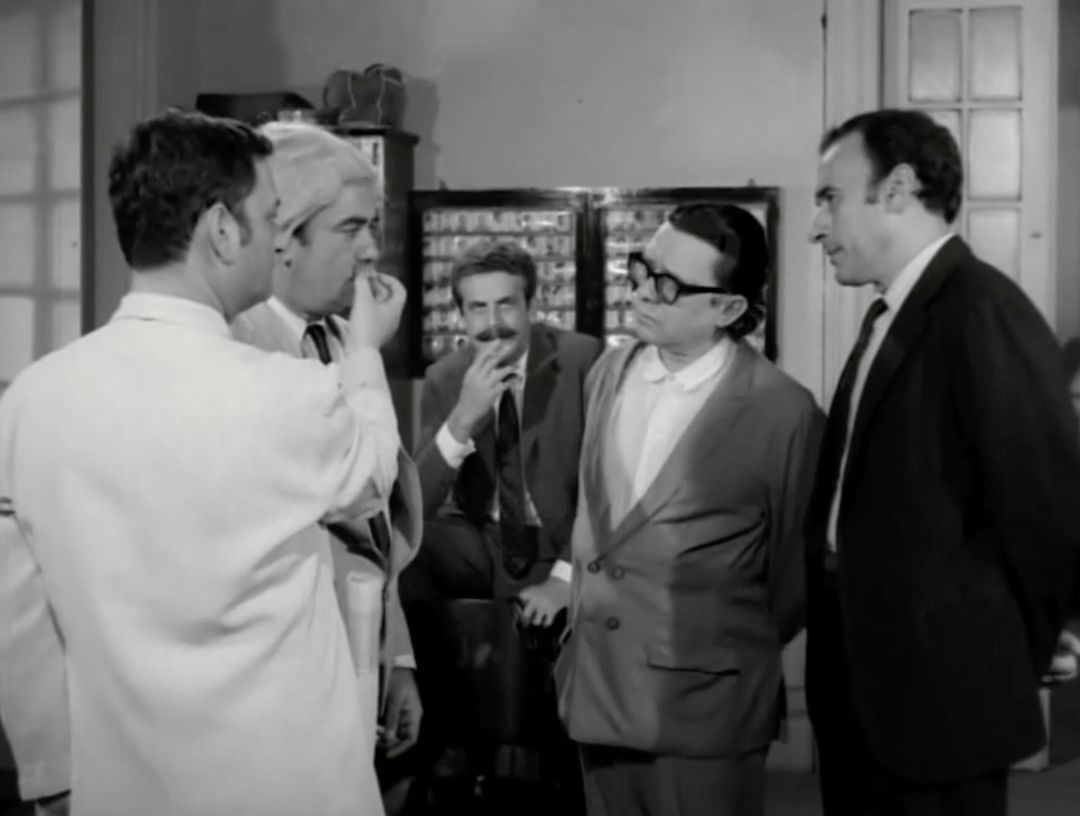
If, at the time of its release, Os Raptores was promoted as a Hitchcock wannabe in its advertising, Aurélio Teixeira’s formal choices end up producing something quite opposite to this. There were justifications in the plot for MacGuffins, systematic explorations of the games of voyeurism or relations of duplicity, such as those aforementioned. The film has a series of cliches that include a mysterious outlaw whose image is absent in the police book of criminal profiles (the mere existence of such a book belonging much more to nineteenth century crime fiction and its obsession with the perfection of criminal portraiture, than 1960s Rio de Janeiro), the figure of the mastermind who dominates the temporal synchrony of events and carries out the crime through others he commands (like Lang’s Mabuse), or the anonymous passerby who wasn’t supposed to observe an important clue at the moment of kidnapping, but did. All of these elements could theoretically come under much closer scrutiny in the film, but the filmmaker chooses to pass by them as if they hold no true weight. He keeps with his medium wide shots and with the peremptory speeches in colloquial Portuguese that explain the narrative's mysteries. The simplicity of Aurélio Teixeira’s staging avoids producing too much suspense; it is often economical in visual and sound effects and has no more than a minimum dedication to mise-en-place in composition. So, is what we have here a bad movie, or, at most, a mediocre movie? Hold on a sec.
Os Raptores has an accelerated cadence typical of the most ordinary North American crime B-movies made two or three decades prior to it, from where it also seems to inherit its most rudimentary conventionalism. Is Os Raptores an emulation these works? Perhaps, but I believe that not even the aforementioned B-movies operated to the end of premature ejaculation as much as Teixeira’s film. The beginning of Os Raptores illustrates this rhythm. We fall by parachute onto a phone call that announces the kidnapping of a child. First the child’s mother and then her father are shown. The kidnapper, sitting in front of the father in his banker's office, announces the details of the crime. The criminal has barely finished explaining when, lo and behold, the mother shows up in tears, pleading with her husband to hand over the hundred million. “I can’t take it anymore!”, she says, although it hasn’t been even 3 minutes since the feature started. The hundred million is brought in a suitcase by the secretary in less than 15 seconds, while the mother pleads for her daughter's safe return. This will only occur about 6 or 7 minutes into the film, while in the meantime, the police have been notified about the crime and respond by surrounding the family’s house. It is not only that Aurélio Teixeira does not waste time. He makes events unfold directly, emptied of dramatic significance, applying genre protocols on top of protocols, but with obtuse speed and a major vocation for disposal. So much so that we doubt whether he really wants to narrate said events. A conflict has barely begun, and he immediately tries to resolve it. Teixeira quickly moves on to the next problem, the next drama, the next reversal, the next event or the next victim. Better to accumulate them than to deepen them.

Perhaps it is this isolated manner, coupled with a ‘bangu’9 rhythm (the ball leaves the bottom line, without having to return to the midfield after the goal) of dealing with the crime genre that most marks Aurélio Teixeira’s particular style in this film: conventions are stacked on top of each other, taken at face value. Os Raptores is thus a long trip through readymades. The mother’s cry, in the end, ends up reduced to a passing sign, as dispensable to the narrative as the hunchback from the underground with the pillow on his back, who appears in one scene and dies in the following one. It seems that we are now describing a mannerist film, but that is not the case. It would lack the celebratory self-awareness of a film like A Dama do Cine Shanghai (de Almeida Prado, 1987), where excess is a mark of affectation. Os Raptores does not concern itself with this, as cinema history carries no weight here. There is no affectation or remarkable histrionics. Everything is protocol, and there is an even salutary embrace to classic codes in the aesthetic realm. If we wish, we may speak in a certain ponderatio. It is the storyline that has a slight quality of twisting about itself. Os Raptores throws everything of seeming significance away but has no qualms about introducing a fundamental character during its last twenty minutes. The film is thus both too little genre and too much, rarefying each element while hyperinflating dramatic motive.
But why does Os Raptores operate in this way? Here the trajectory of passing signs does not carry as much meaning in its articulation as the power of the final gesture. Crime cannot be solved by syllogisms. These movements of genre rise over something else, an act of force or violence. The commissioner investigates and keeps investigating, but his work leads to nothing. So, he has to threaten the suspect himself. In Juventude e Ternura (1968) Aurélio Teixeira piled disconnected musical scenes on top of each other, but he also successfully illustrated that all of the play was sustained on top of an economical framework that was always on the fringe of collapsing through the psychological consummation of a very inspired Anselmo Duarte in-performance. In Soninha Toda Pura (Teixeira, 1971), it is the exploration of erotic scenes that will culminate, at the end of the film, in violent rape. Aurélio Teixeira’s cinema thus works on this disparity between ‘playing genre’ and an exploitative force that, deep down, sustains it. This force is always on the verge of collapse, for it has been defiled by principle. Several of his films oppose both things, so as if to demonstrate this double need in Brazil, as much as the double repulsion; one is taken as artifice and the other as artifact. Maybe an auto-reference is being made here to the forms of production of a certain genre cinema back in the 1960s, captained by filmmakers such as Jece Valadão, Victor Lima or Braz Chediak? Possibly, but I think there is even more to this story.
Well then, let’s go back to the props of fantasy. Bruno’s wig is as simple as the sunglasses and the chinstrap that the father in A Filha do Advogado (Jota Soares, 1926) removes in court to reveal who he is or the beard that transformed Harry Richmond (another protagonist who, like Frank, has an Anglo-Saxon name) into Theodoro in the unfinished Três Irmãos (Pedro Comello, 1925). We see these same rudimentary codes in Os Raptores. It is perhaps in our 1920s pioneers, in their emulations of North American adventure films, that we can find the genesis or lineage of Teixeira's film, and its unique form of adaptability. These silent-era films functioned in an apparently classic style, but with very modular narratives. As opposed to the Hollywood three-act structure, there is also our salutary way of letting the best of it rot and keeping things rolling. Violence might be the backbone of our plots, but ultimately it is the backbone of our own authoritarian country (of which the greatest classic of that time, Ganga Bruta, is probably the major synthesizer). Os Raptores takes things a step further. Made in a later era, it handles all the buzzwords better, it isn’t afraid to speak about other things. But this is all genealogy. The birth of a particular and unsuccessful way of doing genre, which is always hastily dismissed. How many times did the chanchadas exhibit musical pieces piled on top of musical pieces, with a very naturalized excess, and for this were rated as nothing more than subpar national films? How many pornochanchadas used to be considered nothing more than large collages of eroticism and voyeurism, and nothing more? Perhaps we need to expand our ideas on appropriation, beyond the forms of more direct anthropophagy or of pastiche, because in this apparent emulation there is also (or perhaps more) creative inability to copy the model. A subtle way to imitate, but also to state that behind the radio star, there is always a pimp. Behind the police, a violent nation.


