

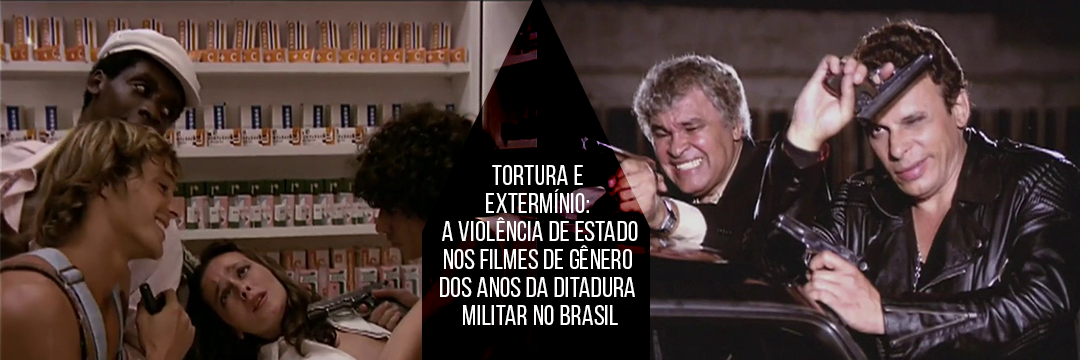


Black bodies thrown into ditches, gunfire exchanges with cops in the city streets, persecution, torture, police executions. These scenes are repeated in crime films1 made in Brazil during the military dictatorship (1964-1984) such as Paraíba, vida e morte de um bandido (1966, Lima), Mineirinho vivo ou morto (1967, Teixeira), Perpétuo contra o esquadrão da morte (1973, Borges), Os amores da pantera (1977, Valadão), Lucio Flavio, passageiro da agonia (1977, Babenco), Eu matei Lúcio Flávio (1979, Calmon), O caso Cláudia (1979, Borges), República dos assassinos (1979, Faria Jr), E agora, José (a tortura do sexo) (1979, Fraga), O torturador (1981, Calmon), A próxima vítima (1983, Andrade), among others.
These films are marked by state violence, one of the strongest characteristics of the country's historical formation. This text will call attention to scenes of torture, where actions of extermination groups reveal the peculiarities behind the daily practices that the Brazilian political police applied to opponents of the regime and common criminals. One of the main narratives used to construct the memory of the military dictatorship in Brazil presented an imaginary scenario where the most important disputes of the period took place between students and artists, on the one hand, and the military, on the other. Other groups, such as peasants and indigenous people are forgotten in these narratives. The heroism of middle-class youth fighting for freedom and an end to social inequalities became the main narrative of resistance. However, Brazilian genre films present another perspective from that period: they show how the residents of the favelas and common criminals suffered at the hands of the police.
It is interesting how during this period, despite the enforced censorship, bandits that were headlined in the pages of the sensationalist press became central characters in films. It is also interesting how torture practices commonly carried out by dictators were re-enacted with complete naturalness in these films and how extermination groups such as the Death Squad became the main focus of feature length films (that were sometimes critical and other times supportive of their brutal means of policing). This text will provide a brief panorama of how Brazilian genre cinema approached themes and dialogues around public debates that were sensationalized by the press during the years of the military dictatorship. If denouncing the murder of political prisoners was forbidden because of censorship, how did filmmakers react and find ways to touch on the open wounds of the years of repression?
At the end of the 1960s, two films drew inspiration from police chronicles to tell the story of bandits who made headlines for their crimes. These bandits are not called by their first names, but by the places in Brazil where they came from: Paraíba and Mineirinho. Jece Valadão is the protagonist in both films and plays the role of an urban bandit who roams the favelas. His character acts as a crime boss, finding the possibility to escape poverty through criminal acts. In Paraíba, vida e morte de um bandido, the criminal who recalls his past on the verge of death is a cruel man. Machismo, violent and fearless, Paraíba kills for a living and dismisses any possibility of reintegrating into society. A note published in the Correio da Manhã newspaper on March 20, 1966, announced that the film, which would open in a few days, "revolves around the crimes of the notorious bandit from Rio de Janeiro, notorious, when alive, in the headlines of the police sections of the daily press".2

Mineirinho, on the other hand, from Mineirinho vivo ou morto, embodies the figure of the bandit-hero. The film is inspired by a character who was in the police chronicles of the Rio de Janeiro press for over a decade: José Rosa de Miranda, Mineirinho. A resident of the Mangueira slum, Mineirinho entered a life of crime after accidentally killing another criminal. Eventually, he became a dangerous gang leader who was pursued by the police. A quick search through newspaper articles of that time reveal the fear created around his name: "Mineirinho attacks again", "Police create a new death squad to eliminate Mineirinho", "[Mineirinho] accused of committing 130 robberies and 28 homicides", "Delegate announced: Mineirinho will be shot", "The police have only one order: shoot to kill Mineirinho ", and "Mineirinho only robs the rich". These headlines appeared in newspapers such as Última Hora in the late 1950s and early 1960s.3 They reveal the complexity of a criminal who killed, but also stole from the rich to give to the poor: a kind of Robin Hood figure of his time.

In O herói anti-herói e o anti-herói anônimo, a text presented at an exhibition in 1968, artist Hélio Oiticica includes Mineirinho in his reflection on the social oppression of those who are marginalized by the police, politics, and the press. Oiticica recalls the murder of Cara de Cavalo, a bandit killed with over 100 machine gun bullets by police officers, and dedicates the work Seja Marginal, seja herói (Be a Marginal, be a hero) to him. In this artwork we see the image of Cara de Cavalo's body, positioned upside down with his arms open - in a position reminiscent of the crucified Christ. In dealing with those who are marginalized, the artist argues that "there is something rotten not in them, but in the society in which we live”.4
The way Mineirinho was killed, executed with thirteen shots by the police, caught the attention of writer Clarice Lispector, who in 1962 published an article in Revista Senhor in which she asks herself: "why is the death of a thug heartbreaking?". In a beautiful text about the paradoxes of life and the importance of defending human rights, Lispector recognizes that "Mineirinho was dangerous and had already killed too many". However, the barbarity of his execution revealed the worst in the notion of justice linked to feelings of revenge or divine punishment.5 fifteen years later, in an interview for TV Cultura, Lispector reiterates: "whatever his crime was, one bullet was enough. The rest was the will to kill, it was arrogance".
In the 1970s, executions like Mineirinho’s gained prominence in the press and in police films due to broader public interest around the activities of police extermination groups. In 1971, the press made a record sheet that reported the eight thousand murders committed by death squads all over Brazil during four years of criminal organization activities. The figure of the marginal hero, so well-constructed in Mineirinho vivo ou morto, became contrasted with that of the policeman who kills to "defend good morals" and to "put an end to criminality". This criminal is, above all, a complex figure. Writing about Lúcio Flávio, o passageiro da agonia , Ismail Xavier points out that:6
…the hero is surrounded by the world of crime in which power is passing from the hands of corrupt cops, with whom it is possible to negotiate (although under unfavorable conditions), to "hard-line" cops, equally corrupt, but associated with a doctrine of extermination, cleansing society by all means (the so-called Death Squad) (2003, p.133)
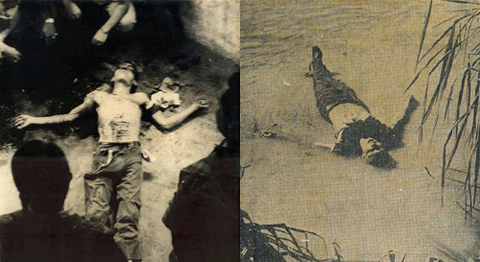
One of the peculiarities of the Death Squad and the reason for its high public visibility was the relationship it maintained with the press. The press would publicize the places where the Death Squad’s victims were killed, creating posters that displayed the messages from the killers written on the victims’ bodies. These messages included the famous drawing of a skull with crossbones, a symbol of the Death Squad in Rio de Janeiro. In República dos Assassinos, the close connection between the members of the Death Squad, the press, and the privileged access of reporters to the crime scenes appears in a sequence of photographs of anonymous bodies. The bodies are torn apart and abandoned on empty roads with brutal signs of torture displayed upon them. These images were taken from newspapers of the 1960s and 1970s and were originally published to reveal the high crime rates of the period.

The use of methods of torture, the same methods used against political militants who fought against the dictatorship, is another peculiarity of these films. There are no records of the torture of militants in images kept in the archives of the Brazilian political police. However, in Lúcio Flávio, O Passageiro da Agonia, the character describes the practice of the pau de arara, one of the most vehement symbols of political repression witnessed by many survivors:
They took me to a dark room, tore off my clothes, turned on a tape recorder and said: 'Here you can confess to anything you want. They beat me, twisted my arm until it broke, but even so I resisted. But then, my brother, they put me in the pau-de-arara, they burned me with a lit cigarette butt. I couldn't take it anymore. Then I confessed everything. I said that I had indeed killed the girls.
In one of the film's strongest scenes, we witness the staged practice of drowning. In a clandestine location, hooded men dressed in suit and tie stick the bandits' heads in water for several minutes until they provide the information demanded by their executioners. During the same torture session, the policeman threatens to rape Lucio Flavio. Tied to a chair, the bandit's head is forced by his torturers against the naked groin of one of his accomplices - thus forcing him to perform oral sex. As per the police officer's threat:
Tell the whole story or you’ll become a mangrove whore. [In the speech of the same policeman, the relationship of torture as a state practice is made explicit:] No thief makes a fool of me...Tell the truth, dog! Or else I'll kill you. Punishment for bandits has to be like in the Orient: tongue cut out and an eye pierced. Economy for the state and safety for society.
Despite the focus on the performance of the civil police, scenes such as this reveal the connection between organized crime and the branches of power during the military dictatorship. We must remember that, as early as 1969, Operation Bandeirante was created to unite the Armed Forces and the federal, civilian, and military police in the fight against leftist groups. The coordination between military and police enabled the exchange of experiences such as torture and the use of collaborators (informants) who were employed by the police to fight common crimes. The Oban spread throughout the country through the Internal Operations Detachments and the Internal Defense Operations Centers, the so-called DOI-CODI, and from that moment on the practice of torture intensified, the power of life and death remained in the hands of those who represented the State, and violence became the go-to method for officials when dealing with suspects accused of transgressing the order.
Making the practices of torture and corruption explicit in the films of the late 1970s was only possible due to new discussions about the possibilities of political openness. It was a time of tensions and contradictions in which public opinion was divided about the practices carried out by the squads. Two films - Lúcio Flávio, passageiro da agonia and Eu matei Lúcio Flávio - make this split in society clear by dealing in opposite ways with two characters central to this debate: the bandit Lúcio Flávio and the detective Mariel Mariscot.
Lúcio Flávio was a famous criminal in the Brazilian police chronicle who worked from the late 1960s to the early 1970s. A middle-class son, he robbed banks, stole cars, and established a strong bond with the police. In a statement to the press while in jail, Lucio Flavio helped dismantle the Death Squad by revealing details of how the police facilitated his crimes and his escapes from prison, always in exchange for money. He was murdered in 1975.
It was Lúcio Flávio who denounced policeman Mariel Mariscot, who took part in a swindling scheme and vehicle robberies. Mariscot became known as one of the 11 golden men of the Rio de Janeiro police, a member of Scuderie Le Cocq, a group of clandestine killers who served the dictatorship. While executing suspects, the detective negotiated with bandits. Mariscot was also known for his romances with actresses and was featured in articles in daily newspapers and women's magazines, where he was called a hero and a myth. Because of his excessive visibility, he was expelled from the squadron, went to jail, and was murdered in 1981.
Lúcio Flávio, passageiro da agonia denounces the methods of the Death Squad with their murders, torture and corruption. We witness the return of the bandit hero, the only one capable of revealing the rottenness of the police system by denouncing his relationship with Mariscot. In an interview to the newspaper Estado de São Paulo, in 1986, Babenco - who received death threats when the film was released - explains the reasons for his interest in denouncing the Death Squad.
A country where the police were annihilating in the name of God-since nobody disputed it, it had to be in the name of God, no? The police killing a thousand people on the outskirts of the cities and attributing this to a dusty Death Squad name, the press fed this as if it were a Chinese anagram, or an André Breton metaphor! And nobody was wondering who the people were that this was happening to, and there was no record of it in the media. So, I said: I will show myself and the people how I am see this country. And I decided to make Lúcio Flávio, which for me was a certificate of naturalization.
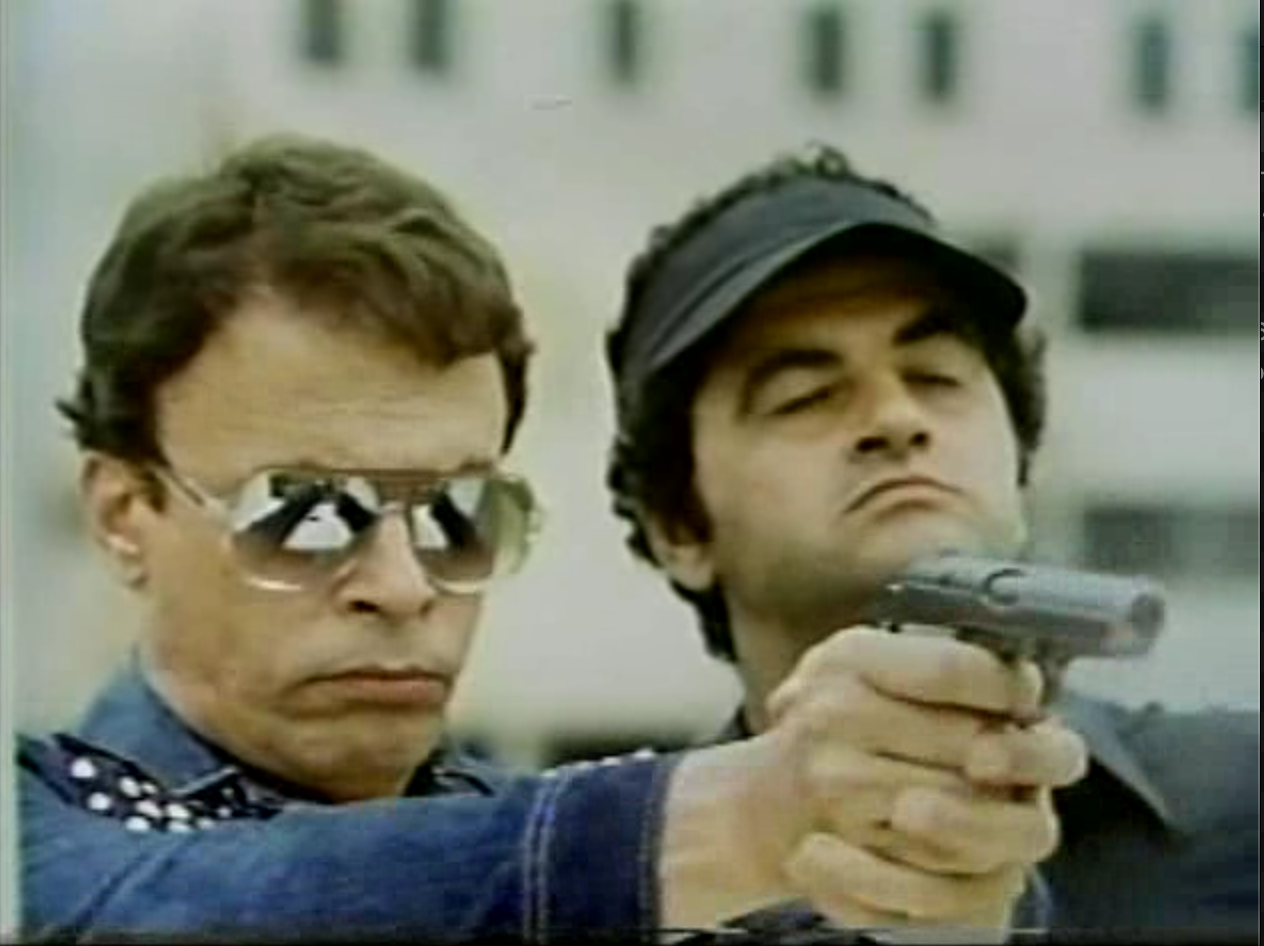
Made two years later, Eu Matei Lúcio Flávio is a response to Hector Babenco's film. Directed by Antonio Calmon and produced by Mariscot himself and Jece Valadão (who also plays the policeman), the film constructs an image of the detective as a hero whose principle was to eliminate evil from society. It is a kind of authorized biography that reveals a more humanized side of the detective who saved lives when he was a fireman, who fell in love with a prostitute, and who bravely fought dangerous criminals. The excessive violence of the police is justified in the film because of the boldness of the criminals. The action of the extermination groups is therefore portrayed as a necessary evil.
In an interview with journalist Mirian Alencar at the time of the film's release, Calmon said that he accepted to direct the film because he would like to deal with the current affairs of the country without the "feeling of class paternalism" that would be typical of the previous generation (probably referring to Cinema Novo itself, a movement in which he participated). The filmmaker also reiterates that "police excesses, torture, summary executions cannot be blamed only on this or that individual or organization".
More than forty years later, voices defending police violence echo on social networks and in extreme right-wing discourse in Brazil. In the name of an alleged quest for security, some publicly justify extermination and torture. Recently, in an interview with the actress Vera Gimenez, who was married to Jece Valadão, a critic-blogger complained that films like Eu Matei Lúcio Flávio "could hardly be produced today" because "the criminal is now treated as a victim, good values are demonized". The return of this kind of speech reveals both a lack of knowledge of the films of the time and a criticism of progressive and humanitarian ideas. A return to the films and police cinema of the 1960s/70s helps us to perceive both the lines of continuity of the violent and authoritarian practices of the Brazilian police, as well as the radical splits between progressive and reactionary discourses in Brazilian society, characteristics that have always been present, although suppressed at certain historical moments.

1. Note: Crime genre films are most often referred to as “Filmes Policias” (Police Films) in Brazil.
2. All reports cited are available in the newspaper archive of the Brazilian National Library
3. ibid.
4. O texto na íntegra encontra-se publicado aqui: http://culturaebarbarie.org/sopro/arquivo/heroioiticica.html
5. Lispector, Clarice. Todos os contos. Rio de Janeiro: Rocco, 2016.
6. Xavier, Ismail. The Look and the Scene - Melodrama, Hollywood, Cinema Novo, Nelson Rodrigues. São Paulo: Cosac & Naif, 2003.


